eBook - ePub
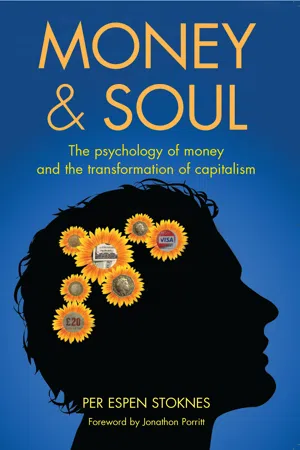
Money and Soul
The psychology of money and the transformation of capitalism
- 296 pages
- English
- ePUB (mobile friendly)
- Available on iOS & Android
eBook - ePub
Money and Soul
The psychology of money and the transformation of capitalism
About this book
Money and Soul opens up new methods of looking at, thinking about and using money. It points to a future where our ideas about money will be greatly epxanded, and there will be different kinds of money, with different social purposes, in circulation.
Frequently asked questions
Yes, you can cancel anytime from the Subscription tab in your account settings on the Perlego website. Your subscription will stay active until the end of your current billing period. Learn how to cancel your subscription.
At the moment all of our mobile-responsive ePub books are available to download via the app. Most of our PDFs are also available to download and we're working on making the final remaining ones downloadable now. Learn more here.
Perlego offers two plans: Essential and Complete
- Essential is ideal for learners and professionals who enjoy exploring a wide range of subjects. Access the Essential Library with 800,000+ trusted titles and best-sellers across business, personal growth, and the humanities. Includes unlimited reading time and Standard Read Aloud voice.
- Complete: Perfect for advanced learners and researchers needing full, unrestricted access. Unlock 1.4M+ books across hundreds of subjects, including academic and specialized titles. The Complete Plan also includes advanced features like Premium Read Aloud and Research Assistant.
We are an online textbook subscription service, where you can get access to an entire online library for less than the price of a single book per month. With over 1 million books across 1000+ topics, we’ve got you covered! Learn more here.
Look out for the read-aloud symbol on your next book to see if you can listen to it. The read-aloud tool reads text aloud for you, highlighting the text as it is being read. You can pause it, speed it up and slow it down. Learn more here.
Yes! You can use the Perlego app on both iOS or Android devices to read anytime, anywhere — even offline. Perfect for commutes or when you’re on the go.
Please note we cannot support devices running on iOS 13 and Android 7 or earlier. Learn more about using the app.
Please note we cannot support devices running on iOS 13 and Android 7 or earlier. Learn more about using the app.
Yes, you can access Money and Soul by Per Espen Stoknes, Susan M. Davies in PDF and/or ePUB format, as well as other popular books in Social Sciences & Sociology. We have over one million books available in our catalogue for you to explore.
Information
Part I
Like oil and water?
Chapter 1
Money everywhere
The world is shaped by globalisation and money. The economic system is by far the strongest driving force on the planet. Its basic philosophy has spread throughout human consciousness – and particularly during the last two or three decades – with an immense intensity. Its ‘memes’ seem to override even our genes. In our era, money is the one thing we all want. At other times and places, values such as pyramids, palaces, potlatches, horses, cattle, religion, dukedoms, knighthoods, armies or honour have taken precedence as ultimate values. Now the thing that causes us to struggle with each other is the hunt for money and capital; but it also unites us, since everyone has the same goal. It is tempting to borrow a phrase from Tolkien’s Lord of the Rings: ‘One ring to bind them’1.
Cultures have been constructed around ideas and stories of honour and shame, around family and lineage, land or livestock. The giving of gifts has been central to some cultures. But the thing that binds together the globalised world of today is neither ideas of truth nor gods nor language. Only the ideas of business and economics are actually universal. Our contemporary civilisation is held together by ideas such as property, trade, product, competition, market, price, interest and profit. Pervasive economic ideas have been internalised in all of us and now rule mankind’s conscious and unconscious life on this Earth. “These ideas trickle down into each act of making, serving, choosing, and keeping that we perform,” says the psychologist James Hillman. Day by day, these ideas conjoin to give business its power, establishing the Economy’s world empire across all borders of geography and barriers of custom.2
All humans are today participants in economic rituals such as buying, selling, budgets, cost/benefit analyses, annual accounts and self-assessment declarations of taxes. And, almost regardless of the topic being discussed in society – energy, medicines, care of the elderly, transport, education, construction, refugees, the countryside, or agriculture and food – money and economic theories take the lead in debates. Development projects involving roads, parks, buildings, arable and livestock farming are all largely decided on the basis of economic calculations and arguments. Do we want suburbs? Housing schemes? Urban concentration? Do we want more nursery schools? Do we want to have an agricultural industry? How many farmers are really needed? What is the cost of a farmer to society – what is the per-annum net profit or loss? A total can be calculated and an economic average given. And the sum can be weighed up against alternatives such as importing food or using the money in some other way.
The figures are perceived as real, and as a central part of reality. This becomes possible thanks to the legitimacy and significance that economic theories are given by all parties. They are the central building blocks of our social everyday reality.
Here are a few examples of the way this shapes the public debate: how much does an refugee actually cost us? What is the net cost of accepting one extra immigrant? Let us calculate this for different categories of immigrant, so that the political discussions can use it as basic documentary evidence. The media compare food prices, seldom its quality. When the price of petrol or power rises, there is a political furore, since this affects the poorest. The daily newspapers ask ‘Do you earn enough?’ and offer ‘help’ in thinking that you can demand even more pay because others have a higher level of earnings. Are house prices going up or down? What is your house actually worth? Not that you must sell it now, but you have to remember, know and speculate about what it could be sold for. We think of our houses in the form of their monetary value.
People’s health may be taken care of by health-care companies that have to be run ‘profitably’. When the money follows the patient, the issue becomes how much the patient’s diagnosis is worth. This mindset affects the way the hospitals operate on a day-to-day basis, and the treatment individuals are given.
Better care for the elderly? What would it cost for all care-home residents to have their own rooms? No questions asked of whether elderly people feel they have greater dignity, whether their skills are valued, whether they are capable of doing more, nurturing friendships or improving their relationships. Our financial mindsets make us calculate, talk about and consider the cost of single rooms or whether any extra person-years for care and nursing are affordable. Issues related to the soul and society, such as what it means to be old in modern society, hung up the new and youth, become subordinate. Often purely material improvements are made without any corresponding improvement to social networks and meeting places – these have no price tags and therefore no quantifiable value, and are thus quickly left out of decision processes in management meetings. When our economic mindset filters these other values out of sight, they disappear from corporate activities too – neither dignity nor capability are included in budgets to be quantified and monitored.
The economy’s ‘neutral’ analysis shifts the attention irrevocably towards a calculative mode of mind. Gradually, relentlessly, our consciousness and our patterns of behaviour are formed on the basis of monetary templates.
“The Age of Chivalry is gone; that of sophisters, economists and calculators has succeeded,” lamented British statesman Edmund Burke already in 1790. But is this really so lamentable – has money replaced our soul with an objective calculator?
Money – objective or subjective?
The fascinating thing about money is that it acts in such a concrete, factual, way, and is utterly quantifiable and seemingly objective. Each deal and transfer can be documented, counted and totalled. This is what the economic control systems relate to: facts. Emotional reactions have no place in conventional economics: money is dealt with rationally – or at least such is the attempt. And everyone assumes they act on the basis of their economic judgment.
But the shadow side of soul is easily brought forth in the encounters with money, such as in cases of greed, fraud or gambling addiction. According to traditional economic theory, that is best left to other professions. Conventional economists assume that when the individual human mind succumbs to subjective and irrational behaviour, this belongs to the domain of psychologists or social workers (or some other relevant professionals). Such deviations lie outside the core task of economics, which is to draw up general and objective analyses at the societal level.
However, the soul or psyche is not just individual and subjective. The soul is participating wherever people enter into relationships with each other and feelings are evoked. Markets and stock exchanges are prime exemplars of where such emotional relationships play themselves out. What I mean by the term ‘soul’ will be discussed further in Chapter 4, and in Part II I will examine the extent to which the soul can also be discovered even in accounting, in finance and credit, as well as in debt and interest. This book maintains that the soul and emotion are inescapably and necessarily interwoven into all economic life. The aim of the book is to ‘venture boldly forth’ into these hidden recesses of the economy.
Emotions and feelings have, in recent times, been the subject of renewed interest in economics. Recent research has – through experiments with people in economic laboratories – discovered a broader spectrum of motivation and human behaviour than traditional economics has taken into account. The old polarity between objective rational money on the one hand and subjective irrational feelings on the other seems increasingly less relevant to economic theory too. But normal economic practice lives on just as strongly, as if nothing had happened. We can talk about a widespread belief system, based on a set of convictions that used to be self-evident economic truths. Economism (Chapter 11) is what I would like to call this economic ideology, based on this type of inherited belief and how it continues to be lived out in politics, trade and industry. That is what I am primarily focusing on, more than the latest news from the research front where economics and psychology meet.3
Many people maintain, in a condemnatory tone, that we live in a society controlled by money. For my part, I am happy that we live in that type of society. The alternatives are usually worse. At the same time, I am convinced that we need a new understanding of money – and soon. In his book A History of Money: From Ancient Times to the Present Day, the British professor of economics Glyn Davies writes: “Despite man’s growing mastery of science and technology, he has so far been unable to master money … And to the extent that he has succeeded, the irrevocable costs in terms of mass unemployment and lost output seem to outweigh the benefits. If money were merely a tangible technical device so that its supply could be closely defined and clearly delimited, then the problem of how to master and control it would easily be amenable to man’s highly developed technical ingenuity.”4 But there is too much psychology in money to make it yield to mechanical controls, he asserts. And this psychological factor continually eludes the analysts and planners, so output is lost and inequity increased.
Unfortunately, it is not just economic output that we are losing out on. Many people feel they are also losing their soul in money. The spark of life, the emotional vitality, is drained out by the economic sphere into which so much effort is poured. There is a feeling that one has to flee from the power of money – to drop out or resign from it. Money seems to be robbing us of our social community, the natural world and a stable climate.
On the one hand, then, it seems that we can’t determine how the subjective soul is at work in money issues. on the other, we can’t find room for the soul within the stern, objective realm of money. It seems that the two just don’t mix.
Money – loved and hated
A woman’s daughter came home from secondary school one muddy spring afternoon and told her artist mother that she had decided to start studying business economics in the autumn. The mother immediately burst into tears. No, my dear, not you, not trade and industry!
Some people feel quite at home and comfortable in the economic world of markets and brokers, of shopping and shipping, of the quick buck and bountiful opportunities. Others can’t free themselves from the perception of something rather distorted and suspicious in the movements of capital, profit and the fast money of business. They denounce it as the casino economy, or speculative turbo-capitalism.
Economics itself has a well-defined relationship with money. Money is seen as completely neutral. It is defined first and foremost as a generally accepted means of exchange. Having such means of exchange and payment makes trading in goods and services much more efficient than having to take along stacks of dried fish down south from Norway to Italy in order to bring a new Fiat back north. As economic reasoning puts it, money simply makes trading with one another much more efficient than bartering would be. In addition to being a means of exchange, money is both a store of value and a unit of account. Accoring to the theory of money’s neutrality, money has virtually no intrinsic value. Economists usually perceive money as only a veil covering the real economy which consists of actual assets, like houses and goods. Money is to real assets as a ruler to a plank of wood.5
However, psychologists object, human beings do not experience money just as a neutral means of exchange or as an arbitrary measuring stick. Otherwise why would we react so strongly, so emotionally, to money? Why do friendships change once money enters into the relationship? Why do people get so angry when someone does a deal to gain him- or herself – some extra of these ‘means of exchange’? Why are inheritance settlements so agonising; post-divorce child maintenance payments so bitter? Why do rich people get an unfairly large share of society’s attention? Why are we so interested in interest rates and the central bankers’ convoluted utterances? And why are we so eager to interview share analysts, statisticians and brokers for their opinions on the pound against the euro? Why do we get so worked up if a manager gets a few extra millions in share-option profits from a company that has made a deficit? Why does a scandal erupt if a politician spends a little fortune on a dinner or a trip, whereas a manager in a private business can spend twice the amount on exactly the same thing without any fuss? Money is not, never has been and never will be neutral in the eyes of society’s citizens.
We are probably approaching somewhere nearer the truth if we admit that money generates enormous emotion. In addition to being a means of exchange and a unit of account, money is also symbolic of a whole spectrum of expression relating to the soul: fear and vindictiveness, suspicion and envy, nationalism and the winner’s instinct, longing and loyalty, euphoria and ecstasy. Money is so saturated with symbolic meaning and has such emotional power that it makes huge groups of people turn at the same time or run with the herd – and sometimes collectively cast themselves over the edge, like lemmings into the sea. Overlooking these powers of emotion in money by insisting that money be neutral is like choosing to be willingly blind.
The problem is that we have a fairly schizophrenic relationship with money: one moment we are rational, and the next irrational. Money can rip up and fragment our rational attitudes in a surge of emotions. One moment we are hanging on to it tightly, and the next we are spending it on some extravagant object because ‘we deserve it’. Sometimes, money itself is the Problem, at other times it is the Solution to most things. While most people want and strive to acquire money, many people are disgusted by what money is doing to us, and large fortunes are regarded with an uneasy mixture of scepticism and envy. The reason for this is probably historical, for we have a long cultural tradition of inherited hatred and suspicion of money that we find difficult to free ourselves from. It is easier for us to understand ‘soul or money’ than it is ‘soul and money’. For a long time, we have seen book titles such as Your Money or Your Life.6 But the idea that soul and money should belong together rouses instinctive resistance, rather like the kick reflex point immediately below the knee: surely, we feel, that can’t be the case.
“The universal regard for money is the one hopeful fact in our civilization, the one sound spot in our social conscience. Money is the most important thing in the world. It represents health, strength, honour, generosity and beauty as conspicuously as the want of it represents illness, weakness, disgrace, meanness and ugliness.” – George Bernard Shaw
If money is viewed as filthy lucre, this easily feeds the suspicion that something must be rotten in the state of the Economy itself. In particular, this applies to private businesses and major multinational corporations. Big busin...
Table of contents
- Cover
- Half Title
- Title Page
- Copyright
- Contents
- Acknowledgements
- Foreword
- Introduction
- Part I: Like oil and water?
- Part II: Searching for soul in economic ideas
- Part III: Towards a pluralist capitalism
- Notes
- Bibliography
- Index