"I love this book - it's a beautiful yet practical and accessible guide that will help you transform whatever sized patch you have into an abundant oasis of flowers." - Mark Diacono, gardener, food writer and broadcaster. Grow your own cut flowers and you can fill your house with the gorgeous colours and heavenly scents of your favourite blooms, knowing that they haven't travelled thousands of miles - and you can make money while you do it! Combining boundless passion with down-to-earth guidance and practical advice, Georgie Newbery draws on her own experiences as an artisan flower farmer and florist as she takes you through: • how to start a cut-flower patch • what to grow • cutting, conditioning and presenting cut flowers • creating a hedgerow Christmas • starting a cut-flower business • where to sell • marketing and social media • a flower farmer's year planner. Whether you want to grow for your own pleasure or start your own business, The Flower Farmer's Year is the perfect guide.

- 256 pages
- English
- ePUB (mobile friendly)
- Available on iOS & Android
eBook - ePub
About this book
Information
Topic
Ciencias biológicasSubtopic
Horticultura
The blank canvas – the freshly fenced-off acre of a field – may be an exciting start to building your dream, but can be rather daunting in its emptiness. The trick is to chop your space into carefully planned, manageable chunks, and all of a sudden you’ll have a strategy. Plant your ideas one small seed at a time, and watch them grow and bloom.
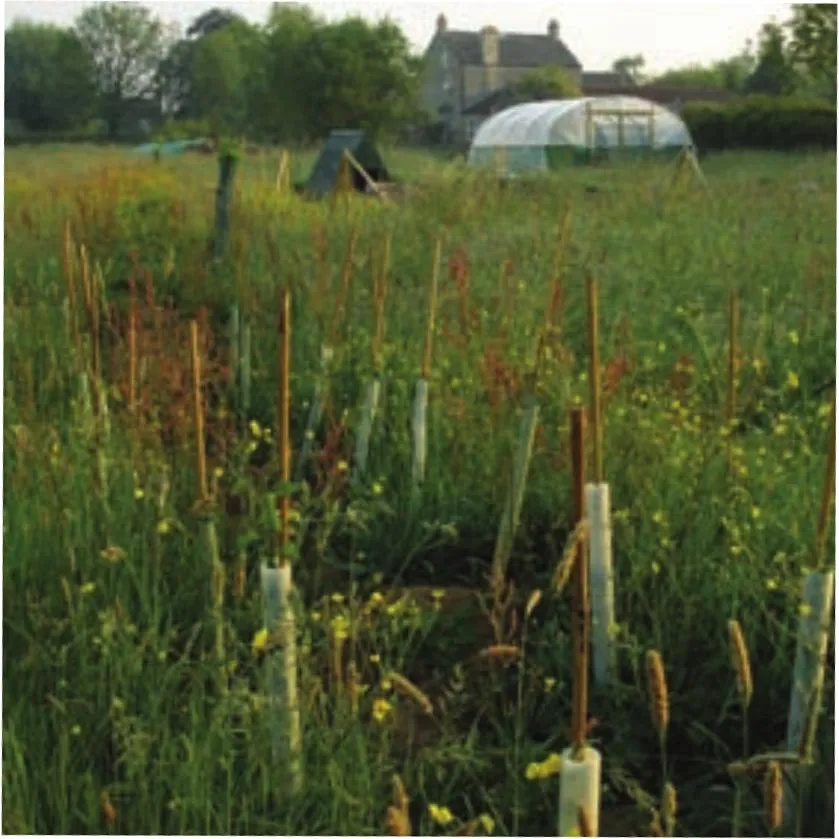
The first cutting patch at Common Farm, which was cleared by pigs. Note the soon-to-be wind-protecting curve of native hedging settling in among the buttercups.
You need surprisingly little space to create a really productive cut-flower patch. At a lesson I taught in Northamptonshire recently, we assessed an ordinary-sized domestic garden space and identified a patch of the vegetable garden that would happily turn itself over to flower production.
In a bed of about 3m x 3m (10' x 10'), we saw room for perhaps 15 sweet pea plants, five ammi, five cosmos, five dahlias, five sunflowers, a row of cornflowers, a row of pot marigolds and a row of hare’s ear. There were already roses in a herbaceous border edging the vegetable patch, and the herbs growing at the other end of the garden would make lovely scented foliage for the grower’s posies. Among the group I was teaching were two garden designers, a florist, a baker, a writer, a lady with an allotment who wanted cut flowers for her house, and another who wanted to sell mixed bunches from her front gate. None of these people would call themselves ‘eco-warriors’ – they were simply sensible people who had looked at the inter national cut-flower trade and didn’t like what they saw. They realized that if one is a gardener of any kind, one can grow cut flowers – which will not only satisfy the aesthetic desire for cut flowers in the house, but also feed the bees.
So, you have your dream – or even your patch, your meadow, your corner of a rented field. It’s time to lay out your plot. Go and stand in it, sniff the wind, test the earth, and think hard before you apply the sharp edge of spade to soil. The better planned your plot is, the harder it will work for you.
Plot design and practicalities
Whether you’re planning a single bed for small-scale growing or several acres for commercial production, the same design rules apply. Think carefully about how you will lay out your patch, and you will save yourself time, energy and (most of all) irritation later on. A carefully planned garden will reward you time and again for the work you put into getting the mechanics of it right.
How much space?
If you’re growing to sell at your gate, at farmers’ markets or to local florists, beds of 3m x 1m (10' x 3') will never be too long to walk around or too wide to reach across without treading on. It’s a good idea to begin with one bed cut into three (or three whole beds, and so on), since if your beds are divisible by three, you’re set up for a plant rotation system (see page 21). If you then lay out another bed to the windward side of your first bed, to help with wind protection (see page 19), you are ready to plant a substantial crop in three annual beds and one perennial – all possible in less space than the size of an average allotment.
Cutting your space up into small sections also makes the job less daunting for any grower, as you can achieve great things by dealing with one small section at a time. A great ploughed plain before you is daunting, whereas a series of small areas that can be dealt with one at a time is a list of surmountable challenges.

Our first flower patch – about the size of three allotments – provided enough for us to run plenty of market stalls and do five weddings in that first year.

We had a 6m (20') polytunnel, an effective wind-proofing hedge, and about twelve 3m x 1m (10' x 3') beds.
WHAT WE’VE LEARNED
The space between our beds is too narrow for a tractor mower. Our beds are ‘attractively’ laid out but not consistent in size – giving us uneven lengths to work with. This means we can’t just count the beds and know how much space we have and therefore how many plants we need.
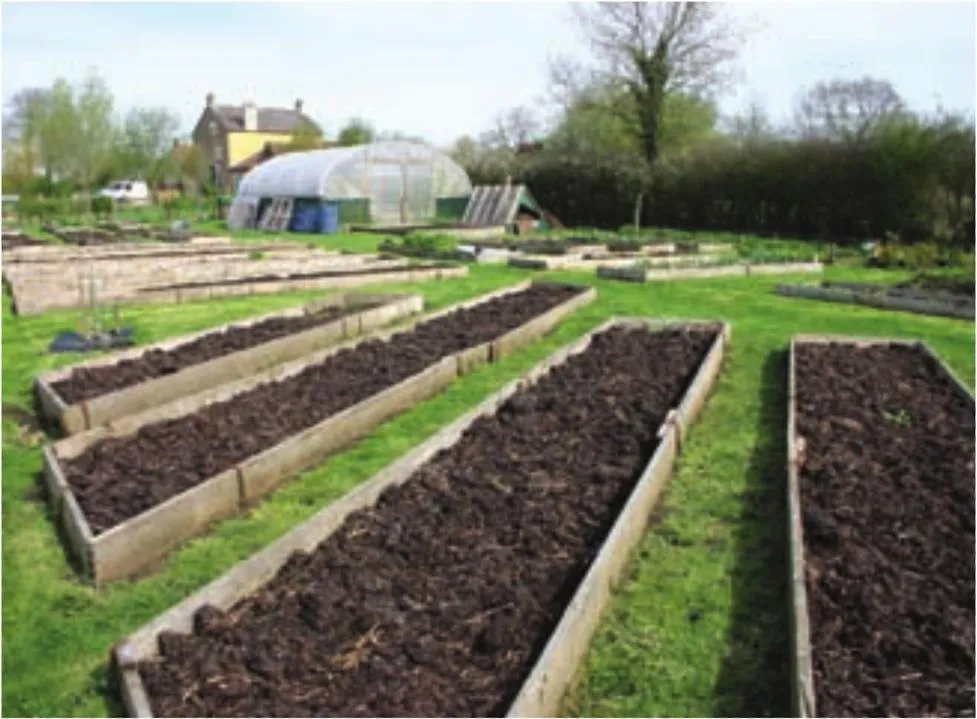
A fan of mulched raised beds ready for planting in spring. While an attractive design, the beds are unequal in length and difficult to get a mower in between – you could be more organized!
What to grow
There’s no need to try to include a wide variety of flowers in your patch. You can be a professional cut-flower farmer and grow as few as ten different varieties – the skill is in being clever about which ones you choose. The advice and recommendations in this book should help with making your choice, but remember that the most important thing is to grow flowers that you love. A patch of something you grow because you think you ought to, but which you don’t love, will be ignored and will cost you money in wasted space. I never grow cleome because I hate the smell and the spines. I could think that I ought to include it, because it’s a classic annual to grow for cut-flower production, but I’ve learned – to my cost in space and time – that I won’t pay it any attention other than to be annoyed by it.
Last year in our garden we planted up two 3m x 1m (10' x 3') beds as follows:

These beds started flowering at the end of May and we cut from them until September – you can expect to get a maximum of two months’ useful production out of an annual plant.
Both the beds have low hedges of young box plants at one end, and one of them has a small hedge of Spiraea japonica ‘Candlelight’ at the other end.
So from just this small planting area we had cut flowers and greenery to take us all through the season. I could have planted fewer ammi and put a stand of sweet peas at one end of that bed instead, and th...
Table of contents
- Cover
- Title Page
- Dedication
- Contents
- Acknowledgements
- Foreword
- Introduction: Why grow cut flowers?
- Chapter one: Getting started
- Chapter two: Annuals
- Chapter three: Biennials
- Chapter four: Perennials
- Chapter five: Bulbs & corms
- Chapter six: Shrubs
- Chapter seven: Roses
- Chapter eight: Dahlias
- Chapter nine: Sweet peas
- Chapter ten: Herbs
- Chapter eleven: Wildflowers
- Chapter twelve: Cutting, conditioning & presenting cut flowers
- Chapter thirteen: Hedgerow Christmas
- Chapter fourteen: Starting a cut-flower business
- Chapter fifteen: Where to sell
- Chapter sixteen: Marketing & social media
- Afterword
- Appendix 1: The flower farmer’s year planner
- Appendix 2: Plant names
- Resources
- Index
- Copyright
- Advertisement
Trusted by 375,005 students
Access to over 1.5 million titles for a fair monthly price.
Study more efficiently using our study tools.
Frequently asked questions
Yes, you can cancel anytime from the Subscription tab in your account settings on the Perlego website. Your subscription will stay active until the end of your current billing period. Learn how to cancel your subscription
No, books cannot be downloaded as external files, such as PDFs, for use outside of Perlego. However, you can download books within the Perlego app for offline reading on mobile or tablet. Learn how to download books offline
Perlego offers two plans: Essential and Complete
- Essential is ideal for learners and professionals who enjoy exploring a wide range of subjects. Access the Essential Library with 800,000+ trusted titles and best-sellers across business, personal growth, and the humanities. Includes unlimited reading time and Standard Read Aloud voice.
- Complete: Perfect for advanced learners and researchers needing full, unrestricted access. Unlock 1.5M+ books across hundreds of subjects, including academic and specialized titles. The Complete Plan also includes advanced features like Premium Read Aloud and Research Assistant.
We are an online textbook subscription service, where you can get access to an entire online library for less than the price of a single book per month. With over 1.5 million books across 990+ topics, we’ve got you covered! Learn about our mission
Look out for the read-aloud symbol on your next book to see if you can listen to it. The read-aloud tool reads text aloud for you, highlighting the text as it is being read. You can pause it, speed it up and slow it down. Learn more about Read Aloud
Yes! You can use the Perlego app on both iOS and Android devices to read anytime, anywhere — even offline. Perfect for commutes or when you’re on the go.
Please note we cannot support devices running on iOS 13 and Android 7 or earlier. Learn more about using the app
Please note we cannot support devices running on iOS 13 and Android 7 or earlier. Learn more about using the app
Yes, you can access The Flower Farmer's Year by Georgie Newbery in PDF and/or ePUB format, as well as other popular books in Ciencias biológicas & Horticultura. We have over 1.5 million books available in our catalogue for you to explore.