This book is available to read until 10th December, 2025
- 112 pages
- English
- ePUB (mobile friendly)
- Available on iOS & Android
eBook - ePub
Available until 10 Dec |Learn more
About this book
We live in a consumer society, and over-consumption is the driving force of environmental degradation. This stark reality led Pooran Desai and Sue Riddlestone to found BioRegional Development Group. In this Briefing they show how we can meet more of our needs for wood products, paper, textiles, food and housing from local renewable and waste resources. They outline the theoretical framework of bioregional development and the award winning practical solutions that BioRegional have developed with industry partners. They quantify how we can significantly reduce CO2 emissions and recycle waste, and so greatly reduce our ecological footprint.
Frequently asked questions
Yes, you can cancel anytime from the Subscription tab in your account settings on the Perlego website. Your subscription will stay active until the end of your current billing period. Learn how to cancel your subscription.
At the moment all of our mobile-responsive ePub books are available to download via the app. Most of our PDFs are also available to download and we're working on making the final remaining ones downloadable now. Learn more here.
Perlego offers two plans: Essential and Complete
- Essential is ideal for learners and professionals who enjoy exploring a wide range of subjects. Access the Essential Library with 800,000+ trusted titles and best-sellers across business, personal growth, and the humanities. Includes unlimited reading time and Standard Read Aloud voice.
- Complete: Perfect for advanced learners and researchers needing full, unrestricted access. Unlock 1.4M+ books across hundreds of subjects, including academic and specialized titles. The Complete Plan also includes advanced features like Premium Read Aloud and Research Assistant.
We are an online textbook subscription service, where you can get access to an entire online library for less than the price of a single book per month. With over 1 million books across 1000+ topics, we’ve got you covered! Learn more here.
Look out for the read-aloud symbol on your next book to see if you can listen to it. The read-aloud tool reads text aloud for you, highlighting the text as it is being read. You can pause it, speed it up and slow it down. Learn more here.
Yes! You can use the Perlego app on both iOS or Android devices to read anytime, anywhere — even offline. Perfect for commutes or when you’re on the go.
Please note we cannot support devices running on iOS 13 and Android 7 or earlier. Learn more about using the app.
Please note we cannot support devices running on iOS 13 and Android 7 or earlier. Learn more about using the app.
Yes, you can access Bioregional Solutions by Pooran Desai,Sue Riddlestone in PDF and/or ePUB format, as well as other popular books in Biological Sciences & Environmental Science. We have over one million books available in our catalogue for you to explore.
Information
Chapter 1
Joined Up Locally

If everyone on the planet consumed as much as the average person in the UK, we’d need three planets to support us.1 Our target in the UK must therefore be to reduce our consumption of raw materials and fossil fuels—our ecological footprint—by two-thirds. Only then can we say we are living sustainably and giving people around the world an equal chance to share in the earth’s resources. Meeting more of our everyday needs from local renewable and reclaimed sources—bioregional development—can help us to achieve this target. Although this may seem unattainable at first, in our own experience from our own projects we know it is possible and can be achieved in the mainstream. At the same time we can increase our quality of life, re-create communities, promote accountability and leave space for wildlife and wilderness.
We live in a market economy and therefore the approach we have taken has been based on providing sustainable products and services. As we transform into a sustainable society, companies will need to supply products and services that allow us all to live within our means on this planet. They will need to be designed in such a way that they don’t destroy natural systems. They will also need to promote social equity. We will not be able to live sustainably on a small planet with great divisions between rich and poor, causing resentment and unrest, where the rich are destroying the planet through overconsumption and the poor through desperation.
The approach we have taken arises out of the philosophy of bioregionalism2 in which natural factors, such as local ecology and climate, rather than politics and trade, determine the way people live.* At BioRegional Development Group, however, we have been keen to engage with the market on its own terms and to link ourselves back to the local environment and the earth’s natural nutrient and energy cycles. We value technology and the marketplace, but recognise that these can only bring long term benefits when they are linked to natural cycles—i.e. when we work with, rather than against, nature. If not, we will continue to cause environmental damage and store up long-term economic and health problems for ourselves. Our current culture and government policies are guided by concepts such as democracy, human rights and economics; but these are ultimately meaningless unless we recognise our fundamental dependence on the living part of our planet.
Even if we live in large cities, renewable resources are all around us. We import huge quantities of virgin wood pulp, yet we could meet a large proportion of our needs from the millions of tonnes of high-grade waste paper we send to landfill. London, for instance, is permeated and surrounded by woodlands that could be managed sustainably for a variety of products. Even street trees, managed as a sustainable forest, can provide a renewable energy supply. Other resources include solar energy falling on the city, sewage which is full of nutrients, and glass and plastic in the waste-stream.
Since 1994, BioRegional has been working to create sustainable products and services based on using local renewable and waste resources. Our partners include major companies like B&Q, M-real, Inveresk plc, BP and Cosmopolitan Cosmetics. We have teamed up with UK housing providers like The Peabody Trust, as well as community groups and a local prison. The products and services developed within a BioRegional framework and described in this book are working examples of thinking globally and acting locally within a market economy, and aimed at reducing our ecological footprint.
Using local renewable and waste resources wisely allows us to create communities that locally recycle many of the materials and nutrients required to support them, much like natural eco-systems. This ties in with the UK government’s Proximity Principle, advocating local recycling. Local Paper for London, our closed loop office paper recycling and buyback scheme, is one working example. Converting wastes from one activity into resources for another using the principle of ‘industrial ecology’ will also be an important strategy in building a sustainable future. For example we can use waste arising locally from textile production to make particle board for packing crates and furniture, as we describe in our vision for a BioRegional fibre industry.
Localisation of production and consumption is a key theme in our work. Local production cuts down on unnecessary transport, supports local economic development and re-establishes a direct link between people and their living environment. To create more locally self-sustaining communities in compact cities, we also need to reconsider the scale and organisation of our production systems. Local and regional scale (rather than global scale) technologies can form the basis of a new industrial revolution. There are many opportunities for bulky commodity products, which are expensive to transport, to be produced locally on a decentralised basis. We can set up co-ordinated networks of local producers, responsive to local needs—bioregional networks—as we have done for charcoal supply in the UK. As we move to more locally self-sustaining communities, we will see the balance of international trade moving away from low value commodities to high value added products, allowing countries to generate foreign exchange with low environmental impact as measured by our ‘FEET’ index.
Although we see sustainability being delivered via products and services—that is, via a sustainable market economy—we will also need strong international governance to ensure that the market operates with sustainability principles and creates a level global playing field. A market defined by sustainability criteria will automatically support more local production—where the benefits of globalisation and Comparative Advantage are balanced by those of BioRegional Advantage.
To demonstrate that it is possible to design a much more sustainable urban way of life we have developed a variety of initiatives that are described in the following chapters. One of our projects has been the design and construction of an urban eco-village in South London, Beddington Zero (fossil) Energy Development, or BedZED. Designed with architect Bill Dunster and developed in partnership with Peabody Trust, we are showing how green living is a real, attractive and affordable option for the person in the street, created by integrating energy efficiency, renewable energy and water harvesting with services like car pools and local organic food deliveries. This joined up approach to green lifestyles and the use of local sustainable building materials typifies the BioRegional approach. Bill Dunster describes bioregional development as the glue that binds BedZED together.
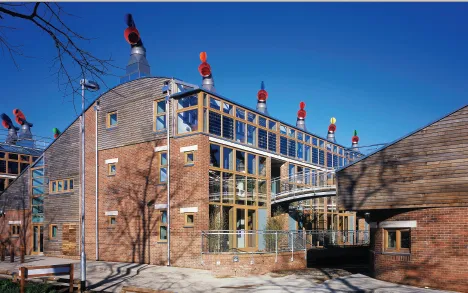
BedZED, the UK’s largest eco-village, with 82 homes and office space for 200. photo: Raf Makda
BedZED is the UK’s largest eco-village. It is made up of 82 homes, plus office space and live-work studio apartments. The village has a mix of social housing for people on low incomes and private homes for sale at prices comparable to more conventional homes in the area. It is designed for a comfortable, yet highly resource-efficient bioregional way of life.
BedZED can trace its history back to the early 1990s, when Bill Dunster built his own prototype solar home, Hope House, in Surrey. Hope House is very well insulated, faces south and has a large conservatory on the south side to trap warmth from the sun—providing so-called passive solar heating. Bill later added a solar hot water system and photovoltaic (PV) panels. The PV panels are used to charge an electric car that provides the main form of transportation for the Dunster family and also serves as the company car for his architectural practice.
Working with environmental services engineer Chris Twinn of Arup, Bill used Hope House to create a theoretical model of a high density mixed residential and commercial development: Hope Town. With some seed funding from the World Wide Fund for Nature International, BioRegional starting working with Bill to develop this concept further and turn it into a reality. We looked at how we could use local sustainable materials, local renewable energy supply and integrate a range of services for residents to make green living an easy option. When BioRegional identified a possible site at Beddington Corner, the opportunity for a real project was born.
The site was 1.65 hectares (approximately 4 acres) of former sewage works, due to be sold by London Borough of Sutton. The land had some heavy metal contamination and so some decontamination work would be needed when developing the site. We started approaching the local community to find out their views about an eco-village. As we described the concept in more detail, the local residents’ association and vicar became increasingly supportive. Bill Dunster drew up plans, incorporating ideas such as space for a nursery suggested by the local residents. The cost of the scheme was determined by quantity surveyors, Gardiner and Theobald. At this point we had a project to take to potential backers. The mix of the less conventional companies, Bill Dunster Architects and BioRegional, with well respected and established ones like Arup and G&T, proved a powerful one.
We needed a developer partner for the project. A number of house builders—big and small—were contacted and although they showed interest, felt no need to change their product from the one they were already selling to the consumer. In retrospect, we were therefore very lucky to identify the Peabody Trust as potential partners. Peabody are London’s largest housing association, set up in 1870 through an endowment by American philanthropist, George Peabody. The Peabody Trust had grown to provide 19,500 homes for tenants on low incomes and developed a culture of innovation and leadership. Having invested its money wisely, the Trust had gained the financial freedom to support new ideas. Our project had now assumed the name Beddington Zero (fossil) Energy Development, to describe the aim to generate all the heat and power from renewable sources. We were invited by Peabody’s development manager, Malcolm Kirk, to present the project. Peabody’s development team recognised that it would take a “brave developer” to take on the scheme, but under the leadership of Dickon Robinson, Director of Development, they took on the challenge and agreed to bid for the Beddington site when it came up for sale.
Sutton Council put the site on the market in May 1998. We had a good idea of how much money conventional developers would offer for the site. We also knew Sutton Council was a leader in sustainability, being one of the first local authorities to develop a Local Agenda 21 to improve its environmental performance. Specifically, in its main planning document, the Unitary Development Plan, the council had committed itself to support a model energy-efficient housing development.
We wished to secure some financial leeway to share some of the risk we were taking in innovating, when the council would benefit in terms of meeting its own targets. We therefore pitched our offer around 10% below what we estimated would be the highest offer from a conventional developer. Although generally required to accept the highest bid in money terms, councils are free to accept a bid within 10% of the highest offer. In our bid we also placed a financial value on some the benefits such as the reduced carbon dioxide emissions and high building quality, the latter in effect being an investment in the long term future of the area. We put forward the case that if all the environmental and social factors were taken into account (i.e. internalised), our bid was effectively much higher than that which a conventional developer was offering.
Sutton Council were divided as to whether to accept the Peabody/BioRegional offer. Sutton Council engaged economists from Aspinwall Environmental Consultants to value the environmental benefits. They placed these at around £200,000, mainly for the savings to the public purse of helping meet European Union targets for CO2 reduction. This was in comparison to a value for the site of around £2 million. On this basis our offer was accepted, setting as far as we know a precedent for financial valuation of environmental benefits by a local authority selling land in the UK.
Sutton Council quite rightly specified environmental performance targets as part of the land sale contract and planning permission. This meant Peabody and BioRegional were bound to deliver the BedZED project in its entirety to deliver the environmental savings. There have been other cases in the UK, such as the Greenwich Millennium Village, which have failed to meet the high environmental specifications on which developers have won competitions to develop sites.
Work on site started in May 2000, and the first residents moved in to BedZED in March 2002 with full occupation achieved in July 2002. Homes range from one-bedroom flats to four-bedroom family townhouses. Both BioRegional and Bill Dunster Architects have moved offices to BedZED. Office space has been reserved by some of the residents on site. Some are being converted to live-work units suitable for homeworkers including software engineers, architects and designers. There is a sports pitch and clubhouse, and a café and nursery are planned. As a mixed-use development, BedZED will never be deserted in the way that purely residential areas are during the day and commercial areas at night, lending itself to self-policing and increasing security.
The main principles which underpin BedZED are:
• reducing energy requirements to the point where renewable energy is a viable option for the entire energy supply
• designing for a lifestyle less dependent on the car, promoting car pools and electric cars
• maximising the use of local, reclaimed and recycled materials and materials with a low embodied energy (i.e. energy required in manufacture)
• reducing mains water consumption by collecting rainwater and recycling water on site
• integrating ‘green lifestyle’ services such as recycling and on-site composting, bulk home deliveries of groceries and local organic food deliveries to make it easy for people to chose a completely green lifestyle.
Space heating needs at BedZED are reduced by 90% compared to a typical home in the UK (e.g. one which meets the UK’s 1995 Building Regulations standards). BedZED’s exceptional energy efficiency means that we haven’t had to fit central heating. This is made possible by having terraces of super-insulated south-facing homes with double-glazed conservatories to provide passive solar heating. The free heat energy from the sun provides up to 30% of the heating needs of the homes.
The passive solar warmth is stored within the mass of the building (the concrete, brick and blockwork), the heavy weight construction giving the buildings a high thermal mass or thermal inertia. The buildings heat up and cool down slowly, so that heat stored from the day is released at night, and coolth from the night is carried over into the day, which avoids over...
Table of contents
- Cover
- Title Page
- Acknowledgements
- Contents
- Foreword by HRH Prince Charles
- Preface by Herbert Girardet
- Introduction
- 1 Joined Up Locally
- 2 Our Planetary Means
- 3 A Sustainable Local Paper Cycle
- 4 BioRegional MiniMills: Scale of Technology and Local Resource Use
- 5 Charcoal, Butterflies and International Trade
- 6 Local Food, Lower Risk
- 7 Hemp, Clothes and Fair Trade
- 8 The Multiple Benefits of Bioregional Development
- 9 Bioregional Economics: Comparative Advantage vs Bioregional Advantage
- 10 BedZED: Living off One Planet
- 11 A Sustainable Future?
- 12 What You Can Do to Live Bioregionally
- References
- Copyright