eBook - ePub
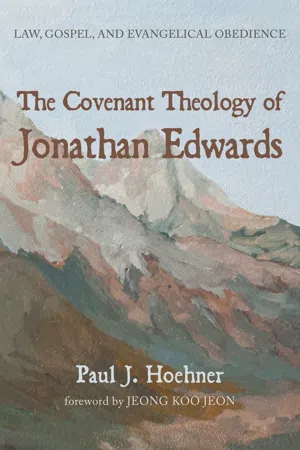
The Covenant Theology of Jonathan Edwards
Law, Gospel, and Evangelical Obedience
- 362 pages
- English
- ePUB (mobile friendly)
- Available on iOS & Android
eBook - ePub
About this book
As a theologian in the Reformed tradition, covenant theology was for Jonathan Edwards the internal scaffolding that gave shape to the biblical story of redemption. The establishment of the eternal rule of righteousness as the basis of the believer's communion with God and eternal happiness is a central theme beginning with the Covenant of Works, grounded in the eternal Covenant of Redemption, and culminating in the Covenant of Grace. It is the basis for the law-gospel distinction in Edwards and the early architects of federal theology. For the "God intoxicated" New England Puritan preacher, this was no dry academic exercise. Rather, it was a joyous and affectionate discovery and embrace of what God had ordained in eternity, what Christ accomplished in history on the cross, and what the Holy Spirit is doing and will complete in the church.
This study grew out of current discussions in Reformed scholarship questioning aspects of traditional covenant theology. As a key transitional figure in the history of Reformed theology, Edwards's thinking is still relevant. The richness and depth of Edwards's vision of redemptive history provides a clear and comprehensive understanding of his Reformed soteriology and the role of evangelical obedience in justification.
Information
Topic
Theology & ReligionSubtopic
Christian Denominations3
Jonathan Edwards
on the Covenant of Redemption
Introduction
In the previous chapter, I showed how Edwards’s doctrine of the Covenant of Works was rooted in the “works” principle of complete and perfect obedience to God’s covenant stipulations. While the covenant was abrogated in terms of its fulfillment by Adam, it was not abrogated in terms of its judgment. In this chapter I will show how the works principle is rooted in the intratrinitarian relationship. In other words, Adam’s sin makes Christ’s perfect obedience according to the intratrinitarian Covenant of Redemption the only basis of salvation. In historical Reformed covenant theology, the Covenant of Redemption roots the gospel message in the eternal council of the Trinity and connects the eternal decrees to their outworking in the history of redemption. It is a doctrinal argument for the ad intra (“to within”) trinitarian grounding of the ad extra (“to without”) work of salvation as it terminates on the individual divine persons of the Trinity.
Like the Covenant of Works, Edwards inherited from his Reformed tradition a well-established conceptual framework that included the Covenant of Redemption, albeit not without variations in its expression. In many formulations it is the key link between the eternal decrees and the Covenant of Grace, and this is no less true for Edwards. The Covenant of Redemption, as Edwards articulates the doctrine, is central and crucial to his concept of the history of the work of redemption.227 For Edwards, the Covenant of Grace is not only the historical outworking and application of the Covenant of Redemption as it impacts the history of redemption as it progresses from the fall of Adam to the second coming of Christ, from the Old Testament to the New Testament, it also informs the ordo salutis in the individual elect believer. In other words, the Covenant of Redemption, properly understood in its relationship to the Covenants of Works and Grace, links Edwards’s biblical and systematic theologies and is the foundation for the law-gospel distinction in his theology. Edwards’s trinitarianism involves the whole Trinity in this work. He shows how the Covenant of Redemption is founded upon, and not opposed to, the eternal decrees of election. Finally, Edwards’s theology of the Covenant of Redemption has important implications for evangelical obedience. This chapter, along with the previous and the two subsequent, form an extended prolegomenon to understanding the role of works in Edwards’s theology.
The Covenant of Redemption in Reformed Theology
The Covenant of Redemption is a special new arrangement that exists only between the Father and the Son, entered by mutual and free consent, to undertake the work of redemption. This “new” covenant is fundamentally the “old” covenant with a new mediator, the Second Person of the Trinity. The Covenant of Redemption (pactum salutis) was not a speculative doctrine of philosophical theology, as proposed by some historians, but a conclusion of Reformed theologians’ comprehensive biblical exegesis. It was also an integral aspect of a systemizing of theology, especially in relation to the divine decrees.228
A Speculative Doctrine
The Covenant of Redemption (pactum salutis or foedus redemptionis) is admittedly the most speculative element in Reformed doctrine. But, according to Richard Muller, it represents that most basic issue of the Reformed system: “the eternal, divine, and consistently gracious ground of the plan of salvation, the resolution of the seemingly unbridgeable gap between the eternal and the temporal, the infinite and the finite, undertaken redemptively and by grace alone from the divine side.”229 Despite its seeming centrality, the doctrine in its full explication does not fully appear until the middle of the seventeenth century. This has caused historians of theology to question its origins and basis within Reformed doctrine. Does its sudden appearance on the stage of church history expose its novelty as a theological innovation and belie its veracity, or were there antecedents and reasons for its appearance at this stage of the development of Reformed theology?
The name Johannes Cocceius has been so associated with the Covenant of Redemption that Wilhelm Gass believed (in a bit of overstatement) that Cocceius invented the concept.230 However, Cocceius himself recognizes the influence of Johann Cloppenburg (1592–1652) on his theology231 and Gottlob Schrenk discusses the presence of the Covenant of Redemption in Cloppenburg’s theology just prior to Cocceius.232 Heppe argued that it was fully present even earlier than Cloppenburg, e.g., in Kaspar Olevianus’s De substantia foederis (1585).233 More recently Bierma also located the roots of the doctrine in Olevianus.234
Muller notes the potential for eve...
Table of contents
- Title Page
- List of Tables
- Foreword
- Preface
- Acknowledgments
- Abbreviations
- Reading Jonathan Edwards in Covenant Context
- Jonathan Edwards on the Covenant of Works
- Jonathan Edwards on the Covenant of Redemption
- Jonathan Edwards on the Covenant of Grace
- Jonathan Edwards on the Mosaic Covenant
- Jonathan Edwards on Justification and Faith
- Jonathan Edwards on Evangelical Obedience
- Summary and Concluding Comments
- Bibliography
Trusted by 375,005 students
Access to over 1.5 million titles for a fair monthly price.
Study more efficiently using our study tools.
Frequently asked questions
Yes, you can cancel anytime from the Subscription tab in your account settings on the Perlego website. Your subscription will stay active until the end of your current billing period. Learn how to cancel your subscription
No, books cannot be downloaded as external files, such as PDFs, for use outside of Perlego. However, you can download books within the Perlego app for offline reading on mobile or tablet. Learn how to download books offline
Perlego offers two plans: Essential and Complete
- Essential is ideal for learners and professionals who enjoy exploring a wide range of subjects. Access the Essential Library with 800,000+ trusted titles and best-sellers across business, personal growth, and the humanities. Includes unlimited reading time and Standard Read Aloud voice.
- Complete: Perfect for advanced learners and researchers needing full, unrestricted access. Unlock 1.5M+ books across hundreds of subjects, including academic and specialized titles. The Complete Plan also includes advanced features like Premium Read Aloud and Research Assistant.
We are an online textbook subscription service, where you can get access to an entire online library for less than the price of a single book per month. With over 1.5 million books across 990+ topics, we’ve got you covered! Learn about our mission
Look out for the read-aloud symbol on your next book to see if you can listen to it. The read-aloud tool reads text aloud for you, highlighting the text as it is being read. You can pause it, speed it up and slow it down. Learn more about Read Aloud
Yes! You can use the Perlego app on both iOS and Android devices to read anytime, anywhere — even offline. Perfect for commutes or when you’re on the go.
Please note we cannot support devices running on iOS 13 and Android 7 or earlier. Learn more about using the app
Please note we cannot support devices running on iOS 13 and Android 7 or earlier. Learn more about using the app
Yes, you can access The Covenant Theology of Jonathan Edwards by Paul J. Hoehner in PDF and/or ePUB format, as well as other popular books in Theology & Religion & Christian Denominations. We have over 1.5 million books available in our catalogue for you to explore.