Journal for the Evangelical Study of the Old Testament (JESOT) is a peer-reviewed journal devoted to the academic and evangelical study of the Old Testament. The journal seeks to fill a need in academia by providing a venue for high-level scholarship on the Old Testament from an evangelical standpoint. The journal is not affiliated with any particular academic institution, and with an international editorial board, open access format, and multi-language submissions, JESOT cultivates and promotes Old Testament scholarship in the evangelical global community. The journal differs from many evangelical journals in that it seeks to publish current academic research in the areas of ancient Near Eastern backgrounds, Dead Sea Scrolls, Rabbinics, Linguistics, Septuagint, Research Methodology, Literary Analysis, Exegesis, Text Criticism, and Theology as they pertain only to the Old Testament. JESOT also includes up-to-date book reviews on various academic studies of the Old Testament.
Table of Contents
ARTICLES
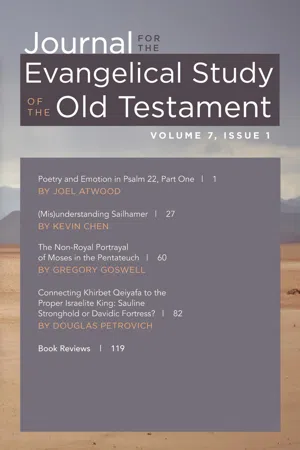
Poetry and Emotion in Psalm 22, Part One
Joel Atwood
(Mis)understanding Sailhamer
Kevin Chen
The Non-Royal Portrayal of Moses in the Pentateuch
Gregory Goswell
Connecting Khirbet Qeiyafa to the Proper Israelite King:
Sauline Stronghold or Davidic Fortress?
Douglas Petrovich
BOOK REVIEWS
- 170 pages
- English
- ePUB (mobile friendly)
- Available on iOS & Android
eBook - ePub
Journal for the Evangelical Study of the Old Testament, 7.1
About this book
Information
Poetry and Emotion in Psalm 22 (Part 1)
Keywords: Psalms, Psalm 22, Hebrew poetry, emotion, hermeneutics
Abstract: This study examines how the Hebrew poetry of Psalm 22 expresses the emotions of the psalmist and the potential transformative effort upon the emotions of an engaged reader. Part 1 establishes a working definition of emotion as the perception and evaluation (‘construal’) of a situation or object, grounded in a personal interpretative framework. The manner in which Hebrew poetry may express emotion is then examined in light of how poetic techniques show how the psalmist perceives and evaluates their situation, particularly through sensory language, metaphor, and narrative structure. These techniques combined with the implications of the psalms as songs show how the psalmist’s construal may affect the reader as they are encouraged to experience the situation as the psalmist does, and so ‘feel’ what they feel.
A selective exegetical study of the Hebrew text of Psalm 22 will then begin, with particular attention paid to how the text expresses emotion and its potential effect upon an engaged reader.
Part 2 will complete the exegetical study and employ it as the basis for wider theological reflection on topics such as the causality of emotions, and especially the importance of ‘performance’ to link authorial expression with effect upon the reader. The engagement of performance allows the reader to perceive the situation and self of the psalmist as it is expressed in the psalm, and so be affected by it.
The Psalms have been central to the life of the church from its earliest days.1 While their influence was most markedly felt in the area of prophecy, their poetic expression of emotion and potential to transform the emotions of the reader has been key to devotional life and pastoral ministry since at least the time of Athanasius.2
The expression and impact of emotions in Hebrew texts has begun to receive serious attention in recent years. These may be categorised as those seeking to explore a universal methodology for emotive language in Hebrew and those that seek to examine the emotional content of a particular text. In the first category would fall the work of Kruger and King, both of whom emphasise the role of metaphor in expressing emotion.3 Their models broadly understand emotional description to be extensions of metaphors that may be understood in light of their core comparisons, rooted in the physiological manifestations that accompany that emotion. For example, “steam came from his ears” is an extension of the core metaphor, “heat is anger” which is rooted in the metonymy of a reddened face.4 The second category includes Estes’ article on Psalm 49 and Clendenen’s on Malachi.5 Estes examines how the techniques of overlapping semantic fields, repetition, lexical exploitation, and sound-play communicate fear as a central theme of Psalm 49. Clendenen draws parallels between his comments on the text of Malachi with observations upon particular emotions from the works of cognitive theorists of emotion. While providing helpful and often very sophisticated and stimulating forays into the field, these studies fail in one or both of two areas. The first is that, with the exception of Clendenen, they fail to define what is meant by emotion, rendering subsequent discussion ambiguous.6 The second weakness is an overly narrow focus on a single or handful of pre-decided techniques as those which encode emotion. If emotion is present in a text, and intended to be communicated by that text, it will be present throughout all aspects of the text.
This present study will seek to examine how the Hebrew text of Psalm 22 expresses the emotions of the psalmist and explore the transformative effect of that expression upon an engaged reader. This will take place in three parts:
(1) The necessary foundations will be laid by providing a brief outline of the cognitive model of emotion, and a sketch of how the Psalms express their content ...
Table of contents
- Title Page
- Poetry and Emotion in Psalm 22 (Part 1)
- (Mis)Understanding Sailhamer
- The Non-Royal Portrayal of Moses In The Pentateuch
- Connecting Khirbet Qeiyafa to the Proper Israelite King: Sauline Stronghold or Davidic Fortress
Trusted by 375,005 students
Access to over 1.5 million titles for a fair monthly price.
Study more efficiently using our study tools.
Frequently asked questions
Yes, you can cancel anytime from the Subscription tab in your account settings on the Perlego website. Your subscription will stay active until the end of your current billing period. Learn how to cancel your subscription
No, books cannot be downloaded as external files, such as PDFs, for use outside of Perlego. However, you can download books within the Perlego app for offline reading on mobile or tablet. Learn how to download books offline
Perlego offers two plans: Essential and Complete
- Essential is ideal for learners and professionals who enjoy exploring a wide range of subjects. Access the Essential Library with 800,000+ trusted titles and best-sellers across business, personal growth, and the humanities. Includes unlimited reading time and Standard Read Aloud voice.
- Complete: Perfect for advanced learners and researchers needing full, unrestricted access. Unlock 1.5M+ books across hundreds of subjects, including academic and specialized titles. The Complete Plan also includes advanced features like Premium Read Aloud and Research Assistant.
We are an online textbook subscription service, where you can get access to an entire online library for less than the price of a single book per month. With over 1.5 million books across 990+ topics, we’ve got you covered! Learn about our mission
Look out for the read-aloud symbol on your next book to see if you can listen to it. The read-aloud tool reads text aloud for you, highlighting the text as it is being read. You can pause it, speed it up and slow it down. Learn more about Read Aloud
Yes! You can use the Perlego app on both iOS and Android devices to read anytime, anywhere — even offline. Perfect for commutes or when you’re on the go.
Please note we cannot support devices running on iOS 13 and Android 7 or earlier. Learn more about using the app
Please note we cannot support devices running on iOS 13 and Android 7 or earlier. Learn more about using the app
Yes, you can access Journal for the Evangelical Study of the Old Testament, 7.1 by Russell Meek in PDF and/or ePUB format, as well as other popular books in Theology & Religion & Biblical Criticism & Interpretation. We have over 1.5 million books available in our catalogue for you to explore.