eBook - ePub
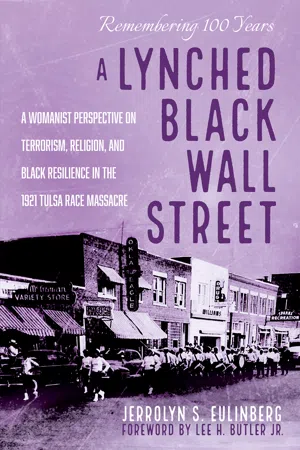
A Lynched Black Wall Street
A Womanist Perspective on Terrorism, Religion, and Black Resilience in the 1921 Tulsa Race Massacre
- 248 pages
- English
- ePUB (mobile friendly)
- Available on iOS & Android
eBook - ePub
A Lynched Black Wall Street
A Womanist Perspective on Terrorism, Religion, and Black Resilience in the 1921 Tulsa Race Massacre
About this book
This book remembers one hundred years since Black Wall Street and it reflects on the 1921 Tulsa Race Massacre. Black Wall Street was the most successful Black business district in the United States; yet, it was isolated from the blooming white oil town of Tulsa, Oklahoma, because of racism. During the early twentieth century African-Americans lived in the constant threat of extreme violence by white supremacy, lynching, and Jim and Jane Crow laws. The text explores, through a Womanist lens, the moral dilemma of Black ontology and the existential crisis of living in America as equal human beings to white Americans.
This prosperous Black business district and residential community was lynched by white terror, hate, jealousy, and hegemonic power, using unjust laws and a legally sanctioned white mob. Terrorism operated historically based on the lies of Black inferiority with the support of law and white supremacy. Today this same precedence continues to terrorize the life experiences of African-Americans. The research examines Native Americans and African-Americans, the Black migration west, the role of religion, Black women's contributions, lynching, and the continued resilience of Black Americans.
Information
Topic
Theology & ReligionSubtopic
African American HistoryCHAPTER 1
The Making of a Promised Land
Native Americans, African-Americans, and the Black Migration
The colonized, underdeveloped man (sic) is a political creature in the most global sense of the term.
—Frantz Fanon
The Wretched of the Earth
Oklahoma Territory
Oklahoma came into existence through the massive influx of many different Native American tribes as they were expelled over the years from their various homelands across the nation. Arthur Tolson investigates tribes that were moved from upper Louisiana across the Mississippi River from as early as the 1790s through the 1830s.16 Yet many other Indian tribes came from the southeastern sector of the United States. Some of the first tribes in Oklahoma were Kickapoos, Delawares, Shawnees, Osages, and Cherokees. As time passed, another sixty-two Native American tribes would come. The forcible and painful removal of Indians from their tribal and ancestral land is known as the Trail of Tears.17
The Trail of Tears was initiated by the Indian Removal Act in 1830 to uproot the Native Americans. The Indian tribes included Cherokees, Chickasaws, Choctaws, Muscogee (Creek), and Seminoles.18 The federal government decided in 1825 to move the Indians from their land in order to make room for the gold rush and white settlement. It was President Andrew Jackson who was determined to implement the Act. “The prospect of forcing Indians to the West horrified many Americans, and petitions opposing removal poured into Congress in opposition to removal, but in the end, they could not stop the ethnic cleansing that took place.”19 This moment in history is reflective of Homi K. Bhabha’s foreword to Fanon’s Wretched of Earth, in which he highlights one of “Fanon’s most quoted (and quarreled over) passages”:20
The singularity of the colonial context lies in the fact that economic reality, inequality, and enormous disparities in lifestyles never manage to mask the human reality. Looking at the immediacies of the colonial context, it is clear that what divides this world is first and foremost what species, what race one belongs to. In the colonies the economic infrastructure is also a superstructure.21
Fanon’s quote represents not only one of America’s ethical and historical challenges, but also the political, social constructs and hegemonic power being exercised domestically and globally today. The Trail of Tears unfolded from this type of conflict.
The Indians’ native lands occupied Georgia, Tennessee, Alabama, Mississippi, North Carolina, and Florida.22 President Andrew Jackson was excited about the Removal Act because of the wealth and population growth. As the gold rush grew so did the hostility in the state of Georgia. In 1831, the Cherokee Nation had major conflict with the State of Georgia and they took their suit to the United States Supreme Court. The question was whether “the Court had original jurisdiction to hear a case filed by a tribe against a state.”23 In other words, was the Cherokee Nation a domestic dependent nation, sovereign state, or foreign nation? Hannibal Johnson outlines the legal aspect. The Court heard the cases under Cherokee Nation v. Georgia and Worcester v. Georgia. The Court ruled in favor of Georgia’s state law, saying the Cherokees were not a state or foreign nation.
The case Worcester v. Georgia was the follow-up to Cherokee Nation v. Georgia. “Under an 1830 law, Georgia required all white residents in Cherokee country to secure a license from the governor and to take an oath of allegiance to the state.”24 When two missionaries who supported the Indians refused to get those licenses, they were convicted by the state. They appealed their case to the Supreme Court. The Court reversed their decision in the Cherokee Nation v. George by making the following rulings: “1) Indian nations are capable of making treaties, 2...
Table of contents
- Title Page
- Foreword
- Acknowledgments
- Introduction
- Chapter 1: The Making of a Promised Land
- Chapter 2: Agents of Resistance
- Chapter 3: Black Wall Street and the Greenwood District
- Chapter 4: A Living Faith
- Chapter 5: The Hidden Secrets
- Chapter 6: White Parties of Terror
- Chapter 7: White Parties of Terror Continue
- Chapter 8: A Lynched Black Wall Street
- Chapter 9: Following the Massacre
- Appendix
- Bibliography
Trusted by 375,005 students
Access to over 1.5 million titles for a fair monthly price.
Study more efficiently using our study tools.
Frequently asked questions
Yes, you can cancel anytime from the Subscription tab in your account settings on the Perlego website. Your subscription will stay active until the end of your current billing period. Learn how to cancel your subscription
No, books cannot be downloaded as external files, such as PDFs, for use outside of Perlego. However, you can download books within the Perlego app for offline reading on mobile or tablet. Learn how to download books offline
Perlego offers two plans: Essential and Complete
- Essential is ideal for learners and professionals who enjoy exploring a wide range of subjects. Access the Essential Library with 800,000+ trusted titles and best-sellers across business, personal growth, and the humanities. Includes unlimited reading time and Standard Read Aloud voice.
- Complete: Perfect for advanced learners and researchers needing full, unrestricted access. Unlock 1.5M+ books across hundreds of subjects, including academic and specialized titles. The Complete Plan also includes advanced features like Premium Read Aloud and Research Assistant.
We are an online textbook subscription service, where you can get access to an entire online library for less than the price of a single book per month. With over 1.5 million books across 990+ topics, we’ve got you covered! Learn about our mission
Look out for the read-aloud symbol on your next book to see if you can listen to it. The read-aloud tool reads text aloud for you, highlighting the text as it is being read. You can pause it, speed it up and slow it down. Learn more about Read Aloud
Yes! You can use the Perlego app on both iOS and Android devices to read anytime, anywhere — even offline. Perfect for commutes or when you’re on the go.
Please note we cannot support devices running on iOS 13 and Android 7 or earlier. Learn more about using the app
Please note we cannot support devices running on iOS 13 and Android 7 or earlier. Learn more about using the app
Yes, you can access A Lynched Black Wall Street by Jerrolyn S. Eulinberg in PDF and/or ePUB format, as well as other popular books in Theology & Religion & African American History. We have over 1.5 million books available in our catalogue for you to explore.