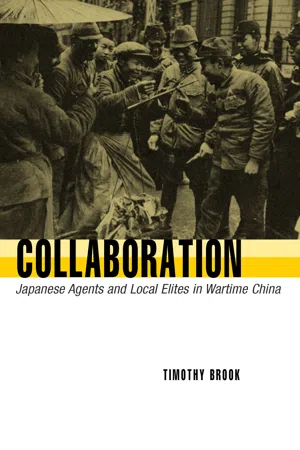
Studies of collaboration have changed how the history of World War II in Europe is written, but for China and Japan this aspect of wartime conduct has remained largely unacknowledged. In a bold new work, Timothy Brook breaks the silence surrounding the sensitive topic of wartime collaboration between the Chinese and their Japanese occupiers.
Japan's attack on Shanghai in August 1937 led to the occupation of the Yangtze Delta. In spite of the legendary violence of the assault, Chinese elites throughout the delta came forward to work with the conquerors. Using archives on both sides of the conflict, Brook reconstructs the process of collaboration from Shanghai to Nanking. Collaboration proved to be politically unstable and morally awkward for both sides, provoking tensions that undercut the authority of the occupation state and undermined Japan's long-term prospects for occupying China.
This groundbreaking study mirrors the more familiar stories of European collaboration with the Nazis, showing how the Chinese were deeply troubled by their unavoidable cooperation with the occupiers. The comparison provides a point of entry into the difficult but necessary discussion about this long-ignored aspect of the war in the Pacific.
- 303 pages
- English
- PDF
- Available on iOS & Android
eBook - PDF
About this book
Information
Publisher
Harvard University PressYear
2007Print ISBN
9780674023987
9780674015630
eBook ISBN
9780674270596
Table of contents
- Cover
- Title Page
- Copyright
- Dedication
- Contents
- Acknowledgments
- Abbreviations Used in the Text
- Chapter 1. Considering Collaboration
- Chapter 2. The Plan
- Chapter 3. Appearances / Jiading
- Chapter 4. Costs / Zhenjiang
- Chapter 5. Complicities / Nanjing
- Chapter 6. Rivalries / Shanghai
- Chapter 7. Resistance / Chongming
- Chapter 8. Assembling the Occupation State
- Conclusion: Four Ways Truth Disappears with History
- Notes
- Sources
- Index
Trusted by 375,005 students
Access to over 1.5 million titles for a fair monthly price.
Study more efficiently using our study tools.
Frequently asked questions
Yes, you can cancel anytime from the Subscription tab in your account settings on the Perlego website. Your subscription will stay active until the end of your current billing period. Learn how to cancel your subscription
No, books cannot be downloaded as external files, such as PDFs, for use outside of Perlego. However, you can download books within the Perlego app for offline reading on mobile or tablet. Learn how to download books offline
We are an online textbook subscription service, where you can get access to an entire online library for less than the price of a single book per month. With over 1.5 million books across 990+ topics, we’ve got you covered! Learn about our mission
Look out for the read-aloud symbol on your next book to see if you can listen to it. The read-aloud tool reads text aloud for you, highlighting the text as it is being read. You can pause it, speed it up and slow it down. Learn more about Read Aloud
Yes! You can use the Perlego app on both iOS and Android devices to read anytime, anywhere — even offline. Perfect for commutes or when you’re on the go.
Please note we cannot support devices running on iOS 13 and Android 7 or earlier. Learn more about using the app
Please note we cannot support devices running on iOS 13 and Android 7 or earlier. Learn more about using the app
Yes, you can access Collaboration by Timothy Brook in PDF and/or ePUB format, as well as other popular books in History & Chinese History. We have over 1.5 million books available in our catalogue for you to explore.