The Fifth Volume in the Studies in Interpretation Series
In interpreting, professionals must be able to convey to their clients the rhythm, stress, and length of phrases used by the communicating parties to indicate their respective emotional states. Such subtleties, which can signal sarcasm and irony or whether a statement is a question or a command, are defined in linguistics as prosody. Brenda Nicodemus's new volume, the fifth in the Studies in Interpretation series, discusses the prosodic features of spoken and signed languages, and reports the findings of her groundbreaking research on prosodic markers in ASL interpretation.
In her study, Nicodemus videotaped five highly skilled interpreters as they interpreted a spoken English lecture into ASL. Fifty Deaf individuals viewed the videotaped interpretations and indicated perceived boundaries in the interpreted discourse. These identified points were then examined for the presence of prosodic markers that might be responsible for the perception of a boundary. Prosodic Markers and Utterance Boundaries reports on the characteristics of the ASL markers, including their frequency, number, duration, and timing. Among other findings, the results show that interpreters produce an average of seven prosodic markers at each boundary point. The markers are produced both sequentially and simultaneously and under conditions of highly precise timing. Further, the results suggest that the type of prosodic markers used by interpreters are both systematic and stylistic.
eBook - PDF
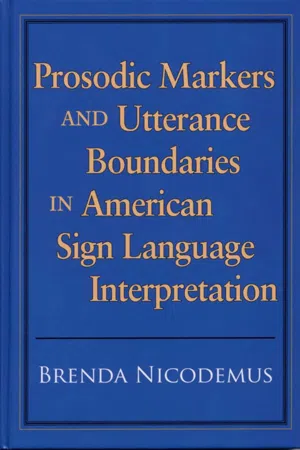
Prosodic Markers and Utterance Boundaries in American Sign Language Interpretation
- 179 pages
- English
- PDF
- Available on iOS & Android
eBook - PDF
Prosodic Markers and Utterance Boundaries in American Sign Language Interpretation
About this book
Information
Publisher
Gallaudet University PressYear
2009Print ISBN
9781563685712
9781563684128
eBook ISBN
9781563684593
Table of contents
- Cover
- Contents
- List of Figures
- List of Tables
- Acknowledgments
- Author’s Note
- 1. Where the Edges Meet
- 2. What Is Prosody?
- 3. Beyond the Signs: Examining Prosody in ASL Interpretation
- 4. A Closer Look: Randomization and Case Studies
- 5. Frequency, Duration, and Number
- 6. Timing and Type
- 7. Bringing It All Together
- References
- Appendix A. Lecture Introduction
- Appendix B. Lecture
- Appendix C. Lecture Summary
- Appendix D. Lecture Outline
- Appendix E. Interpreter Consent Form
- Appendix F. Interpreter Image Consent Form
- Appendix G. Interpreter Information Form
- Appendix H. ASL Transcription of ASL Interpretation
- Appendix I. Project Directions
- Appendix J. Deaf Participant Consent Form
- Appendix K. Participant Background Information Form
- Index
Trusted by 375,005 students
Access to over 1.5 million titles for a fair monthly price.
Study more efficiently using our study tools.
Frequently asked questions
Yes, you can cancel anytime from the Subscription tab in your account settings on the Perlego website. Your subscription will stay active until the end of your current billing period. Learn how to cancel your subscription
No, books cannot be downloaded as external files, such as PDFs, for use outside of Perlego. However, you can download books within the Perlego app for offline reading on mobile or tablet. Learn how to download books offline
Perlego offers two plans: Essential and Complete
- Essential is ideal for learners and professionals who enjoy exploring a wide range of subjects. Access the Essential Library with 800,000+ trusted titles and best-sellers across business, personal growth, and the humanities. Includes unlimited reading time and Standard Read Aloud voice.
- Complete: Perfect for advanced learners and researchers needing full, unrestricted access. Unlock 1.5M+ books across hundreds of subjects, including academic and specialized titles. The Complete Plan also includes advanced features like Premium Read Aloud and Research Assistant.
We are an online textbook subscription service, where you can get access to an entire online library for less than the price of a single book per month. With over 1.5 million books across 990+ topics, we’ve got you covered! Learn about our mission
Look out for the read-aloud symbol on your next book to see if you can listen to it. The read-aloud tool reads text aloud for you, highlighting the text as it is being read. You can pause it, speed it up and slow it down. Learn more about Read Aloud
Yes! You can use the Perlego app on both iOS and Android devices to read anytime, anywhere — even offline. Perfect for commutes or when you’re on the go.
Please note we cannot support devices running on iOS 13 and Android 7 or earlier. Learn more about using the app
Please note we cannot support devices running on iOS 13 and Android 7 or earlier. Learn more about using the app
Yes, you can access Prosodic Markers and Utterance Boundaries in American Sign Language Interpretation by Brenda Nicodemus in PDF and/or ePUB format, as well as other popular books in Languages & Linguistics & Linguistics. We have over 1.5 million books available in our catalogue for you to explore.