Thomas P. Horejes's new book focuses on revealing critical knowledge that addresses certain social justice issues, including deafness, language, culture, and deaf education. He conveys this information through discourses about his own experiences being deaf and through his research in which he "stresses the contingency of the social" in educational institutions.
In Social Constructions of Deafness: Examining Deaf Languacultures in Education, Horejes contends that schools as social institutions play powerful and exacting roles in the creation and maintenance of social constructions such as language and culture for deaf children. He subscribes to Michael Agar's concept of "languaculture," defined as the inextricable relationship between language and culture in which a specific language will shape and influence culture. His approach employs other anthropological terminology as he connects his personal experience as a deaf student (emic) to academic research on deafness (etic) to bring understanding to the multidimensional aspects of his own negotiated identities.
Horejes extends his inquiry through his analysis of two kindergarten classes for deaf students, one orally oriented and the other conducted using sing language. His findings are sobering evidence of the myriad challenges educators face in defining appropriate academic, linguistic, and cultural pedagogy for deaf children in schools and other social institutions.
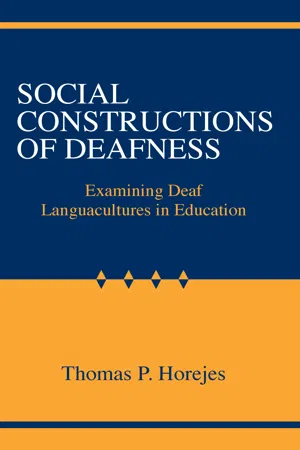
eBook - PDF
Social Constructions of Deafness
Examining Deaf Languacultures in Education
- 310 pages
- English
- PDF
- Available on iOS & Android
eBook - PDF
About this book
Information
Table of contents
- Contents
- Preface
- Introduction
- 1. My Journey
- 2. Social Constructions
- 3. Archaeology of Deaf Education and Languaculture
- 4. A “Tale” of Two Classrooms
- 5. Constructions of Deaf Languacultures
- 6. Coming Full Circle
- Afterword
- Appendix A: Methodological Orientations
- References
- Index
Trusted by 375,005 students
Access to over 1.5 million titles for a fair monthly price.
Study more efficiently using our study tools.
Frequently asked questions
Yes, you can cancel anytime from the Subscription tab in your account settings on the Perlego website. Your subscription will stay active until the end of your current billing period. Learn how to cancel your subscription
No, books cannot be downloaded as external files, such as PDFs, for use outside of Perlego. However, you can download books within the Perlego app for offline reading on mobile or tablet. Learn how to download books offline
Perlego offers two plans: Essential and Complete
- Essential is ideal for learners and professionals who enjoy exploring a wide range of subjects. Access the Essential Library with 800,000+ trusted titles and best-sellers across business, personal growth, and the humanities. Includes unlimited reading time and Standard Read Aloud voice.
- Complete: Perfect for advanced learners and researchers needing full, unrestricted access. Unlock 1.5M+ books across hundreds of subjects, including academic and specialized titles. The Complete Plan also includes advanced features like Premium Read Aloud and Research Assistant.
We are an online textbook subscription service, where you can get access to an entire online library for less than the price of a single book per month. With over 1.5 million books across 990+ topics, we’ve got you covered! Learn about our mission
Look out for the read-aloud symbol on your next book to see if you can listen to it. The read-aloud tool reads text aloud for you, highlighting the text as it is being read. You can pause it, speed it up and slow it down. Learn more about Read Aloud
Yes! You can use the Perlego app on both iOS and Android devices to read anytime, anywhere — even offline. Perfect for commutes or when you’re on the go.
Please note we cannot support devices running on iOS 13 and Android 7 or earlier. Learn more about using the app
Please note we cannot support devices running on iOS 13 and Android 7 or earlier. Learn more about using the app
Yes, you can access Social Constructions of Deafness by Thomas P. Horejes in PDF and/or ePUB format, as well as other popular books in Social Sciences & Educational Policy. We have over 1.5 million books available in our catalogue for you to explore.