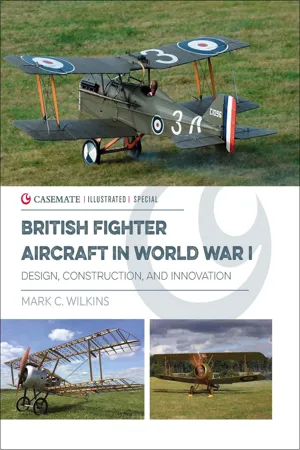
A vivid pictorial history: "Buy this book right now. It is rare that ISD gives an instant five-star rating to any new volume, but [this] is a rare book." — Indy Squadron Dispatch World War I witnessed unprecedented growth and innovation in aircraft design, construction, and—as the war progressed—mass production. Each country generated its own innovations, sometimes in surprising ways—Albatros Fokker, Pfalz, and Junkers in Germany and Nieuport, Spad, Sopwith, and Bristol in France and Britain. This book focuses on the British approach to fighter design, construction, and mass production. Initially the French led the way in Allied fighter development with their Bleriot trainers, then nimble Nieuport Scouts—culminating with the powerful, fast gun platforms as exemplified by the Spads. The Spads had a major drawback however, in that they were difficult and counterintuitive to fix in the field. The British developed fighters in a very different way; Tommy Sopwith had a distinctive approach to fighter design that relied on lightly loaded wings and simple functional box-girder fuselages. His Camel was revolutionary as it combined all the weight well forward, enabling the Camel to turn very quickly—but also making it an unforgiving fighter for the inexperienced. The Royal Aircraft Factory's SE5a represented another leap forward with its comfortable cockpit, modern instrumentation, and inline engine—clearly influenced by both Spads and German aircraft. Each manufacturer and design team vied for the upper hand and deftly and quickly appropriated good ideas from other companies—be they friend or foe. Developments in tactics and deployment also influenced design—from the early reconnaissance planes, to turn fighters, and finally planes that relied upon formation tactics, speed, and firepower. This book tells their story through extensive photos and accompanying text. "Handy not only as an aircraft model reference, but also as great reading for all history fans." — DetailScaleView "Sidebars add important information at the proper place." — Air Power History
eBook - ePub
British Fighter Aircraft in World War I
Design, Construction and Innovation
- 192 pages
- English
- ePUB (mobile friendly)
- Available on iOS & Android
eBook - ePub
About this book
Information

Appendix 1
°e 1915 Defence of the Realm
Act
Be it enacted by the King’s most Excellent Majesty, by and with the advice and consent of
the Lords Spiritual and Temporal, and Commons, in this present Parliament assembled,
and by the authority of the same, as follows:
His Majesty in Council has power during the continuance of the present war to issue regulations for securing
the public safety and defence of the realm, and as to the powers and duties for that purpose of the Admiralty
and Army Council and of the members of His Majesty’s forces and other persons acting on his behalf; and may
by such regulations authorise the trial by courts-martial, or in the case of minor offences by courts of summary
jurisdiction, and punishment of persons committing offences against the regulations and in particular against
any of the provisions of such regulations designed …
It shall be lawful for the Admiralty or Army Council—
(a) to require that there shall be placed at their disposal the whole or any part of the output of any factory
or workshop in which arms, ammunition, or warlike stores or equipment, or any articles required for
the production thereof, are manufactured;
(b) to take possession of and use for the purpose of His Majesty’s naval or military service any such factory
or workshop or any plant thereof; and regulations und this Act may be made accordingly.
Defence of the Realm Act Catalogue reference: MUN 5/19/221/8, 5 Geo. 5. Defence of the Realm Consolidation
Act, 1914, Ch.8. An Act to consolidate and amend the Defence of the Realm Acts. 27th November 1914. http://
www.nationalarchives.gov.uk/pathways/firstworldwar/transcripts/first_world_war/defence_oſthe-realm.htm
174
British Fighter Aircraft in World War I
Appendix 2
Aircraſt Designer Patents
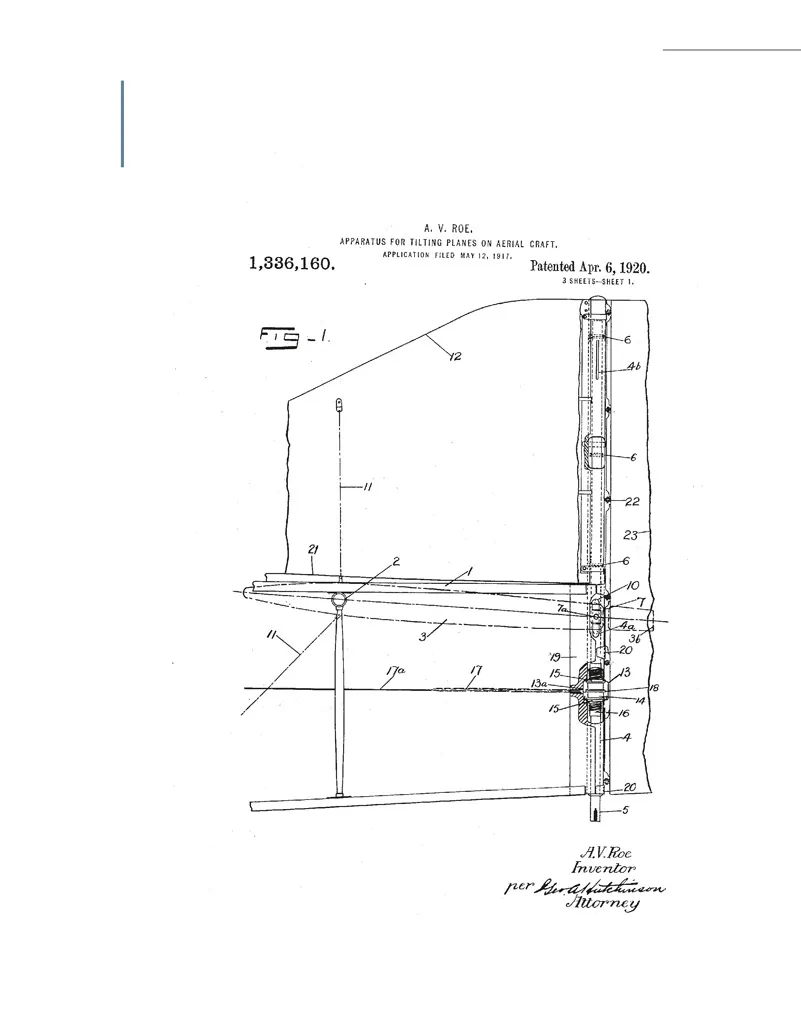
A. V. Roe Patents
This mechanism enabled the horizontal stabilizer and elevators
to vary the angle of incidence (up or down) to trim the aircraft in
flight, thus eliminating the need for the stick to compensate for
excessive climbing or diving of the aircraft.
175
Appendices
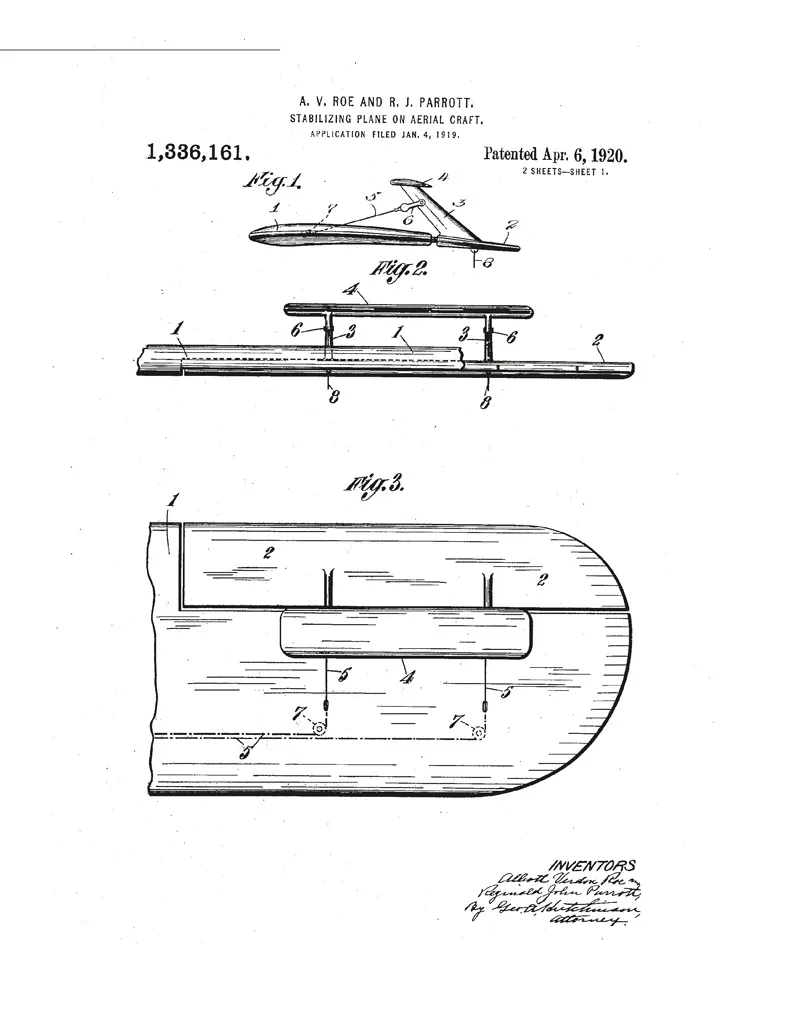
This patent was for what amounted to a balancing
mechanism for control surfaces, which made them easier
to handle from the cockpit (the pilot didn’t have to use as
much muscle to move various control surface).
176
British Fighter Aircraft in World War I
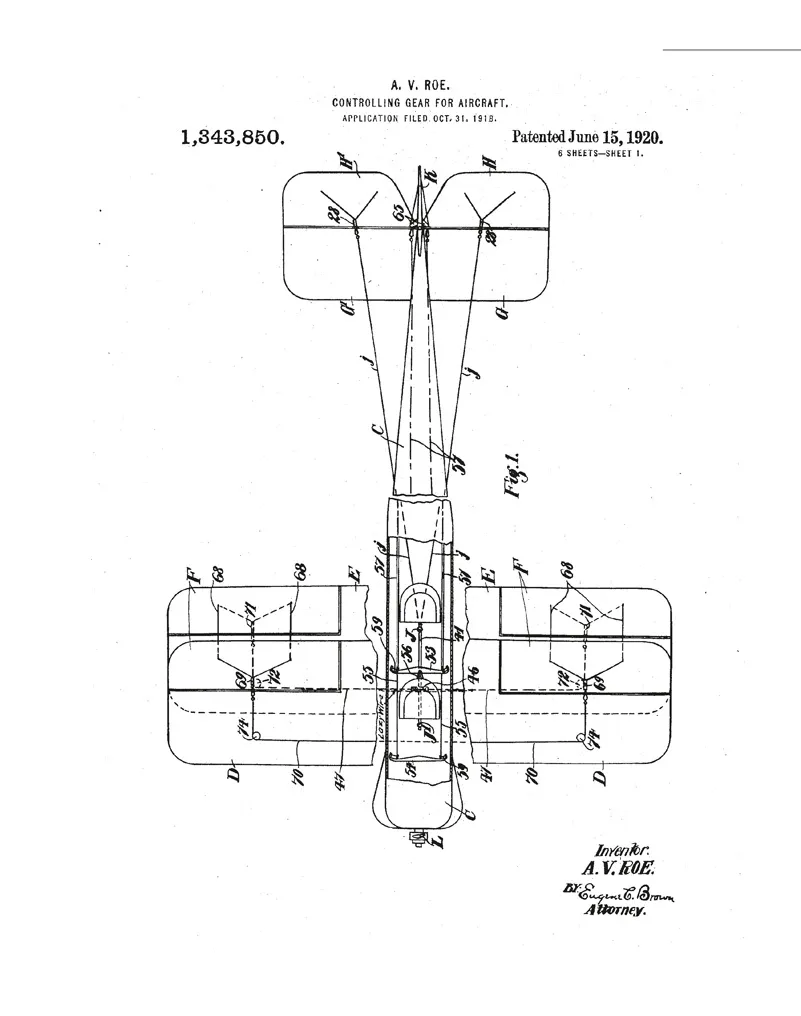
This patent refers to a mechanism for dual control of a given aircraft,
such that tandem cockpits as each are equipped with a full set of
controls. This was important for trai...
Table of contents
- Cover
- Title
- Acknowledgements
- Copyright
- Contents
- Introduction
- The British Aircraft Industry
- The British and Colonial Aeroplane Company (B&CAC)/Bristol
- The Royal Aircraft Factory
- Aircraft Manufacturing Company (Airco)
- A. V. Roe & Company (Avro)
- Sopwith Aviation Company
- Engines and Props
- Conclusion
- Appendix 1: The 1915 Defence of the Realm Act
- Appendix 2: Aircraft Designer Patents
- Notes
- Bibliography
Trusted by 375,005 students
Access to over 1.5 million titles for a fair monthly price.
Study more efficiently using our study tools.
Frequently asked questions
Yes, you can cancel anytime from the Subscription tab in your account settings on the Perlego website. Your subscription will stay active until the end of your current billing period. Learn how to cancel your subscription
No, books cannot be downloaded as external files, such as PDFs, for use outside of Perlego. However, you can download books within the Perlego app for offline reading on mobile or tablet. Learn how to download books offline
Perlego offers two plans: Essential and Complete
- Essential is ideal for learners and professionals who enjoy exploring a wide range of subjects. Access the Essential Library with 800,000+ trusted titles and best-sellers across business, personal growth, and the humanities. Includes unlimited reading time and Standard Read Aloud voice.
- Complete: Perfect for advanced learners and researchers needing full, unrestricted access. Unlock 1.5M+ books across hundreds of subjects, including academic and specialized titles. The Complete Plan also includes advanced features like Premium Read Aloud and Research Assistant.
We are an online textbook subscription service, where you can get access to an entire online library for less than the price of a single book per month. With over 1.5 million books across 990+ topics, we’ve got you covered! Learn about our mission
Look out for the read-aloud symbol on your next book to see if you can listen to it. The read-aloud tool reads text aloud for you, highlighting the text as it is being read. You can pause it, speed it up and slow it down. Learn more about Read Aloud
Yes! You can use the Perlego app on both iOS and Android devices to read anytime, anywhere — even offline. Perfect for commutes or when you’re on the go.
Please note we cannot support devices running on iOS 13 and Android 7 or earlier. Learn more about using the app
Please note we cannot support devices running on iOS 13 and Android 7 or earlier. Learn more about using the app
Yes, you can access British Fighter Aircraft in World War I by Mark C. Wilkins in PDF and/or ePUB format, as well as other popular books in History & 20th Century History. We have over 1.5 million books available in our catalogue for you to explore.