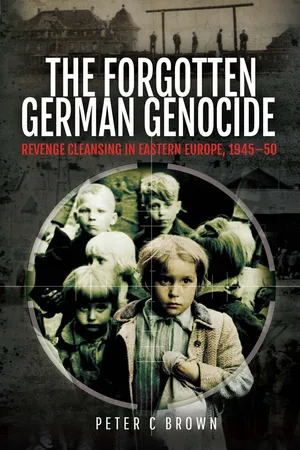
The Potsdam Conference (officially known as the "Berlin Conference"), was held from 17 July to 2 August 1945 at Cecilienhof Palace, the home of Crown Prince Wilhelm, in Brandenburg, and saw the leaders of the United Kingdom, the Soviet Union and the United States, gathered together to decide how to demilitarize, denazify, decentralize, and administer Germany, which had agreed to unconditional surrender on 8 May (VE Day). They determined that the remaining German populations in Poland, Czechoslovakia and Hungary - both the ethnic (Sudeten) and the more recent arrivals (as part of the long-term plan for the domination of Eastern Europe) - should to be transferred to Germany, but despite an undertaking that these would be effected in an orderly and humane manner, the expulsions were carried out in a ruthless and often brutal manner. Land was seized with farms and houses expropriated; the occupants placed into camps prior to mass expulsion from the country. Many of these were labor camps already occupied by Jews who had survived the concentration camps, where they were equally unwelcome. Further cleansing was carried out in Romania and Yugoslavia, and by 1950, an estimated 11.5 million German people had been removed from Eastern Europe with up to three million dead. The number of ethnic Germans killed during the ‘cleansing’ period is suggested at 500, 000, but in 1958, Statistisches Bundesamt (the Federal Statistical Office of Germany) published a report which gave the figure of 1.6 million relating to expulsion-related population losses in Poland alone. Further investigation may in due course provide a more accurate figure to avoid the accusation of sensationalism.
- 208 pages
- English
- ePUB (mobile friendly)
- Available on iOS & Android
eBook - ePub
About this book
Information
Chapter One
Hitler’s Final Solution
As their impending defeat became increasingly clear in 1944 and into 1945, the Nazi regime began a desperate undertaking to destroy all documentary evidence of their various crimes against humanity, including internal reports, personal correspondence, and various propaganda materials.
The earliest piece of verbal evidence from Hitler pointing to his personal premeditation of the Final Solution is a statement he made to journalist Josef Hell during an interview in 1922:
Once I really am in power, my first and foremost task will be the annihilation of the Jews. As soon as I have the power to do so, I will have gallows built in rows … Then the Jews will be hanged indiscriminately … until all of Germany has been completely cleansed of Jews.1
This shows that Hitler had begun premeditating, at least in its most basic form, a campaign of genocide against the Jews prior to him taking power. However, in another statement made to the Czech foreign minister František Chvalkovský during a meeting on 21 January, 1939, he said, ‘We are going to destroy the Jews … The day of reckoning has come.’2 Yet despite the abundance of transcripts of Hitler’s public statements and speeches regarding the ‘Jewish Question’, no definitive written orders are known to exist.
His direct responsibility for planning and implementing the Holocaust can be firmly established by diary entries by high-ranking Nazi bureaucrats which point to his personal ordering of it. An example of this can be seen in a diary entry by Minister of Propaganda Joseph Goebbels dated 12 December 1941:
With respect of the Jewish Question, the Führer has decided to make a clean sweep. He prophesied to the Jews that if they again brought about a world war, they would live to see their annihilation in it. That wasn’t just a catch-word. The world war is here and the annihilation of the Jews must be the necessary consequence.3
Goebbels had made further reference in his diary to Hitler’s ordering of the Final Solution a year later, on 14 February 1942: ‘The Führer once again expressed his determination to clean up the Jews in Europe pitilessly … Their destruction will go hand in hand with the destruction of our enemies … The Führer expressed this idea vigorously and repeated it afterwards to a group of officers.’4 Another private Nazi record that points to Hitler’s having ordered the Final Solution is a handwritten note by Reichsführer-SS Heinrich Himmler from a meeting with Hitler at the Wolfsschanze on 18 December 1941, which simply read: ‘Jewish Question/to be exterminated like the partisans.’
The Euthanasia Programme
Following a petition by the parents of a severely disabled infant to have him put to sleep, Hitler sent one of his personal physicians, Karl Brandt, to go to the village of Pomssen, in the south-east of Leipzig, to investigate the case. Following his own examination of the child, Brandt consulted with paediatrician Dr Werner Catel and Dr Helmut Kohl, and they concluded that the child was beyond help. Brandt had been given the authority by Hitler to have the child killed, and if any legal action were to be taken, it would be thrown out of court, and subsequently, the mercy killing (Gnadentod) of five-month-old Gerhard Herbert Kretschmar who, until 2007, had been known only as ‘Child K’, took place on 25 July 1939, and marked the beginning of one of the most hideous programmes of the Second World War – the ‘Euthanasia programme’, which ultimately resulted in the deliberate killing of about 200,000 people with mental and/or physical disabilities.
Three weeks after Gerhard Kretschmar’s death, the Nazis set up the Reich Committee for the Scientific Registering of Hereditary and Congenital Illnesses. The committee registered the births of all babies born with defects identified by physicians. While Hitler moved against Jews, Sinti, and Roma, he also included those whom he personally viewed as ‘marginal humans’; the Aryans whom he considered unworthy of life – people with birth defects, senility, epilepsy, hearing loss, mental illnesses, personality disorders, Down’s Syndrome, chronic alcoholism, as well as those who had vision loss, or delays in their development, or who suffered from certain orthopaedic problems.
Experiments with poisonous gas aimed at killing handicapped people, whose life had been deemed unworthy by the regime, were carried out during the so-called ‘T4 Action’ in National-Socialist Germany from October 1939, and proved satisfactory. It killed quickly, and was easier and cheaper than firing squads that required many soldiers and bullets. It was also much less traumatising for the executioners because they didn’t have to see the faces of the victims – which is exactly what happened to the Einsatzgruppen units of the SS and the German Police on the Eastern Front as they had to follow the front, and secure territories at the rear of the Wehrmacht and Waffen-SS, by executing communists and male Jews (and later, in the course of the summer of 1941 all Jews, including women, elderly people and children).
Hitler, who maintained a fixed policy of not issuing written instructions relating to anything that could later be classified as crimes against humanity, made an exception in the case of the ‘T4 Euthanasia Programme’, to overcome opposition to it within the German state bureaucracy. He signed the involuntary euthanasia order, antedated to 1 September 1939, which authorised his physician Karl Brandt and the National Leader Philipp Bouhler, to implement the programme to execute the mentally and physically disabled on the basis that it would help German people get rid of existences that would be a burden in the international struggle for life.
The Reich’s Interior Ministry and the regional and authorities of the Länder (states) responsible for the asylums sent out the first registration forms to all mental hospitals and psychiatric clinics in Germany. The one-page forms were designed to select those inmates that were to be killed. The completed forms were registered in the office of the KdF in Tiergartenstraße 4 in Berlin (from which ‘T4’ was derived), copied and sent to three medical experts, who decided upon the death or life of the patients based solely on the information provided by the registration form. A red cross meant murder, a blue dash meant survival. The final decision was made by the senior referees, among them Herbert Linden of the Reich’s Interior Ministry, and Werner Heyde, Head of the T4 medical department. Patients were generally rendered somnolent by being given morphine and scopolamine injections, or narcotic tablets, to create a ‘Twilight Sleep’ before being taken, in groups of ten, to the gas chamber. Families were advised of the patient’s death by form letters which stated that the patient had succumbed to ‘heart failure’ or ‘pneumonia’. The central T4 clearing office received care allowances for the period of time that elapsed between the killing and the attestation of death – usually two weeks – and by the time the programme was terminated on 24 August 1941, it had generated several million Reichsmarks in revenue.
However, the programme had already been initiated, and was being covertly used in the Nazi concentration camps, and would further be applied in occupied Poland, where the murder of the handicapped was a precursor to the Holocaust. Heinrich Himmler, who had witnessed one of the gassings liked what he saw, and gassing would later become the extermination method of choice during the Final Solution. The killing centres to which the handicapped were transported were the antecedents of the Nazi death camps, and many of the physicians who became specialists in the technology of cold-blooded murder in the late 1930s, later staffed those camps, having long since lost all their moral, professional, and ethical inhibitions.
Carbon monoxide exhausted by truck engines was the first method used to kill the victims, who would be placed in a sealed hermetic truck and the exhaust gas would kill them. The problem was the high pressure (that led at least one truck to explode) and the time needed to asphyxiate the prisoners. In Auschwitz Rudolph Hess, an aide of the camp commander, had the idea of using the pesticide Zyklon B. Impregnated in small crystal substrates, the hydrogen cyanide (prussic acid) was vaporised when it came in contact with air. Poured into the gas chambers, Zyklon B would kill in six to twenty-five minutes, depending on the season, because it needed an ideal temperature of 27°C. In other camps, like Belzec or Treblinka, the carbon monoxide remained in use: the engine of an army tank provided the poison.
Bottled Gas
From November 1939, mentally ill people were systematically killed with carbon monoxide gas in Fort VII in Poznan. Under the command of Lange, the inmates of the asylums near Poznan were driven to the camp, locked in casemates and suffocated with carbon monoxide from pressurized steel bottles. The corpses were buried in mass graves in a forest near Oborniki, 30km (18.6 miles) north of Poznan. The handling of the corpses was done by Polish prisoners of Fort VII assigned to SS-Sturmbannführer Herbert Lange. The method of carbon monoxide bottle gassings was subsequently implemented at the Euthanasia killing site Brandenburg in the Reich. In January 1940, Lange moved on from the stationary gas chambers in Fort VII to a motorised mobile homicidal gas chamber.
Gas Vans
Alois Brunner, the right-hand-man to Adolf Eichmann, the supreme logistician of the Holocaust who plotted the transports across Europe to the extermination camps in occupied Poland, was responsible for the creation of gas vans, which initially operated outside ghettos and concentration camps in Eastern Europe. Nazi SS Colonel Walter Rauff was instrumental in the modification of scores of trucks into mobile ‘gas chambers’. Under his command, Division II D3a of the Reich Security Main Office ordered six 3,175kg (3.5 t) four-wheel drive Opel Blitz trucks to be adapted, along with the first five of thirty of the larger 6,350kg (7 t) Saurerwagens ordered for the end of 1941. The box structures with tight-closing double doors at the rear were purchased from Gaubschat delivered / Berlin-Neukölln. The conversion to the gas wagon was carried out in the workshop of Unit II D 3 a. A witness, Harry Wentritt, described it in 1961 before the Court in Hannover, as follows:
There was an exhaust gas hose attached, which was conducted from the outside to the floor of the car. In this car, we drilled a hole in the diameter of about fifty-eight to sixty millimetres, in the thickness of the exhaust pipe. A metal pipe (exhaust pipe) was welded to the inside of the car, above this hole, which could be connected to the exhaust hose connected to the outside. At the start of the engine and after connections, the exhaust gases of the engine went through the exhaust into the exhaust hose and from there to the exhaust pipe, which was installed inside the vehicle, where the gas then spread.
The box structure was clad in the inside with sheet metal. An initially attached small viewing window was omitted in later versions. Rauff delegated the task of keeping the gas vans, which carry between twentyfive and sixty people at a time, which operated in the Soviet Union and other Nazi-occupied areas to the SS chemist, August Becker, who kept Rauff fully informed on the gas van killing operations.
On the pretext that they needed to shower to become clean, and that their clothes had to be disinfected, up to fifty people with mental and physical disabilities, and later Jews and other prisoners, were escorted to the undressing room, where they gave up their valuables and clothes. Having then been led up steps to the ‘washrooms’, they found themselves in a sealed compartment. The doors were closed and locked, and the van was driven away towards pre-cleared spaces in nearby woods or forest. During the short journey, the carbon-monoxide exhaust fumes were piped directly into the compartment, asphyxiating the passengers. The dead were subsequently buried in mass graves. In September 1944, the Nazis destroyed the camp and tried to erase the evidence of the mass murders by digging up and cremating all of the bodies from the mass graves. Around 7,000 Jews, Roma, communists, Jehovah’s Witnesses and the disabled died in gas vans.
Observation Stations
Between October 1939 and August 1941, more than 70,000 German handicapped people were killed by gas, after a selection made by SS physicians. Regional governors were eager to clear out their institutions to make way for wounded soldiers, and having seen what was going on in Poland, they jumped at the chance to implement similar programmes on the home front, and what had begun as a regional solution to ‘hospital overcrowding’ soon spread across Germany. The administrators established gas chambers at six killing centres, referred to as ‘Observation Centres’, in Germany and Austria: Hartheim, Sonnenstein, Grafeneck, Bernburg, Hadamar, and Brandenburg.
Herbert Lange was transferred directly from duties in the T4 euthanasia programme, murdering psychiatric patients in Posen, to Chelmno, which had been selected as the site of the first experiments by gas chambers for the mass killings of Jews as part of the ‘Final Solution’. In November 1941, they took over the grounds of an empty manor house called ‘The Castle’ in Chelmno, and converted it into a base camp with barracks and a reception area for deportees. For security reasons, the main gate to the site was constructed as a sluice: when the guards opened one gate, the other one was closed. Several other buildings of the former estate were located within a 2.5–3 m (8 ft) high wooden fence and densely planted trees.
Each afternoon, Jews were brought under guard by train from Łódź via Kolo junction (where they transferred to open rail cars running on a narrow-gauge track), or from nearer locations by lorry, to the castle or Schloss. Upon arrival, they were told that some of them would go to work to Austria or further eastward, others would work at his estate; they would be fairly treated and receive good food. They were told that for sanitary reasons they had to take a shower first. They were then gathered in the castle courtyard, subdivided into groups of fifty, and told to undress. They were forced to hand over all valuables. They were then told they were about to be transferred to a work camp, but first they had be disinfected and showered. They were taken down into the castle cellar to a ‘washroom’ which led via a ramp into a waiting van. Vicious beatings ensured that none hesitated or declined to go inside. After fifty to seventy persons were jammed into the van’s freight compartment, the exhaust pipe was connected to an opening in the compartment and the engine switched on. After about ten minutes those inside were dead. The driver, usually a member of the ‘Schutzpolizei’, then drove the van 4km (2.5 miles) to a camp in the nearby Rzuchowski Forest. Here, the SS had prepared long deep trenches, dug out by Jewish slave labour (after spring 1942, the bodies were cremated on site). Ten minutes were allowed for the exhaust fumes to evaporate, and then a team of forty to fifty Jews, wearing leg-irons to prevent their escape, hauled the corpses out of the van and dumped them in the graves. The bodies were searched for jewellery and gold teeth, which were extracted, and then another team of Jews sorted the clothes and objects of those killed so that they could be made available to Germans in the Reich. No less than 370 wagon loads of clothing were supplied by these means.
The Gas chambers at Auschwitz were hidden in the basement of the crematoria, and so were not visible from the outside. Victims selected on the arrival ramp of the camp train terminus were led straight to the chambers. Numerous bath and shower signs written in different languages were aimed to assure the victims, as were many shower heads in the chambers. In other extermination camps, there were no false shower heads. The chambers were the heart of the nationalsocialist death industry, and their location under the crematoria ensured maximum efficiency and rapidity. Not limited to extermination camps, gas chambers were installed in some concentration camps. Mauthausen, Sachsenhausen, Ravensbrück, Stutthof, Neuengamme, Natzweiler, and Dachau, were equipped with gas chambers and crematoria, although the camps were not designed for mass killings.
As the Third Reich embarked upon its plan of conquest and genocide, a way of identifying and cataloguing Jews had to be found straight away, so they were targeted for efficient asset confiscation, ghettoization, deportation, enslaved labour, and, ultimately, annihilation. It was a cross-tabulation and organisational challenge so monumental, it called for a specialised system. International Business Machine (IBM) founder Thomas Watson cooperated with the Nazis, despite international calls for an economic boycott, and leased IBM’s Herman Hollerith punchcard technology for very high fees, to automate Hitler’s persecution of the Jews. The data generated employing counting and alphabetisation equipment supplied by IBM through its German subsidiary Dehomag, and other national subsidiaries, was instrumental in the efforts of the German government to concentrate and ultimately destroy ethnic Jewish populations across Europe.
It was first used in Germany, and then rolled out across Nazi Europe, recording the identification of the Jews in the 1933 censuses, registrations, and ancestral tracing programmes, to the running of railroads, and the organisation of concentration camp slave labour. IBM and Dehomag custom-designed complex solutions, one by one, as required by the needs of Reich, with continuous upkeep and service. The machines became the sole source of the billions of punch cards Hitler needed. IBM and its subsidiaries helped create enabling technologies, step-by-step, from the identification and cataloguing programmes of the 1930s to the selections of the 19...
Table of contents
- Cover
- Title
- Copyright
- Contents
- Introduction
- Chapter One Hitler’s Final Solution
- Chapter Two The Nazi Camps
- Chapter Three The Death Marches
- Chapter Four Czechoslovakia
- Chapter Five Hungary
- Chapter Six Poland
- Chapter Seven The Removal of Germans from Eastern Europe
- Chapter Eight Germany
- Notes
- Glossary
- Bibliography
- Endnotes
- Plates
Trusted by 375,005 students
Access to over 1.5 million titles for a fair monthly price.
Study more efficiently using our study tools.
Frequently asked questions
Yes, you can cancel anytime from the Subscription tab in your account settings on the Perlego website. Your subscription will stay active until the end of your current billing period. Learn how to cancel your subscription
No, books cannot be downloaded as external files, such as PDFs, for use outside of Perlego. However, you can download books within the Perlego app for offline reading on mobile or tablet. Learn how to download books offline
Perlego offers two plans: Essential and Complete
- Essential is ideal for learners and professionals who enjoy exploring a wide range of subjects. Access the Essential Library with 800,000+ trusted titles and best-sellers across business, personal growth, and the humanities. Includes unlimited reading time and Standard Read Aloud voice.
- Complete: Perfect for advanced learners and researchers needing full, unrestricted access. Unlock 1.5M+ books across hundreds of subjects, including academic and specialized titles. The Complete Plan also includes advanced features like Premium Read Aloud and Research Assistant.
We are an online textbook subscription service, where you can get access to an entire online library for less than the price of a single book per month. With over 1.5 million books across 990+ topics, we’ve got you covered! Learn about our mission
Look out for the read-aloud symbol on your next book to see if you can listen to it. The read-aloud tool reads text aloud for you, highlighting the text as it is being read. You can pause it, speed it up and slow it down. Learn more about Read Aloud
Yes! You can use the Perlego app on both iOS and Android devices to read anytime, anywhere — even offline. Perfect for commutes or when you’re on the go.
Please note we cannot support devices running on iOS 13 and Android 7 or earlier. Learn more about using the app
Please note we cannot support devices running on iOS 13 and Android 7 or earlier. Learn more about using the app
Yes, you can access The Forgotten German Genocide by Peter C Brown in PDF and/or ePUB format, as well as other popular books in History & Eastern European History. We have over 1.5 million books available in our catalogue for you to explore.