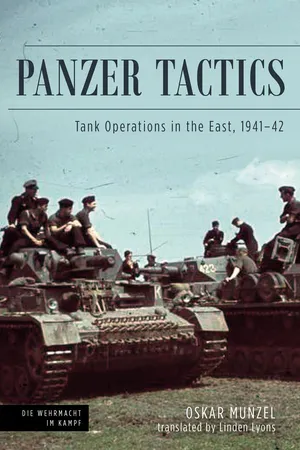
This book discusses a number of operations undertaken by the XXXXVIII Panzer Corps in the direction of the Black Sea in 1941 and 42. It explores the tactics used and why they were successful, based upon the detailed combat reports prepared by the corps staff immediately after each battle. Die Wehrmacht im Kampf Battles and Problems of the Second World War is a series published in Germany in the 1950s and 1960s. Written by ex-members of the German army in WWII, it provides important information not available elsewhere on the German army’s perspective of many crucial campaigns and battles. None of the volumes have previously been available in English. Each volume has a modern introduction by Professor Matthias Strohn, expert on the German army.
- 208 pages
- English
- ePUB (mobile friendly)
- Available on iOS & Android
eBook - ePub
About this book
Information
CHAPTER 1
The XXXXVIII Panzer Corps Prepares for the Campaign in Russia
The situation at the beginning of the campaign in the East
The first major objective of the campaign in the east in 1941 was the annihilation of the enemy forces that stood in western Russia and thereby the prevention of the withdrawal of those forces into the depths of the country. The Pripet Marshes, which lie in the middle of western Russia, considerably influenced the operational plan. German forces, especially motorised units, would be unable to advance through such terrain. They would have to go around it instead.
The operational area was therefore split into two, and the inner wings of the army groups on either side would be separated from one another. This proved to be disadvantageous, as the strong Russian forces that remained behind in the gap eventually had to be dealt with. The bulk of both army groups had to pivot inwards, the result of which was the battle of Kiev.
The point of main effort of the entire campaign in the East lay to the north of the marshes. Two army groups were to be committed there. Their task was to gain ground to the east in the direction of Moscow as quickly as possible.
To the south of the marshes was Army Group South under the command of Field-Marshal Gerd von Rundstedt. With a strong northern wing, this army group would initially push towards and to the south of Kiev and then, advancing into the deep flank and rear of the enemy forces in Galicia and western Ukraine, would roll up the enemy along the Dnieper. The first operational objective would be to take the economically important Donets Basin.
The task to be undertaken by the army group would be a great challenge. The terrain was vast, and the German forces, weakened as they were after the campaign in Greece, were few. The enemy was almost twice as strong. Rapid movement would be difficult. A 400-kilometre stretch of the Carpathians ran along the border, but it had to remain demilitarised on political grounds. The Pripet Marshes on the northern flank presented an element of uncertainty. It was possible that enemy forces would be lying in wait there. These circumstances essentially dictated that the army group place the emphasis of its advance on its northern wing. The formations on that wing were the Sixth Army, the Seventeenth Army, and Panzer Group 1. The last of these was commanded by Colonel-General Ewald von Kleist. With the infantry armies on either side, the task of the panzer group was to break through the Russian front between Rava-Ruska and Kovel, to advance through Berdichev and Zhitomir, and to reach the area near and to the south of Kiev as soon as possible so as to prevent the withdrawal of the enemy over the Dnieper.
The Sixth Army was to follow closely behind the panzer group, elim-inate any Russian forces that remained behind the armoured spearhead, and prevent any threat to the flanks of that spearhead.
Facing the army group and on standby were two strong enemy formations under the command of Marshal Semyon Budyonny. These formations were distributed in depth between Kiev and the headwaters of the Western Bug.
At the beginning of the campaign, Panzer Group 1 consisted of the XXXXVIII Panzer Corps and the III Panzer Corps. It was also allocated the XXIX Army Corps to help with the penetration of the border fortifications. The success of the entire operation in the southern sector of the Eastern Front would depend on whether the panzer formations could swiftly dislodge and destroy the enemy forces near the frontier.
The main thrust would be carried out by the XXXXVIII Panzer Corps. Although it was at that time still known as a motorised army corps, it would be redesignated as a panzer corps as early as August. Its commander was General of Panzer Troops Werner Kempf.
Preparations for the operation
The XXXXVIII Motorised Army Corps was formed in Wiesbaden on 15 December 1940 from the deputy headquarters of the XII Army Corps. The new motorised army corps was fully operational by 15 January 1941. It was transferred to Bad Schandau on 19 and 20 February, making its way there by road via Erfurt. On 15 March, the 14th Motorised Infantry Division (from the vicinity of Leipzig) and the 18th Panzer Division (from the military base in Milowitz) were subordinated to the motorised army corps.
The motorised army corps was ready to march on 6 April. Between 20 and 23 April, it was transported by rail to Kielce via Breslau and Czenstochau. After a short stay in Kielce, it proceeded by road through Oratow, Sandomierz, Nisko, Janow, and Bilgoraj to Zamosc, with the last unit arriving at its destination on the night of 25/26 April. The II Battalion of the 64th Motorised Heavy Artillery Regiment was placed under the command of the motorised army corps on 24 April, and the same was done with the 520th Motorised Pioneer Regiment on 29 April.
Coming under the command of the Sixth Army, the motorised army corps was assigned the codename ‘48th Fortress Construction
Headquarters’.
The motorised army corps was to advance through Sokal, but the roads in its vicinity were in poor condition. The headquarters of the Sixth Army therefore created a special Construction Headquarters Puttkammer so that a useable and partly cemented road could be built for the motorised army corps.
On 10 June, the motorised army corps was allocated the 57th and 75th Infantry Divisions.
The commander in chief of the German Army, Field-Marshal Walther von Brauchitsch, visited Zamosc on 11 June. He met with the commander of the Sixth Army and the commander of Panzer Group 1 and then drove to the German position near Sokal, where General Kempf showed him the terrain into which the motorised army corps would advance.
Early on 16 June, the commander of the motorised army corps held a conference at which the upcoming operation was discussed. In attendance were the divisional, regimental, and even battalion commanders from the 57th Infantry Division, the 75th Infantry Division, and the 11th Panzer Division. At noon, Field-Marshal von Rundstedt arrived at the headquarters of the motorised army corps near Sokal so that General Kempf could present to him his plans for the operation.
Another conference took place on 18 June. This one was held by the commander of Panzer Group 1 with the commanders of the III, XIV, and XXXXVIII Panzer Corps, as well as with the commanders of the panzer divisions.
It was very busy at the command post of the XXXXVIII Panzer Corps, which was shifted to Usmierz (north of Waręz) on 19 June. Many commanders came and went in order to partake in last-minute discussions.
On 21 June, the XXXXVIII Panzer Corps was placed under the command of Panzer Group 1. And at 1645 hours, the panzer corps received the following message from the first general staff officer of the panzer group: ‘Heroic Saga, Odin, Neckar 15.’ With that, the commencement of the campaign against Bolshevism had been ordered for 22 June at 0315 hours. The panzer corps correspondingly issued its own orders to
the units under its command.
Despite the difficulties presented by the bad roads and the concentration of large numbers of troops in the narrow assembly zone, the preparations of the panzer corps were thorough and proceeded according to plan. The last elements of the artillery and heavy weapons were brought into position on the night of 21/22 June. The infantry units made themselves ready without making a noise.
Sokal was not blacked out. The Russian troops could be seen quite easily in their bunkers. They seemed to have no idea what was about to occur.
The XXXXVIII Panzer Corps was fully prepared for the attack by 0200 hours. The fight against the Red Army was soon to commence.
CHAPTER 2
The XXXXVIII Panzer Corps Thrusts to the Stalin Line
The first day of battle – crossing the Western Bug (22 June 1941)
The starlit night sky gradually faded at dawn. In the east, on the other side of the Western Bug, the first reddish rays of light appeared on the horizon.
The infantry advanced at 0315 hours with the support of the tremendous firepower of the artillery, smoke-shell mortars, rocket launchers, and anti-aircraft guns. The enemy was completely taken by surprise. He barely put up any resistance to begin with. The important bridge in Sokal fell into our hands intact. The crossing of the Western Bug ran smoothly. The infantry ascended the heights to the east of the river and reached the bunker positions, which were still under construction, without encountering any noteworthy resistance. It seemed that the enemy forces in those bunkers had also been caught unawares. Russian artillery, in a state of complete disorder and confusion, opened fire here and there. Our aerial reconnaissance reported that several columns of enemy troops were in retreat.
At 0500 hours, the 57th Infantry Division broke through the line of fortifications and seized the Sokal Hills. The 75th Infantry Division also penetrated the line and took Hill 222. Many of the bunkers were fiercely defended, so the fighting was tough. By 1000 hours, the infantry divisions had made further good progress. The leading elements of the 57th Infantry Division were in action on Hill 234, to the north of Perespa. The bulk of this division had marched through the woods south of Horbkov and was at that moment to the south of Tartakov. The 75th Infantry Division had reached Kopytov and was advancing on Tartakov. While the enemy fell back to the east, the military bridges of the 57th and 75th Infantry Divisions were completed.
The bridge over the Western Bug in Krystynopol remained undamaged and was captured by the XXXXIV Army Corps.
The commander of the XXXXVIII Panzer Corps decided that the time was right to exploit our initial success by committing the 11th Panzer Division to a deep thrust. At noon, having obtained the approval of the panzer group, he ordered the panzer division to drive towards and seize the bridges over the Styr in Szczurowjce and Beresteczko.
The infantry divisions reached their first objective, the Perespa– Tartakov–Kopytov line, at 1500 hours, and the panzer division commenced its advance through Sokal with its reconnaissance battalion leading the way. Part of the road of advance of the panzer division lay within firing range of enemy forces that still occupied the bunker line near Rawszczynia. The fortifications were very modern. It was difficult to shoot directly at their deep firing ports, and the three-storey construction allowed the garrison to go deeper under the ground during a bombardment and to ascend and open fire again afterwards.
By the evening, the infantry, whose efforts that warm day had been nothing short of extraordinary, stood before a determined enemy along the Perespa–Tartakov–Bobiatyn–Royatyn line. The reconnaissance battalion of the 57th Infantry Division pushed as far as Torki, while the 11th Panzer Division reached the area to the west of Stoyanov, which was held by motorised enemy forces, at 2300 hours.
The first day of the offensive had been a great success. The strong and fully developed Russian defensive line along the Western Bug had been overcome. The panzer corps had advanced more than 20 kilometres into enemy territory.
The first tank battle near Radekhov (23 June 1941)
It was generally quiet overnight. The infantry divisions resumed their eastward advance at 0330 hours. Corps pioneer troops were at that time committed to the mopping up of the enemy forces that remained in the frontier fortifications. This task proved to be unexpectedly difficult.
After a short fight, the 11th Panzer Division took Stoyanov in the early hours of the morning. The first Russian tanks were encountered and destroyed. At 0530 hours, the spearhead of the panzer division clashed with strong motorised Russian forces, including tanks, to the north of Radekhov. Our aerial reconnaissance had reported earlier that these forces had been on their way from the area near and to the south-east of Kholoyov.
The situation that developed in the combat zone of the XXXXVIII Panzer Corps was what became the first tank battle of the campaign in the East. The 15th Panzer Regiment moved into position and then commenced an envelopment manoeuvre on the western side of Radekhov.1 The enemy defended tenaciously and counter-attacked ruthlessly and repeatedly. But he suffered heavy casualties and was thrown back to the south towards noon. More than 30 destroyed tanks stood on the battlefield. Our own losses were by no means insignificant, but the victorious outcome of this first tank battle inspired the confidence of the troops.
The 110th Rifle Regiment of the 11th Panzer Division overcame resistance in Khmilno and then reached Lopatyn towards 1700 hours. The 61st Motorcycle Battalion carried out a rapid thrust and took the bridges over the Styr in Merva and Beresteczko intact.
Despite the poor condition of the roads in its sector, the 57th Infantry Division put in the utmost effort and pushed beyond the Stoyanov– Volitsa–Drutskopol line.
The 75th Infantry Division marched beyond the Drutskopol– Pieczychowsty line and sent advance companies to the Kholonov and Staro Stavy crossings. The enemy counter-attacked ferociously, but the crossings fell into our hands by the evening. Horokhov and the high ground to its north-east remained under the control of Russian heavy artillery.
On the deep northern flank of the panzer corps, enemy forces started to push forward from the forests to the south and south-west of Poryck. The strength of the enemy in those forests was unknown. The 175th Reconnaissance Battalion was therefore committed to the protection of the flank.
Fighting was still taking place in the vicinity of the fortifications near Rawszczynia. The enemy forces there severely disrupted the advance of the rear formations and the flow of supplies.
Towards 1830 hours, the 110th Rifle Regiment reached Szczurowjce and established a bridgehead there. The bridge in the village had been destroyed by the enemy.
The advance detachment of the 297th Infantry Division relieved the panzer reconnaissance battalion of the 11th Panzer Division in Radekhov, while the XXXXIV Army Corps relieved the forces protecting the endangered southern flank of the XXXXVIII Panzer Corps shortly afterwards.
By 2100 hours, the 57th Reconnaissance Battalion had executed a brilliant lunge and had crossed the Styr at Plaszowa. In the meantime, the headquarters of the panzer corps had been shifted to Perespa.
Over the Styr towards Dubno (24 June 1941)
Aerial reconnaissance reported towards 0700 hours the concentration of strong Russian tank forces to the south of the route of advance of the 11th Panzer Division. A panzer company of the panzer division was sent to defend the area on the southern outskirts of Lopatyn.
The 57th Infantry Division had been advancing without any difficulty towards the Styr since the early hours of the morning. It encountered no enemy resistance. The 75th Infantry Division, which had left some of its forces behind in the region to the north of Tartakov, was also making good progress to the east. From noon, this division was to come under the command of the LV Army Corps.
The 61st Motorcycle Battalion seized Ostrov at 0800 hours, but the 11th Panzer Division experienced difficulties due to enemy air raids on the road of advance and on the bridge in Szczurowjce.
The 16th Panzer Division, under the command of Major-General Hans-Valentin Hube, was assigned to the XXXXVIII Panzer Corps. This panzer division had advanced via Krystynopol and reached Radekhov at 1700 hours. However, it could proceed no further due to traffic congestion caused by the rear elements of the 11th Panzer Division.
By the evening, the 11th Panzer Division had pushed beyond Ostrov as far as Kozyn and Ptycza (12 kilometres south of Dubno). In the meantime, the infantry divisions reached the area near and to the north of Beresteczko.
We received more reports from our aerial reconnaissance that confirmed the Russians were assembling strong armoured and motorised forces in the area to the south of Radekhov and Leshnev. Additionally, there were several motorised columns heading north through Brody. This was a clear indication that the enemy intended to strike the southern flank of the panzer corps, which was at that time already 80 kilometres in length. The 57th Infantry Division therefore pivoted to the south in order to protect the flank.
The seizure of Dubno (25 June 1941)
The road of advance between Horbkov and Tartakov was disrupted by enemy machine-gun and artillery fire. The enemy forces to the south of Poryck were attempting to press forward against our weak security units in the direction of Tartakov and Sokal, so the rifle battalion of Infantry Regiment Großdeutschland was committed there in order to strengthen our defence.
While the 57th Infantry Division sent ahead elements of its motorised units to secure Lopatyn and Leshnev, there was a revival of the fighting around the fortifications near Sokal. About 20 bunkers had come to life again. The enemy was obviously putting up stiff resistance and was refusing to give up. Only his complete annihilation would resolve the situat...
Table of contents
- Cover
- Title
- Contents
- Introduction
- Translator’s Note
- Foreword
- Offensive Operations
- Translations of Place Names
- Maps
- Chapter 1 The XXXXVIII Panzer Corps Prepares for the Campaign in Russia
- Chapter 2 The XXXXVIII Panzer Corps Thrusts to the Stalin Line
- Chapter 3 The XXXXVIII Panzer Corps Penetrates the Stalin Line
- Chapter 4 The XXXXVIII Panzer Corps in the Battle of Uman
- Chapter 5 The XXXXVIII Panzer Corps Thrusts to the Black Sea
- Chapter 6 The III Panzer Corps Drives Towards Kiev
- Chapter 7 The XXIV and XXXXVIII Panzer Corps in the Battle of Kiev
- Chapter 8 The XXIV Panzer Corps Drives Towards the Zusha and in the Direction of Tula
- Chapter 9 The First Panzer Army Advances into the Caucasus
- Chapter 10 Experiences with Panzer Attacks
- Appendix 1 Headquarters Staff
- Appendix 2 Excerpts from the War Diary of the Commander of the 8th Company of the 6th Panzer Regiment
- Appendix 3 A Selection of Orders Issued by the Units of the 11th Panzer Division
- References
Trusted by 375,005 students
Access to over 1.5 million titles for a fair monthly price.
Study more efficiently using our study tools.
Frequently asked questions
Yes, you can cancel anytime from the Subscription tab in your account settings on the Perlego website. Your subscription will stay active until the end of your current billing period. Learn how to cancel your subscription
No, books cannot be downloaded as external files, such as PDFs, for use outside of Perlego. However, you can download books within the Perlego app for offline reading on mobile or tablet. Learn how to download books offline
Perlego offers two plans: Essential and Complete
- Essential is ideal for learners and professionals who enjoy exploring a wide range of subjects. Access the Essential Library with 800,000+ trusted titles and best-sellers across business, personal growth, and the humanities. Includes unlimited reading time and Standard Read Aloud voice.
- Complete: Perfect for advanced learners and researchers needing full, unrestricted access. Unlock 1.5M+ books across hundreds of subjects, including academic and specialized titles. The Complete Plan also includes advanced features like Premium Read Aloud and Research Assistant.
We are an online textbook subscription service, where you can get access to an entire online library for less than the price of a single book per month. With over 1.5 million books across 990+ topics, we’ve got you covered! Learn about our mission
Look out for the read-aloud symbol on your next book to see if you can listen to it. The read-aloud tool reads text aloud for you, highlighting the text as it is being read. You can pause it, speed it up and slow it down. Learn more about Read Aloud
Yes! You can use the Perlego app on both iOS and Android devices to read anytime, anywhere — even offline. Perfect for commutes or when you’re on the go.
Please note we cannot support devices running on iOS 13 and Android 7 or earlier. Learn more about using the app
Please note we cannot support devices running on iOS 13 and Android 7 or earlier. Learn more about using the app
Yes, you can access Panzer Tactics by Oskar Munzel, Linden Lyons in PDF and/or ePUB format, as well as other popular books in History & German History. We have over 1.5 million books available in our catalogue for you to explore.