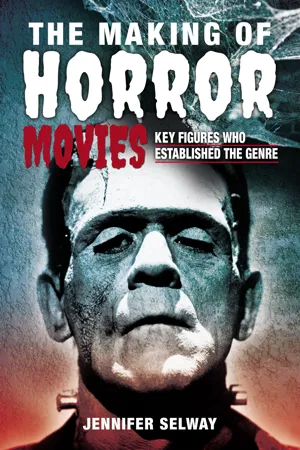
A fascinating journey through society's changing preoccupations as reflected in horror films—plus profiles of the genre's top actors and directors.
It wasn't until 1973 that a horror film—
The Exorcist—was nominated for an Oscar for Best Picture, and critics are still divided today, many regarding them with amused condescension. The public's view is also sharply divided. Some cinema-goers revel in the thought of being made very, very afraid, while others avoid horror films because they don't want to be frightened.
This guide, which is for both the fan and the more fainthearted, steers an illuminating path through a genre that has, since the early days of cinema, split off into many subdivisions—folk horror, slasher movies, Hammer, sci-fi horror, psychological thrillers, zombie movies, among others. Times change but moviemakers can always find a way to tap into what we fear and dread, whether it's blood-sucking vampires or radioactive mutations, evil children, or the living dead. This book also gives concise biographies of the many actors and directors who saw their careers—for better or worse—defined by their association with horror movies, and who created a genre that is instantly recognizable in all its forms and continues to find new and ingenious ways of scaring us in the dark.
- 232 pages
- English
- ePUB (mobile friendly)
- Available on iOS & Android
eBook - ePub
About this book
Information
Subtopic
Film & VideoChapter One
Tod Browning – ‘Go bite yourself!’
‘We didn’t lie to you folks,’ says the master of ceremonies at a circus sideshow. ‘We told you we had living, breathing monstrosities…’.
Tod Browning’s 1932 film Freaks is one of the strangest movies ever made. It was also a box-office disaster that appalled audiences and was banned in Britain for thirty years. In the late 1960s it achieved a kind of cult status on the late night, independent cinema circuit, finding a place in the counterculture’s embrace of all things weird. Now, with its theme of physical deformity, it would be a tricky film to programme even after the most careful and sensitive contextualisation. The title itself condemns it.
In the film, Cleopatra (played by Olga Baclanova) is a trapeze artist. The circus ‘midget’ Hans (Harry Earles) has a crush on her (‘She’s the most beautiful big woman I ever saw’) even though he has a fiancée (played by Daisy Earles) who is also of restricted growth. When she finds out that Hans is in line to inherit a fortune she agrees to marry him, even though she is having an affair with the circus strongman Hercules (Henry Victor).
She begins to poison Hans on their wedding day and when the other sideshow performers (the ‘freaks’) discover that she is laughing at them, they plot their revenge. These were real circus performers – women without arms, conjoined twins, a bearded lady, an intersex character, a man without legs. As a result, Hercules is castrated and Cleo has her feet amputated and is left permanently tarred and featured – half woman, half chicken.
Even on its release, Freaks did Tod Browning no good at all. One woman who attended a preview threatened to sue MGM on the grounds that she had suffered a miscarriage.
After it flopped at the box office he went from being one of Hollywood’s highest paid directors to something of an embarrassment. Yet his lifelong obsession with the grotesque, the morbid and the macabre undoubtedly struck a chord with audiences who had seen a generation of young men return from the battlefields of the First World War without limbs or faces or minds; who knew what it was like to become – through disability – an outsider in an unforgiving world.
Charles Albert ‘Tod’ Browning was born in Louisville, Kentucky on 12 July 1880 – the second son of Charles and his wife Lydia (who was over 6 foot tall). Among the family, his uncle Pete (born 1861) was a famous baseball player nicknamed the ‘Louisville Slugger’.
Pete suffered from mastoiditis, which left him almost completely deaf and in chronic pain. He self-medicated with alcohol, was a noted eccentric and philanderer and died from ‘asthenia’ at the age of 44. This was a catch-all term employed by doctors, which meant a weakening of the body and was usually a euphemism for tertiary syphilis.
Avery, Tod’s elder brother – who became a successful coal merchant – was also somewhat eccentric. He was germ-phobic and wore a long dark overcoat whatever the weather. A ‘sister’, Virginia, was actually a cousin but raised by Tod’s parents.
In keeping with the family’s slightly odd behaviour, Charles senior ended his days (he died of a stroke in 1922) endlessly shelling peanuts and papering the walls of the bathroom with identical red and green twocent postage stamps that had been steamed from letters.
As a child, Tod began staging shows in an old shed in the family home which he described as ‘performances to astound’. The Louisville Herald-Post attended and described Browning as ‘a precocious youngster, a Barnum perhaps in the making’.
At the time, Louisville was a boom town and between 1888 and 1892 staged a Satellites of Mercury carnival financed by local businesses. The first Kentucky Derby had been run in 1875, attracting huge crowds then and in subsequent years. It was a city accustomed to hucksters and chancers and showmen. The young Browning was drawn to this rackety life and ‘ran away to the circus’ in 1898 with the Manhattan Fair and Carnival Company, acting as a barker for a ‘Wild Man of Borneo’ act.
The ‘wild man’ who could equally be an ‘Aztec’ or an ‘Australian’ would be available for scrutiny in a pit. Characters who would bite the heads off snakes or rats were a staple of circuses at the time. Browning also promoted himself as ‘Bosco the Snake Eater’ and worked at various times as a handcuff escape artist, a contortionist, a ringmaster, a jockey and he put on blackface for a vaudeville act known as ‘Lizard and Coon’.
There was no end to his abilities, and he also had himself buried alive as the ‘Hypnotic Living Corpse’. Reel Life magazine reported on this act in 1914:
He would fall into a trance. Then he would be lowered several feet under the ground and the earth thrown over him. A wooden shaft permitted the wonder-struck crowd, one by one, to gaze down upon his inert form in the bottom of the pit – and incidentally supplied him with air.
Sometimes he would be buried for as long as forty-eight hours. He worked with magicians, including the famous Leon Herrmann, performing the dangerous bullet-catch illusion, and with a Mongolian magician who produced goldfish bowls out of thin air.
During this period, he married Amy Louise Stevens, the 23-year-old daughter of a pawnbroker. The couple lived with her parents as Browning’s income was negligible. He often borrowed from his mother-in-law and failed to pay back the loans. The couple divorced in 1910.
Browning then spent a period living in cheap, squalid boarding houses, moving from town to town. Times were hard for many. In one house, he opened the door of the bathroom he shared with the other lodgers, including a near-destitute woman with two small children. The woman was there in the bathroom. She had already killed one of her children, who was lying dead on the floor. She was holding the other child, who had blood pouring out of its throat into the bathtub. Browning closed the door quietly and phoned the police.
There are many routes into the movie business and, in its early years, Hollywood would draw in emigrés, aristocrats, ingénues, intellectuals and showmen. And as David J. Skal and Elias Savada write in their biography of Browning: ‘Much like Tod Browning himself, the motion picture had worked its way up from carnival roots.’
Browning’s introduction to the new cinema industry came from his meeting with the film director D. W. Griffith, who was also from Kentucky. Both of them had attended the same school in Louisville though at different times.
In 1913, Griffith asked Browning to appear with a comedian, Charles Murray, in a couple of Biograph Company comedies called Scenting a Terrible Crime and A Fallen Hero. Browning moved to Los Angeles and worked for the Komic subsidiary of the Reliance-Majestic Studios under Griffith (who had now left Biograph). He appeared in around fifty one-reel comedies and had top billing in Nell’s Eugenic Wedding (1914) scripted by Anita Loos (who would later write the 1953 film Gentlemen Prefer Blondes). In it a man eats a bar of soap, vomits everywhere … and that’s about it. The taste for the bizarre in Hollywood’s early days never ceases to amaze.
Browning was living in a bohemian apartment house called the Reiter Arms at the intersection of Sunset and Hollywood Boulevards. There were a lot of card games and alcohol-fuelled parties. He also developed a taste for flashy automobiles.
In 1915, Tod Browning appeared as an extra in D. W. Griffith’s silent epic Intolerance, which was released the following year, and directed his own first short film called The Lucky Transfer, in which a female reporter uncovers a jewel theft. He followed it up with The Living Death (1915), in which an over-protective father deliberately misdiagnoses his prospective son-in-law’s poison ivy as leprosy to prevent him marrying his daughter. The theme of obsessive parental relationships is repeated in The Burned Hand (1915), in which a man kidnaps his own daughter following an acrimonious divorce.
In June of that year Browning, almost certainly steaming drunk, drove full tilt into a railway flatbed car loaded with iron rails. One of his passengers was killed and another badly injured. Browning fractured his right leg in three places, suffered serious internal injuries and lost all his teeth. For the rest of his life he wore false teeth, which caused him considerable discomfort.
He was out of action for the best part of a year, returning to work to make Jim Bludso, a feature-length steamboat drama filmed on location on the Rio Vista in San Francisco and released in 1917. He married a vaudeville actress, Alice Lillian Houghton, and took a new job with Metro Pictures for whom he made nine feature films.
By 1919 he was with Universal Studios where he directed The Wicked Darling starring Priscilla Dean. Dean was one of the top stars of the day and one whose career stalled with the arrival of the talkies. Significantly for Browning, the film marked the first time he worked with the actor Lon Chaney.
The Virgin of Stamboul (1920) was a big sand ’n’ sheikhs production which cost half a million dollars to make and starred Wallace Beery. Across the US, cinema foyers were turned into harem tents to promote the film.
The Bioscope, a British magazine said: ‘The film cannot be regarded very seriously as a picture of Oriental life and chapter but it makes fine entertainment.’
By the early 1920s, Browning’s drinking was again causing problems. Universal Studios laid him off because he had gained a reputation for being unreliable. At a New Year’s Eve party at the St Francis Hotel in San Francisco (the same hotel where, in 1921, Fatty Arbuckle was said to have raped an actress who subsequently died of her injuries), Browning yanked out his upper and lower dentures and threw them at his assistant, shouting, ‘Go bite yourself!’
At the time, he was having an affair with the 16-year-old Chinese-American actress Anna May Wong, who would be a sensation in The Thief of Baghdad (1924) with Douglas Fairbanks.
So, all in all, it’s hardly surprising that, in 1923, Browning’s wife Alice walked out on him.
In an interview, he later admitted that his career was at a low point. He said he had, ‘a reputation for being contrary and temperamental and uncertain. The rumour got around that I had a nasty disposition – and let me tell you it was true.’
Of his wife’s departure, he said: ‘It was vaguely annoying after she’d gone that my clothes weren’t in shape, the house disorderly and meals irregular.’ But despite his flippancy he was desperate to win her back, which eventually he did.
Apart from keeping house, Alice was also a canny operator and was instrumental in persuading studio boss Irving Thalberg to take Browning on at MGM. In 1925, Browning directed The Unholy Three, a silent murder thriller about a criminal gang comprised of a midget jewel thief (Harry Earles who would star in Freaks) masquerading as a baby in a pram, a cross-dressing ventriloquist (played by Lon Chaney) who pretends to be a little old lady, and a strong man (Victor McLaglen).
MGM had misgivings about this oddball story but Thalberg proved his bosses wrong and the film was a box-office sensation. The New Yorker magazine described it as ‘a ghoulish combination of cruelty and hard laughter, irony and action’.
MGM ran a tight ship. It produced a new picture every week and twelve to fourteen-hour days were the norm. Browning was a hard taskmaster, unwilling to break for lunch. He had become something of a dandy too, favouring loud-patterned suits, two-tone shoes and a waxed moustache, which did something to disguise his dental problems.
He directed Lon Chaney in The Blackbird (1926). Chaney plays a Limehouse crook who pretends to be his fictitious crippled twin. Then in The Road to Mandalay (1926), shot over thirty days at breakneck speed, Chaney plays a father who desperately tries to prevent the marriage of his daughter to his criminal partner.
John Gilbert, hated by Louis B. Mayer as it happens, was cast in The Show (1927). The two men had had a brawl in the bathroom at Gilbert’s wedding to Greta Garbo, though Garbo herself never showed up. In The Show, Gilbert is an illusionist in a carnival freak show playing John the Baptist, who has his head severed every night by Salome (played by Renée Adorée). A rival plans to have him decapitated for real.
Said the New York Herald Tribune: ‘Tod Browning revels in murkiness. His cinematic mind is a creeping torture chamber, a place of darkness, deviousness and death.’
Browning did nothing to disprove this assessment in his next film Alonzo the Armless (1927), which would later be titled The Unknown. An armless circus knife thrower and sharpshooter Alonzo (Lon Chaney) is, in reality, a fugitive. His double thumb would give him away to the police so he has his arms bound. His glamorous partner in his act, Nanon (Joan Crawford), cannot bear being pawed by men but she feels comfortable around Alonzo. Eventually, to win her love, Alonzo has his arms amputated, but by now Nanon has got over her aversion and fallen into the arms of the circus strongman.
Mordaunt Hall in The New York Times on 13 June, 1927 reviewed it:
It is gruesome and at times shocking, and the principal character deteriorates from a more or less sympathetic individual to an arch-fiend… . The role of Alonzo, who poses as the Armless Wonder with a Spanish circus, is one that ought to have satisfied Mr. Chaney’s penchant for freakish characterisations, for here he not only has to go about for hours with his arms strapped to his body, but when he rests behind bolted doors, one perceives that he has on his left hand a double thumb. Mr. Chaney really gives a marvellous idea of the Armless Wonder, for to act in this film he has learned to...
Table of contents
- Cover
- Title
- Copyright
- Contents
- Introduction
- Chapter One Tod Browning – ‘Go bite yourself!’
- Chapter Two Bela Lugosi – ‘Dracula is Hamlet to me.’
- Chapter Three Lon Chaney and Lon Chaney Jr – ‘To endure pain brought him a strange joy.’
- Chapter Four Boris Karloff – ‘As British as cricket and tea-time.’
- Chapter Five F. W. Murnau – ‘Here is a man of exceptional nature.’
- Chapter Six James Whale – ‘Faun-like charm.’
- Chapter Seven Elsa Lanchester – ‘A glittering and satiric sprite.’
- Chapter Eight Val Lewton – ‘The sultan of shudders.’
- Chapter Nine Terence Fisher – ‘A director for hire.’
- Chapter Ten Vincent Price – ‘Bring me my pendulum, kiddies … I feel like swingin’!’
- Chapter Eleven Peter Cushing – ‘Acting? You either can or you can’t.’
- Chapter Twelve Nigel Kneale – ‘But you can’t hear the sea in the kitchen … .’
- Chapter Thirteen Christopher Lee – ‘Too tall to be an actor and too old to be a singer.’
- Chapter Fourteen Roger Corman – ‘The Pope of Pop Cinema.’
- Chapter Fifteen Roman Polanski – ‘Pray for Rosemary’s Baby.’
- Chapter Sixteen Ingrid Pitt – ‘The most beautiful ghoul in the world.’
- Chapter Seventeen Michael Reeves – ‘And may God be with you till we meet again.’
- Chapter Eighteen John Carpenter – ‘Too much of the monster.’
- Afterword Do You Actually Like Horror Films?
- Bibliography
- Acknowledgements
- Plate section
Trusted by 375,005 students
Access to over 1.5 million titles for a fair monthly price.
Study more efficiently using our study tools.
Frequently asked questions
Yes, you can cancel anytime from the Subscription tab in your account settings on the Perlego website. Your subscription will stay active until the end of your current billing period. Learn how to cancel your subscription
No, books cannot be downloaded as external files, such as PDFs, for use outside of Perlego. However, you can download books within the Perlego app for offline reading on mobile or tablet. Learn how to download books offline
We are an online textbook subscription service, where you can get access to an entire online library for less than the price of a single book per month. With over 1.5 million books across 990+ topics, we’ve got you covered! Learn about our mission
Look out for the read-aloud symbol on your next book to see if you can listen to it. The read-aloud tool reads text aloud for you, highlighting the text as it is being read. You can pause it, speed it up and slow it down. Learn more about Read Aloud
Yes! You can use the Perlego app on both iOS and Android devices to read anytime, anywhere — even offline. Perfect for commutes or when you’re on the go.
Please note we cannot support devices running on iOS 13 and Android 7 or earlier. Learn more about using the app
Please note we cannot support devices running on iOS 13 and Android 7 or earlier. Learn more about using the app
Yes, you can access The Making of Horror Movies by Jennifer Selway in PDF and/or ePUB format, as well as other popular books in Media & Performing Arts & Film & Video. We have over 1.5 million books available in our catalogue for you to explore.