- 272 pages
- English
- ePUB (mobile friendly)
- Available on iOS & Android
eBook - ePub
About this book
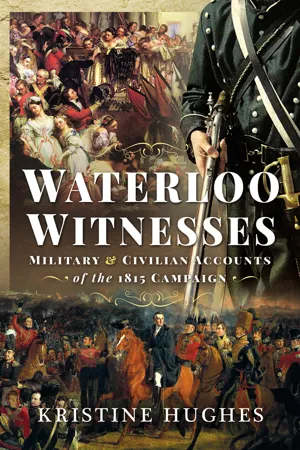
The events of Sunday, 18 June, stand as the defining moment of the year 1815, if not of an entire era. The allied victory over Napoleon's French army at the Battle of Waterloo reshaped governments and boundaries, made or broke fortunes and touched thousands of lives in ways both large and small, and it has been analysed, dissected and refought on paper a hundred times. Perhaps, though, the very best words ever written about that momentous campaign are the first-person accounts recorded as events unfolded. It is these vivid accounts that Kristine Hughes has collected together in order to convey the hopes, fears and aspirations of their authors. They inject the story of the battle with a level of humanity that reclaims it from the realm of legend and restores it to the people who witnessed it. In chronological order her work pieces together a novel view of the battle and events surrounding it as they were experienced by both military men and civilians. The result is a fascinating and varied picture of the individuals involved and the society of the period. Their words make compelling reading.
Information
Chapter 1
Civilians and Celebrations
A dinner party at home. In the evening, about eleven o’clock, we took our party to Madame de Stael’s, where we heard the astonishing news of the abdication of Bonaparte, which had just been published in a Gazette of ten lines long. One could hardly believe it; one could hardly persuade oneself that one was already at peace with all the world – that the struggle was over – not faute de combattans[sic], but mais [sic] faute de quelque ennemi a combattre.1 Nobody could think or talk of anything but the wonderful news that we had just heard.
[from the Diary of Mary Berry2]
Over the course of 30–31 March 1814, the Allied Russian, Austrian and Prussian Sixth Coalition army fought the French at the Battle of Paris. Upon the Allied victory, Prince Talleyrand, who had been elected as President of the provisional Parisian government, gave the key of the city to the Russian Tsar, Alexander I.3 Later that day, the Coalition armies triumphantly entered Paris with the Tsar at their head, followed by the King of Prussia (Frederick William III)4 and Austrian Field Marshal Prince Schwarzenberg.5 From there, things moved speedily onwards. On 2 April, the Senate passed the Acte de Déchéance de l’Empereur (the Emperor’s Demise Act), which effectively deposed Napoleon as Emperor. Napoleon then tendered an unconditional abdication at Fontainebleau on 6 April, and the Treaty of Fontainebleau was signed at Paris on 11 April by the plenipotentiaries of each nation and ratified by Napoleon on 13 April. The treaty also provided for Napoleon to enter into voluntary exile on the island of Elba.
Meanwhile, almost 700 miles to the south of Paris, the British army under the command of Wellington had claimed another victory at the Battle of Toulouse on 10 April. It would prove to be one of the last battles of the Napoleonic Wars.
Lieutenant Colonel Frederick Ponsonby,6 Commander of the 12th Light Dragoons, brought word of Napoleon’s abdication to Wellington at Toulouse. He reported that, upon hearing the news, Wellington exclaimed, ‘You don’t say so, upon my honour! Hoorah!’7 The field marshal then raised his arms above his head, snapped his fingers and sketched the steps of a flamenco.
With the end of hostilities in sight, Viscount Castlereagh,8 the Foreign Secretary, sought to keep Wellington in a key strategic position by writing to request that he accept the role of British ambassador to France. Wellington’s military successes had been achieved in conjunction with the diplomatic skills he had honed during negotiations in India, Portugal and Spain. In fact, before embarking for England to accept congratulations and officially accept the role of ambassador, Wellington would stop in Paris and then, at Castlereagh’s request, travel to Madrid to confer with his brother, Henry,9 Britain’s ambassador to Spain. The newly restored King Ferdinand VII was busy reestablishing absolute monarchy, resulting in a coup by the ousted liberals (many of whom Ferdinand had arrested). Spain was by this time nearly bankrupt and the King had yet to fashion a new constitution. The prospect of a civil war was not entirely out of the question and it was imperative that Spain’s loyalty should remain with Britain rather than with its nearer neighbour, France, during this period of transition. To this end, Wellington was sent to Madrid to confer with the King on the finer points of a constitutional government and to retain his allegiance. There was also the matter of Spain’s reluctance to cease its participation in the slave trade to be tackled. Coincidentally, it would fall to Wellington, in his role as ambassador to France, to address many of these points with the newly restored King Louis XVIII.10
Wellington arrived in Paris on 4 May, where he was met with the sort of public acclaim with which he never became entirely comfortable. He also met with Lord Castlereagh, who, by the by, informed Wellington that he had recently been awarded a dukedom. In London, the events unfolding in Paris were of great interest to society, as Mrs Calvert,11 an Irish heiress and society beauty of the day, recorded.
Mrs Calvert, London, 6 June 1814
I had a good many visitors yesterday, amongst the rest Lady Charlemont,12 who I really think the prettiest creature there ever was. Old Blücher13 was dining at Paris in company with Lady Burghersh14 and the Duke of Wellington and made this speech, à propos of what I don’t know: Jaime le Duc de Wellington et je respecte Lady Burghersh. Voilà ce que dit ma bouche. Mais mon coeur dit au contraire. J’aime Lady Burghersh etje respecte le Duc de Wellington,’15 – a very neatly turned compliment.16
* * *
It is safe to say that, as the Duke of Wellington and Marshal Blücher dined together in Paris, neither man could have conceived the extent to which their lives, and their legacies, would forever be entwined.
We are given a picture of what the climate was like in Paris at this time from the following letter received by Mary Berry.17
From the Hon. J.W. Ward18 to Miss Berry, Paris, Wednesday, 11 May 1814
Paris is certainly at this moment the most wonderful show-box in the world. It has within its walls as many live emperors, kings, generals, and eminent persons of all kinds, as the ingenious Mrs Salmon19 ever exhibited in wax. What is a matter of greater interest and greater surprise is to see France – to see the great nation that only a few months ago seemed so near realising its old plan of universal dominion – not only beaten, but delivered over bound hand and foot to foreign masters.
The fact, I believe, is that the people have become quite callous by what they have suffered for the last twenty years, and that no public event makes much impression upon them. They are generally well inclined to the Bourbons – not, however, as a positive good, but as the least of the evils they are likely to endure. There are, however, I understand, a great many malcontents; and the army is still, in general, attached to the late Emperor. But the different bodies of which it is composed have no means of union, or indeed of communication; no individual in whom they confide, and round whom they could rally; and in peace (if the court manages tolerably well) they will rapidly crumble away, so that I see no great danger from that side.
You see the King has rejected the constitution with as little ceremony as he would send away a dish at dinner that he did not like. This event will probably excite quite as much sensation in England as it does in France. I cannot find that anybody here cares about the matter. The constitution was generally disapproved of, and the framers of it still more generally despised; so the rejection of it appeared quite a matter of course.
Paris is at this moment a garrison town, and, what is worse, a town garrisoned by foreign troops; Lord Wellington was here for a few days: his dukedom met him on his arrival. He was received in a manner that could not but give great pleasure to every Englishman. He seems quite unspoilt by success. He has not even contracted that habit of silence, and reserve which so often accompanies dignity and favour, even when they produce no more unfavourable change. But he is just as he was – gay, frank, and ready to converse. I counted myself lucky in meeting him one of the days he was here, at Aberdeen’s20 Stadion21 observed that he believed he had never been engaged against Bonaparte in person. The Duke of W. answered instantly: ‘No; and I am very glad I never was. I would at any time rather have heard that a reinforcement of forty thousand men had joined the French army, than that he had arrived to take the command.’ I had heard the opinion ascribed to him before, but I was glad to find he had the liberality to repeat it after Bonaparte’s fall. You know he is to be our ambassador here. His presence may inspire the Marshals of France with some respect; or, to speak more properly, may keep up that sentiment in their minds. Nor is that such an easy matter as you will think, when I tell you the topic Ney22 chose to dwell upon the other day, at Lord Castlereagh’s table, in presence of Lord Wellington and seven or eight more foreign generals, by all of whom the French had at sundry times been defeated. It was the invasion of England; a project which, Ney said, had always met with his warmest approbation, and of the success of which, if it were attempted, he had always felt quite confident. The Emperor, he owned, had treated it as more hazardous, and as an undertaking more fit for a partisan than a general, but that his own opinion had remained unshaken.
* * *
Wellington sailed for Dover on 23 June and was treated to his first glimpse of England in over five years. He was returning home a hero and, as such, was given a hero’s welcome by the enthusiastic populace of England at every stop along his route from Dover to the capital. Outside London, the people eagerly awaited his arrival and stood ready to meet his coach in order to unharness his horses and pull the carriage the rest of the way into the City in a traditional display of acclaim. Having learned about these plans ahead of time, Wellington chose instead to mount a horse and ride into London unobserved.
Wellington enjoyed a few private hours with his family before his whereabouts were made known and the honours he’d won caught up with him. Because Wellington had been out of the country for almost six years, he had not been able to present his letters patent or take the oaths in the House of Lords when he had received the titles of Baron Douro (1809), Viscount Wellington (1809), Earl of Wellington (1812), Marquess of Wellington (1812) and Duke of Wellington (1814). On 28 June, the Duke of Wellington was finally able to take his seat in the House of Lords, when he ‘showed his patent and right of summons … then approached the table, where His Grace’s various patents, as Baron and Viscount, Earl, Marquess, and lastly as Duke, were each read by the clerks. The oaths were then administered, and the Test Rolls were signed by him. He then, accompanied by his noble supporters, took his seat on the Duke’s bench, and saluted the House in the usual manner, by rising, taking off his hat, and bowing respectfully.’23
Wellington’s having been invested with all five titles in a single day remains a singular circumstance and the event prompted a host of celebrations.
Lady Shelley,24 London, 21 July 1814
The night [the Duke of Wellington] dined with us happened to be the Prince’s25 Fête. Thi...
Table of contents
- Cover
- Title
- Copyright
- Contents
- List of Plates
- Acknowledgements
- Preface
- 1. Civilians and Celebrations
- 2. The British Invasion
- 3. Planned Arrivals and an Unexpected Departure
- 4. Gathering the Troops
- 5. Ruffled Feathers
- 6. The Calm Before the Storm
- 7. 15 June
- 8. 16 June
- 9. 17 June
- 10. 18 June
- 11. 19 June
- 12. 20 June
- 13. Life Goes On
- Epilogue
- Notes
- Bibliography
- Plate section
Trusted by 375,005 students
Access to over 1.5 million titles for a fair monthly price.
Study more efficiently using our study tools.
Frequently asked questions
Yes, you can cancel anytime from the Subscription tab in your account settings on the Perlego website. Your subscription will stay active until the end of your current billing period. Learn how to cancel your subscription
No, books cannot be downloaded as external files, such as PDFs, for use outside of Perlego. However, you can download books within the Perlego app for offline reading on mobile or tablet. Learn how to download books offline
Perlego offers two plans: Essential and Complete
- Essential is ideal for learners and professionals who enjoy exploring a wide range of subjects. Access the Essential Library with 800,000+ trusted titles and best-sellers across business, personal growth, and the humanities. Includes unlimited reading time and Standard Read Aloud voice.
- Complete: Perfect for advanced learners and researchers needing full, unrestricted access. Unlock 1.5M+ books across hundreds of subjects, including academic and specialized titles. The Complete Plan also includes advanced features like Premium Read Aloud and Research Assistant.
We are an online textbook subscription service, where you can get access to an entire online library for less than the price of a single book per month. With over 1.5 million books across 990+ topics, we’ve got you covered! Learn about our mission
Look out for the read-aloud symbol on your next book to see if you can listen to it. The read-aloud tool reads text aloud for you, highlighting the text as it is being read. You can pause it, speed it up and slow it down. Learn more about Read Aloud
Yes! You can use the Perlego app on both iOS and Android devices to read anytime, anywhere — even offline. Perfect for commutes or when you’re on the go.
Please note we cannot support devices running on iOS 13 and Android 7 or earlier. Learn more about using the app
Please note we cannot support devices running on iOS 13 and Android 7 or earlier. Learn more about using the app
Yes, you can access Waterloo Witnesses by Kristine Hughes in PDF and/or ePUB format, as well as other popular books in History & Military Biographies. We have over 1.5 million books available in our catalogue for you to explore.