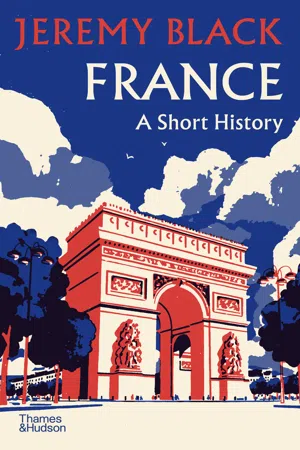
Artists, martyrs, kings, revolutionaries: Frances sense of national identity is inextricably linked to its dramatic history, which fascinates the world and attracts millions each year to visit its chateaux and cathedrals, boulevards and vineyards. Ancient roots allied to a social, political and military history that has witnessed revolution, conflict and occupation mean that France holds a unique position in the modern world. In this short, easy-to-digest history of a vast subject, Jeremy Black succinctly narrates how Frances past has created its distinct character. Country and destination, nation and idea, France has an incomparable cultural legacy, and exerts a powerful artistic, intellectual and political influence across the globe. Blacks vivid take on history emphasizes the unexpected nature of events and unpredictable outcomes on a fragmented country, from the prehistoric cave paintings of Lascaux to the origins of Gothic architecture, from Monet and Degas to the Lumière brothers, and from the cataclysm of the 1789 Revolution through the countercultural student protests of 1968 to todays gilets jaunes. Blacks concise, insightful tour of the key historical moments and vibrant personalities that shaped France provides an indispensable guide to understanding the country today.
- English
- ePUB (mobile friendly)
- Available on iOS & Android
eBook - ePub
France: A Short History
About this book
Information
Subtopic
French HistoryIndex
History1. Prehistoric Legacies
The 2,753 Standing Stones of Carnac, prehistoric monuments dating from 6,600 years ago in Brittany, remain a striking image of ancient France (see pl. I). The cave paintings of animals in Lascaux, made about 17,000 years ago, also famous and again a source of impressive photographs, alas are not so visible: closed in 1963, they have to be seen through the effective Lascaux II reconstruction.
Archaeological finds abound across France and deserve more attention than many tourists give to them. These finds are aspects of an ancient past that has provided images, mythic or otherwise, that stretch to the present. In particular, the tribes of what became France, going back to some of the inhabitants of the present country before the Romans arrived in the first century BCE, retain a pull on the national consciousness. Indeed, many of these tribes remain with us today in the names of regions, and in the characteristics called upon by the people that lay claim to their legacy.
The last Ice Age was important to France’s history, although it was, in practice, a series of ice advances with intervening warmer periods, and even when the ice advanced, most of France was not covered. Evidence of human settlement in this period has been found. Alongside Neanderthals, there were hominids. The Musée de la Préhistoire des gorges du Verdon suggests there has been human life in that region from about 400,000 years ago. Cave systems, notably in the Dordogne region, south-western France, provide evidence of human life – in the form of anatomically modern humans – about 32,000 years ago, and the paintings reflect the focus on animals to be expected in hunter-gatherer societies. As part of a changing system of nomenclature, Cro-Magnon, a rock shelter in the Vézère Valley of the Dordogne, where human remains were discovered in 1868 by diggers preparing a new rail link, gave the name to what are now generally termed European early modern humans, those from about 48,000 to about 15,000 years ago. Their skeletons reveal a hard life, one of injury and infection, but also suggest cognitive development to a level that permitted rituals. Cro-Magnon remains in that area are extensive, including prehistoric camps near Les Eyzies and the pictures of animals that can be seen in the Abri de Cap Blanc and the Font-de-Gaume and Combarelles grottoes. The focus on illustrations of animals can also be seen in prehistoric caves in the Pyrenees, notably at Niaux and Bédeilhac, and in the Massif Central, as at Chauvet-Pont d’Arc.
The warmer weather that followed the Last Glacial Maximum, which ended about 16,000 years ago, caused a major rise in the sea level, by about 100 to 120 metres. This led to a retreat of the coastline, to the creation of la Manche/the Channel, and to the abandonment of some cave systems. The warmer weather also encouraged the spread northwards of more vigorous plant and animal life and, in time, the humans, who followed about 15,000 years ago, developed both cultivation and pastoralism. That was the basis for the Lascaux cave dwellings and for the Megalithic Stone Age settlements, as at Carnac, Locmariaquer and Gavrinis in Brittany. The stone alignments were probably for astronomical reasons, linked to ritual practices. Flint mines were of importance and, in Vassieux-en-Vercors in the Drôme department, the Musée de la Préhistoire de Vassieux en Vercors is on the site of one.
Visible even from the sea and dominating a huge area as the symbol of a very organized society, the tumulus of Saint Michel on the edge of Carnac, at 125 metres (410 feet) long and 10 metres (33 feet) high, may have been one of the largest stone structures in the world about 7,000 years ago. Even in the Neolithic period, the extent of trade networks was impressive, with stones at Carnac coming from as far as Portugal and the Baltic. Later pottery designs of the Bronze Age confirm the links that ran across Europe. Long before the Celts, there were some sophisticated cultural goods, and France was no backwater but part of the wider world.
The transformative diffusion of metals is grouped first in the Bronze Age, and then, from about 500 BCE in France, the Iron Age. Iron axes and ploughs made it easier to clear the woodland and to work the soil. Indeed, alongside the retention of significant areas of woodland, large parts of lowland France were swept of trees during the Iron Age. This opened up what became a permanent difference between upland and lowland France, one that was linked to a significant contrast in the density of population.
In what became France, archaeologists have distinguished a number of cultures, particularly the Hallstatt from about 900 BCE, and the Celts from about 500 BCE, although there was a degree of overlap, and notably between the last two. At the Gallic Bibracte in today’s Nièvre department, there is the Musée de la civilisation Celtique. The Celts, more specifically La Tène culture, had a number of territories that were centred on fortified hilltop towns ruled over by princes. These towns were the foci of trade networks that in part supplied Greek bases in southern France, notably Massalia (Marseille), which was founded in about 600 BCE, Nice and Agathe, and therefore fed Mediterranean trade. Other coastal bases included Antipolis, Olbia and Tauroeis between Nice and Marseille, Emporion near later Narbonne and Alalia on the Corsican coast. The Greeks moved north from the Mediterranean, notably building a settlement at Glanum near Saint-Rémy-de-Provence. Subsequently, the Romans took over the town. The excavations of a Celtic settlement can be visited at the Oppidum d’Entremont just north of Aix.
The Celts of what became France were known by the Romans as Gauls, although their territories extended further than the boundaries of modern France. In his Gallic Wars (58–49 BCE), Julius Caesar noted the diversity of Gaul and its division among different tribes. The Gauls had a rich civilization, one that was capable of producing art of some sophistication, as with the Treasure of Vix in the museum at Châtillon-sur-Seine in Burgundy, a collection of finds from the tomb of a Celtic woman buried in a chariot. Impressive pottery and swords were produced by a society that was able to use metals and was knowledgeable about agriculture. Indeed, even from the critical comments of the Romans, it is clear to see that they were impressed by the Celts.
2. Roman France
Move down into the valley of the River Gardon and look up at the Pont du Gard (see pl. II), the dramatic first-century CE aqueduct carrying water to the nearby city of Nemasus (Nîmes). The three tiers of arches were a triumph of purpose and skill, and the quality of the museum increases the appeal of the site. Yet, war was the key to the establishment of Roman control. Attacking Massalia (Marseille) in 49 BCE when it backed one of his Roman opponents, Julius Caesar blockaded the port and then, in order to help compress the soil for a mighty ramp, ‘all the woods were felled’. Two towers on rollers were placed on the ramp, and from there fire was directed at the defenders. The catapults of the attackers bombarded the towers, while, in turn, the attacking troops were pummelled by stones dropped from the walls. Inexorable effort won Caesar success. Having conquered the Celts of northern Italy, which they termed Cisalpine (this side of the Alps) Gaul, the Romans had sought to expand their power into Transalpine Gaul, establishing control over much of southern France in 125–121 BCE, notably by beating the Saluvii tribe at their capital, Entremont, in about 123–122 BCE. In part, this expansion was to protect Massalia, which had earlier backed Rome against Carthage. However, in reality, the extension of Roman power, not least to establish a land route to the wealthy provinces in Spain, was the key theme, and this extension was anchored by the establishment of fortresses such as Aquae Sextiae, now Aix-en-Provence.
The pursuit of power was certainly the central goal for Julius Caesar, who became the provincial governor of northern Italy and southern France in 59 BCE. The following year, in response to an invasion of Germanic tribes, he expanded his power northwards, beating the tribes piecemeal, and, in 56 BCE, conquered Brittany, defeating the Veneti in a naval battle. The year 52 BCE was key in terms of conflict. Caesar then faced stronger resistance, particularly organized by Vercingétorix of the Arverni tribe, who brought a measure of unity among the Gauls, but, aside from divisions among the Gauls, they had to face Caesar’s brutal and remorseless methods and the more disciplined fighting style of the Romans. Caesar’s deputy, Titus Labienus, defeated the Parisii, who had backed Vercingétorix’s rising in the battle of Lutetia in what is now Paris. Meanwhile, Vercingétorix was unable to relieve Avaricum (Bourges) when Caesar besieged it, but his scorched-earth tactics helped lead to the supply problems that contributed to the failure of Caesar’s siege of Gergovia, a formidable position.
At Alesia, Vercingétorix made what became his last stand on a hilltop town, which Caesar surrounded with a ditch and earthworks. Breakout attempts to avoid being starved out were defeated. A relief force failed to penetrate the outward fortified line of contravallation that protected the besiegers from relief, lines that were important to Roman siegecraft as the attempted relief of positions was a key element in the fighting of the period. Vercingétorix surrendered, and was imprisoned until presented in Caesar’s triumph in Rome in 46 BCE, after which he was strangled. The site of Alesia is dominated by a bronze statue of Vercingétorix, a product of Napoleon III’s attempt to demonstrate a pre-Roman origin for France. A divided tribal opposition to Roman conquest was presented as the valorous resistance of a Gaulish nation. The defeat had been bad, but France was given a hero, and France entered civilization – in the sense of Roman civilization – which for Napoleon III, looking in retrospect, was an excellent thing.
Thereafter – despite the idea offered in the popular Astérix comic-book stories, created by René Goscinny and appearing from 1959, of heroic resistance in remote fastnesses – the Roman perspective was that Gaul was held with relative ease. Thus the fortified frontier of Roman control became the Rhine; this established a key divide between Gaul and the Germanic peoples that would become important to the later cultural and political identity of France.
The Romans ruled all of Gaul but it was not one territory. Instead, Gaul was divided into a number of provinces. Most of Gaul was in Gallia Lugdunensis, but some was in Belgica, and some in Aquitania. Lugdunum (Lyon) became the political capital of Gaul and, until the third century CE, its economic capital, too. Gaul was valuable, providing goods for Italy, including wine, ceramics, metal goods and, from the Camargue, salt. Gaul, in turn, received from the Romans the template of control and civilization, at least as understood and enforced by the Romans. While existing towns adapted to the Roman model, many cities, indeed the basis of the modern city system, were founded on this model and administered as Roman centres in order to foster the Romanization of Gaul. Major cities included Gallia Narbonensis (Narbonne), Tolosa (Toulouse), Burdigala (Bordeaux), Augustodunum (Autun), Mediolanum Santonum (Saintes) and Lapurdum (Bayonne).
These cities gained the temples, amphitheatres and forums that characterized Roman cities in the Mediterranean, and much of their remains can still be seen. Triumphal arches from the period include the Porte de Mars in Reims, while the amphitheatre in Paris, the Arènes de Lutèce, is of interest. It was destroyed during ‘Barbarian’ attacks at the end of the third century, as were the major public baths, the remains of which are an impressive part of the Musée de Cluny in Paris. The remains of the baths in Metz can be seen in the local museum; Autun displays extensive remains including a substantial theatre and two gates; while Saintes has an amphitheatre and the Arc de Germanicus. There are more dramatic Roman remains in the south, especially in Arles, and in Nîmes with its amphitheatre, Maison Carrée and Porte d’Auguste. One of the best preserved, Nîmes’s amphitheatre is extraordinary for the quality of its design, sightlines and accessibility. Orange has a well-preserved Roman theatre, which included a statue of Augustus as well as a stage wall facing the seats, and also a Roman triumphal arch. A Roman town can be approached through the excavations at Vaison-la-Romaine.
The cities were linked by roads and bridges, fragments of which can be seen west of Nîmes on the Via Domitia, the route from Italy, crossing the Alps by the Col de Montgenèvre, to Spain. The Romans built about 21,000 kilometres (13,000 miles) of roads in Gaul. Marcus Vipsanius Agrippa, who reorganized Gaul under the Emperor Augustus, developed a network of Via Agrippas from Lugdunum. One led travellers to Boulogne, from where ships sailed to Britannia (Britain), while another went from Lugdunum to Colonia Agrippina (Cologne). Other roads marched alongside the rivers, for example from Massalia to Lugdunum, or filled in gaps in the river system, for example the Via Aquitania joining Gallia Narbonensis to Burdigala, and roads that joined Lutetia to the Loire Valley, and Lugdunum to Mediolanum Santonum. This system of roads showed a key aspect of the significance of Gaul to the Romans: it provided crucial backing to the territories in Britain and the Rhineland.
Alongside the settlement of Roman colonists on the land there were practised methods designed to placate the Gauls and to incorporate them into the Roman system. Tribal leaders took part in a process of Romanization, notably with the spread of Roman religious cults, and of the Latin language; and with the enticement of the benefits of citizenship. Recruitment into the army was also a crucial form of social mobility and political integration, helping indeed to create a ‘Gallo-Roman’ spirit. As in Britain and Spain, Romanization was more apparent in some areas than others, thus in the Rhône Valley, rather than in Brittany. In the former, 30 kilometres (19 miles) south of Lyon, one of the most important archaeological sites in Europe, the Musée Gallo-romain de Saint-Romain-en-Gal-Vienne includes the remains of a fullonica (fulling mill) from the second century CE. Another impressive site is the Musée départemental Arles antique.
By the third century, the Roman empire as a whole faced more difficulties, both from external attacks and as a result of internal problems, notably economic strain and disease. In response, in the late third and fourth centuries, the Romans fortified about 100 urban centres in Gaul with impressive stone walls. Those at Le Mans and Périgueux survive in part. There were also many lesser fortifications. Moreover, much of the elite moved from the cities to rural villas, where they enjoyed a degree of self-reliant protection and were in effect autonomous, not least from the urban authorities. This was the period in which major landowners imposed their patronage and power on free peasants, reducing them toward serfdom.
Meanwhile, religious movements spread across the empire. However, to an extent that was frequently subsequently underplayed, there was no automatic turn to Christianity. Indeed, paganism continued for a couple of centuries, certainly in Brittany where the sixth century was the most active period of conversion. Mithraism, the Roman religion focused on the god Mithras, took hold and had centres at Bourg-Saint-Andéol, Saravi and Narbo, and Mithraic sites continue to be discovered, including at Angers and at Mariana, Corsica, in the 2010s. There were also Jewish communities, including in Lugdunum and Vienne. Yet Christianity was the most significant movement, replacing the Imperial Pantheon as the official religion. Episcopal centres, such as Saintes and Tours, gained importance accordingly. The oldest Christian building in France may be the Baptistery of Saint John in Poitiers. Early Christians risked martyrdom: Sainte Blandine, a slave, was martyred at Lyon in 177, while Saint Denis, the first Bishop of Lutetia, was allegedly beheaded around 250 on the hill of Montmartre before picking up his head and walking while preaching. According to tradition, he died at the site where a chapel was established by Sainte Geneviève in 475, and where the present Basilique Saint-Denis stands. The first king to be buried in the basilica was the Frankish Dagobert I, who died in 639. Saint Devota, the patron saint of Corsica and Monaco, was allegedly martyred at Mariana in 303. Christianity became an accepted religion in Gaul in 311 and, in the form of Catholicism, the only authorized religion in 392.
Religious division was a cause of strain; but far more difficulty was caused by the pressure from outside. In response to ‘Barbarian’ attacks from across the Rhine, the Romans made arrangements with particular groups of ‘Barbarians’, including some of the Franks, originally Germanic peoples. These groups provided troops to help the Romans, but this in effect led to a longer-term process of ‘Barbarianization’ in northern Gaul and large-scale attacks. Always unstable, the terms of this relationship changed in the fifth century, as the Roman governmental presence began to decline in northern and central Gaul. There was also a continued interaction of cooperation, however, as in 451 when Franks fought alongside Romans against Attila’s Huns, defeating them at the battle of the Catalaunian Plains after the Huns had sacked Metz and Reims. In the end, Gaul did not so much succumb to the Germanic invaders of the fifth century as become transformed by them.
3. The Early Middle Ages
The landscape of post-Roman France was studded with evidence of conflict. This was not simply a matter of tribes and warlords. Indeed, the struggle between Good and Evil was dramatized in particular locations where the Archangel Michael was believed to have fought the Devil, as in the Meuse Valley near Sedan and at Mont Dol on the Breton coast. Michael, as a warrior figure who had overcome the Devil himself, was a particularly inspired choice to counter the warlike or vengeful pagan gods and to attract the fierce tribes who worshipped them. Belief in the real presence of evil resulted in dubbing features located in deep caves as ‘gates of Hell’, such as the hole at the bottom of the Fosse Dionne, a pool at Tonnerre.
Less dramatically, several ‘Barbarian’ tribes, under pressure from others further east, moved into Gaul from the late fourth century. Some passed through to conquests elsewhere, notably the Vandals en route to North Africa, and the Suevi en route to western Iberia. Others settled, among them the Franks, Burgundians, Alemanni and Visigoths. The Roman administrators of Gaul sought to p...
Table of contents
- Cover
- Title Page
- About the Author
- Other titles of interest
- Contents
- Preface
- Introduction
- 1. Prehistoric Legacies
- 2. Roman France
- 3. The Early Middle Ages
- 4. Medieval France
- 5. Renaissance France, 1494–1598
- 6. From Henry IV to Louis XIV, 1598–1715
- 7. The Ancien Régime, 1715–1789
- 8. The Revolution, 1789–1799
- 9. From Napoleon I to Napoleon III, 1799–1870
- 10. The Third Republic, 1870–1939
- 11. The Second World War, 1939–1945
- 12. France Reborn, 1945–1969
- 13. Modern France, 1969–2000
- 14. France Today, 2001–
- 15. Conclusions
- Selected Further Reading
- Acknowledgments
- Illustration Credits
- Index
- Copyright
Trusted by 375,005 students
Access to over 1.5 million titles for a fair monthly price.
Study more efficiently using our study tools.
Frequently asked questions
Yes, you can cancel anytime from the Subscription tab in your account settings on the Perlego website. Your subscription will stay active until the end of your current billing period. Learn how to cancel your subscription
No, books cannot be downloaded as external files, such as PDFs, for use outside of Perlego. However, you can download books within the Perlego app for offline reading on mobile or tablet. Learn how to download books offline
Perlego offers two plans: Essential and Complete
- Essential is ideal for learners and professionals who enjoy exploring a wide range of subjects. Access the Essential Library with 800,000+ trusted titles and best-sellers across business, personal growth, and the humanities. Includes unlimited reading time and Standard Read Aloud voice.
- Complete: Perfect for advanced learners and researchers needing full, unrestricted access. Unlock 1.5M+ books across hundreds of subjects, including academic and specialized titles. The Complete Plan also includes advanced features like Premium Read Aloud and Research Assistant.
We are an online textbook subscription service, where you can get access to an entire online library for less than the price of a single book per month. With over 1.5 million books across 990+ topics, we’ve got you covered! Learn about our mission
Look out for the read-aloud symbol on your next book to see if you can listen to it. The read-aloud tool reads text aloud for you, highlighting the text as it is being read. You can pause it, speed it up and slow it down. Learn more about Read Aloud
Yes! You can use the Perlego app on both iOS and Android devices to read anytime, anywhere — even offline. Perfect for commutes or when you’re on the go.
Please note we cannot support devices running on iOS 13 and Android 7 or earlier. Learn more about using the app
Please note we cannot support devices running on iOS 13 and Android 7 or earlier. Learn more about using the app
Yes, you can access France: A Short History by Jeremy Black in PDF and/or ePUB format, as well as other popular books in History & French History. We have over 1.5 million books available in our catalogue for you to explore.