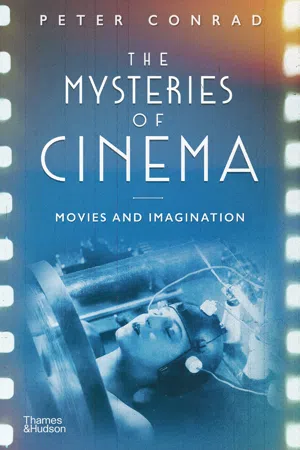
People who saw the first moving pictures at the end of the nineteenth century were delighted by a new art that communicated without words yet they were also alarmed to be witnessing events in a strange, mute, spectral realm, where the laws of time and space were suspended and magical transformations could occur. Some early commentators hailed cinema as a blessing and praised it for resurrecting the dead; others likened it to a hypnotic trance or a hallucinogenic drug. The medium has always been excited by speed, and it enjoys sending the body on furious kinetic chases; at the same time, it stealthily probes our minds, invading our dreams and titillating our desires. Although this is an art kindled by light and inflamed by colour, it is nurtured by darkness and can reduce life to an insubstantial shadow play. Either way, as Peter Conrad argues in this brilliant book, the movie camera has given us new eyes and changed forever our view of reality. The Mysteries of Cinema sets out to map this ambiguous territory by taking readers on a thematic roller-coaster ride through movie history. Directors and critics speculate about the nature of cinematic vision, and there are contributions to the debate from writers like Kafka, Virginia Woolf and Joan Didion, artists including Salvador Dalí, George Grosz and Fernand Léger, and the composers Arnold Schoenberg and Dmitri Shostakovich. The book begins from the audacious innovations of silent film, and examines the influence of French surrealism and German expressionism; it accounts for the appeal of Hollywood genres like the Western, the horror film and the musical, and ends by considering the fate of the moving image in our visually glutted society. Combining contagious enthusiasm with an eye for the subjective quirks of filmmakers and the allure of favourite performers, Conrad delivers an astonishing addition to the literature on the seventh art.
- English
- ePUB (mobile friendly)
- Available on iOS & Android
eBook - ePub
About this book
Information
Subtopic
Film & Video1
THE CINEMA AGE
At the end of the nineteenth century, an eerie marvel startled the world. A product of science, it challenged religion: thanks to a machine that could do the work of a god, light materialized in darkness and made images move. ‘But the films!’ exclaimed Leo Tolstoy in 1908. ‘They are wonderful!’ They had, the nonagenarian novelist declared, ‘divined the mystery of motion’, and he excitedly mimicked the insect-like buzz of the contraption that performed this feat: ‘Drr! Drr!’
The shock of animation recaptured the moment in Genesis when clay was first imbued with life. Better yet, these moving pictures told stories without needing to rely on words, so the new art earned extra praise for overcoming the curse of Babel. In Genesis, when the earth was ‘of one language’, men built a sky-scraping tower that reached up towards heaven. A jealous God toppled the structure and, to ensure that his creatures could never again undertake such a grandiose collective work, confounded their speech. According to the myth, this was how monoglot mankind splintered into linguistic tribes whose members babbled at each other without being able to communicate. Cinema, which bypassed language altogether in its silent days, restored a universality that we supposedly lost when the tower fell.
In 1918, in an essay rejoicing in the advent of cinema, the surrealist poet Louis Aragon said that he was happy ‘to be deprived of everything verbal’: so much for the humanist definition of Homo sapiens as an animal uniquely endowed with the power of speech. Language had enabled us to argue, to tell lies. Cinema, by contrast, possessed an ecumenically sympathetic reach. Because Charlie Chaplin’s battered but eternally resilient tramp never spoke, viewers everywhere could laugh at his physical pranks or shed tears over his emotional distress. As cinema’s first global celebrity, he made the whole world kin.
George Bernard Shaw took stock of an epochal change in 1914 when he welcomed cinema as ‘a much more momentous invention than the printing press’. Shaw admired Chaplin, but thought that the possibilities of ‘dramatic dumb show and athletic stunting’ would soon be exhausted; instead he expected cinema to begin educating people as soon as ‘the projection lantern begins clicking’. He hoped that these silent lectures delivered in what he called ‘electric theatres’ would contribute to the sum of our shared knowledge, ‘spreading news, demonstrating natural history and biology’ and so on. Cinema’s true mission turned out to be less worthily literate: its gift to us is not information but empathy. Shaw’s own drama upheld the primacy of talk, and in 1919 he forbade a cinematic adaptation of Pygmalion. ‘How,’ he demanded, ‘can you film “Not bloody likely”?’ But he was wrong to think that ‘The silent drama is exhausting the resources of silence’, as he claimed in 1924. Words can only approximate to the ideas or emotions they seek to translate, whereas the camera’s first close-ups, studying the face as a living organism not a pictorial mask, suggested that it might be possible to film thought.
The new art looked at the world in new ways, and endowed human beings with sensory capacities and mental powers unknown before; this book sets out to explore the altered, heightened state of awareness that films induce, and to show how it has permanently changed our understanding of life. In 1929 the critic André Levinson boldly declared that cinema was responsible for the greatest ‘philosophical surprise’ since the eighteenth century, when Immanuel Kant demonstrated that time and space were subjectively perceived, not entities in themselves. Cinema, Levinson implied, went further: it made Kant redundant because it merged two categories of experience that had always been kept apart, and as a result it was able to convey the sensation of being alive.
Vitagraph, a studio that opened in Brooklyn in 1897, came up with an apt coinage: its products exhibited vitality. The Bioscope, a travelling film show that toured fairgrounds for a decade or so after the late 1890s, used a similar etymology to advertise the living things that could be seen on its screens. The name of cinema establishes that it is a product of kinesis, devoted to the physical exhilaration of speed. Emerging among the gadgetry of the machine age, it has tirelessly invigorated us with the sight of people running or chasing each other or driving vehicles at maximum velocity. But cinema from its earliest days flouted the customary laws of physics in ways that athletes and automobiles could not. Time, no longer ticking at a steady pace, quickened or slowed down to match the speed at which film spooled through the projector, and space turned dynamic as the camera travelled through it. Reversed motion sent bodies skittering backwards, or made swimmers vault out of the water in defiance of gravity. Sitting still to watch a film, people twisted and turned through a demonstration of what Albert Einstein called relativity.
More than a technical innovation, Levinson considered cinema to be a Messiah-like ‘cosmic agent’. It addressed a new audience of multitudes whom it turned into converts, worshippers of the exotic beings they saw on screen: a fan is a fanatic – the Latin word identified a temple servant, charged with tending the sacred fire. Vachel Lindsay, a proselytizing American bard who preached the gospel of cinema, said in 1915 that films were an answer to ‘the non-sectarian prayers of the entire human race’. The Italian poet and essayist Ricciotto Canudo sensed a more Manichean force at work. In 1908 he declared that cinema’s clockwork mechanism placed it under the sign of ‘Ahriman, the master’, the destructive spirit who rules the world in the dualistic doctrine of Zoroaster. When seen through the camera, substance becomes shadow, and our familiar world dematerializes. As Man Ray pointed out when describing the solarized photographs he made during the 1920s, images on film are ‘oxidised residues … of living organisms’ – luminous ashes. The same principle reduced the phantasmal gods and goddesses on the screen to will-o’-the-wisps, clouds of light.
Another disillusioning shock lay in wait. The animation that so thrilled Tolstoy turned out to be deceptive: in fact nothing in the movies actually moves. We are duped by a rapid succession of stills, which dazzle us and make us overlook the black bars between the frames; we surrender because cinema has skills that our blinking eyes lack. The camera can close in to focus on details, or it can retreat to a distant height to look down at cities that float beneath us and mountains whose tops we graze as we seem to glide through the air. Now, as Shaw said about a 1912 documentary that followed Captain Scott’s expedition, it was possible to see ‘what the South Polar ice barrier is really like’. Impressed by such ocular forays, Shaw complained that films wasted our time by showing us people getting out of cars, opening doors, crossing rooms, mounting stairs – yet when those unremarkable movements are studied by the camera, they too exhibit character in action, as drama is supposed to do. A staircase was only of interest, Shaw said, if a comedian tumbled down it. Not so: just think of all the staircases that people apprehensively climb in the films of Alfred Hitchcock. These are life ladders or even a domestic Via Crucis, with unwelcome revelations on every landing and an abyss below for those who lose their footing, and it is only the cinema that has the flexibility to negotiate their convolutions.
Acting is not necessarily required of the astral creatures on the screen: what we want is simply to watch other people existing. We often find ourselves staring in wonderment as characters in films walk down a street away from us – sometimes swaggering, sometimes wiggling, occasionally improvising dance steps. And if they turn back to smile, we long to believe that they are recognizing our watchful, expectant presence in the dark. The surrealist André Breton asked himself ‘what radiation, what waves’ keep us there, hypnotized by those molten images. He suspected that the attraction was aphrodisiac, because no painting could equal the heat emitted by an on-screen kiss. He may have been right: in 1924 the Hollywood mogul Samuel Goldwyn complimented Freud as a ‘love specialist’, and said that he hoped to lure the psychoanalyst into a collaboration that would make his studio’s products more erotically potent.
This was an art that worked out its aesthetics on the run. Cinema’s early days were its most ingenious and idiosyncratic, and for that reason my book, while roving to and fro through the history of the medium, devotes much of its attention to the silent era. The filmmakers of that period – many of whom were brilliant theorists and critics as well as practitioners – had to devise wordless narratives, and in the process they unsettled ancient assumptions about the importance of language and logical thinking. Snobs decried cinema as barbarous or savagely irrational. More often than not, the filmmakers took that as an accolade.
The camera wanted to look at everything, though it had no interest in seeing life steadily and seeing it whole, which was how a Victorian sage thought that serious-minded artists should proceed. Movies are inevitably jittery, unsteady, over-excited, and they present a world that is fractured, cubistically jarred, rendered strange by odd angles of vision or partial points of view. For cinema, reality has never been more than raw material, to be rearranged at will when editors piece together the scrappy alternative versions of the same thing that the camera has recorded.
Beginning in monochrome, cinema stages a metaphysical battle between white and black. The art’s existence depends on the sun, but its most compelling stories are invaded by nocturnal devils or vampires who shun the daylight, and the cinematic genre of film noir is named after the blackness of its settings and the sombre, melancholy mental state that its dark cities induce. This dualism has a technical source. It reflects the reversibility of positive and negative: before a reel of film is developed, the bright carnal forms we admire on the screen look like skeletons or spectres. Sometimes the extremes at opposite ends of the spectrum overlap in a haunted obscurity, like that of the so-called grey matter we picture behind our eyes. When colour belatedly arrived on the screen, four decades after the first films were exhibited, it came as a virtual transfiguration. The street that leads to the celestial city of Oz is literally paved with gold.
Whatever the colour of the road, we are always being taken somewhere, with a breeze or a whirlwind behind us, because we are travelling on the celluloid ribbon that the director Frank Capra called ‘the MAGIC CARPET of film!’ Louis Aragon made a similar point: in 1918 he called cinema a form of ‘modern magic’ and marvelled at its ‘superhuman, despotic power’.
When Aragon paid it this tribute, cinema’s power already seemed superhuman, because it trapped ghosts and projected them through the air like spirits from a nether world; it exercised that power despotically by stirring up contagious sensations. Aragon thought that comedy on film provoked the only truly uninhibited public laughter he had ever heard – a howling riot. The art historian Erwin Panofsky remembered that Berlin’s first ‘kino’ early in the twentieth century had the English name of The Meeting Room, although its patrons did not go there to meet. Instead they huddled in the dark, side by side but not together, and waited for tidal waves of emotion to wash over them. Cinematic genres accordingly define themselves by the nervous responses they are designed to produce. Feel-good movies make it their business to put us in that mood, and thrillers are defined by the deliciously tingling alarm they engender.
Terror is no disincentive to this communal enjoyment, and several recent films picture the destruction of our world by nuclear winter, alien invasion or a cosmic traffic accident. In the beginning, cinema – still elated by the miracle of motion – was content to record everyday comings and goings in the street or on a railway platform. Now, having graduated from Genesis to anticipations of Armageddon, its ambitions are bolder: it wants to envision things we should hope never to see. Here is the ultimate proof of what André Breton, emphatically but a little nervously, called its ‘power to disorient’. Breton believed that cinema was where ‘the only absolutely modern mystery is celebrated’, and more than a century after it helped to modernise the world, it remains mysterious.
The first half of my book considers the novelty of cinema, the often exalted claims made for it by early exponents, and its relations with the other arts. Next comes a section on technique and vision, dealing with the treatment of time and space, the advance from monochrome to colour, the trade-off between silence and sound, and the unique quirks of the editing process. The concluding chapters look at films about filmmaking, and lastly at the fate of cinema in our current audio-visual age, when images as a result of their very omnipresence have been cheapened and demystified.
* * *
When Breton fondly remembered the first silent films he saw – Chaplin comedies, or detective serials like Louis Feuillade’s Les Vampires – he was in his mid-fifties and had outgrown what he called ‘the cinema age’. ‘This age,’ he explained, ‘exists in life – and it passes.’ He might have been farewelling the age of faith, not without regret.
Breton wrote that in 1951. A few years later, my own cinema age began, and it lasted throughout my adolescence, ending when the play of light gave way to the more abstract games played by words. Back then it did not occur to me that films might be works of art; instead they were an enchantment. I doubt that I had ever heard the word ‘cinema’, which in Australia in the late 1950s would have sounded pretentious and British, just as ‘the movies’ would have been too brash, requiring an American accent. Even ‘film’ was a later and more adult designation, which I adopted in the mid-1960s when I joined a Film Society and began to watch people who spoke in French, Swedish and Russian. My weekly treat was known as ‘the pictures’. A slangier and perhaps more accurate name was ‘the flicks’, because these pictures flickered, bemusing the eye and pleasantly confounding the brain.
The buildings where I spent my Saturday afternoons had outlandish names. One local haunt was called the Avalon, which alluded to a mystical island in Arthurian lore; nearby was the Odeon, which in classical Greece or ancient Rome would have housed song contests or recitations of poetry. True to their pedigree, these oblong boxes contained both blazing illumination and murky deception, and inside them I was introduced to primal emotions – feelings of awe and tingling astonishment or icy dread and outright panic, along with some unaccustomed sensual itches – that had no place in my suburban life during the rest of the week.
I always arrived early, wanting to enjoy the anxious wait for the moment when the lights dimmed, the curtains slid apart and the introductory fanfares sounded. My skin prickled at the sight of the studio logos, which transmitted siren calls from afar. London Films had Big Ben, staid and stern as its hands approached noon. Columbia personified America with a glamourized version of the Statue of Liberty, dressed for a Hollywood premiere but without her spiked crown. It rankled a little that the swivelling globe behind the golden letters of Universal-International stopped revolving when it got to what Americans call the western hemisphere and never reached Australia – but I accepted that images had to be imports, generated by countries above the equator. What excited me was that films offered access to a larger world, commensurate with the elongation of CinemaScope or the widescreen process called VistaVision. I wanted to be taken, quite literally, out of myself. THE END, even if it was a happy ending for the characters in the story, always depressed me. Expelled into the daylight, I was left to count off the days before the heady experience could happen again.
My Saturday matinees consoled me for a few childish woes, and served as my equivalent to the Sunday mornings of my churchgoing Catholic relatives. It was a fair exchange, because cinema had the capacity to make mysteries visible. On a school outing to see Cecil B. DeMille’s The Ten Commandments in 1957 we all gaped in amazement when the Red Sea parted, happily unaware that water mixed with gelatin had been dumped into cavernous tanks, then projected back to front and upside down. A year after the Red Sea performed its stunt, I was even more excited when I saw the detonator pressed at the climax of David Lean’s The Bridge on the River Kwai. An expensive explosion – always one of the cinema’s proudest feats, this time blowing up a train full of dignitaries along with the painstakingly fabricated bridge – surely outdid a divine portent.
Once I got past the piety of The Ten Commandments and the staunch military stoicism of The Bridge on the River Kwai, most of what I could discover about sex, crime and other transgressive matters came from films. At the start of the 1960s I was officially debarred from seeing Some Like It Hot and Psycho, which thanks to their delayed release in our remote location just about coincided with puberty. I sneaked in to see them anyway, and privately balanced their previews of what lay ahead – in one case, snuggled intimacy in a curtained bed on a train as it sped south through the night; in the other, purgative death in a shower and burial in the trunk of a car that is swallowed by a swamp. Perhaps Billy Wilder’s wicked farce and Hitchcock’s perverse black comedy were not so very different, because they both catered to a curiosity that deliciously mingled desire and fear.
Breton’s cinema age coincides with the time of life when imagination is at its most febrile, and I impatiently checked off every birthday as I came closer to the year when I would be admitted to films labelled AO, meaning ADULTS ONLY. Cinema’s offerings had to be scrutinized and graded by the censors because it never subscribed to the ennobling agenda of the classical arts: it aimed instead to ravish the senses and probe the shadier recesses of the mind. In A Matter of Life and Death, written and directed by Michael Powell and Emeric Pressburger in 1946, we glimpse the process at work. Here while David Niven is being readied for brain surgery, the camera looks out from inside his head as he is anaesthetized, and his eyelid draws down a translucent screen lacily flecked with veins and fringed with curly lashes, like a curtain. Is he in an operating theatre or at the cinema? Frank Capra dared to call cinema ‘a disease’, claiming that it hormonally bullied the enzymes and took charge of the pineal gland. It ‘plays Iago to your psyche,’ he said – an entirely justifiable remark, although in Shakespeare’s play Iago, lacking ‘ocular proof’ of Desdemona’s infidelity, has to fall back on verbal suggestion to mislead Othello. Capra even likened cinema’s effect to that of heroin. Among the surrealists, Robert Desnos shamelessly recommended films as ‘superior to opium’, all the more intoxicating because the drug was administered in the ‘perfect night’ of a theatre.
In those nocturnal rooms, an invisible border separated light from darkness, fantasy from reality, stardom from anonymity. When Chaplin stepped down from the screen to fraternize with his admirers, he felt diminished as he travelled the wrong way across the frontier. People, he said, were dismayed to discover that he was ‘just human’. The appeal of the larger, more exalted cinematic existence that Aragon called superhuman is so irresistible that even characters watching films-within-films sometimes wish that they too could enjoy it. ‘Why can’t life be more like the movies?’ asks a crestfallen actor in Anthony Asquith’s Shooting Stars, released in 1927, as he sees himself swashbuckling on screen. It is a common complaint, vi...
Table of contents
- Cover
- Title Page
- About the author
- Other titles of interest
- Contents
- 1 The Cinema Age
- 2 Fantastic Voyages
- 3 Wheels and Wings
- 4 Bravo for Dark Rooms
- 5 In The Realm of Hermes
- Plate Section One
- 6 Cinegenesis
- 7 The Seventh Art and The Other Six
- 8 The Physics of Film
- 9 Sun Plays
- 10 Benighted or Bedazzled?
- 11 A New Eye, An Old Ear
- Plate Section Two
- 12 Anatomy Lessons
- 13 Meta-Movies
- 14 The Second Era of The Image
- 15 Seeing Other Worlds
- Acknowledgments
- Picture credits
- Index
- Copyright
Trusted by 375,005 students
Access to over 1.5 million titles for a fair monthly price.
Study more efficiently using our study tools.
Frequently asked questions
Yes, you can cancel anytime from the Subscription tab in your account settings on the Perlego website. Your subscription will stay active until the end of your current billing period. Learn how to cancel your subscription
No, books cannot be downloaded as external files, such as PDFs, for use outside of Perlego. However, you can download books within the Perlego app for offline reading on mobile or tablet. Learn how to download books offline
Perlego offers two plans: Essential and Complete
- Essential is ideal for learners and professionals who enjoy exploring a wide range of subjects. Access the Essential Library with 800,000+ trusted titles and best-sellers across business, personal growth, and the humanities. Includes unlimited reading time and Standard Read Aloud voice.
- Complete: Perfect for advanced learners and researchers needing full, unrestricted access. Unlock 1.5M+ books across hundreds of subjects, including academic and specialized titles. The Complete Plan also includes advanced features like Premium Read Aloud and Research Assistant.
We are an online textbook subscription service, where you can get access to an entire online library for less than the price of a single book per month. With over 1.5 million books across 990+ topics, we’ve got you covered! Learn about our mission
Look out for the read-aloud symbol on your next book to see if you can listen to it. The read-aloud tool reads text aloud for you, highlighting the text as it is being read. You can pause it, speed it up and slow it down. Learn more about Read Aloud
Yes! You can use the Perlego app on both iOS and Android devices to read anytime, anywhere — even offline. Perfect for commutes or when you’re on the go.
Please note we cannot support devices running on iOS 13 and Android 7 or earlier. Learn more about using the app
Please note we cannot support devices running on iOS 13 and Android 7 or earlier. Learn more about using the app
Yes, you can access The Mysteries of Cinema by Peter Conrad in PDF and/or ePUB format, as well as other popular books in Media & Performing Arts & Film & Video. We have over 1.5 million books available in our catalogue for you to explore.