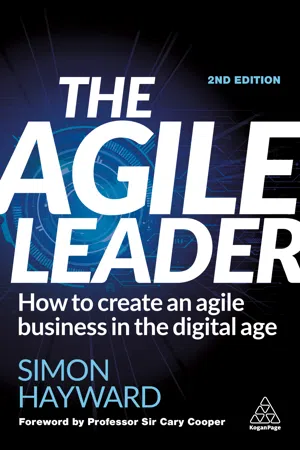
Ever feel like you and your team are stretched across multiple demands or that the goal posts change constantly? Never before have businesses felt so acutely this constant need to adapt, pivot and change tack. This book will teach you how you can not only survive in the context of digital transformation, but also thrive and grow, by adopting a powerful agile leadership model.
This new and revised edition of The Agile Leader lays out clearly in eight steps how agile leaders empower their team to make decision quickly, evaluate correctly where the biggest opportunities are and mould their strategies around market dynamics and ever-changing needs. If there's one leadership skill that successful businesses have in spades, it's the ability to enable teams to adapt and grow within complex eco-systems of clients, partners and suppliers.
By focusing on teamwork and collaboration, as well as promoting shared decision making and ruthless prioritizing, leaders can transform the way they work as well as how their teams function to make them more malleable. Simon Hayward is an agile leadership expert. In this new edition of this successful book, he distills years of leadership and agile research into an actionable 8 step plan, brought to life with examples of agile digital businesses. Learn how to become agile and make digital transformation and delivery part of your business as usual.
- English
- ePUB (mobile friendly)
- Available on iOS & Android
eBook - ePub
About this book
Information
PART ONE
Agile leadership and organizations
CHAPTER ONE
What is agile leadership?
Agility is a rapid whole-body movement with change of velocity or direction in response to a stimulus.
SHEPPARD ET AL (2006)
Introduction
What great leaders do has changed. Time has changed. Digital and pandemic disruption is reducing the time we have to adapt or die. To create and lead organizations capable of succeeding in this environment we need to adapt our leadership approach – to become agile, both as a leader and as an organization. In fact, without agile leaders we cannot have agile organizations. Agile leaders create the vision and the environment where agile teams create innovation and drive constant improvement. To succeed in such complex times, we need to enable our teams to embrace agile ways of working and challenge the status quo. Being an agile leader means being an enabler and a disruptor at the same time – this is the agile leadership paradox, which we will explore as we go.
QUESTIONS TO ASK YOURSELF
In this chapter you may find it helpful to consider the following questions as you read, to help you extract the key insights for yourself as a leader:
- How well have you led others through recent changes in our world?
- Do you think in an agile way?
- Are you more comfortable as a leader being an enabler or a disruptor? How can you achieve a helpful balance?
Leading in a digital disrupted world
Agile leaders are connected leaders. They know how to connect with their team, customers, colleagues and wider stakeholders. They also know how to interpret societal trends that are shaping a new reality around us. The Covid-19 pandemic changed how we work and interact, accelerating digitization and political uncertainty. This creates novel opportunities and raises the threat of obsolescence across products and whole sectors. In this new reality, agile leaders and their teams make choices that define their business success or the achievement of their goals on a day-to-day basis.
At the time of writing this second edition, the effects of the Covid-19 pandemic had been seismic: millions ill and dead, massive unemployment and significant economic disruption. The pandemic also had a major impact on work, with workforce dislocation as well as new levels of flexibility in how we work, and changes to the flow of goods and services across national and regional boundaries challenging global business operations. Such disruption requires a new approach to leadership, one which the agile approach is well suited to provide.
On top of this, technology, and what we can do with it, is transforming human behaviour and how we communicate across sectors and geographies. The explosion of internet connectivity and artificial intelligence is raising questions about who, or what, is in control. It feels like time and space are shrinking and the time we have as leaders to think and respond to changes around us is in danger of diminishing in parallel. The pace at which we can now operate is an amazing achievement driven by mobile technology, the internet, innovative apps and intelligent systems. In this context, we need to create new ways of working that reflect the changing world outside and inside our organizations and enable us to respond to unexpected opportunities and threats with speed and accuracy.
In this digital post-Covid-19 world, where customer experience expectations (and the quality of internal operating models to deliver them) are rising at an ever-faster rate, we need to learn to create an environment for our organizations that can embrace uncertainty and flourish by working in ways we had not even heard of five years ago. For some this will continue to be more incremental change in response to competitive forces, whereas for others it involves wholesale reinvention. The software company moves into hardware, for example. The telecoms company becomes a digital company. The retailer becomes a service provider. The car manufacturer becomes a tech giant. We are all too aware of the ‘Uber moments’ happening around us, where competitors change the rules and structure of our market – Uber has disrupted the taxi market around the world, using an app to change how we travel in cities. Covid-19 has disrupted Uber in a way it probably had not anticipated – disrupting the disruptor.
In this book I am using the term ‘disruption’ in line with the Oxford English Dictionary (2017) definition: ‘disturbance or problems which interrupt an event, activity or process’. This captures the sense of interruption, of challenging established norms, and the level of change needed to flourish in this digital age. I am using the term ‘agile’ to embrace a whole approach to being ‘able to move quickly and easily’ (OED, 2017). To quote from my first book (Hayward, 2016):
Organizational agility presents something of a paradox. You must be able to identify and respond quickly to emerging threats and challenges while at the same time having a firm vision of your strategic plans and coordinated activity to execute them. This paradox is at the heart of connected leadership, with its stable foundations and flexible and evolving ways of working. Creating an organization that is ‘able to move quickly and easily’ needs a strong spine and supple muscles.
Whether we face an Uber moment or not, if we are not evolving at least as quickly as our environment, we are likely to be caught out. A 2020 forecast from IDC estimates that there will be 56 billion internet-connected devices by 2025 (IDC, 2020). These intelligent devices are sensing and responding to data about everything from our heart rates, the movement of goods in supply chains, to volcano temperatures. As this exponential growth in connectivity continues, we are in the middle of a shift where human interaction will no longer be needed for systems around the world to connect, adapt and decide on future actions. In this context the potential for chaos is increasing and the ability for human control decreasing.
Covid-19 has demonstrated how for many of us the risk of an Uber moment in our industry is just around the corner, and it is better to be evolving as quickly as we can rather than waiting for change to be forced upon us. Online retailing, for example, has been an unforgiving battleground over the last decade or so, with many traditional retailers struggling to embrace a digital business model when they are rooted in more ‘bricks-and-mortar’ or paper-based operations. The Covid-19 pandemic accelerated the shift to digital retail in 2020 in a matter of weeks. Consumer expectations are being raised daily by innovations driven by the clever use of technology, such as same-day delivery with online shopping, in-play betting during sporting events, virtual reality gaming experiences, and online sizing for clothing when we can try the garment on and see what it looks like before buying.
Here is how Angela Spindler, ex-CEO of N Brown, the successful UK online clothing retailer, describes the shift it has seen over the last few years. N Brown has moved from being a traditional business that printed catalogues to a digital business trading through a range of brand websites. Angela describes how things changed quickly in the online clothing retail market:
The big difference in the pace of change has been the connectivity of consumers, fuelled by technology, both to each other, the market and the world. This both introduces and accelerates the pace of change and the expectations that consumers have. They know far more about pretty much everything, and it’s at their fingertips, quite literally.
Many of the people and most of the systems have changed in the last few years at N Brown as it has moved quickly to a digitally led retail model. The results have been impressive, but the journey has been painful at times, with changes in business platform, people, and ways of working. In April 2020 another fashion retailer, clothing giant Primark, went from making £650 million in sales a month to nothing as the coronavirus pandemic forced it to close its stores in Europe and the United States (BBC, 2020). The company also wrote down the value of its clothing stock by £284 million at that time. Primark had done well without an online presence, but when the corona-virus struck it was unable to respond effectively in the short term.
This book is a guide for leaders to think and act in an agile way so that you can create an environment where organizational agility can flourish and you can stay relevant even when the rules change, sometimes gradually, sometimes overnight. I will draw on research that is both current and robust, as well as nearly 30 years of working with many international corporate clients to create new leadership practices to transform the way their organizations operate. I will use my own research and that of leading experts in their fields, from both academic and practitioner research sources, so that you can understand what the experts are reporting and interpret this in relation to your own organization. I will explore how agile software development processes work, focusing on Scrum, and what we can learn from them as business leaders. I will also use case studies to explore what various leading organizations are doing to deepen their levels of agility and include extracts from interviews I held with participants in my research. I will provide tools to help you apply this to your own organization, whether you are the CEO or an aspiring CEO.
Most of the organizations I have studied or worked...
Table of contents
- About the author
- Foreword to the second edition
- Foreword to the first edition
- Preface
- Acknowledgements
- Part One Agile leadership and organizations
- 1 What is agile leadership?
- 2 Being an agile leader
- 3 Agile ways of working
- 4 Barriers to agility
- Part Two Becoming an agile leader
- 5 Safe to explore
- 6 Disrupt and innovate
- 7 Prioritization and performance
- 8 Agile execution
- Part Three Making it happen inside and out
- 9 Creating an agile enterprise
- 10 Agility and the network society
- Index
Trusted by 375,005 students
Access to over 1.5 million titles for a fair monthly price.
Study more efficiently using our study tools.
Frequently asked questions
Yes, you can cancel anytime from the Subscription tab in your account settings on the Perlego website. Your subscription will stay active until the end of your current billing period. Learn how to cancel your subscription
No, books cannot be downloaded as external files, such as PDFs, for use outside of Perlego. However, you can download books within the Perlego app for offline reading on mobile or tablet. Learn how to download books offline
Perlego offers two plans: Essential and Complete
- Essential is ideal for learners and professionals who enjoy exploring a wide range of subjects. Access the Essential Library with 800,000+ trusted titles and best-sellers across business, personal growth, and the humanities. Includes unlimited reading time and Standard Read Aloud voice.
- Complete: Perfect for advanced learners and researchers needing full, unrestricted access. Unlock 1.5M+ books across hundreds of subjects, including academic and specialized titles. The Complete Plan also includes advanced features like Premium Read Aloud and Research Assistant.
We are an online textbook subscription service, where you can get access to an entire online library for less than the price of a single book per month. With over 1.5 million books across 990+ topics, we’ve got you covered! Learn about our mission
Look out for the read-aloud symbol on your next book to see if you can listen to it. The read-aloud tool reads text aloud for you, highlighting the text as it is being read. You can pause it, speed it up and slow it down. Learn more about Read Aloud
Yes! You can use the Perlego app on both iOS and Android devices to read anytime, anywhere — even offline. Perfect for commutes or when you’re on the go.
Please note we cannot support devices running on iOS 13 and Android 7 or earlier. Learn more about using the app
Please note we cannot support devices running on iOS 13 and Android 7 or earlier. Learn more about using the app
Yes, you can access The Agile Leader by Simon Hayward in PDF and/or ePUB format, as well as other popular books in Business & Management. We have over 1.5 million books available in our catalogue for you to explore.