This collection of essays is a fitting tribute to Denis Edwards, who was one of Australia's leading theologians. In exploring the most challenging questions of our time, these essays canvas some of the great themes of Christian theology that were the focus of Edwards' research. Denis Edwards was a theologian of dialogue: dialogue with our rich theological tradition, dialogue with science, dialogue with contemporary theologians. The contributors to this volume enter into a dialogue with substantial parts of the theological output of Denis Edwards. In the process, they capture something of his humanity, his love of creation, and his concern for our common home. The book demonstrates the commitment Denis Edwards had to a theology that is truly ecumenical and always learning from the insights of others. The editors and authors have done a great service in helping many others to deepen reflection on Denis Edwards' contribution to our understanding of God and the natural world.
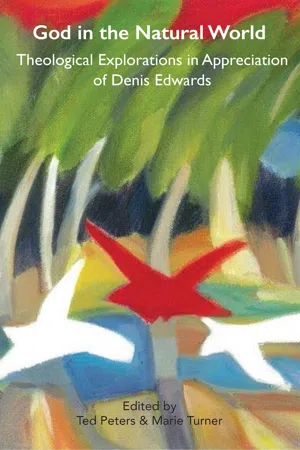
eBook - ePub
God in the Natural World
Theological Explorations in Appreciation of Denis Edwards
- 416 pages
- English
- ePUB (mobile friendly)
- Available on iOS & Android
eBook - ePub
God in the Natural World
Theological Explorations in Appreciation of Denis Edwards
About this book
Trusted by 375,005 students
Access to over 1.5 million titles for a fair monthly price.
Study more efficiently using our study tools.
Information
Topic
Theology & ReligionSubtopic
Christian TheologyIs the Universe a Sacrament? Denis Edward’s Contribution to Sacramental Thinking
At a more fundamental level still, Jesus of Nazareth is the fundamental sacrament of God in the world. He is the radical expression of, and mediation of, divine self-bestowal.
Denis Edwards.1
Abstract: The article discusses Denis Edwards’ expansion of sacramental thinking into the view of a deep sacramental presence of Christ in the world of nature. Edwards uses Karl Rahner’s theology as a matrix for his own thinking but I argue that he adds important new aspects to Rahner’s sacramental theology. First, he prioritizes a deep Christology over the sacramental view of the church; second, he emphasizes a corresponding deep pneumatology, in which the Spirit of God opens up human minds for experiencing grace in our interactions with nature. Edwards’ view of the sacramentality of nature is in line with the Encyclical Laudato si’ from 2015, which sees the world of creation as ‘a sacrament of communion’ but his emphasis on the interaction between human beings and nature leads him to a more concrete approach to events of grace within that communion.
Keywords: Denis Edwards; Karl Rahner; Paul Tillich; Laudato si’, deep incarnation; sacramental theology
‘Do we experience God in our encounters with birds, animals, tree, forests, mountains, deserts and beaches?’ Denis Edwards raises this question in an essay on human experiences of Word and Spirit in the world of nature,2 and he responds in the affirmative, based on theological arguments derived from Athanasius and Karl Rahner. Edwards brings in his own spiritual experiences with engrossing landscapes and rivers on the Australian continent too. He is not a Romanticist with a rosey view of nature, however, for he is fully aware of the ambiguities of nature. Since all life is lived at the expense of other life, mother Earth is not only a space for positive experiences of wonder and beauty but also a space of pain and suffering. ‘The natural world is both unspeakably beautiful and also a place of competition and violence.’3 While already empirical observations point to the mixture of joy and woe in nature, evolutionary theory shows its inescapability. Since God is the source of all that is, theology too has to acknowledge that joy and pain are interconnected in the development of living organisms. In the uncompromising words of the Danish philosopher-theologian KE Løgstrup, ‘the Creator has coupled development and decay together in His creation . . . God’s act of creation is terrifying in its splendor and annihilation; it exceeds our intellectual and emotional apprehension.’4
The fact that nature is indeed a mixed package seems to foreclose any reference to the nature as a sacrament. Indeed, Edwards nowhere declares that nature is a sacrament in the strict sense of the term, fully in parallel to the sacraments of the church, which are accompanied by an unambiguous divine promise of salvation. Yet Edwards insists that people sometimes do encounter God—even the gracious presence of God the Father, Son and Spirit—in their everyday encounters with nature. And he is arguing that since the co-suffering of Christ is present in the midst of our cruciform creation, there is a sacramental presence of Christ also in states of decay and pain.
So, what is the difference between saying that nature simply is a sacrament, and saying that we need to extend our sacramental thinking so that we can receive the grace of God in our encounters with nature too, in joy as well as in woe? What is the difference between being a sacrament and having the potential of becoming a sacrament? What are the differences and continuities between the sacramental potentials of nature, and the sacraments of the church? These are the questions to be explored in this essay.
Denis Edwards’ View of Sacramentality: The Inspiration from Athanasius
In his sacramental thinking, Denis Edwards often goes along with two of his principal theological sources, bishop Athanasius of Alexandria (c 298–373) and Karl Rahner, SJ (1904–1984). Athanasius has played a growing role in Denis Edwards’ work, as can be seen in many essays from recent years.5 Yet the theology of Karl Rahner has been the companion of Denis Edwards throughout, and I will therefore go into more detail with his reception of Rahner, noting what he is takes in from Rahner, what he does not receive, and what he adds of his own to Rahner’s work. As I will argue, only the encyclical Laudato si’, issued by Pope Francis at Pentecost 2015, provides the broader perspective for Denis Edwards’ view of the sacramentality of the world of creation.
With Athanasius, Edwards underlines the immediacy of God’s Wisdom/Word to each creature individually, and in sustaining the body of the world at large.6 In Athanasius’ anti-Arian theology, there exists no intermediary buffers between the Triune God and the world of creation; rather, the deep unity between God’s creation of the cosmos and God’s saving presence in the incarnate Word and through the divine Spirit is the fundamental Christian assumption. The Father’s love of humanity (philanthropia) can only be mediated only by the immediacy of God Godself, that is, by the incarnation of the same divine Logos by which the world was brought into being from the beginning. In God’s incarnational reach, God’s own Son, Word or Wisdom, comes down to earth to live with and for the creatures, and through full re-connection of the divine Logos with the whole of creation, the Spirit of God lifts up the world of creation into participation with the Triune God. ‘Every creature on Earth, every whale, every sparrow and every earthworm exists by participation in the Father through the Son and in the Spirit—not one of them is forgotten in God’s sight (Lk 12:6).’7
Sacramentality and Deep Incarnation: Karl Rahner and Denis Edwards
With Karl Rahner, Edwards shares the emphasis on the ‘mysticism of everyday life’.8 Rahner’s view of the self-endowment of the transcendent God in the world of creation may be said to undergird Edwards’ understanding of the universe as having a potential sacramental value for human beings, that is, a potential for becoming an effective medium of divine grace by the divine Spirit.
Let us now take a look at Denis Edwards’ own understanding of the sacraments: ‘In Christian theology, a sacrament is a visible sign and agent of divine self-bestowal.’9 The underlying thrust of Denis Edwards’ Rahner-inspired thinking may be rendered as follows: Since (1) the transcendent God is radically present in the world by the divine self-bestowal, and since (2) no natural event is without the grace of the self-giving God, (3) no theologian is entitled to say that natural events cannot become embodied carriers of divine grace for human beings. I here phrase this underlying argument cautiously, since it only says that there no barriers to the access of grace, no divine self-withdrawal involved in God’s self-giving, even though the world of nature, as we saw above, remains ambiguous. Therefore, I suggest to make distinction between affirming the sacramental potentials of nature while not equating the sacramental potentials of nature with the sacraments of the church. For only the latter are accompanied with the divine promise, or donor intention, that the grace of God is offered in the message and sacraments of church in unambiguous form.10 While the divine grace is omnipresent in Rahner, it is not omnimanifest, we may say.
Denis Edwards, too, takes his point of departure in the concrete sacraments before discussing the sacramental presence of Christ in the universe. The prime instances of sacrament are to be found in the midst of the life of Christian communities, like Baptism and the Eucharist. These are the sacraments in the proper sense, since they are accompanied by the promise of the self-donating God that will be present there for us. On this basis Edwards presents the Roman-Catholic view that ‘the church itself has a sacramental nature. It is a sign and agent of communion with God and of human community, called to be the universal sacrament of salvation’.11 This is fully in line with Rahner too, but it is worth noting some subtle differences of emphasis. First, Rahner consistently writes the Church with capital letters with reference to the hierarchical body of the Roman-Catholic Church, while Edwards omits any reference to the church as having a particular social shape with a particular ‘juridical composition’, as Rahner puts it.12 Second, Edwards refers to the ‘calling’ of the church to be a sacrament for all people, rather than simply stating a given fact. Third, and in the same line, Edwards omits any reference to Rahner’s view that the sacraments of the Church are visible and efficient means of grace that are at work ex opere operato, that is, valid prior to and independently from the individual reception of grace. Fourth, and most importantly: While Rahner views the Church as the ‘primary sacrament of the grace of God’,13 Edwards is very clear in stating that it is Christ who is the primary sacrament:
At a more fundamental level still, Jesus of Nazareth is the fundamental sacrament of God in the world. He is the radical expression of, and mediation of, divine self-bestowal. As the incarnate Word and Wisdom of God, he is the sacrament of divine self-bestowal in the world. He is the real symbol of God, in which God is manifested and acts in a world of matter and flesh.14
Edwards here appropriates ...
Table of contents
- Cover
- Title Page
- Copyright
- Table of Contents
- Introduction Marie Turner
- Contributors
- From God to Nature and Back Again
- From Deep Incarnation to Deep Divinisation
- From Evolution to Eucharist to Ecology
- From Spirit to Life in a Scientific Age
- From Deep Crucifixion to Deep Resurrection: Biblical Perspectives
- Chapter Quotations
- Bibliography of Works by Denis Edwards
- Biblical References
- Author and Subject Index
Frequently asked questions
Yes, you can cancel anytime from the Subscription tab in your account settings on the Perlego website. Your subscription will stay active until the end of your current billing period. Learn how to cancel your subscription
No, books cannot be downloaded as external files, such as PDFs, for use outside of Perlego. However, you can download books within the Perlego app for offline reading on mobile or tablet. Learn how to download books offline
Perlego offers two plans: Essential and Complete
- Essential is ideal for learners and professionals who enjoy exploring a wide range of subjects. Access the Essential Library with 800,000+ trusted titles and best-sellers across business, personal growth, and the humanities. Includes unlimited reading time and Standard Read Aloud voice.
- Complete: Perfect for advanced learners and researchers needing full, unrestricted access. Unlock 1.5M+ books across hundreds of subjects, including academic and specialized titles. The Complete Plan also includes advanced features like Premium Read Aloud and Research Assistant.
We are an online textbook subscription service, where you can get access to an entire online library for less than the price of a single book per month. With over 1.5 million books across 990+ topics, we’ve got you covered! Learn about our mission
Look out for the read-aloud symbol on your next book to see if you can listen to it. The read-aloud tool reads text aloud for you, highlighting the text as it is being read. You can pause it, speed it up and slow it down. Learn more about Read Aloud
Yes! You can use the Perlego app on both iOS and Android devices to read anytime, anywhere — even offline. Perfect for commutes or when you’re on the go.
Please note we cannot support devices running on iOS 13 and Android 7 or earlier. Learn more about using the app
Please note we cannot support devices running on iOS 13 and Android 7 or earlier. Learn more about using the app
Yes, you can access God in the Natural World by Ted Peters and Marie Turner in PDF and/or ePUB format, as well as other popular books in Theology & Religion & Christian Theology. We have over 1.5 million books available in our catalogue for you to explore.