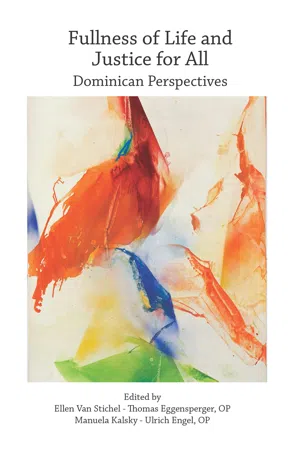
Poverty, inequality, violent conflicts, climate change, migration, racism, burn-out are just a few of the symptoms showing how living life to the fullest is out of reach for so many people in our world. Is, then, seeking 'fullness of life and justice for all' not a too ambitious project? For nothing less than the wellbeing of humanity – and in extension, the whole of creation – is at stake. On the other hand, we see people responding, acting and struggling for justice, liberation and a more sustainable world. How to make sense of the ideas of fullness of life and justice for all, in light of the many crises humanity currently faces but also the glimpses of positive and hopeful responses? Even more so, how to make sense theologically? In this volume twenty authors reflect on how the notions of fullness of life and justice for all are theoretically conceived and have practically taken form from within Dominican theology and spirituality. The contributions on youth spirituality, contemplation, art as a means to community building, gender, pluralization, populism and management discuss the fullness of life in both its material and spiritual dimensions. The question on justice for all is raised in confrontation with issues such as poverty, migration, ecological threats and the role of virtues in society. In this way, the book aims to uncover a variety of Dominican perspectives as valuable contributions to a broader dialogue on the fullness of life and justice for all.
eBook - ePub
Fullness of Life and Justice for All
Dominican Perspectives
- 342 pages
- English
- ePUB (mobile friendly)
- Available on iOS & Android
eBook - ePub
Fullness of Life and Justice for All
Dominican Perspectives
About this book
Trusted by 375,005 students
Access to over 1.5 million titles for a fair monthly price.
Study more efficiently using our study tools.
Information
Topic
Theology & ReligionSubtopic
Christian TheologyHow to Link Fullness of Life and Justice for All? Theological Explorations Inspired by Schillebeeckx and Lebret
The Christian theological-ethical understanding of fullness of life is strongly influenced by Aristotle’s explicit use of the notion ‘the good life’ and his particular interpretation.1 The human search for sustainable and long-lasting happiness (eudaimonia) is related to living a ‘good life’, understood by the Greek philosopher as striving to actualise one’s full potential and self-realisation. Although this natural inclination to human flourishing is an individual striving of each person, this process includes an undeniable social aspect.2 Since human beings are ‘social and political animals’ in Aristotle’s view, the ‘good life’ entails developing and sustaining human’s social dimension, referring to both their direct and indirect relationships (respectively family ties, friendship and larger networks through organisations, society and politics). Being part of a community, and actively contributing to it, is an indispensable aspect of human flourishing.3 As a result, development of the self and of the community, or put differently: the human good and the common good, are intertwined.
Theologically speaking, as shown in the first chapter of this volume, fullness of life cannot be reduced to the earthly ‘good life’; the ultimate good is bound to God self and humans’ union with God. However, this does not diminish the importance of striving for the best human good possible. Rather the opposite, Thomas Aquinas argues, because the communion sought with God, is analogous with the terrestrial communion people can and should try to establish.4 Hence, integrating Aristotle’s reflections with Christian theology, led the Dominican theologian to argue that the ‘true good of persons is communion with other persons, [and] not something that can be enjoyed in solicitude’.5
Today, this interpretation of the ‘good life’ is regarded with an amount of suspicion. Especially, seeking fullness of life is highly questioned as a communal project. Inspired by an individualistic anthropology and radical shift in (world) view, political philosophers such as Thomas Hobbes and John Locke considered the common search as an impossibility and unrealistic ideal. In Thomas Hobbes’ view, human beings are not inclined towards the common good—rather the opposite: conflict prevails. The individual(‘s) search for personal flourishing leads to a ‘war of all against all’, which can only be escaped by obeying to an absolutist political power. John Locke in his turn considered cooperation and thus social life possible on the basis of a voluntary agreement among individuals whose individual rights are primordial and should be guaranteed in this social contract. For both philosophers, ‘the Aristotelian conception of natural sociability is replaced with the idea that society is held together by an artificial pact’.6 The result was a focus on ‘the rights’ of the individual, at the expense of ‘the good’ in general and of the community in particular.
More recently, philosopher John Rawls argued that such a common search and shared understanding of the good is impossible in a pluralistic society.7 Rather we have to focus on the ‘right’ instead of the ‘good’. Moreover, society should be neutral towards any particular view on the ‘good life’; tolerance becomes the supreme value of society. In this view, ‘justice for all’ implies organising the public sphere in such a way that it provides the necessary space for each individual to seek the fulfillment of the ‘good life’ as s/he conceives it personally.8 The public sphere, however, is not the space to search for the common ground on what human flourishing entails; non-interference should characterise its strategy. More recently these arguments seem to gain influence in our societies, because of increasing conflict and fear between different (faith) communities, and the consequential polarisation of views. The common search for the good life for all appears within this context as problematic and, more than ever, as highly unrealistic. Hence the question: do public theological discourses on the fullness of life still have a role to play?
A Catholic interpretation of justice challenges exactly the former presupposition of a discrepancy between the seeking of fullness of life (as belonging to the private sphere) and justice for all (as a matter of the public sphere to sketch the contours in which seeking one’s flourishing in the private sphere is safeguarded). Catholic social teaching’s particular understanding of both reflect how they are interlinked. To show this, a more fundamental question arises, namely why the question of justice for all is included in the notion of fullness of life in the first place: why does this matter theologically at all? Within the scope of this volume, we can find inspiration in the work of two Dominicans thinkers, Edward Schillebeeckx and Louis-Joseph Lebret. While Schillebeeckx’ thoughts are more suited in answering the question why the ‘fullness of life and justice for all’ is of any theological interest in the first place (or why should it be), Lebret laid the foundation for theology’s understanding on how fullness of life is linked with justice for all. As will become clear, his interpretation of ‘integral development’ is up till today influencing Catholic social teaching’s continual reflection on human flourishing and its subsequent link with notions as justice and the common good.
Why Fullness of Life Includes Justice for all: Some Theological Arguments
What are the arguments for explaining why the theme of fullness of life should include justice for all? In his Mensen als verhaal van God (Church: The Human Story of God), Dominican Edward Schillebeeckx argues convincingly and inspiringly how the commitment to human flourishing, including a struggle for justice, is an inevitable part of Christian faith because of God’s self-revelation. God’s salvation for humankind is not exclusivist, but universal and thus ‘for all’; neither is it merely eschatological and future-oriented, but it is also already perceptible in the present; nor is it merely spiritual, but also material and thus takes all aspects of human flourishing into account.
‘Contrast experiences’ give human beings insight in what this fullness of life is about when we feel ‘spontaneously’ that something is ‘fundamentally wrong’ with the world as it is and express a ‘veto’ to current state of affairs. We feel indignation. This, for Schillebeeckx, is the positive element of the contrast experience, because the indignation felt reveals an awareness of the humanum, an openness to a different situation which is, however, undefined, unknown and open, but is in any case far better.9 The result is protest and opposition to the current situation, legitimised and made possible by this ‘open yes’. Such contrast experiences are pre-religious and universal experiences, accessible to all, he claims. For Christians, these experiences refer to God. To the extent that human history entails a liberating history, developing itself in the direction of more humanity, human history is God’s saving history. For God is a salvific presence in human history, whether or not we are aware of it and explicitly signify it as such. ‘There exists no situation whatsoever in which God could not be near us and we would not be able to find God.’10 This divine presence is not to be reduced to religions. Rather, it is in the world and human history that salvation is to be found: ‘no salvation outside the world’. God promises the eschatological fulfilment for every human being, breaking up history to realise that. This grace will, however, not vertically be bestowed on us; it is in and through the world that God is working for human liberation, mediated by the agency of human beings.11
By recognising an active and salvationist presence of God among humanity, of which traces can be found in the struggle against oppression and injustice and the establishment of more just and peaceful relationships, the Kingdom of God manifest itself.
The Kingdom of God is a changed new relationship (metanoia) of men and women to God, the tangible and visible side of which is a new type of liberating relationship among men and women within a reconciling society and a peaceful natural environment.12
This Kingdom will never be fully achieved through human actions and remains thus out of reach, but at the same time every concrete realisation of justice and liberation in solidarity is a sign of its dawning, as Erik Borgman notes. Rather than striving for an unreachable ideal, human actions pointing to and in fact establishing the Kingdom of God are expressions of the ‘art of the impossible, as possibility’.13 We can begin to establish the Kingdom of God, not as an ideal which we must implement, but as already being present in this world and thus given as a possibility as the signs show. ‘The impossible ap...
Table of contents
- Cover
- Title Page
- Copyright
- Table of Contents
- Introduction Ellen Van Stichel, Thomas Eggensperger, OP, Manuela Kalsky, Ulrich Engel, OP
- Biblical Introduction
- Fullness of Life and Pluralism
- Fullness of Life and Ecology
- Fullness of Life and Justice
- Fullness of Life and Embodiment
- Fullness of Life and Spirituality
- Fullness of Life and Society
- Authors
- Index of Names and Organisations
Frequently asked questions
Yes, you can cancel anytime from the Subscription tab in your account settings on the Perlego website. Your subscription will stay active until the end of your current billing period. Learn how to cancel your subscription
No, books cannot be downloaded as external files, such as PDFs, for use outside of Perlego. However, you can download books within the Perlego app for offline reading on mobile or tablet. Learn how to download books offline
Perlego offers two plans: Essential and Complete
- Essential is ideal for learners and professionals who enjoy exploring a wide range of subjects. Access the Essential Library with 800,000+ trusted titles and best-sellers across business, personal growth, and the humanities. Includes unlimited reading time and Standard Read Aloud voice.
- Complete: Perfect for advanced learners and researchers needing full, unrestricted access. Unlock 1.5M+ books across hundreds of subjects, including academic and specialized titles. The Complete Plan also includes advanced features like Premium Read Aloud and Research Assistant.
We are an online textbook subscription service, where you can get access to an entire online library for less than the price of a single book per month. With over 1.5 million books across 990+ topics, we’ve got you covered! Learn about our mission
Look out for the read-aloud symbol on your next book to see if you can listen to it. The read-aloud tool reads text aloud for you, highlighting the text as it is being read. You can pause it, speed it up and slow it down. Learn more about Read Aloud
Yes! You can use the Perlego app on both iOS and Android devices to read anytime, anywhere — even offline. Perfect for commutes or when you’re on the go.
Please note we cannot support devices running on iOS 13 and Android 7 or earlier. Learn more about using the app
Please note we cannot support devices running on iOS 13 and Android 7 or earlier. Learn more about using the app
Yes, you can access Fullness of Life and Justice for All by Ellen Van Stichel, Thomas Eggensperger OP, Manuela Kalsky and Ulrich Engel OP in PDF and/or ePUB format, as well as other popular books in Theology & Religion & Christian Theology. We have over 1.5 million books available in our catalogue for you to explore.