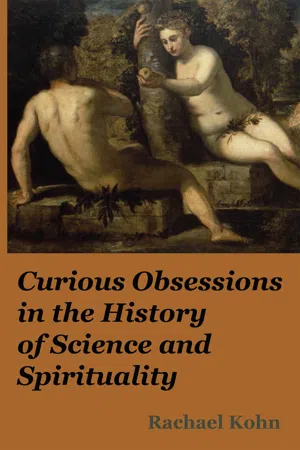
It is a delicious quirk of history that individuals dismissed by their contemporaries as eccentrics and troublemakers are often those with the most impact on the world. Curious Obsessions in the History of Science and Spirituality is a captivating look at the famous and the forgotten who emerged in times of extreme change and social disruption to change science and spirituality for ever. During our current Covid19 pandemic, this collection is highly relevant to a world still seeking novel answers to the human condition and also drawn to old theories long ago debunked. 'Curious Obsessions is one of those rare books you just don't want to put down. It is full of delicious stories, enlightening insights and valuable information… From the very beginning the reader is drawn in by Rachael's quiet approach - respectful, keenly insightful often very funny!' Maireid Sullivan, GlobalArtsCollective
- 210 pages
- English
- ePUB (mobile friendly)
- Available on iOS & Android
eBook - ePub
About this book
Trusted by 375,005 students
Access to over 1.5 million titles for a fair monthly price.
Study more efficiently using our study tools.
Information
Topic
Theology & ReligionSubtopic
Religion & ScienceChapter 1
Nuns, Sex and The Vatican
In the international waters of the St Lawrence Seaway between Canada and the United States, nine women in white cassocks lay prostrate in a boat during the ceremony that would ordain them as priests and deacons. It was 25 July 2005, and under the auspices of Roman Catholic Women priests, an American organisation, they defied the Vatican’s refusal to ordain women.1 A similar ceremony was held in 2002 on the Danube River by the German group Weiheämter für Frauen between Germany and Austria. After ordination, these women ministered in a variety of settings but without the approval of the Vatican, although it seems they did find quiet support among some priests. While nuns are among those who wish to be ordained, they could not openly partake in such a brazen rejection of Vatican authority without endangering their own position in the Church and that of their order. But it was not for want of trying. Back in 1971, thirty-five-year-old Celine Goess—a Sister of Mercy of Holy Cross in Birch Run, Michigan—wrote to her bishop asking to be ordained as a deacon. She received a scathing letter in reply, telling her not to ask ‘stupid’ questions. Now, older but no less determined to see her desire fulfilled—if not for herself, then for others in the future—she serves on the board of the Detroit-based Women’s Ordination Conference.2
Some of the most independent and spirited women I have ever met are Catholic nuns. They are also among the most educated and far-thinking about their faith. In fact, most of the nuns I’ve met are nothing like their popular image as old- fashioned and submissive. It is an image that dies hard, however, even among journalists, who are usually heat-seeking missiles when it comes to obliterating holier-than-thou religion. A story about the transformation of a Brigidine convent into a nursing care facility in Sydney was a case in point. All the nuns, including a sharp-minded octogenarian, wore slacks and T-shirts, but the press article featured a photo of the only nun who insisted on wearing the outmoded black-and-white habit, complete with wimple. It is just the sort of cliché that sells newspapers, but the reality of a nun’s life is very different from the anachronistic stereotype the picture conveyed. In fact, journalists are none the wiser because they almost never ask nuns what they think of the Church. Quite possibly, they could not publish what they heard, because although nuns are often very critical of the hierarchy under which they nominally must take their place, the price of their hard-won freedoms is discretion, with ‘off the record’ comments being the norm. So while nuns do have a record of dissenting from authority, they are practised in keeping just enough distance to avoid arousing suspicion from or causing embarrassment to the Church, which they love and serve. Most nuns are not attention-seekers, and are used to achieving their ends within the system. Occasionally, however, feisty nuns who have risked all to follow their passion have failed to keep their superiors at bay. Occasionally they even have won them over.
Nuns have a long history of not running with the crowd, and some of them achieved fame well beyond their community. Today the popularity of German mystic, musician and abbess Hildegard von Bingen (1098–1179), the English Benedictine anchoress and mystic Julian of Norwich (1342–1423) and the Spanish Carmelite, Teresa of Avila (1515–82), has reached into all manner of contemporary spirituality. Their unfettered expressions of love for God and creation, in contrast to the turgid language of Church doctrine, have great appeal. Their love of beauty touches that part of the soul which recognises the glory of God in the wonders of creation. Even the conventions of monastic dress, already well established by the medieval period, were thrown aside by the Abbess Hildegard, who had no taste for rough cassocks and dark colours. In the illuminated manuscript The Garden of Delights, she depicted her nuns in the brilliant red and purple veils of secular dress. She was criticised at the time for her lavish tastes, but that did not stop her from designing elaborate crowns for her nuns.3
Just about every country has had its share of remarkable nuns, but in Australia their daring had less to do with radical mysticism and extravagant visions and more to do with practical ventures, like Mary MacKillop’s schools for deprived children. On reflection, perhaps the mystical union with God and the practical care of the needy are not so different. After all, it is in the act of humbly serving others that Jesus of the Gospels demonstrated to his followers the way of the Lord. Such active faith is certainly a more convincing act of holiness than the artificially contrived suffering and sacrifice that nuns were meant to endure behind the high walls of a convent or in an anchor hold. In any case, the realities of monastic life were not always consistent with that contemplative and holy ideal. A look at sixteenth-century Venice, which had more convents than anywhere in Europe, shows that a nun’s life was not always as straitlaced as might be imagined.
There had been nuns in Venice since 640, when a Benedictine community of San Giovanni Evangelista (St John the Evangelist) was founded on the island of Torcello. A millennium later the population of nuns had grown to over three thousand, housed in fifty nunneries in Venice and its islands. By then, however, the reputation of nuns had suffered serious damage. The Protestant Reformation aimed some of its criticism of the Roman Church directly at the convents, which were described as dens of decadence, cruelty and lascivious behaviour. While this could not be said of all convents, neither could the published accounts of ‘escapees’ be dismissed as mere Protestant propaganda, since the Church itself was becoming sufficiently nervous about the activities of nuns to initiate its own investigation. Its recorded interviews with nuns have provided Oxford scholar Mary Laven with an unprecedented first-hand account of the cloistered life in the legendary city.4
Sending papal investigators into the Venetian nunneries to document the conditions therein was one of the means by which the Church of Rome in the late Renaissance arrived at its policy of enclosing nuns in communities behind high walls and secured by locked doors. The Council of Trent, the great reforming council of the Church, imposed policies that were meant to regulate the conduct of nuns, which at the time showed an alarming degree of variation and at times flagrant disregard for the life of chaste obedience expected of the Brides of Christ. This should have surprised no one, since convents were often considered ‘dumping grounds’ for girls and women of noble families who, for one reason or another, were not destined for married life. Perhaps the girl’s parents had an insufficient dowry to pay for a good marriage or, conversely, there was no suitor worthy of her station. Alternatively, fear of childbirth, the single greatest cause of female mortality at the time, or unlovely looks, might send a young woman into the care of Mother Superior. The convent was also the only decent option for daughters born of illicit relationships, such as that between the world-renowned scientist Galileo Galilei and the Venetian beauty Marina Gamba. Illegitimate girls were unmarriageable except to Christ Himself.5 A litany of practical rather than religious reasons could land a girl in a convent, but once there she was not necessarily on her own. Cousins, aunts and sisters might be there as well, and an extended family of women could take up residence in their ‘corner’ of the convent, complete with their own furnishings, wine store, and even the elegant clothes for which Venice was famous. This caused no end of rivalries in the communities in which they lived and undoubtedly led to the complaints against one another that the investigators duly noted. What is clear from Mary Laven’s thorough study is that the nunneries experienced their greatest turmoil when friars and other men of the Church intervened in their affairs, often to oversee if not engineer the election of a favoured abbess. Sometimes these men of the cloth took up temporary residence in the convents just to partake of the nuns’ larder and largesse. This frequent occurrence led to further scandalous rumours—especially when a nun and a friar went missing.
One of the most infamous of such cases in Italy involved the renowned Florentine Renaissance painter and Carmelite friar Filippo Lippi, whose love affair with the nun Lucrezia Buti resulted in two children. Eventually they were released from their vows and married; and Lippi continued to depict his wife in many of his religious paintings. The much-loved and -admired artist got off lightly; others who were caught in flagrante delicto and had no friends or relatives in the Vatican were threatened with imprisonment and castration. The most notable victim of the latter was the twelfth-century priest Peter Abelard, the poet and theologian who fell passionately in love with his student Heloise and made her pregnant. Heloise, herself a gifted woman of letters, bore their child, but refused ‘the chains of marriage’, and insisted instead on becoming a nun and a lifelong friend to Abelard. At a time when Church records show the practice of priests taking concubines was so widespread that ex-cathedra directives forbidding such priests from conducting mass were necessary, Abelard’s castration at the behest of Heloise’s uncle, Canon Fulbert, seems particularly tragic and cruel. Indeed, such became the decadence of the papacy later on, at the height of the Renaissance, the notorious Rodrigo Borgia, who became Pope Alexander VI in 1492, was even said to have fathered a son to his daughter Lucrezia. After him, Pope Leo X (Giovanni de Medici of Florence), who schemed to make his bastard cousin the next pope, wrote to his brother, saying, ‘God has given us the papacy; let us enjoy it’. This they did, indulging in all the physical pleasures normally enjoyed by princes.6
It is no wonder that nuns were not always models of obedience and prayerful devotion, especially when some of them had no calling to the religious life. ‘Forced vocations’ were both a necessity and a curse. Although the Council of Trent made it clear that they were forbidden, and various measures were advocated to relax the stringent obligations of monastic life for women—such as fasting and wearing rough clothes—there were still those who argued in favour of forced vocations. In 1619 the Venetian Patriarch Giovanni Tiepolo warned:
If the two thousand or more noblewomen, who in this City live locked up in convents as if in a public whorehouse, had been able or had wanted to dispose of themselves differently, what confusion! What damage! What disorder! What dangers! What scandals and what terrible consequences would have been witness for their families and for the City!7
It would be hard to imagine women meekly accepting such statements without responding in kind. The Patriarch would later find his match in a nun who made it clear in her writings that her parents had forced her into the convent, and that she was but one of many women who were similarly deprived of their liberty. Elena Cassandra Tarabotti (1604–52) was one of five daughters of a Venetian merchant family. She had been sent to a Benedictine monastery at the age of twelve, where she later took vows. Ironically, when the Patriarch Giovanni Tiepolo relaxed some of the restrictions on monastic life in 1629, she criticised his grand gesture by saying, essentially, that it was too little too late. Although she could not leave the monastery, she was permitted visitors, including members of the Accademia degli Ingoniti, progressive thinkers who kept her informed of current debate and brought her books. It was through them that her works were published. Initially she wrote two volumes, Paternal Tyranny (La tirannia paterna), and The Monastic Hell (L’inferno monacale), which she circulated to friends. Undoubtedly, such written criticism of the Church put her in some danger, and in 1643 she published a work in praise of monastic life, The Monastic Paradise (Il paradiso monacale), for those who had freely chosen it. In 1654, two years after her death, Simplicity Deceived (La semplicita ingannata) was published, reviving her criticism of the Church for allowing the coercion of women. Tarabotti, whose religious name was Arcangela, was by all accounts a woman ready to engage the debates of her day; she even penned a treatise on a woman’s right to beautify herself.
The irony is that locking up women in convents only served to powerfully increase their allure, and the analogy to the whorehouse is easily made. While the median age of Catholic nuns today is around sixty, such was not the case in the past. A collection of virginal women, who in some instances were kept against their will, was shrouded in mystery yet dependent on the outside world for support. They earned their keep through the sale of baked goods and other manufactured products, such as textiles and lace. Such a ‘female factory’ drew its share of loitering males, who sometimes serenaded the nuns from the streets when they were not trying to get inside in the guise of handymen, delivery boys or even me...
Table of contents
- Cover
- Title Page
- Copyright
- Table of Contents
- Acknowledgments
- Preface to the Revised Edition
- Introduction
- 1. Nuns, Sex and the Vatican
- 2. Dying to Know About the Stars
- 3. Mad About Books
- 4. The Ten Lost Tribes
- 5. The Spiritual Art of Medicine
- 6. The Snake Goddess and Mrs God
- 7. The Lost Race of Giants and Aryans
- 8. The Allure of the East
- 9. When Religion Became Science
- 10. Utopian Dreams
- Index
Frequently asked questions
Yes, you can cancel anytime from the Subscription tab in your account settings on the Perlego website. Your subscription will stay active until the end of your current billing period. Learn how to cancel your subscription
No, books cannot be downloaded as external files, such as PDFs, for use outside of Perlego. However, you can download books within the Perlego app for offline reading on mobile or tablet. Learn how to download books offline
Perlego offers two plans: Essential and Complete
- Essential is ideal for learners and professionals who enjoy exploring a wide range of subjects. Access the Essential Library with 800,000+ trusted titles and best-sellers across business, personal growth, and the humanities. Includes unlimited reading time and Standard Read Aloud voice.
- Complete: Perfect for advanced learners and researchers needing full, unrestricted access. Unlock 1.5M+ books across hundreds of subjects, including academic and specialized titles. The Complete Plan also includes advanced features like Premium Read Aloud and Research Assistant.
We are an online textbook subscription service, where you can get access to an entire online library for less than the price of a single book per month. With over 1.5 million books across 990+ topics, we’ve got you covered! Learn about our mission
Look out for the read-aloud symbol on your next book to see if you can listen to it. The read-aloud tool reads text aloud for you, highlighting the text as it is being read. You can pause it, speed it up and slow it down. Learn more about Read Aloud
Yes! You can use the Perlego app on both iOS and Android devices to read anytime, anywhere — even offline. Perfect for commutes or when you’re on the go.
Please note we cannot support devices running on iOS 13 and Android 7 or earlier. Learn more about using the app
Please note we cannot support devices running on iOS 13 and Android 7 or earlier. Learn more about using the app
Yes, you can access Curious Obsessions by Rachael Kohn in PDF and/or ePUB format, as well as other popular books in Theology & Religion & Religion & Science. We have over 1.5 million books available in our catalogue for you to explore.