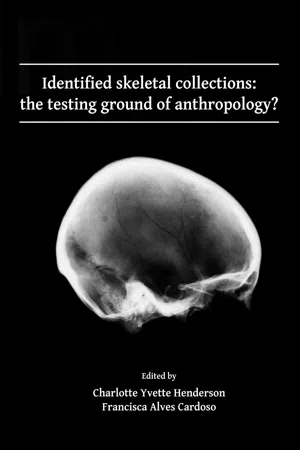
Human skeletons are widely studied in archaeological, anthropological and forensic settings to learn about the deceased. Methods used to identify individuals in forensic contexts and to determine age and sex in archaeological settings are normally tested on identified skeletal collections: collections of skeletons with known age-at-death, sex, often occupation and cause of death. These collections often represent individuals dying within the last century, but this is variable and often depends on the purpose for creating the collection. Many were developed in attempts to understand local population biology whereas those collected recently are for forensic purposes: to improve identification in legal contexts. Some of these collections were developed from body donation programmes, while others have come from cemeteries: cemeteries which were either no longer viable or needed clearing. All these factors impact on who curates these collections: archaeology or anthropology departments and museums. However, unlike many other skeletons curated in these locations, these are individuals with names. All this raises ethical questions about their creation, curation and their use for research. This book focusses on identified skeletal collections in the UK, Portugal, South Africa, USA and Canada. The chapters discuss how and why collections were amassed including the local legislation governing them. Alongside this run the ethical issues associated with their collection, curation and access to them. The demographics of the collections: who is included and why, along with such biases and how they can impact on research are also discussed, as are limitations in the documentary data associated with these individuals. The importance of these collections is also focussed on: particularly their role in developing and testing methods for age determination in adults. This shows why these collections are so vital to improve methods and interpretations for archaeological and forensic research. The importance of communicating this to the wider public is also addressed.
eBook - PDF
Identified skeletal collections: the testing ground of anthropology?
- 198 pages
- English
- PDF
- Available on iOS & Android
eBook - PDF
Identified skeletal collections: the testing ground of anthropology?
About this book
Information
Table of contents
- Cover
- Copyright information
- Contents
- Introduction
- Archaeological human skeletal collections: their significance and value as an ongoing contribution to research
- The Grant Human Skeletal Collection and Other Contributions of J. C. B. Grant to Anatomy, Osteology, and Forensic Anthropology
- Strategies for Dealing with Bias in Identified Reference Collections and Implications for Research in the 21st Century
- Bioarchaeology and Identified Skeletal Collections: Problems and Potential Solutions
- tThe significance of identified human skeletal collections to further our understanding of the skeletal ageing process in adul s
- Secular changes in cranial size and sexual dimorphism of cranial size: a comparative analysis of standard cranial dimensions i two Portuguese identified skeletal reference collections and implications for sex estimation
- Lives Not Written in Bones: Discussing Biographical Data Associated With Identified Skeletal Collections.
- The Fate of Anatomical Collections in the US: Bioanthropological Investigations of Structural Violence
- Final Summary
Trusted by 375,005 students
Access to over 1.5 million titles for a fair monthly price.
Study more efficiently using our study tools.
Frequently asked questions
Yes, you can cancel anytime from the Subscription tab in your account settings on the Perlego website. Your subscription will stay active until the end of your current billing period. Learn how to cancel your subscription
No, books cannot be downloaded as external files, such as PDFs, for use outside of Perlego. However, you can download books within the Perlego app for offline reading on mobile or tablet. Learn how to download books offline
Perlego offers two plans: Essential and Complete
- Essential is ideal for learners and professionals who enjoy exploring a wide range of subjects. Access the Essential Library with 800,000+ trusted titles and best-sellers across business, personal growth, and the humanities. Includes unlimited reading time and Standard Read Aloud voice.
- Complete: Perfect for advanced learners and researchers needing full, unrestricted access. Unlock 1.5M+ books across hundreds of subjects, including academic and specialized titles. The Complete Plan also includes advanced features like Premium Read Aloud and Research Assistant.
We are an online textbook subscription service, where you can get access to an entire online library for less than the price of a single book per month. With over 1.5 million books across 990+ topics, we’ve got you covered! Learn about our mission
Look out for the read-aloud symbol on your next book to see if you can listen to it. The read-aloud tool reads text aloud for you, highlighting the text as it is being read. You can pause it, speed it up and slow it down. Learn more about Read Aloud
Yes! You can use the Perlego app on both iOS and Android devices to read anytime, anywhere — even offline. Perfect for commutes or when you’re on the go.
Please note we cannot support devices running on iOS 13 and Android 7 or earlier. Learn more about using the app
Please note we cannot support devices running on iOS 13 and Android 7 or earlier. Learn more about using the app
Yes, you can access Identified skeletal collections: the testing ground of anthropology? by Charlotte Yvette Henderson, Francisca Alves Cardoso, Charlotte Yvette Henderson,Francisca Alves Cardoso in PDF and/or ePUB format, as well as other popular books in Social Sciences & Archaeology. We have over 1.5 million books available in our catalogue for you to explore.