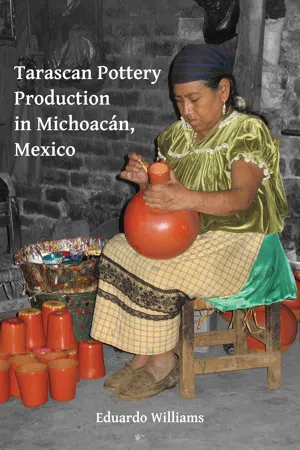
Pottery is one of humankind's most important inventions. It is thousands of years old, and it is fair to say that without it the development of civilization as we know it would not have been possible. Food preparation and storage, religion and ritual, wine-making, trade, art, and architecture, among many other human achievements, were all aided by pottery, an artificial material that lent itself to the elaboration of all kinds of objects: vessels, figurines, roof tiles, water pipes, fishnet weights, and tablets inscribed with the earliest forms of writing, to name but a few; a veritable litany of human creativity. This book examines a contemporary pottery tradition in Mesoamerica, but also looks back to the earliest examples of cultural development in this area. By means of ethnographic analogy and ceramic ecology, this study seeks to shed light on a modern indigenous community and on the theory, method and practice of ethnoarchaeology; undoubtedly one of the most important aspects of archaeological research in Mexico today.
eBook - PDF
Tarascan Pottery Production in Michoacán, Mexico
An Ethnoarchaeological Perspective
- 188 pages
- English
- PDF
- Available on iOS & Android
eBook - PDF
About this book
Information
Table of contents
- Cover
- Copyright Page
- Contents
- List of Figures
- Preface
- Chapter I
- Figure 1. Diagram of ceramic ecology, incorporating the ceramic complex, the biological environment, the physical environment, human biology, and culture (after Kolb 1989a: Figure 3).
- Figure 2. Michael Schiffer’s flow model for viewing the life-cycle of durable elements in the archaeological record
- Chapter II
- Figure 3. The place of ethnoarchaeology in anthropology (after Thompson 1991: Figure 11.1).
- Chapter III
- Figure 4. Teponahuasco is a small peasant community located in the municipality of Cuquío, Jalisco, some 80 km northeast of Guadalajara, the state capital of Jalisco.
- Figure 5. Each pottery-producing household in Teponahuasco has its own kiln, which may be located in the inner courtyard or ou side the house. (1)
- Figure 6. Some households produce ollas (cooking pots) and cazuelas (pans), large-size vessels for tesgüino fermentation (traditional corn beer), and other items, such as drainage pipes and flower pots (not shown).
- Figure 7. Some clay vessels, like the olla or cooking pot, are made using a mold. Here we see a potter using a convex mold to make a pot, while her daughter watches and learns.
- Figure 8. Making a pan or cazuela requires a stone tool to make a flat clay cake (a).
- The clay cake is then placed in a mold with the desired shape (b).
- Figure 9. The cántaro, or water jug, is made in two stages: (a) the lower half is shaped using a mold;
- Figure 10. In Cuquío, some households still use clay vessels on a daily basis (like this one used for water storage). In some cases, they are up to 70 years old and are passed down from one generation to the next.
- Figure 11. Every Friday during the dry season the potters set up their stands around the plaza in front of the church, where they sell their wares.
- Figure 12. Pottery making in Teponahuasco is a seasonal activity, limited to the dry part of the year (from October to April) because most of the potters (both men and women) have at least some cropland that requires their attention. The graph shows the p
- Figure 13. Rainfall in Ayacucho, Peru, showing the mean amount of precipitation in 1961-1970 (left scale) and the mean number of days with rainfall (right scale) in 1962-1970 (after Arnold 1993: Figure 2.3).
- Figure 14. Map of La Cañada de los Once Pueblos, indicating the main towns in the area. Key: black dot: present location; white dot: Likely location in 1579, according to the Relaciones Geográficas; black-and-white dot: without change in location. Solid l
- Figure 15. Graph showing average rainfall and temperature for the area of La Cañada. The months of higher precipitation here a e from June to September; the highest temperatures occur in April and May
- Figure 16. Many kilns in Huáncito are covered by a roof to protect them in case of rain (1990).
- Figure 17. One of the most crucial aspects of the ceramic process is procuring clay from local sources (1990).
- Figure 18. Potters used to go to the hills around Huáncito to collect firewood for their kilns. Nowadays, most potters obtain heir fuel from people who bring it from other towns in trucks, which have replaced the burros and horses used in the past
- Figure 19. Firing the kiln is a difficult matter that involves great care and knowledge. It is performed by men, though women and children may help out as well (a: Fidel Lorenzo household, 2014; b: Elena Felipe household, 2014).
- Figure 20. Clay is taken from pits dug by potters with pick and shovel. Some of these pits may be up to three meters deep (1990).
- Figure 22. Once the potter obtains the clay, he has to pay to have it ground in one of the mills found in the community (1990).
- Figure 23. Potters used large rocks to pulverize the clay until some 20 years ago, but this is no longer the case in Huáncito (1990).
- Figure 24. The most common technique for shaping pots in Huáncito and other towns in Michoacán and neighboring areas involves he vertical-half mold (1990).
- Figure 25. The vertical-half mold technique consists of making a clay tortilla or “pancake” which is cut in half and introduced into each one of the two molds. The next step is to smooth the clay with a piece of cloth until it has the shape of the mold (1
- Figure 26. The kiln used in Huáncito and other areas of Mexico has a simple design, consisting of a circular adobe wall around 1.5 m in diameter and 1.60-1.80 m high. The fire box or hearth is underground; this is where the potter puts the fuel for firing
- Figure 27a. There is a high demand for firewood in Huáncito, as it is used for cooking as well as firing pottery in the kilns
- Figure 27b. There is a high demand for firewood in Huáncito, as it is used for cooking as well as firing pottery in the kilns
- Figure 29. The pot is covered with charanda and then polished with a cloth to produce a shiny surface (Fidel Lorenzo household, 2014).
- Figure 30. Nowadays, most craftspeople in Huáncito use industrially-produced paints, which have two main advantages over natural colorants: they are cheaper, and are applied to pots after firing, so no time is wasted painting pots that may break or be oth
- Figure 31. The decoration motifs painted by Huáncito potters are usually naturalistic, including flowers, birds, rabbits, and other animals (1990).
- Figure 32. Potters sometimes sell their production to middlemen, who may have shops in town or on the highway near Huáncito (a: 2014; b: 1990).
- Figure 33. In some households one can see vessels that are no longer functional recycled as flower pots once their use-life is over (1990).
- Figure 34. Many potters usually carry their pots in bundles made with sacks padded with twigs and grass for protection when taking them to sell outside Huáncito (1990).
- Figure 35a. In Fidel Lorenzo’s household, food may be prepared and consumed near the kiln, using a small clay stove made of adobe (a). Sometimes food is prepared in the patio outside the kitchen using an improvised hearth with several rocks placed directl
- Figure 35b. In Fidel Lorenzo’s household, food may be prepared and consumed near the kiln, using a small clay stove made of adobe (a). Sometimes food is prepared in the patio outside the kitchen using an improvised hearth with several rocks placed directl
- Figure 36. The patios of many houses in Huáncito have several fruit trees and other plants that provide shade while potters are working in the open (Fidel Lorenzo household, 1990).
- Figure 37. The worktable found in many houses in Huáncito consists of a thick wooden plank (30 cm wide by 50 cm long) placed at ground level or at a height of some 50 cm. This figure shows a worktable in use. Note the pots around it, the paint containers
- Figure 38. In Huáncito, every potter’s house has a variable number of molds used in the ceramic process. Here we see one potte at the worktable, putting the clay “tortilla” inside one half of the mold (a), and then joining the two halves of the mold to s
- Figure 39. Many houses in Huáncito have an area for drying the pots, like this room in Isaac Cayetano’s house where fresh pots are stacked before being fired in the kiln (2014).
- Figure 40. Some houses in Huáncito also have storage areas, like this room in the house of Bernaldina Rivera and Alfredo Felipe, where pots are stacked awaiting customers (2014).
- Figure 41. In Fidel Lorenzo’s home, the room where the kiln is located is used as a de facto storage area, where all kinds of objects are kept in a somewhat chaotic arrangement. Note the remains of a meal near the hearth in the lower right-hand corner (0
- Figure 42. A storage area in Isaac Cayetano’s house is used to store many items used in the ceramic process. Here we see pots, molds, and plastic buckets (2014).
- Figure 43. Map of Fidel Lorenzo’s household showing activity areas and some elements and features linked to pottery manufacture (1990).
- Figure 44. Map of Isaac Cayetano’s household showing activity areas and some elements and features linked to pottery manufactu e. An asterisk indicates features that were destroyed by household members during fieldwork (1990).
- Figure 45. Map of Salomón Espicio’s household showing activity areas and some elements and features linked to pottery manufacture (1990).
- Figure 46. In some cases, the clay must be sifted to eliminate small stones, twigs and other “impurities” using a sieve
- Figure 47. The potter puts fresh clay in the mold in order to obtain the desired vessel shape. This activity is usually performed on the worktable or near it, and requires making a “tortilla” of clay, cutting it down to size and inserting it into the two
- Figure 48. Once out of the mold, the vessel is smoothened with a piece of wet cloth to erase the mold scars and any imperfections on the surface of the still-fresh vessel. Lafira (left) and Marina are working in the patio of their home (Fidel Lorenzo hous
- Figure 49. Pots are usually polished with a fragment of plastic until the surface is smooth and shiny
- Figure 50. Before placing the pots in the kiln, they are further dried in the open, usually in the patio. Potters try to use the area of the patio with less traffic to avoid breakage due to accidents (Salomón Espicio household, 1990).
- Figure 51. In Huáncito and most other places where pottery is made, the kiln is the feature where firing, the most crucial activity, takes place. The kiln is usually located in the patio, like this one that has not been used in many years
- Figure 52. The top of the kiln is covered with broken pots called “wasters” (tepalcates in Spanish) and comales (griddles) to insure a proper temperature and, at the same time, allow smoke and gasses to escape from the kiln during the firing operation ⤀
- Figure 53. The wasters and comales that cover the kiln during firing are usually kept nearby when not in use. Such concentrations of broken and burned potsherds, in addition to the kiln itself, would be prime archaeological correlates or markers for potte
- Figure 54. In Huáncito, the kitchen or some other room is commonly used for painting the pots (Fidel Lorenzo household, 2014).
- Figure 55. In most potting households, pots that are totally useless or broken beyond repair are discarded outside the house. In this case, a wheelbarrow is used to transport the potsherds to the dumping area (1990).
- Figure 56. Potsherds are periodically discarded in a gully on the outskirts of Huáncito (1990).
- Figure 57. After many years of using the same dumping area, there is a great concentration of potsherds. This activity has clear archaeological implications (1990).
- Figure 58. A small adobe stove has been built for cooking in the area near the kiln in Fidel’s house. Lafira is seen cooking a far right, Fidel and Magdaleno are eating in the middle, and Marina is working at the left of the figure (painting pots). This
- Figure 59. In order to obtain a complete vision of domestic activities, it is important to recognize the locales where tools a d raw materials are stored, like clay in this instance. Other items shown here are a wheelbarrow, a sieve and several plastic bu
- Figure 60. Many items used by contemporary Tarascan potters will disappear from the material record of production with the passage of time. One example is the ring made of cloth (upper right) that is used as a pot stand in all domestic workshops (Isaac Ca
- Figure 61. Some tools used by potters in their daily work would be difficult to identify in the archaeological record; for ins ance, handstones or manos used to make the flat clay “tortilla”, as opposed to those used to grind corn. A microscopic analysis
- Figure 62. Plan of a pre-Hispanic structure excavated in Xaltocan, Central Mexico, showing the activities carried out in the house: food preparation, fish-processing, reed mat-making, and pottery-firing, among others (adapted from De Lucia 2013: Figure )
- Figure 63. Firing pots in Camoapan, Veracruz, during the Classic period took place in circular kilns with a vertical shaft, much like the ones still used today in that region (Adapted from Arnold et al. 1993).
- Figure 64. The Tarascan towns of Zipiajo and Cocucho are located in the Zacapu Basin and the Meseta Tarasca (Tarascan Plateau) of Michoacán, respectively (adapted from Moctezuma 2001: Figure 1).
- Figure 65. Today, Zipiajo is known for its large brown pots, which are fired without a kiln and thus are usually stained by smoke, giving them a somewhat “rustic” appearance (photo by Teddy Williams).
- Figure 66. In Zipiajo, black clay is usually sieved with a net (or sometimes a plastic shopping bag), to eliminate impurities, small rocks, twigs, and so on (1995).
- Figure 67. The form of the vessel is attained by building it from the ground up (after Moctezuma 1998: p. 100).
- Figure 68. This potter is polishing a vessel with a wet corn cob to give it a smooth, even surface (after Moctezuma 1998: p. 100).
- Figure 69. Once the shape of the pot is attained, a river cobble is used to make its surface smooth and even (1995).
- Figure 70. The tool kit or assemblage used by potters is quite simple, consisting of corn cobs, polishing stones, and an improvised metal tool (1995).
- Figure 71. In Zipiajo, the pots are covered with a clay slip (which turns them from gray to brown) before firing (1995).
- Figure 72. Before firing the pots, the firewood has to be prepared by cutting it into smaller pieces with an axe (1995).
- Figure 73. The first step in the actual firing process is to prepare the firing area by covering it with ash that has been recycled from previous firings (1995).
- Figure 74. Pots must be laid down in the right manner on top of the ash layer (a). A small fire is ignited inside each vessel to further dry it before the actual firing begins (b) (1995).
- Figure 75. Pots are stacked up with great care in the firing area, surrounded by firewood and covered with comales in preparation for the firing operation (1995).
- Figure 76. The pots and comales are covered with a long grass called tzurumuta, as well as cow or donkey dung, ocote (resinous pine wood), corn cobs and firewood (1995).
- Figure 77. At some point during the firing operation, ash is poured on top of the stacked pots covered with grass, presumably o improve heat retention (1995).
- Figure 78. Potters have an uncanny sense of the heat achieved by the firing structure, which is essential to ensure that the pots are removed at the right moment to avoid overfiring (1995).
- Figure 79. The comales made in Zipiajo are coveted throughout the region and beyond, as they are famous for making perfect tor illas (1995).
- Figure 80. Cocucho is known for its unique large-size vessels, known as cocuchas (photo by Patricia Moctezuma).
- Figure 81. Cocuchas have become a mainstay of the local economy thanks to the many tourists who buy them
- Figure 82. The process of making a cocucha begins with preparing the clay: first the potter adds temper, then she kneads the paste in a corner of her home (after Moctezuma 2001: Figure 4).
- Figure 83. The upper half of the pot is made by adding coils of clay by hand (after Moctezuma 2001: Figure 6).
- Figure 85. Polishing the fresh pots with a corncob insures a smooth, even surface (after Moctezuma 2001: Figure 9).
- Figure 86. Once the desired height has been reached, the two halves of the pot are ready to be joined, and the pot is practically ready for firing (after Moctezuma 2001: Figure 10).
- Figure 87. Because cocuchas are so large, firing is a challenge for potters who must tackle only one pot at a time (after Moctezuma 2001: Figure 15).
- Figure 88. Two potters are often needed to perform the firing, since this delicate operation involves holding the pot steady i its place, aided by long wooden poles (after Moctezuma 2001: Figure 18).
- Figure 89. At the end of the firing, the potters carefully retrieve the pot. Often pots emerge from the fire with smudges caused by uneven firing, but this is part of the “rustic appeal” of these mostly sumptuary and decorative pieces (after Moctezuma 20
- Figure 90. Once the potters finish firing the cocucha, the potter carries it away from the firing area on her back. This craft requires not just great technical knowledge, but also a good deal of physical stamina (after Moctezuma 2001: Figure 19).
- Chapter IV
- Figure 91. Map of Western Mexico showing the main lakes and rivers. Shaded areas indicate interior drainage basins including the major archaeological sites: (1) Capacha; (2) Chupícuaro; (3) El Opeño; (4) Ihuatzio; (5) Loma Alta; (6) Loma Santa María; (7)
- Figure 92. Map of the Tarascan territory during the Protohistoric period (ca. AD 1450-1530), indicating the extent of the empire ca. 1522, and the maximum extent of land under Tarascan control. The triangles indicate archaeological sites (adapted from Pol
- Figure 93. Illustration from the Relación de Michoacán entitled “How lords got married.” The scene shows an elite Tarascan couple in a palace with many items displayed in a courtyard, such as fine ceramics including vessels with handle and spout
- Figure 94. Tarascan porters with tumplines similar to the mecapales that were used by carriers throughout Mesoamerica. They appear to be carrying pots, among other things, as illustrated in the Relación de Michoacán (adapted from Alcalá 2008, p. 253).
- Figure 95. Canoes were an important means of transportation in the Tarascan area. In this scene from Lake Pátzcuaro (early 20th century) we see a long canoe loaded with rolled-up reed mats (petates). In the background are many smaller canoes used for fish
- Figure 96. Illustration from the Relación de Michoacán, entitled “How the people got married.” In the background we see a house with many pottery vessels, apparently of a functional nature, as well as baskets and other everyday items (adapted from Alcalá
- Figure 97. Pre-Hispanic Tarascan ceramic vessels; a. Pot decorated with geometric designs; b. Tripod bowl; c. Spouted vessels
- Figure 98. These pots, called chondas, were used until recent decades in the Lake Cuitzeo saltworks to store and transport bri e and water.
- Figure 99. This pot was made in Maruata, a Nahua town on the Michoacán coast. Pots like this one may have been used by local saltmakers to store and transport brine and water.
- Figure 100. Pots like these were used by saltmakers in Cuyutlán, Colima, to store and transport brine and water (Museo de la Sal, Cuyutlán, Colima).
- Figure 101. Pre-Hispanic pot of the Texcoco Fabric Marked type, used by local saltmakers in the Basin of Mexico to store and t ansport brine and water (after Parsons 2001).
- Figure 102. Clay pots used by the Hñahñu (Otomí) of Valle del Mezquital (Hidalgo, Mexico) to process aguamiel and pulque: (a) cántaro for carrying aguamiel, 35-liter capacity; (b) cántaro, 25-liter capacity; (c) olla for pulque fermentation, 60-liter capa
- Figure 103. The sáalei is the largest pottery vessel made by the Huichol of Jalisco and Nayarit. It was used almost exclusively to prepare nahuá (maize beer) (adapted from Weigand 2001: Figures 3a and 4c).
- Figure 105. Olla of the tesgüinera type, during use in Quirare, in the Tarahumara region (1991) (after Lewenstein 1995: Figure 4).
- Figure 106. Tarahumara pots of the tesgüinera type, found in Chilicothe, Municipio of Batopilas (after Lewenstein 1995: Figure 5).
- Figure 107. Olla for tesgüino repaired with resin (height: 37 cm). Ethnographic collection of the Arizona State Museum, Unive sity of Arizona (after Lewenstein 1995: Figure 6).
- Figure 108. Olla for storing water, supported by a forked tree trunk (Chilicothe, 1991) (after Lewenstein 1995: Figure 7).
- Figure 109. Olla for cooking beans (44 cm high). Ethnographic collection of the Arizona State Museum, University of Arizona (after Lewenstein 1995: Figure 8).
- Figure 110. Spindle whorls excavated by Helen Pollard at Urichu in the Lake Pátzcuaro Basin. The item at the upper left-hand corner was used to spin coarse maguey fiber (called ixtle), while the others were used to spin cotton thread (courtesy of Helen Po
- Figure 111. Otomí woman spinning ixtle (maguey) fiber using ceramic spindle whorls in Valle del Mezquital, Hidalgo, Mexico (courtesy of Jeffrey Parsons).
- Figure 112. In Lake Pátzcuaro, the gill net is called cherémekua, like this one displayed by a fisher from Colonia Revolución (near Erongarícuaro, Michoacán). Note the small stones used as sinkers.
- Figure 113. Modified potsherds used as fishnet sinkers: (a) El Cirio, Lake Cuitzeo Basin; (b) Jarácuaro, Lake Pátzcuaro Basi ; (c) Ucazanastacua, Lake Pátzcuaro Basin.
- Chapter V
- References Cited
Trusted by 375,005 students
Access to over 1.5 million titles for a fair monthly price.
Study more efficiently using our study tools.
Frequently asked questions
Yes, you can cancel anytime from the Subscription tab in your account settings on the Perlego website. Your subscription will stay active until the end of your current billing period. Learn how to cancel your subscription
No, books cannot be downloaded as external files, such as PDFs, for use outside of Perlego. However, you can download books within the Perlego app for offline reading on mobile or tablet. Learn how to download books offline
Perlego offers two plans: Essential and Complete
- Essential is ideal for learners and professionals who enjoy exploring a wide range of subjects. Access the Essential Library with 800,000+ trusted titles and best-sellers across business, personal growth, and the humanities. Includes unlimited reading time and Standard Read Aloud voice.
- Complete: Perfect for advanced learners and researchers needing full, unrestricted access. Unlock 1.5M+ books across hundreds of subjects, including academic and specialized titles. The Complete Plan also includes advanced features like Premium Read Aloud and Research Assistant.
We are an online textbook subscription service, where you can get access to an entire online library for less than the price of a single book per month. With over 1.5 million books across 990+ topics, we’ve got you covered! Learn about our mission
Look out for the read-aloud symbol on your next book to see if you can listen to it. The read-aloud tool reads text aloud for you, highlighting the text as it is being read. You can pause it, speed it up and slow it down. Learn more about Read Aloud
Yes! You can use the Perlego app on both iOS and Android devices to read anytime, anywhere — even offline. Perfect for commutes or when you’re on the go.
Please note we cannot support devices running on iOS 13 and Android 7 or earlier. Learn more about using the app
Please note we cannot support devices running on iOS 13 and Android 7 or earlier. Learn more about using the app
Yes, you can access Tarascan Pottery Production in Michoacán, Mexico by Eduardo Williams in PDF and/or ePUB format, as well as other popular books in Social Sciences & Archaeology. We have over 1.5 million books available in our catalogue for you to explore.