This analysis is concerned with the dating of megaliths in Europe and is based on 2410 available radiocarbon results from pre-megalithic and megalithic sites, and to the megaliths contemporaneous contexts and the application of a Bayesian statistical framework. It is, so far, the largest existing attempt to establish a supra-regional synthesis on the emergence and development of megaliths in Europe. Its aim is to assist in the clarification of an over 200-year-old, ongoing research debate.
eBook - PDF
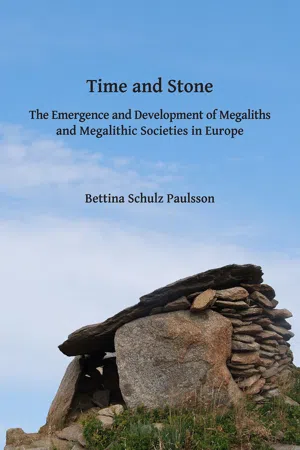
Time and Stone: The Emergence and Development of Megaliths and Megalithic Societies in Europe
- 392 pages
- English
- PDF
- Available on iOS & Android
eBook - PDF
Time and Stone: The Emergence and Development of Megaliths and Megalithic Societies in Europe
About this book
Information
Table of contents
- Copyright Page
- Contents
- Chapter 1
- Figure 1.1 The megalithic regions in Europe and North Africa (after Camp 1961; Whitehouse 1981; Soulier 1998; Burl 2000; Kalb 2001; Malone 2001; Trump 2002; Sjögren 2003; Piccolo 2007; Scarre 2007; García Sanjuán 2009; Cicilloni 2010; Fritsch et al. 201a
- Figure 1.2 Dolmens world-wide. Drawings from Montelius 1905 Orienten och Europa. 1. India, p. 11, Figure 4; 2. Krim, p. 14, Figure 8; 3. Sudan, p. 16, Figure 9; 4. Portugal, p. 23, Figure 13; 5. Palestine, p. 13, Figure 6
- Figure 1.3 The modified diffusionism of Gordon Childe in Europe and his successors. Passage graves are seen as derivations of Cretan passage graves (after Renfrew 1973, 46)
- Figure 1.4 Estimates for the start of construction of accessible megaliths from Müller (1998), based on the then available 60 radiocarbon results out of megalithic and long barrow contexts. The time intervals are showing the approximate modified values f
- _GoBack
- Chapter 2
- Figure 2.1 Number of radiocarbon dates considered in this volume obtained from different material types (n=2410)
- Figure 2.2 Number of radiocarbon dates from charcoal samples identified after wood species (n=102)
- Figure 2.3 The charcoal samples: classification of the contexts (n=944)
- Figure 2.4 Classification of the sample contexts
- Figure 2.5 Simulation A by a process of back-calibration of calibrated dates for 25 radiocarbon determinations which actually date within 25 y from 4000‒3976 BC
- Figure 2.6 Sum calibration of simulation A. The bar marks the actual time span and shows that a sum calibration would extend the real time interval 4 times
- Figure 2.7 Simulation B by a process of back-calibration of calibrated dates for 30 radiocarbon determinations which actually date within 300 y from 4100‒3800 BC
- Figure 2.8 Sum calibration of simulation B. The bar marks the actual time span and shows that a sum calibration would extend the real time interval by more than 50%
- Figure 2.9 Sum calibration versus Bayesian statistical framework. The analysis of all available radiocarbon dates for the Bell Beaker contexts in Southern France (Lemercier et al. 2014, Figure 13) show the large discrepancies between the two different met
- Figure 2.10 The calibration curve Intcal09 (Reimer et al. 2009). Detailed the for this analysis important time intervals
- Chapter 3
- Figure 3.1 Planum necropolis Passy (Lemercier et al. 2010)
- Figure 3.2 Necropolis Passy. The monuments of sector A and B with burials and radiocarbon determinations
- Figure 3.3 Probability distributions of dates from the necropolis Passy (cf table 3.1). Model 1 is established under the assumption, that all monuments of sector A and sector B belong to one necropolis and the same society. Model agreement: Amodel=98, A
- Figure 3.5 Span A, sector La Sablonnière
- Figure 3.6 Span B, sector Le Richebourg
- Figure 3.7 Reconstruction of the Passy graves. Drawing by the author after G. Tosello, (Constantin et al. 1997)
- Figure 3.8 Planum necropolis Balloy, Le Réaudins with the available radiocarbon dates (planum after Mordant 1997, 450)
- Figure 3.9 Probability of dates from Balloy, Le Réaudins. Model agreement: Amodel=101.7, Aoverall=105.9
- Figure 3.10 Necropolis Fleury-sur-Orne (Desloges 1994: 532)
- Figure 3.11 Rots (Desloges 1994: 518)
- Figure 3.12 Reconstruction of a double burial in Téviec, Museum Toulouse. Photo courtesy of Didier Descouens - CC-by-sa /Wikimedia Commons
- Figure 3.13 Planum of the double burial A in cist, Téviec (Midgley 2005, 59; Péquart et al. 1937)
- Figure 3.14 Goumoisière, cists 1, 2, 3, and 5 (after Soler 2007: 117)
- Figure 3.15 Probability of dates from all available radiocarbon results in the cist burial site Goumoisière. Model agreement: Amodel=85, Aoverall=82.7
- Figure 3.16 The tumulus Carnacéen St. Michel in Carnac with probability of radiocarbon dates. Planum according to Le Rouzic 192 and Boujot/Cassen 1992. Photo of green stone artifacts with the kind permission of Serge Cassen, University Nantes (Cassen 21
- Figure 3.17 The tumulus Carnacéen Tumiac. Planum after Fouquet 1857, musée de la Société polymathique du Morbihan, Vannes (Herbault/Querré 2004: 501)
- Figure 3.18 Tumiac. Photo courtesy of Stéphane Batigne, CC-by-sa /Wikimedia Commons
- Figure 3.19 Jade axes and variscite collier, Tumiac. Photo courtesy of Serge Cassen (Cassen 2011: Figure 3)
- Figure 3.20 Round and long tumuli with non-accessible ancient dolmens. Le Castellic and Kervinio (after Soler 2007); St. Germain (after Cassen et al. 2000). Ceramic of St. Germain with the kind permission of Serge Cassen. The necropolis Manio (after Casse
- Figure 3.21 Planum Lannec er Gadouer (after Boujot/Cassen 1998, Cassen et al. 2000, Figure 3)
- Figure 3.22 Radiocarbon determinations from Lannec er Gadouer. Model agreement: Amodel=69, Aoverall=71.9
- Figure 3.23 Planum Er Grah with radiocarbon results (after Cassen 2009, Figure 7)
- Figure 3.24 Radiocarbon determinations from Er Grah. Model agreement: Amodel=71.6, Aoverall=73.1
- Figure 3.25 Planum Les Fouaillages, Guernsey (after Kinnes/Grant 1983: 30)
- Figure 3.26 Reconstruction La Pierre Tourneresse. Drawing after Cédric Lacherez,-CC-by-sa /Wikimedia Commons
- Figure 3.27 Probability of radiocarbon dates, La Pierre Tourneresse, Cairon, Calvados. Model agreement: Amodel=94.9, Aoverall= 5
- Figure 3.28 Colombiers-sur Seulles (Billard/Chancerel 1998, 253) and Hazleton in Southwest England (Malone 2005, 120)
- Figure 3.29 Probability distribution of dates from human bones in gallery graves in the Paris Basin. Model agreement: Amodel=9.4, Aoverall=93.2
- Figure 3.30 Probability distribution of dates from human bone samples from megalithic graves in Breton. Model agreement: Amodel=97.1, Aoverall=97.4
- Figure 3.31 The passage graves in Port Blanc, Quiberon
- Figure 3.32 Planum of the passage graves at Port Blanc showing their location directly on the cliffs (after Gouézin 2007). The southwestern grave is today partly eroded
- Figure 3.33 Barnenez from the southeast.
- Figure 3.34 Destroyed section of Barnenez from the northeast
- Figure 3.35 Planum Barnenez (after Joussaume 1985: 129)
- Figure 3.36 Probability of radiocarbon determinations from Barnenez
- Figure 3.37 Planum Le Souc´h (after Laporte 2010)
- Figure 3.38 Probability of radiocarbon results from Le Souc´h. Model agreement: Amodel=94.3, Aoverall=94.3
- Figure 3.39 Ile Guénioc, tumuli I, II and III (Giot 2007: 42)
- Figure 3.40 Planum Table des Marchands with radiocarbon results (after Cassen 2009)
- Figure 3.41 Probability of all dates from the site Table des Marchands. Start alignment/TPQ-activities 5223−5047 cal BC, 68.2%; 5370−4970 cal BC, 95.4%; end alignment TPQ-activities 4208−4057 cal BC, 68.2%; 4257−3977 cal BC, 95.4%; start TDM 4112−3932 cal
- Figure 3.42 Table des Marchands from the southeast
- Figure 3.43 The Petit Mont in Arzon (after Le Roux 1999, 51)
- Figure 3.44 Probability of the dates from the Petit Mont in Arzon. Model agreement: Amodel=74.4, Aoverall=77.8.
- Figure 3.45 Petit Mont. Photo courtesy of Manvyi, - CC-by-sa /Wikimedia Commons
- Figure 3.46 Façade of Gavrinis
- Figure 3.47 Planum Dissignac after the excavations in 1976 (after www.http://bsecher.pagesperso-orange.fr/Dissignac.htm, Figure 14)
- Figure 3.48 Planum from the angle-formed grave Goërem (Briard 2000).
- Figure 3.49 Planum V-formed gallery grave Liscuis I (after Briard 2000, 41)
- Figure 3.50 Probability of the dates from the the necropolis Liscuis. Model agreement: Amodel=98.7, Aoverall=98.7
- Figure 3.51 Planum Le Déhus (after Schulting 2010: 151)
- Figure 3.52 Probability distributions of dates from Le Déhus
- Figure 3.53 Probability distribution for the dates of the passage grave La Hogue Bie, Jersey (after Schulting 2010). Model ag eement: Amodel=84.9, Aoverall=85.9
- Figure 3.54 Planum Chirons/Bougon (after Mohen 1986)
- Figure 3.55 Tumulus F and passage grave FO,Chirons/Bougon. Photo courtesy of Joachim Jahnke, CC-by-sa /Wikimedia commons
- Figure 3.56 Probability of radiocarbon determinations from monuments A-F, Chirons/Bougon. Model agreement: Amodel=96.4, Aoverall=94.5
- Figure 3.57 Chamber FO, Chirons/Bougon (after Chambon 2003, Figure 26)
- Figure 3.58 Planum necropolis Champ Châlon/Benon, monuments A, B and C (after Joussaume 2006)
- Figure 3.59 The probability of radiocarbon dates from the necropolis Champ Châlon. The earliest individual in the necropolis is buried in monument B1 at ~4190 cal BC (4311–4054 cal BC, 68.1%; 4329–4046 cal BC, 95.4%). Four of the individuals in the monume
- Figure 3.60 Planum Péré C (after Laporte et al. 2002)
- Figure 3.61 Péré C: The model calculates the construction of the monument and phase I with the accessible dolmen to ~4340 cal BC (4372–4278 cal BC, 68.2%, 4420–4262 cal BC, 95.4%) and the enlargement with the section to the east and the passage grave some
- Figure 3.62 Probability of all available radiocarbon results from human bones out of passage graves in the Central West (without Bougon).Model agreement: Amodel=98.8, Aoverall=98.7
- Figure 3.63 Sketch of Chamber B with the reported two ‘seated’ skeletons from F.C. Lukis (Schulting 2010, Figure 3) with the kind permission of Coll. Ant. V © Guernsey, Museum / Galleries, State of Guernsey 2009).
- Figure 3.64 Vierville/Butte á Luzerne, chamber A. Photo courtesy of Guy Verron
- Figure 3.65 Probability of dates from Vierville/Butte á Luzerne. Model agreement: Amodel=81.9, Aoverall=84.4
- Figure 3.66 La Hoguette (after Caillaud/Lagnel 1972; Chambon 2003: 64)
- Figure 3.67 Corridor in dry wall technique La Hogue
- Figure 3.68 Distribution of the probability of radiocarbon measurements from La Hoguette. Model agreement: Amodel=83.1, Aoverall=79.8
- Figure 3.69 Necropolis Condé-sur Ifs. Planum Ernes and La Bruyere du Hamel (after Billard/Chancerel 1998)
- Figure 3.70 Main pre-megalithic sites and earliest megaliths mentioned in the text (chapters 3.1-3.2).
- Figure 3.71 Main sites mentioned in text (chapters 3.3-3.7)
- Figure 3.72
- Table 3.1 Radiocarbon dates from the Paris Basin/Northern France
- Table 3.2 Radiocarbon dates from Brittany
- Table 3.3 Radiocarbon dates from the Channel Islands
- Table 3.4 Radiocarbon dates from Central West France
- Chapter 4
- Figure 4.1 El Padró I. Photo courtesy of Miquel Molist
- Figure 4.2 Font de la Vena. Photo courtesy of Miquel Molist
- Figure 4.3 Font de la Vena, planum and side profiles chamber (Molist et al.1987, 64)
- Figure 4.4 Tomba del General, Cap de Creus from the north
- Figure 4.5 Coll de Madas I by Catallops. The simple dolmen is part of a small necropolis
- Figure 4.6 Estanys I, La Jonquera, dolmen with antechamber
- Figure 4.7 Dolmen de la Carena, Cap de Creus from the west
- Figure 4.8 Dolmen de les Ruїnes, Cap de Creus from the southwest
- Figure 4.9 Dolmen Taula del Lladres, Coastal Pyrenees, simple dolmen with cup marks on the cap stone
- Figure 4.10 Vines Mortes I, Cap de Creus. Passage grave with rectangular chamber
- Figure 4.11 Left: dolmen Mas Puig de Caneres, East Pyrenees with a sub-circular chamber, right:gallery Cova d´en Diana, Baix Empordá
- Figure 4.12 Catalonian megalithic graves. Left: dolmen de la Carena (after Tarrús i Galter 2002, Figure 223, right: Dolmen de les Ruїnes, Cap de Creus (after Tarrús i Galter 2002, Figure 222)
- Figure 4.13 Catalonian megalithic graves. Above left: dolmen de Estanys I (after Tarrús i Galter 2002, Figure 69), right: dolmen de Estanys II (Cura/Morera 1996, Figure2). Below left: dolmen de Arrenyats (Cura i Morera/Vilardell 1996, Figure 3) right: dol
- Figure 4.14 Recinto Mas Baleta, La Jonquera from the west
- Figure 4.15 Bayesian model with available radiocarbon dates from the Neolithic and the Copper Age, zone II and IV (according to www. telearchaeology. com with the megalith zones East Pyrenees and Central Catalan Depression,where the first megaliths in Cat
- Figure 4.16 The zoning of the available radiocarbon dates in Catalonia according to www.telearchaeology.es. The proposed zoning follows recent landscapes and natural borders. The main megalithic regions are red marked. Map source Google Earth, 20.09. 2011
- Figure 4.17 The main pre-megalithic sites and early megaliths mentioned in the text (chapters 4.1, 4.2).
- Figure 4.18 The main sites mentioned in text (chapters 4.3- 4.7).
- Table 4.1 Radiocarbon dates from Catalonia
- Chapter 5
- Figure 5.1 Camp del Ginèbre, Caramany. The different grave forms (after Vaquer 2007: 17)
- Figure 5.2 Planum Camp del Ginèbre (after Claustre 1998, 170)
- Figure 5.3 Necropolis Najac, Siran, Hérault. Planum chamber 3 (after Mahieu 1992: 146)
- Figure 5.4 Necropolis Najac, Siran, Hérault. Transversal arrowheads from chamber 2, diagnostic Chasséen ceramic chamber 3 (after Mahieu 1992: 146, 149)
- Figure 5.5 Planum and profile Boujas, Aigne (Hérault) (Vaquer 2007: 16)
- Figure 5.6 Chasséen grave St. Jean du Desert. Photo courtesy of Gérard Sauzade
- Figure 5.7 Probability of radiocarbon results from Château Blanc in Ventabren (Model agreement: Amodel=87, Aoverall=87.5
- Figure 5.8 Château Blanc, Ventabren. Plan after Hasler et al. 1998
- Figure 5.9 Simple dolmen at Coll del Pinyer and Cap the Creus, French Pyrenees
- Figure 5.10 Dolmen with a round stone basement for a tumulus
- Figure 5.11 Ante-chamber Dolmen Languedocien de Lamalou, St. Hippolyte du Fort
- Figure 5.12 Dolmen Cham du Florac in Lozere
- Figure 5.13 Dolmens in Quercy
- Figure 5.14 Provence, Dolmen by Grasse. Photo courtesy of Jonas Paulsson.
- Figure 5.15 Standing stone Cham du Florac in Lozere
- Figure 5.16 The stone circle Peyarine in the Cévennes with an average of approximately 140m is one of the largest stone circles in Europe
- Figure 5.17 Probability of the 18 radiocarbon results from the Dolmen de l´Ubac. Model agreement: Amodel=93.1, Aoverall=93
- Figure 5.20 Planum hypogea Crottes, Roaix in Vaucluse, layer 2 with articulated skeletons (Chambon 2003: 51)
- Figure 5.21 Main sites mentioned in text with pre-megalithic sites and earliest megaliths (chapters 5.1, 5.2).
- Figure 5.22 Main sites mentioned in text (chapters 5.3-5.7).
- Chapter 6
- Figure 6.1 Probability of radiocarbon determinations from the Monte Revincu. Model agreement Amodel=127.5, Aoverall=124.5
- Figure 6.2 The Neolithic settlement with necropolis on the Monte Revincu, North Corsica (after Leandri et al. 2007, Figure 12)⤀
- Figure 6.3 Dolmen Cellucia or Somnital on the Monte Revincu, North Corsica. Photo courtesy of Franck Leandri
- Figure 6.4 The Monte Revincu from Saint Florent
- Figure 6.5 Dolmen di Tola di U Turmento, southwest Corsica
- Figure 6.6 Dolmen de Fontanacchia, plain of Cauria
- Figure 6.7 Dolmen de Settiva, Petreto-Bicchisano
- Figure 6.8 The alignment de Renaghju, plain de Cauria
- Figure 6.9 The alignment of Stantari, plain de Cauria
- Figure 6.10. Main sites mentioned in text (map source: SRTM geodata.)
- Table 6.1 Radiocarbon dates from Corsica
- _GoBack
- Chapter 7
- Figure 7.1 The Li Muri graves in Arzachena. Plan of the necropolis after Antona Ruju Ferrarese Ceruti 1992: 42
- Figure 7.2 Dolmen de Ladas, Dolmen de Billela, Dolmen de Ciuledda, northern Sardinia
- Figure 7.3 Simple Sardinian dolmens : Dolmens Matta Larentu I-VII (after Cicilloni 2010, Figure 90)
- Figure 7.4 More elaborated dolmens and passage graves. 1) Dolmen de Ladas, 2) Dolmen de Sa Coveccada, 3) Dolmen de Motorolla (after Cicilloni 2010 Figure 4, Figure 55, Figure 97)
- Figure 7.5 Dolmen de Sa Coveccada, near Mores
- Figure 7.6 Dolmen de Pranu Muttedu, near Goni
- Figure 7.7 The megalithic pyramid Monte d´Accoddi, Sassari from the southwest, the planum after restauration (after Contu 2000, 42) and the probability of radiocarbon results. Model agreement: Amodel=109, Aoverall=108.5
- Figure 7.9 Plan of the hypogea necropolis at Montessu. With the kind permission of Area archeologica di Montessu.
- Figure 7.10 The hypogea necropolis Montessu in Southwest Sardinia, grave VII and VIII.
- Figure 7.11 Main sites mentioned in text (map source: SRTM geodata, black with white circle: site mentioned in text: black: megalithic graves on Sardinia).
- Table 7.1 Radiocarbon dates from Sardinia
- _GoBack
- Chapter 8
- Figure 8.1 Megalithic temples, settlements and grave forms on the Maltese archipelago
- Figure 8.2 Situation in the landscape and orientation of the megaliths during the Ġgantija phase
- Figure 8.3 Situation in the landscape and orientation of the megaliths during the Tarxien phase
- Figure 8.4 Ħaġar Quim from the southwest
- Figure 8.5 Mnaidra with view to the islands of Fifla
- Figure 8.6 Mnaidra South
- Figure 8.7 Entrance Ġgantija
- Figure 8.8 Door construction Tarxien
- Figure 8.9 Classical late dolmen Wied Filep
- Figure 8.10 The Malta sequence. Bayesian model with the probability of dates from all available radiocarbon results of Maltese Neolithic and Bronze Age Tarxien cemetery contexts (Malone et al. 2009b: 342). Model agreement: Amodel=89.7, Aoverall=90,0
- Figure 8.11 The Brochtorff circle sequence. Model agreement: Amodel=92.7, Aoverall=89.3
- Figure 8.12 Main sites mentioned in text
- Table 8.1 Radiocarbon dates from Malta
- _GoBack
- Chapter 9
- Figure 9.1 Almeria graves. Zurgeña : 1) Loma de las Eras I, 2) Palacés II, 3) Vélez Blanco. Tabernas: 4)Llano de la Rueda I (Leisner/Leisner 1943, Tafel 2)
- Figure 9.2 Planum Campo de Hockey with grave 11 as a transitional structure to the megaliths (after Vijande Vila 2009, Figure 7)
- Figure 9.3 The elaborated monumental graves of Antequera. Above: entrance area Dolmen de Menga with members of the European megalithic studies group, in the middle: interior Dolmen de Menga, below on the left: entrance area Dolmen de Viera, below on the r
- Figure 9.4 The elaborated megalith graves of Andalusia. Above: Dolmen de Viera (Leisner/Leisner 1943, Tafel 57), in the middle: Dolmen de Soto in Huelva (after García Sanjuán/Linares Catela 2009: 143, after Hugo Obermeier), below: Dolmen La Pastora in Se
- Figure 9.5 The Gorafe necropolises: Hoyas del Conquin. Above: dolmen 134, below view over the high plateau Hoyas del Conquin with grave 118
- Figure 9.6 The Gorafe necropolises: graves La Sabina (Leisner/Leisner 1943, Tafel 35)
- Figure 9.7 The Gorafe necropolises: graves La Sabina (Leisner/Leisner 1943, Tafel 35)
- Figure 9.8 The fortified settlement of Los Millares. Above: the main gate, below muralla I, sector with megalithic architectonic elements
- Figure 9.9 The fortified settlement of Los Millares. Above grave LIV form the southeast, below Fortín I and view to the northeast
- Figure 9.10 Probability of radiocarbon determinations from the fortified settlement of Los Millares, Andalusia. Model agreemen : Amodel=92.2, Aoverall=88.1
- Figure 9.11 Necropolis Peñas de los Gitanos, Montefrío. Left: grave 23, right grave 18
- Figure 9.12 Peñas de los Gitanos, Montefrío, main plateau from the northeast
- Figure 9.13 Probability of dates from las Peñas de los Gitanos/Los Castillejos (Montefrío, Granada). Model agreement: Amodel=75; Aoverall=75.2.
- Figure 9.14 Necropolis Peñas de los Gitanos, Montefrío. Graves group 25 (Leisner/Leisner 1943, Tafel 52)
- Figure 9.15 Main sites mentioned in the text.
- Table 9.1 Radiocarbon dates from Andalusia
- Chapter 10
- Figure 10.1 Necropolis Palmeira in the Mochique Mountains, Algarve. Graves 1-17 (Leisner/Leisner 1959, Taf. 46) (1)
- Figure 10.1 Necropolis Palmeira in the Mochique Mountains, Algarve. Graves 1-17 (Leisner/Leisner 1959, Taf. 46) (2)
- Figure 10.2 Alamo Grave 5, Valverde/Evora, Alentejo
- Figure 10.3 Planum Cotogrande 1 (after Fábregas Válcarce/Vilaseco Vázquez 2003, Figure 5)
- Figure 10.4 Passage grave Anta do Olival da Pega 2 . Photo courtesy João Carvalho-CC-by-sa Wikimedia Commons
- Figure10.5 The more elaborated passage graves in the Alentejo: Anta Grande do Zambujeiro, Valverde and Anta Grande da Comenda da Igreja, Montemor-o-Novo
- Figure 10.6 The Anta Grande da Comenda da Igreja, Montemor-o-Novo(Leisner/Leisner 1959, Tafel 25)
- Figure 10.7 Non-accessible dolmens in Galicia (Leisner/Leisner 1956, Tafel 22). 1. Agro dos Balados, 2. Mamoa von Espinareda, 3. -5. La Mourela, 6.-7. Mamoa 2 und 7, Monte de Morá
- Figure 10. 8 Passage graves with graded cover stones in Beira and Minho (Leisner/Leisner 1956, Tafel 19). 1.) Dolmen de Carapito, 2.) Anta da Barrosa, 3.) Chã do Mezio 4, 4.) Lapa do Repilau, 5.) Val de Cadella 2
- Figure 10.9 Cromlech dos Almendres, Alentejo and stone circles in the southern Westiberian peninsula (planum after Calado 2006, Figure 4)
- Figure 10.10 Time interval and span for the results gained from charcoal samples compared to the results gained from human bones from megalithic grave contexts on the West Iberian Peninsula. The measurements for the charcoal samples start ~3800y earlier t
- Figure 10.11 Probability of radiocarbon dates from megalithic contexts in the Estremandura with associated diagnostic material. Model structure and phases (defined according to the approach of Boaventura 2009, 2010).
- Figure 10.12 Probability of dates from megalithic contexts from the Alentejo according to the diagnostic archaeological material. Defined phases and model structure (after Boaventura 2009). Model agreement: Amodel=113.8, Aoverall=113.5
- Figure 10.13 Probability of all dates from megaliths in Beira with clear contexts.Model agreement: Amodel=104.1, Aoverall=104.. The TPQ-values originate from contexts such as the ancient soil and layers under the tumuli or the debris of the tumuli. The p
- Figure 10.14a Dolmen de Areita. The grave from the front and geometric microlites (Museu Eduardo Tavares, S. João da Pesqueira). With the kind permission of Artur Oliveira, Cultural Heritage, Municipality of S. João da Pesqueira
- Figure 10.14b Dolmen de Areita. Beads of schist, variscite and fluorite (Museu Eduardo Tavares, S. João da Pesqueira) and pla um dolmen de Areite. With the kind permission of Artur Oliveira, Cultural Heritage, Municipality of S. João da Pesqueira.
- Figure 10.15 Probability of dates from Areite 1/ S. João da Pesqueira in the Beira interior. Model agreement: Amodel=90.4, Aoverall=90.1
- Figure 10.16 Dolmen de Dombate. Left, photo courtesy Lanbricae - CC-by-sa /Wikimedia Commons, right (after Fábregas Válcarce/Vilaseco Vázquez 2003, Figure 3)
- Figure 10.17 Probability of dates from the dolmen de Dombate. Model agreement: Amodel=98.8, Aoverall=99.6
- Figure 10.18 The ‘black colour sequence’ from Galician megalithic graves. Modell Agreement: Amodel=97.8, Aoverall=97.7
- Figure 10.19 Black and red paintings on the side stones C6 and C5 in the Dolmen de Antelas, Viseu (Shee Twohig 1981, Figure 38)
- Figure 10.20 Idol plaques, Lilios classical type I (2010, Fig: 4a)
- Figure 10.21 Planum Monte Canelas 1, the under layer (Parreira/Serpa 1995, 5)
- Figure 10.22 The main pre-megalithic sites and early megaliths mentioned in the text (chapters 4.1, 4.2).
- Figure 10.23 Main sites mentioned in text (chapters 4.3-4.7)
- Table 10.1 Radiocarbon dates from the West Iberian Peninsula
- Chapter 11
- _GoBack
- Chapter 12
- Figure 12.1 Map showing dates estimated for the start of megaliths in the different European regions in 95% probability (68% probability in brackets). Bold and cursive are the estimations represented based on samples out of megalithic contexts, straight t
- Figure 12.2 Map showing dates estimated for the start of accessible megaliths as dolmens and passage graves in the different European regions in 95% probability (68% probability in brackets). Bold and cursive are the estimations represented based on sampl
- Figure 12.3 Variscite beads from the tumulus Er Grah. Foto with the kind permission of the museum in Carnac
- Figure 12.4 Variscite beads from the tumulus St. Michel with the kind permission of the Museum Carnac (Photo courtesy of Serge Cassen), and dendrogram obtained from a hierarchical classification of data from Neolithic beads and geological references of va
- Figure 12.5 Variscite sources and indications for sources in Europe with the distribution of variscite objects in the 5th millennium and the first half of the 4th millennium cal BC (after Herbaut/Querré 2004) correlated to the early megaliths of the 5th m
- Figure 12.6 Variscite beads from the tumulus Mane er Hroëck, Carnac. Photo courtesy of Serge Cassen
- Figure 12.7 Spreading of variscite objects in contexts from the second half of the 4th and the 3rd millennium cal BC
- Figure 12.8 Distribution of jadeite axes from the 5th and the beginning of the 4th millennium cal BC with the jadeite sources compared to the cooper axes and gold artifacts in Eastern Europe (after Pétrequin et al. 2012: 193) and correlated to the early m
- Figure 12.10 The natural ritual landscape. Rock formations at the alignment Renaghju on Corsica and the necropolis Li Muri on Sardinia
- Appendix 1
- Appendix 2
- Figure Appendix 2.1 Megalithic terminology of the various regions
- Appendix 3
- Bookmark 393
Trusted by 375,005 students
Access to over 1.5 million titles for a fair monthly price.
Study more efficiently using our study tools.
Frequently asked questions
Yes, you can cancel anytime from the Subscription tab in your account settings on the Perlego website. Your subscription will stay active until the end of your current billing period. Learn how to cancel your subscription
No, books cannot be downloaded as external files, such as PDFs, for use outside of Perlego. However, you can download books within the Perlego app for offline reading on mobile or tablet. Learn how to download books offline
Perlego offers two plans: Essential and Complete
- Essential is ideal for learners and professionals who enjoy exploring a wide range of subjects. Access the Essential Library with 800,000+ trusted titles and best-sellers across business, personal growth, and the humanities. Includes unlimited reading time and Standard Read Aloud voice.
- Complete: Perfect for advanced learners and researchers needing full, unrestricted access. Unlock 1.5M+ books across hundreds of subjects, including academic and specialized titles. The Complete Plan also includes advanced features like Premium Read Aloud and Research Assistant.
We are an online textbook subscription service, where you can get access to an entire online library for less than the price of a single book per month. With over 1.5 million books across 990+ topics, we’ve got you covered! Learn about our mission
Look out for the read-aloud symbol on your next book to see if you can listen to it. The read-aloud tool reads text aloud for you, highlighting the text as it is being read. You can pause it, speed it up and slow it down. Learn more about Read Aloud
Yes! You can use the Perlego app on both iOS and Android devices to read anytime, anywhere — even offline. Perfect for commutes or when you’re on the go.
Please note we cannot support devices running on iOS 13 and Android 7 or earlier. Learn more about using the app
Please note we cannot support devices running on iOS 13 and Android 7 or earlier. Learn more about using the app
Yes, you can access Time and Stone: The Emergence and Development of Megaliths and Megalithic Societies in Europe by Bettina Schulz Paulsson in PDF and/or ePUB format, as well as other popular books in Social Sciences & Archaeology. We have over 1.5 million books available in our catalogue for you to explore.