Blockchain: Preferred technology that the world is looking for!
Key Features
Understand the design elements of an enterprise Blockchain and National Blockchain backbone framework and the steps involved in implementing the same.
Prominent use cases across different domain, in different countries.
Examine how Blockchain is used by leading countries like Estonia, Thailand, Dubai etc.. and how it can be leveraged to improve significantly the experience of citizens in availing Government services like citizen records, civil supplies, Land records, Smart city services and many more.
Description We are increasingly faced with several new technologies like IOT, AI & Analytics, Machine learning, 3D printing, AR/VR, Robotics, Drones making inroads into several areas of our corporate & personal lives. All these technologies are offering an unprecedented level of automation that is augmenting our performance & lifestyles as well.As these technologies are leveraging the centralised approach of aggregation & economies of scale to facilitate efficiencies that provide a high level of training data, these are also increasingly becoming vulnerable to sophisticated cyber-attacks from actors searching for lucrative targets, to hold them at ransom.
What you will learn Blockchain the underlying technology that pioneered Bitcoin and resultant innovations in Global Payments industry has made its impact much beyond the core finance domain it transformed initially.Blockchain, one of the latest in the disruptive technologies is seeing a surge in adoption owing to adoption by Start-ups.. There is a need to come out with a systemic thinking approach to leverage this new paradigm. Hence, let us delve into design thinking approach to solve the problems using Blockchain.
Who this book is for Book will take a look at the Global adoption and implementation aspects & their challenges. This book will be very useful to Blockchain Subject Matter Experts, Consultants, CXOs and Government officials and one who is interested in exploring blockchain technology.
Table of Contents 1. Blockchain- A Primer 2. Blockchain Platforms for Real life Applications 3.Types of Problems Blockchain can solve 4. Design Thinking & Blockchain Solution design 5. Blockchain and Governments- Examples and Case studies 6. Blockchain Countries 7. Key Government applications of Blockchain 8. Blockchain Application patterns for Integration and Interoperability 9. Applying Design Thinking to Blockchain 10. Desirable elements in a Blockchain Consortium 11. Implementation of Blockchain projects by Governments 12. Designing a Blockchain Project- Case study 13. Challenges and Limitations of implementing Blockchain solutions 14. Encouraging Blockchain adoption & Educating the new generation for adoption
About the Author Rajesh is an alumnus of Columbia Business School & Sri Sathya Sai Institute of Higher Learning with a Gold Medal in MBA Finance. Driven by his life motto "Help Ever, Hurt Never", Rajesh has mentored several Entrepreneurs, Corporate Executives and MBA Students. LinkedIn Profile: https://www.linkedin.com/in/rajeshdhuddu/ Srinivas Mahankali An alumnus from IIT Madras and IIM Bangalore, Srinivas has over 30 years industry experience of which 12 years is in leading IT Solutions in Indian Private & BSE listed organisations. He has taken an active role in promoting Blockchain across Government of India as the one of the first employees to lead Blockchain at NISG an organisation promoted by NASSCOM and Government of India. LinkedIn Profile: https://www.linkedin.com/in/srinivasindia/
Blockchain Technology has proved its utility beyond its original discovered use case as a unit of decentralised, distributed and Permission less crypto currency and is not being widely looked upon as a foundational technology that is disrupting a number of industries with a variety of use cases for government and enterprises. With its promise of acting as Trusted Third Party governed by automated programs driven by mathematical algorithms, Blockchain is promising to eliminate expensive non-value adding middlemen who add to a number of leakages of money and a variety of other resources that add significantly to costs. As an inter-enterprise collaborative platform, it is promising to take economies of scale to a totally different scale, benefiting the entire participating eco-system.
The technology has the potential to significantly benefit the humanity by dramatically lowering costs and improving trust in transactions through built in transparency aided by almost immutable & tamper-evident transactions.
In this chapter, we shall look at Blockchain Technology fundamentals and a variety of prominent use cases across different domain, in different countries and also look at a number of Consortiums implementing Blockchain solutions.
ORIGIN & EVOLUTION OF Blockchain & How it all started
Bitcoin protocol that was launched on January 3rd, 2009, the first known application of the Blockchain technology paradigm, reliably provided a solution for achieving such a consensus in distributed systems that create and transact value over the internet without fear of ‘Double-spending.’
This problem was formulated into a story called ‘Byzantine General’s Problem’ where a group of nine generals decided to attack a fort they were surrounding, subject to the majority’s decision despite being handicapped by improper communication facilities. A 25-year wait after the problem’s formulation, Bitcoin successfully demonstrated a solution for the computer systems to achieve Byzantine tolerance even in face of a sizable number of adversaries and adverse conditions.
There are different types of consensus mechanisms like POW (Proof-of-Work), POS (Proof of Stake), DPOS (Delegated Proof of Stake), PoET (Proof of Elapsed time), PBFT (Proof of Byzantine Tolerance), RBFT, RAFT, N2N and many more.
A detailed discussion on these various consensus mechanisms is out of the scope of this manuscript and several white papers are available for understanding and evaluating the same.
Bitcoin, the first implementation of the Blockchain paradigm
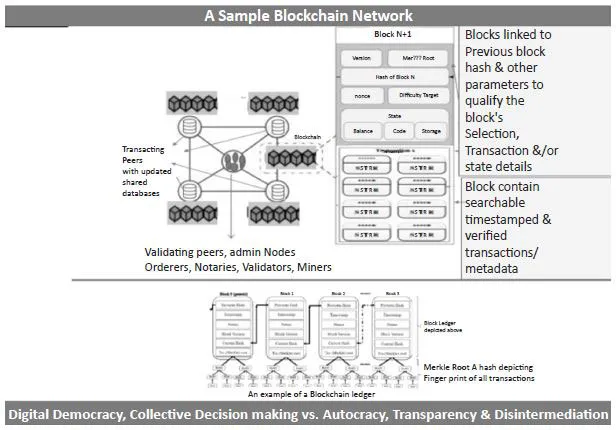
Blockchain technology was demonstrated successfully through its first use case, ‘Bitcoin.’ Bitcoin Blockchain is a living example to show that this often doubted and misunderstood technology is a new paradigm that has come to stay with us for a very long term. Bitcoin is the first implementation of Blockchain technology consisting of six primary elements:
An updated Distributed ledger replicated across all the peers undertaking transactions through the platform, consisting of the updated status of Unspent Outputs (UTXO) in chronological order.
A network of nodes undertaking to verify and propagate the transactions generated by the participants.
A group of miners dispersed across the world to mine the transactions to ensure the authenticity of the same, maintaining the integrity of the Blockchain for all times to come, using an automated execution of the protocol defined by the consensus algorithm called ‘Proof-of Work.’ ‘Proof-of-Work’ represents the amount of work that the miners undertake by utilizing their computing power and electricity spent, to be eligible for block rewards in the form of newly mined coins as per a predefined formula.
Figure 1.1: Sample Blockchain Network
Blockchain wallets used by the participants to initiate transactions and store the value in the form of UTXOs or unspent transaction outputs measured in the number of Bitcoins.
The value that is exchanged across the platform, namely the ‘Bitcoin’ or its fraction, which is treated as a cryptocurrency with all the properties that we associate with the fiat currency in the real world, except the unitized physical representation and regulatory approvals.
Exchanges that facilitate buying and selling of cryptocurrencies and derived products known as tokens among themselves using wallets and conversion of the same into fiat currencies in a dynamic manner.
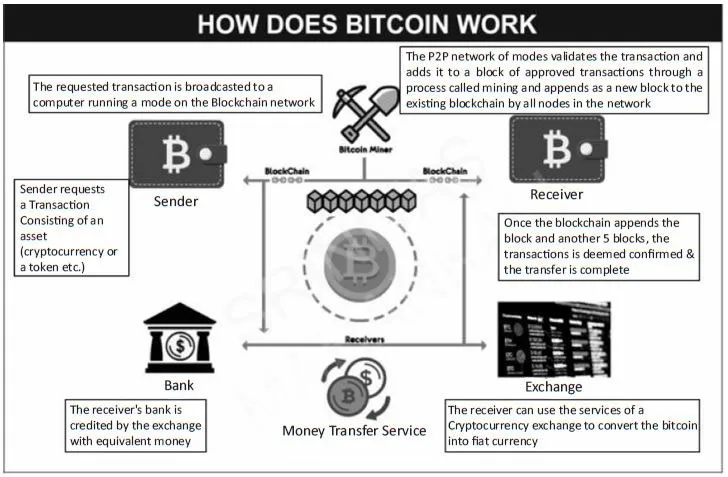
Bitcoin has proved that billions of dollars’ worth of value can be exchanged across the world from one person to another unknown person, without the need of a trusted central party, a bank or Government in this case. As on 1st February 2021, over 18 million Bitcoins with an approximate total value of over 500 billion US Dollar at a unit price of over 30000 US Dollars are in circulation. The success of Bitcoin led to the launch of several variations of alternate Blockchains for a variety of purposes. The majority of them are cryptocurrencies with different properties in terms of privacy, speed of execution, consensus mechanism for transaction validation, the most prominent variation was proposed in the form of the Ethereum Blockchain platform by Vitalik Buterin and his team at Ethereum foundation which we shall discuss a little later.
Figure 1.2: How Does Bitcoin Work
Over the years, the cost of infrastructure in the form of storage space and processing power required for IT applications has come down substantially. The availability of high-quality Cloud service providers has reduced the need for investments in high cost on premise infrastructure. Approaches like ‘Open-source technologies, decentralized methodologies’ and ‘Pay-as-you-go-for-services consumed’ are combining to facilitate the employment of cutting-edge technology powered infrastructure to find new solutions to our problems, rather cheaply. Messaging Protocols, Event-driven communication and record updation, API (Application Programming Interfaces) are facilitating collaboration between applications across multiple on-Premise and Cloud-based applications acting together seamlessly. IBM, Microsoft, Oracle, Amazon and many leading organizations are offering high-end secure IT applications including Blockchain as a service that can facilitate the large-scale implementation of automation enabling technologies in a convenient and cost-effective manner.
What is Blockchain?
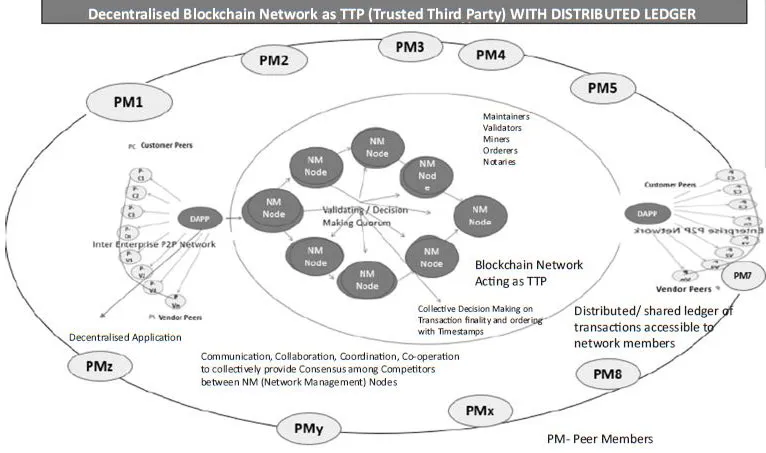
Blockchain is an augmented Peer to Peer Distributed Ledger Technology employing advanced cryptography to secure identities of participants in the network undertaking timestamped, immutable transactions with decentralised processing to exchange data & change ownership of assets using cutting edge technology powered applications also known as Smart contracts running inside the system providing Transparency, Security, Tamper resistance, Auditability and enhanced Trust through system acting as Trusted Third Party in Triple entry accounting.
Figure 1.3: Decentralized Blockchain Network as TTP (Trusted Third Party)
Blockchain: An Augmented Distributed Ledger Technology
Blockchain is a Distributed Ledger that uses peer to peer consensus within a Decentralized Network to validate transactions and a hashing algorithm to cryptographically link them in a Chronological chain of records.
Copies of ledger are shared across computers known as ‘Nodes in the network’
Computerised record of historical transactions chronologically ordered.
Shares resources directly between nodes bypassing third part network with specialized communication protocols.
Every transaction must be approved (or rejected) by Consensus mechanisms (Ex: POW, POA, POS, DPOS, PBFT, RBFT, Raft etc.)
Hosted by many nodes simultaneously controlled by no single entity. Data is accessible by anyone within the network.
Public Permissionless networks like Bitcoin & Ethereum, Permissioned networks like Hyperledger, R3 Corda, Quorum
Transactions may include moving currency, updating a standard enterprise records, transferring ownership of an asset etc.
Converting transaction data to a fixed length string of numbers and letters that cannot be reverse engineered (ex: SHA 256).
The hashing process of a new block includes meta data from the previous block’s hash output. The link makes the chain immutable.
A full immutable time-ordered history of transactions approved by the network.
Resilient Data Structures of Blockchain
We have seen that in the traditional approach, the participants in a typical business scenario pretty much operate in silos and all the parties are connected to the centralized big marketplace or the dominant player who connects the buyers and sellers or provides the services to the clients globally.
Instead, Blockchain presents an inter-enterprise scenario that offers a ‘Single Source of Truth’ where all the peers are connected to every other peer with a possibility to conduct peer-to-peer transactions as per business logic codified in the form of Smart Contracts. Even the dominant player, though while being the facilitator could still be a player whose returns depend on the quantity and quality of the business dealings happening on the network.
The Single Point of Failure has always been the bane of most of the centralized organizations which maintain their databases under a single command, control and administration. This is the weakness most often exploited by the Ransomware virus creators who were behind some of the most lethal attacks on global organizations by unleashing the WannaCry virus.
While distribution and shared database also help in nonrepudiation by the parties undertaking transaction, the ability to reconstruct the database from other members of the network eliminates the risk of the SPOF from this very route, thus blunting the weapons of the cybercriminals. This minimizes the risk by tilting the RRR (Risk-Reward-Ratio) away from the investors of these crooked instruments.
Thus, Blockchain is seen as the vehicle for safe and secure automation at scale.
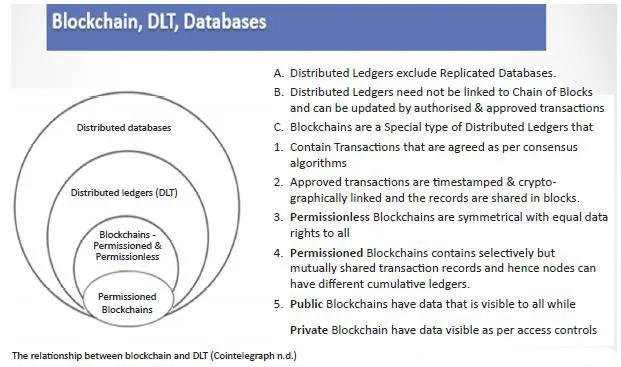
Traditionally we are used to centralised databases for storing data which respect the CRUD methods for manipulating data, namely Create, Update, Update and Delete. We also come across replicated data bases under the command and control of the same IT Administrator’s control. Blockchain, a programmable database differs from the traditional databases in a number of ways, as captured in the following figure.
Figure 1.4: Blockchain & its connection with Databases & Distributed Ledger Tech
As seen in the above diagram, Blockchains can be classified as follows:
Permissioned: If the membership and the validator pool is restricted and must be approved by an admin authority like in the case of Hyperledger Fabric, R3 Corda, Quorum etc. In a Permissioned Blockchain, ability to conduct transactions or write data is restricted as per access control rights
Permissionless: If the membership and the validator pool is not controlled and accessible with equal opportunity to anyone like in the case of public Bitcoin and Ethereum platforms
In case the data stored on the Blockchain is accessible for viewing to anyone without restrictions, then it is considered a Public Blockchain and if the access is strictly restricted and is kept confidential to a selected group of participants, then it is considered Private Blockchain.
If a Blockchain is set up and implemented by a dominant player who controls the access and validation, it is termed Private Permissioned and in case a group of participants work together then it is termed a Consortium Blockchain or Federated Blockchain.
In general, Blockchain databases can be considered SALT databases as per the context may be. In the context of Permissioned Blockchain systems, SALT may be described as Sequenced (timestamped), Agreed (decided in a manner agreeable to the participants as per an approved program), Ledgered (maintained in a database of key-value pairs reflecting the state of ownership of assets and Tamper resistant (almost impossible to change the order of the records committed).
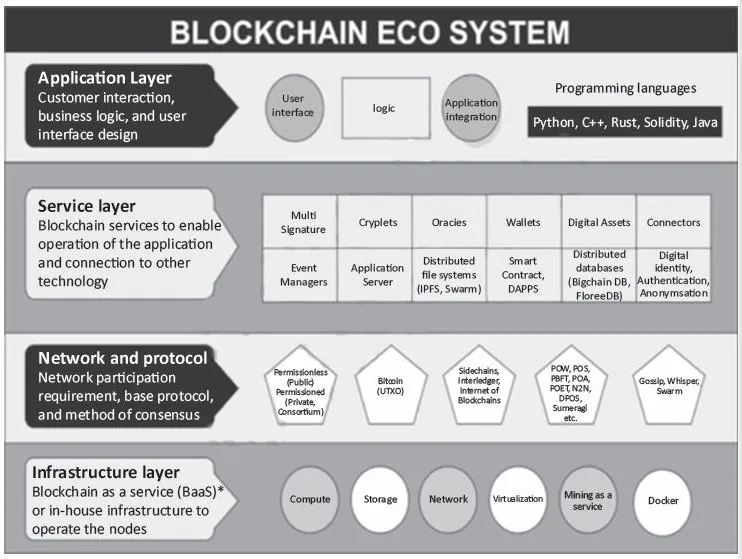
Figure 1.5: An integrated representation of Components of Blockchain eco-system
Components of Blockchain
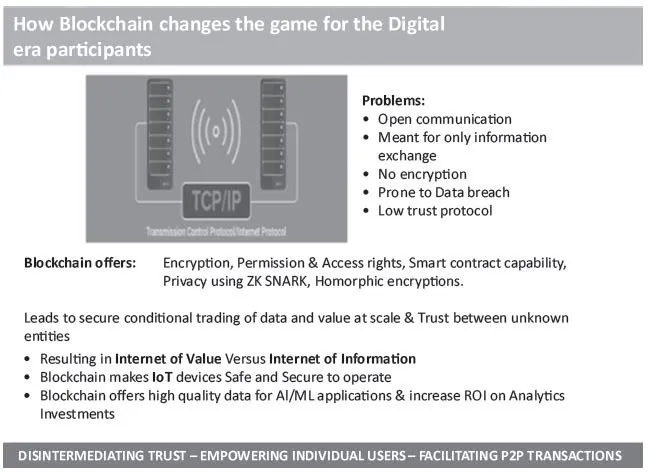
Blockchain Combines Encryption, Encoding, Hashing, PKI, Timestamps, DSA and Broadcast for the Internet of Value by bringing Privacy, Permission, Password management within the reach of an individual peer and frees him/her from the dependence on the Trust Anchors who have now grown unduly large leading to a centralized internet Blockchain converts the traditional internet infrastructure as we know through its TCP/IP protocol from the Internet of Information to the Internet of Value, by acting as a Trusted Third Party to any peer to peer interactions. The features of Blockchain that facilitate this are shown in the following figure.
Figure 1.6: How Blockchain changes the game for the Digital Era Participants
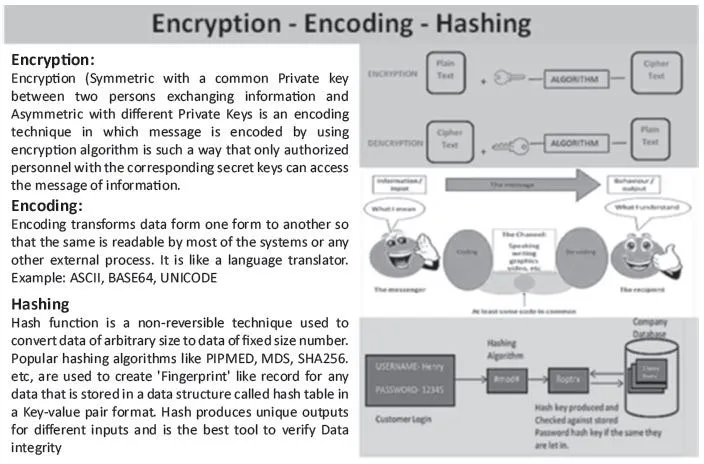
Blockchain combines the cryptographic and programmatic paradigms like encryption, encoding and hashing in a unique manner to achieve amazing benefits offering a new paradigm of trusted disintermediated transactions.
Figure 1.7: Encryption – Encoding – Hashing
Hash function: A hash function produces a unique fixed length output for a corresponding input of any size (like a thumb i...
Table of contents
Cover Page
Title Page
Copyright Page
Dedication Page
About the Authors
Acknowledgements
Preface
Prologue
Errata
Table of Contents
1. Blockchain-A Primer
2. Blockchain Platforms for Real life Applications
3. Types of Problems Blockchain can solve
4. Design Thinking & Blockchain Solution design
5. Blockchain and Governments-Examples and Case studies
6. Blockchain Countries
7. Key Government applications of Blockchain
8. Blockchain Application patterns for Integration and Interoperability
9. Applying Design Thinking to Blockchain
10. Consortium Approach-Operational and Architectural considerations
11. Implementation of Blockchain projects by Governments
12. Designing a Blockchain Project-Case study
13. Challenges and Limitations of implementing Blockchain solutions
14. Encouraging Blockchain adoption & Educating the new generation for adoption
Conclusion
Annexure 1: Model Blockchain Country-Case Study Of Thailand
Trusted by 375,005 students
Access to over 1.5 million titles for a fair monthly price.
Study more efficiently using our study tools.
Frequently asked questions
Yes, you can cancel anytime from the Subscription tab in your account settings on the Perlego website. Your subscription will stay active until the end of your current billing period. Learn how to cancel your subscription
No, books cannot be downloaded as external files, such as PDFs, for use outside of Perlego. However, you can download books within the Perlego app for offline reading on mobile or tablet. Learn how to download books offline
Perlego offers two plans: Essential and Complete
Essential is ideal for learners and professionals who enjoy exploring a wide range of subjects. Access the Essential Library with 800,000+ trusted titles and best-sellers across business, personal growth, and the humanities. Includes unlimited reading time and Standard Read Aloud voice.
Complete: Perfect for advanced learners and researchers needing full, unrestricted access. Unlock 1.5M+ books across hundreds of subjects, including academic and specialized titles. The Complete Plan also includes advanced features like Premium Read Aloud and Research Assistant.
Both plans are available with monthly, semester, or annual billing cycles.
We are an online textbook subscription service, where you can get access to an entire online library for less than the price of a single book per month. With over 1.5 million books across 990+ topics, we’ve got you covered! Learn about our mission
Look out for the read-aloud symbol on your next book to see if you can listen to it. The read-aloud tool reads text aloud for you, highlighting the text as it is being read. You can pause it, speed it up and slow it down. Learn more about Read Aloud
Yes! You can use the Perlego app on both iOS and Android devices to read anytime, anywhere — even offline. Perfect for commutes or when you’re on the go. Please note we cannot support devices running on iOS 13 and Android 7 or earlier. Learn more about using the app
Yes, you can access Blockchain in e-Governance by Srinivas Mahankali,Rajesh Dhuddu, Srinivas Mahankali in PDF and/or ePUB format, as well as other popular books in Computer Science & Information Technology. We have over 1.5 million books available in our catalogue for you to explore.