With the advent of World War I, infantry rapiers or cavalry sabers had practically become obsolete on the European battlefields due to the introduction of machine weapons and tanks. At the same time, in Japan, the samurai sword experienced an impressive renaissance due to the growing demand of Japanese officers for traditionally forged swords.Samurai Swords for the Material Battle tells the story of the last Samurai Swords forged for battle and answers the question of why Japan's soldiers entrusted their fate to these swords in the inferno of material battles. Impressive visual documents tell of the events of that time and allow the viewer to imagine the hell through which the soldiers of all warring parties went.Using the example of the works of contemporary swordsmiths, the author not only proves the art status of these swords. He also examines the question of whether only swords from Tamahagane can be genuine Nihonto. Purists will be shocked by the estimation of a leading contemporary swordsmith who recommended that the Japanese War Ministry supply all swordsmiths with Manchurian steel. Likewise, the estimation of Japanese swordsmen who fought to the death with their swords is likely to turn many Budo devotees' idea of the ideal fighting sword on its head.Based on the personal fates of Japanese soldiers, the author evokes the spirit of the last samurai. The reader can understand how the Japanese sword myth and the samurai's code of honor shaped the Japanese society up to the time of the Second World War and had a decisive influence on their actions.By not looking at the swords in isolation, but placing them in the focus of contemporary historical events, this book differs from many reference books in this genre and complements the existing literature in a unique way. Competently and carefully researched, it is for the connoisseur of the subject as well as for beginners or readers interested in contemporary history a real treasure trove and exciting reading to the end.
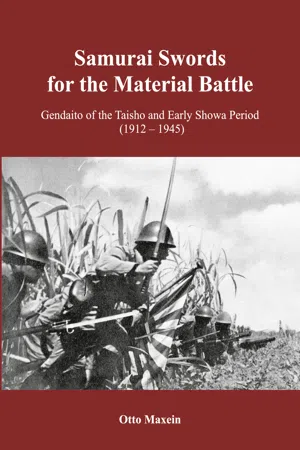
eBook - ePub
Samurai Swords for the Material Battle
Gendaito of the Taisho and Early Showa Period (1912 - 1945)
- 212 pages
- English
- ePUB (mobile friendly)
- Available on iOS & Android
eBook - ePub
Samurai Swords for the Material Battle
Gendaito of the Taisho and Early Showa Period (1912 - 1945)
About this book
Information
Glossary
This glossary is not a complete list of the Japanese sword terminology. It should serve the interested reader only for a better understanding, as far as the description of the swords or the translation faithfulness made the use of the Japanese terms seem reasonable. Further explanations of terms were included, as far as the subject matter made this seem reasonable.
| Amaterasu-o-mi-kami | Most important Shinto deity; personification of the sun and the light, founder of the Japanese imperial house. |
| ashi | Literally “foot”; narrow stripes of nie or nioi, running vertically from the tempering line (hamon) to the cutting edge. |
| Avenger | The Grumman TBF Avenger was the standard torpedo bomber of the US Navy at the end of World War II. |
| bakufu | Military government of the warrior nobility under the leadership of a shogun. |
| bizen-den | Bizen school |
| bizen-zori | Sword blade with the curvature near the tang, also known as koshi-zori. |
| bo-hi | wide fuller |
| bo-hi – hisaki-agari | bo-hi running beyond the yokote |
| bo-hi – kaki-nagashi | bo-hi running into the tang |
| bo-hi – kaku-dome | bo-hi with square end |
| bo-hi – maru-dome | bo-hi with round end |
| boshi | tempering line in the tip of the sword |
| boshi – kaen | flame shaped boshi |
| boshi – kaeri | turn back of the boshi to the mune |
| boshi – ko-maru | small round boshi |
| boshi – o-maru | large round boshi |
| Boshin-Krieg | War (1868-1869) between the Tokugawa-Bakufu and the imperial troops It ended with the defeat of the bakufu and sealed the fate of the samurai. |
| bu | Japanese scale unit; 1 bu = 0,303 cm. |
| buke | warrior nobility, Samurai |
| bushido | Literally "way (do) of the warrior (bushi)". Code of conduct and honor of the samurai in the late Japanese Middle Ages. |
| chikei | darker lines (folds) in ji |
| choji-hamon | clove-shaped tempering line |
| Corsair | The Vought F4U Corsair was a US carrier-operated fighter-bomber during World War II. Its characteristic bent wings were striking. |
| efu (no) tachi | Efu tachi, also known as hoso tachi, were worn exclusively by highranking princes (daimyo) and the highest dignitaries at court. Characteristic features of the mounting (koshirae) are the shitogi tsuba and the same grip without handle winding. This mount serves primarily for ceremonial purposes and less for fighting. Efu tachi were made from the Koto to the Showa period. |
| fuchi | Handle clamp, front fitting part of the sword handle. |
| fukura | cutting edge at the tip of the sword |
| gendaito | Literally “modern sword”; term for a traditionally forged Japanese sword from the time after 1876 until today. |
| gimei | wrong signature |
| gunome-hamon | tempering line of a sequence of uniform short waves |
| gunome shoji | tempering line of a sequence of cloverleaf-shaped figures |
| gunto | Literally “army or military sword”. The blade could be machine made, but also traditionally hand forged. |
| ha | cutting edge of the sword |
| habaki | blade collar |
| hada | “Skin”, damask structure of the blade surface; visible forging pattern. |
| hada – ayasugi hada | horizontal and parallel running waves |
| hada – itame hada | like wood grain |
| hada – ko-itame hada | similar to itame, but smaller/denser grain |
| hada – konuka hada | Extremely dense ko-mokume hada with fine, homogeneous surface structure; characteristic of swords forged by the smiths of the Tadayoshi school in Hizen province. |
| hada – masame hada | horizontal and parallel running straight lines |
| hada – mokume hada | like burl wood |
| hada – muji hada ha-machi | damask structure (to the naked eye) practically no longer recognizable step from the cutting edge to the tang |
| hamon | tempering pattern |
| Heian period | 794 – 1184 |
| Hellcat | The Grumman F6F Hellcat was a US-American carri... |
Table of contents
- Foreword
- Table of Contents
- Dedication
- Special Thanks
- Syntax, Formatting
- Image Material, Own Photos
- Samurai Swords for the Material Battle
- Minamoto Yoshichika, Shodai and Nidai
- Minamoto Yoshichika, Shodai
- Minamoto Yoshichika, Nidai
- Coronation Tachi by Minamoto Yoshichika
- Tamahagane or „Jewel Steel“ A Historical View
- The Symbol of the Broken Sword
- The Japanese Sword as an Art Object
- Art Swords for the Hardest Close Combat
- Minamoto Yoshichika, Shodai and Nidai Picture Section
- Shodai Minamoto Yoshichika with Cutting Test by Hakudo Nakayama
- Nidai Minamoto Yoshichika in Gunto Koshirae
- Nidai Minamoto Yoshichika in Kai-Gunto Koshirae
- The Yasukuni Shrine
- Yasuoki
- Gunto, its Place in the Imperial Army and its Importance in Battle
- Gunto, its Place in the Imperial Army and its Importance in Battle Picture Section
- Kamikaze
- Shimpu Tokkotai
- Missions of the Shimpu Tokkotai, Picture Section
- Glossary
- List of References, Print Media
- List of References, Wikipedia
- Other Internet Sources
- Copyright
Trusted by 375,005 students
Access to over 1.5 million titles for a fair monthly price.
Study more efficiently using our study tools.
Frequently asked questions
Yes, you can cancel anytime from the Subscription tab in your account settings on the Perlego website. Your subscription will stay active until the end of your current billing period. Learn how to cancel your subscription
No, books cannot be downloaded as external files, such as PDFs, for use outside of Perlego. However, you can download books within the Perlego app for offline reading on mobile or tablet. Learn how to download books offline
Perlego offers two plans: Essential and Complete
- Essential is ideal for learners and professionals who enjoy exploring a wide range of subjects. Access the Essential Library with 800,000+ trusted titles and best-sellers across business, personal growth, and the humanities. Includes unlimited reading time and Standard Read Aloud voice.
- Complete: Perfect for advanced learners and researchers needing full, unrestricted access. Unlock 1.5M+ books across hundreds of subjects, including academic and specialized titles. The Complete Plan also includes advanced features like Premium Read Aloud and Research Assistant.
We are an online textbook subscription service, where you can get access to an entire online library for less than the price of a single book per month. With over 1.5 million books across 990+ topics, we’ve got you covered! Learn about our mission
Look out for the read-aloud symbol on your next book to see if you can listen to it. The read-aloud tool reads text aloud for you, highlighting the text as it is being read. You can pause it, speed it up and slow it down. Learn more about Read Aloud
Yes! You can use the Perlego app on both iOS and Android devices to read anytime, anywhere — even offline. Perfect for commutes or when you’re on the go.
Please note we cannot support devices running on iOS 13 and Android 7 or earlier. Learn more about using the app
Please note we cannot support devices running on iOS 13 and Android 7 or earlier. Learn more about using the app
Yes, you can access Samurai Swords for the Material Battle by Otto Maxein in PDF and/or ePUB format, as well as other popular books in History & World History. We have over 1.5 million books available in our catalogue for you to explore.