![]()
INTERVIEW
Yamamba on the Noh Stage: With Noh Actors Uzawa Hisa and Uzawa Hikaru
Ann Sherif
One of the most compelling representations of the yamamba is in the Noh play of the same title. In this interview, acclaimed Noh actors Uzawa Hisa and Uzawa Hikaru discuss their experiences performing Yamamba and their interpretations of the Noh-inflected representation of yamamba. Noh is a classical theater combining dance and song that dates to the fourteenth century, when it was an art form for the entertainment of military rulers and the gods. Today, Noh continues as one of Japan’s living traditional performing arts. The Uzawas’ skill and artistry have earned them solid standing at the highest levels of Noh practice as two women in a male-dominated profession. In December 2019, Ann Sherif conducted this interview with the Uzawas, first on their practice stage in Tokyo and later on Skype. (All translations from the play Yamamba in the interview below are by Monica Bethe and Karen Brazell from their co-edited Traditional Japanese Theater. The interviews were conducted in Japanese and translated by the author.)
Uzawa Hisa and Uzawa Hikaru dedicate this interview to the memory of Mae Smethurst (1935–2019), scholar of Noh, mentor, and friend.
ANN: How would you describe the Noh play Yamamba?
HISA: In Act I, we are introduced to a young dancer named Hyakuma Yamamba. Though she is very famous in the capital for her kusemai (storytelling accompanied by dance) about a yamamba, she doesn’t want to be complacent and keep doing the same thing again and again. So she decides to go on a pilgrimage to the famous Zenkōji temple in Shinano no kuni (present day Nagano Prefecture). She sets out from the capital with her retainer—I’ll call him the manager, since she’s a star in the capital. Often in Noh plays, the waki (or side) role that interacts with the lead actor is a monk. However, in this play, the audience knows that the waki role is not a holy man because the performer is wearing ordinary clothes, instead of a Buddhist monk’s robes.
At one point in their long journey, the dancer has to decide which of the several routes that lead to Zenkōji they will take. She chooses the steepest, most challenging path. That means she has to get off the horse, or ox or whatever she was riding, and go the rest of the way by foot. Noh isn’t a realistic theater, so we don’t see how she is traveling.
HIKARU: Then, as they are making their way up the mountain, it suddenly gets dark.
HISA: They started climbing around midday so they didn’t expect it to get dark so soon. “How strange!” Hyakuma Yamamba thinks. Then, from deep in the mountain, they hear a voice saying, “Travelers, it’s dark now, so I will accompany you to a place where you can stay.” The person speaking appears to be a woman, a woman who lives in these mountains, an older woman.
ANN: In Noh, how does the old woman in the mountains look?
HISA: In the Noh play, the shite (main actor) plays the mountain woman, and in Act II the shite returns in the form of the yamamba. In Act I, the shite’s costume has “no color” (iro nashi, meaning no red hues), which indicates that it’s not a young woman. The mask in Act I is also that of a middle-aged woman.
To return to the story: The mountain woman tells Hyakuma Yamamba that she made the sky darken so she could offer lodging to them. She wants to hear the dancer’s famous yamamba song (uta) that she’s heard so much about. The text here suggests that she is challenging the entertainer: “You may be a renowned singer and dancer who performs the yamamba. But have you ever seen a real yamamba?”
Needless to say, the dancer thinks this is quite unusual. And then, the mountain woman says to her, “I am a real yamamba and here I am before you. Please sing your song for me.”
HIKARU: And please clear me of my delusions (mōshū).
HISA: Yes, delusion is a major concern in this play.
HIKARU: She says, “If you will sing your song tonight as the moon rises, I will appear in my true form as Yamamba!” And with that, the mysterious woman vanishes. That’s the end of Act I.
HIKARU: Immediately following is an interlude (nakairi) in which the guide and a local person talk about legends of female demons (kijo). In some Noh performances, they talk about what the yamamba is made of, such as nuts, mushrooms, plants, metal, and other substances.
HISA: Early in Act II, the dancer decides that she will sing and dance for the mountain dweller, but she does not in fact sing anything at that point in the play. As the chorus chants about the moon illuminating the sky, the real yamamba appears. There’s the question of whether the yamamba looks like a woman or like a man. The shite is wearing a wig and is a rather androgynous figure. The gender is not distinct. Even though the yamamba is referred to as a female demon, the figure on stage could be a woman, might be a man. The audience can’t tell. It’s even less clear to the performer.
ANN: The performer isn’t clear whether the yamamba is woman or man?
HISA: We say that it’s like the mountain moves and comes out on stage. Yamamba is the mountain, and nature itself. What is important is where the energy comes from, not who the character is. During my lessons, my teacher Kanze Hisao Sensei taught me that the yamamba embodies an unimaginable amount of energy, and that’s what the shite has to perform. It should be like a mountain moving, which is something extraordinary, beyond our powers of imagination. The performer has to conceive of that level of strength and energy. It’s clearly beyond what a human is capable of, so the performer just has to try to the best of her ability. I couldn’t just pull it out of my pocket, that’s for sure! I found it really challenging, especially when I was young.
ANN: The beginning of Act II features stunning natural imagery of the moon and the mountains.
HISA: Yes, those lines are full of dense natural images, but the text here also is quite philosophical and difficult. “Awesome, the deep ravines/In graveyards, beating their own bones, fiendish wraiths/groan, bemoaning their deeds from former lives … good and evil are not two … mountains beyond mountains … waters beyond waters.” These lines evoke the mountain, nature itself.
HIKARU: The mountain embodies this world, which relates both to nature and to Buddhist cosmology.
HISA: When chanting those words, the performer has to blend the many Buddhist ideas in this passage with one’s breathing and physical form. It requires a great deal of energy. I find the aesthetic sense in this passage striking. What comes through here is not ordinary beauty but a severe beauty. It’s the severity and harshness of nature, not human’s notion of harshness. Among the many Noh plays, Yamamba particularly challenges the shite because of the requirement to perform something vast and transcendent.
ANN: The music in this section is especially energetic and striking.
HISA: The drummers have to put their all into this part; their playing helps to bring alive the chanting of this particular passage. Both of the drums, otsuzumi (hip drum) and kotsuzumi (shoulder drum), weigh in. So it’s very intricately structured. By the same token, the instrumentalists can do that only if the shite’s chanting is just right. The shite is taking the lead here, not the instrumentalists. So this long passage in the second act is extremely difficult.
ANN: The yamamba is an ambiguous figure. In some legends, she is a demon that eats human flesh. But not in this Noh play.
HISA: That’s true. In the part of the play when the young dancer is trying to find out who this mysterious woman is and suspects she might be the yamamba, the dancer is afraid. She grew up hearing the legend of the yamamba as a demon (oni) that eats humans. In contrast, the yamamba in the Noh play tells her not to be afraid—she’s not that kind of oni.
HIKARU: In the text, the dancer says that it’s like seeing a demon roof tile for the first time [a common decorative tile similar to a gargoyle], with eyes shining, a red face, and bushy hair, so she does have a frightening appearance. She’s also very surprised when she sees the yamamba because the yamamba is able to speak human language.
HISA: Even though the yamamba herself says that she doesn’t intend to be scary, the young woman finds her scary.
HIKARU: Then the yamamba presses the dancer to perform the song and dance (kusemai).
HISA: Kusemai was a distinct performance art that was performed in Zeami’s day [nearly seven hundred years ago when he was shaping Noh as we know it today].
HIKARU: The lines in this part mean “Dragging good and evil Yamamba/Makes her mountain rounds in pain.”
HISA: These lines impress on us the contrast between the light little songs that Hyakuma Yamamba was singing to entertain her audience and the songs of the real yamamba.
This next passage is very profound. One might expect the play to end here, since Hyakuma Yamamba sang her song for Yamamba, but in this final section the shite and chorus chant lines about the vast scale of nature: “Vast and empty valley voice/Reverberates … brimming waters of the sea.…”
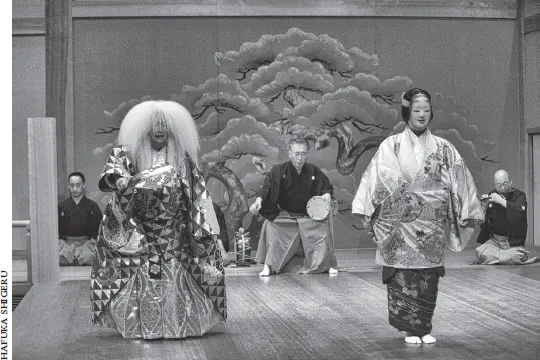
Uzawa Hikaru as Yamamba (left) and Uzawa Hisa as Hyakuma Yamamba (right) performing Yamamba at the 102nd Annual Kawasaki-shi Teiki Noh,Kawasaki Noh Theater, Kawasaki, Japan, 2014.
So the play is not only about Yamamba, but also about nature. Nature is represented here as awesome but also as the interconnection among all creatures and the non-human world. Nature is not a threat to humans. In the Noh, Yamamba is not a malevolent crone. For example, the text says she helps weaving girls with their backbreaking work. And when once in a while a woodsman’s burden is lightened, it is because she helps him out. Yamamba says that sometimes she assists humans, which symbolizes nature’s benevolence. I think Japanese views of nature are well represented in this play.
HIKARU: The theme of delusion (attachment that hinders enlightenment; delusory attachment) comes back in this part of Act II. Yamamba tells the dancer to “return to the capital/tell the world these tales.” In the same line, Yamamba realizes that her wish to be known in the capital may be spiritually problematic, because it shows she is attached to fame and reputation. She asks herself, “Is this still delusion?”
She’s not easy on herself! “Yamamba makes her mountain rounds in pain.” Yamamba holds herself to high standards, in Buddhist terms. The text spells this out clearly. She should not be thinking (proudly) about all the things she does to help humans. Thoughts like that are themselves delusions because such thoughts indicate getting caught up in the “self” (jiko). Many Noh plays revolve around the Buddhist notions of delusion. Even though Yamamba possesses supernatural powers, she is still concerned about her spiritual well-being and potential for enlightenment. In many other Noh plays, we see ordinary humans, or their ghosts, who are similarly vexed by delusory attachments and who are therefore stuck in some kind of limbo. Unrequited love, excessive passion, jealousy resulting from being too much in love—these are some of the most familiar tropes concerning delusion in Noh plays. Noh doesn’t simply condemn Yamamba’s attachment to pride or reputation, but shows her very human, very relatable struggle with her feelings and aspirations, on the one hand, and her spiritual goals, on the other.
HISA: At the very end of the play, Yamamba returns to the mountains. The chanting here uses metaphor to...