The emotional lives of young children are growing increasingly more complex. There is growing interest in understanding early mental health and wellbeing and how early childcare providers can support children birth to age five who have experienced traumatic events and learn strategies to promote children's social and emotional development. Supporting Children's Mental Health and Wellbeing: A Strength-based Approach for Early Childhood Educators incorporates strength-based child care strategies to foster positive reciprocal relationships between caregiver and young children and strengthen children's resiliency and wellbeing.
Strategies include building on children's mental health and resiliency; identifying protective factors and indicators of risk; promoting healthy attachment; and, scaffolding social and emotional development within the context of family relationships and culture.
Supporting Children's Mental Health and Well-being covers
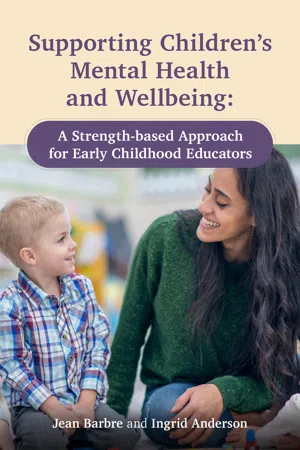
eBook - ePub
Supporting Children’s Mental Health and Wellbeing
A Strength-based Approach for Early Childhood Educators
- English
- ePUB (mobile friendly)
- Available on iOS & Android
eBook - ePub
Supporting Children’s Mental Health and Wellbeing
A Strength-based Approach for Early Childhood Educators
About this book
Trusted by 375,005 students
Access to over 1.5 million titles for a fair monthly price.
Study more efficiently using our study tools.
Information
Topic
EducationSubtopic
Behavioural ManagementSECTION 1The Circle of Caregiver and Child Wellbeing
During the first five years of life, young children are busy exploring and learning about the world. They are developing skills across all five developmental domains: cognitive, linguistical, physical, and especially social and emotional. We believe that adult-child relationships and social and emotional skills are foundational to a child’s mental health and wellbeing. Early attachments to loving, caring adults help children develop feelings of security and trust, providing them with the skills they need to form close relationships with others, adapt to the changing situations of life, and develop a sense of self and wellbeing.
We wrote Supporting Children’s Mental Health and Wellbeing: A Strength-Based Approach for Early Childhood Educators to support early child care providers as they navigate the changing emotional climate of the children and families in their care. This book is designed to help those who work in early care and education understand the relationship between mental health and typical social and emotional development. We hope that by reading this book, you will gain a deeper understanding of the early mental health and wellbeing of children ages birth through five and learn strength-based, developmentally appropriate strategies you can use to support young children’s social and emotional development.
A Strength-Based Approach
Strength-based caregiving is the ability to reflect on which practices best support each child’s individual needs. When we incorporate a strengthbased approach, we start with what is present—skills and competencies that already exist within the child and family. In this approach, focus is placed on the child’s and family’s positive attributes rather than on their deficits. A deficit-based approach sees what is lacking rather than what is present. We want to ask ourselves, How do I build on ______? rather than, Why can’t they ______? When we use a strength-based approach and language, we orient ourselves to working with families. A strength-based approach recognizes individual, family, and environmental strengths. We see the strength of the individual child and their unique capabilities. We acknowledge the strength that comes from their environments, including cultural identity. We build on family strengths by recognizing their resourcefulness and resiliency.

For caregivers, the foundation of strength-based caregiving is the dyadic or one-child/one-adult relationship. The dyadic relationship is fundamentally different from our relationship with a group or classroom of children. A dyadic relationship is mutually engaging. For example, an infant and their primary caregiver engage in serve and return, or behaviors in which each individual in the pair reads facial and body expressions and responds to the other in a back-and-forth pattern. Dyadic relationships are a cornerstone of healthy attachment, brain development, and social and emotional development.
The dyadic relationship requires trust and respect between both members of the dyad. In this relationship, the caregiver trusts that the child’s behavior is genuine and the child trusts the caregiver to meet their needs. As caregivers, we need to recognize that misbehavior emerges from underlying unmet needs. As parent educator Dr. Jane Nelsen states, “Misbehaving children are discouraged children who have mistaken ideas on how to achieve their primary goal—to belong” (Nelsen 2021). All children have a profound need to feel human connections and a sense of belonging. They need their hopes for the future to be nurtured. Each individual child needs their caregivers to treat them with respect and attribute positive intention to their actions.
A strength-based approach requires caregivers to build a culture of trust and respect with each child and their family. Building mutually respectful relationships begins with our first encounters with young children and their families as we create space to build trust with families and enter a relationship that sees every child’s limitless potential. Building on a child’s strengths invites families to feel safe in having complex, and sometimes courageous, conversations about their children. Families will understand that we see the whole child, not just the child’s challenges.
Why We Wrote This Book
We the authors each come from unique backgrounds that frame our understanding of child mental health and wellbeing. We each have over thirty years of experience working in early childhood programs and mental health, and hold doctoral degrees in education.
Jean is a licensed marriage and family therapist, early childhood administrator, and university faculty member. She has extensive advanced training as a certified trauma therapist and in holistic supports for young children in mindfulness and yoga practices.
Ingrid has been an early childhood educator and administrator, and is now a faculty member in graduate programs for infant and toddler mental health and inclusive early childhood education. She has an advanced degree in conflict resolution and peaceable solutions skills. Her work has focused on access and equity issues in early childhood, and her research focuses on the wellbeing of early childhood educators and young children.
We both have trained as parent educators and have worked together since 1998. In our collaborations, we have established and managed preschool programs, collaborated with local mental health supports, and taught and researched at various universities around the world. Over the past two decades, we have seen the early care and education field face increasingly more complex challenges in scaffolding social and emotional development. As we worked, presented, and collaborated together, we began noticing requests for guidance supports from the early childhood field increasing. Caregivers were expressing concerns that the strategies they were using to guide young children were not as effective as in the past.
Concurrently, we have seen a growing interest among early child care providers to understand early mental health and wellbeing. There are now more advances in mental health and empirical evidence about developmental disorders available for mental health professionals than ever before, but we know that this information is not readily available to early childhood providers. In 2016 early childhood advocacy group Zero to Three released the Diagnostic Classification of Mental Health and Developmental Disorders of Infancy and Early Childhood DC:0–5 (Zero to Three 2016). This document provides general diagnostic information for mental health clinicians but is not written for the early child care provider. Therefore, we decided to write this book to help caregivers understand the continuum leading from social and emotional development to mental health and wellbeing.
Our goal is to equip caregivers with the tools they need to address children’s development based on mutual respectful dyadic relationships in the classroom. We want to help caregivers build their practices on a strength-based approach with the resources they need to thrive alongside the children in their care. This book represents a culmination of our work together in thinking about early childhood educators, young children, their families, and the changing social and emotional landscapes of the early childhood classroom.
We will provide an overview of major mental health disorders commonly seen in early childhood environments. Our intention is to educate and inform early childhood providers in understanding mental health and wellbeing in young children. This book is in no way meant for you to label or diagnose children with a mental health disorder. The information in this book is not a substitute for the knowledge, skill, and expertise of qualified mental health professionals. Should you have any health, medical, or disability questions or concerns about the children in your care, please follow your agency’s protocol for referrals to a licensed physician or other health care professional.
As we examine supporting children’s mental health and wellbeing, we must first identify the common terms and definitions used in this book. They are as follows.
- Mental Health: The sense of wellbeing an individual possesses that impacts how they think and feel about, adapt to, and cope with the stresses of life.
- Mental Illness: A wide range of conditions and disorders that affect an individual’s behavior, mood, and thinking. A mental health professional must diagnose a mental disorder, which meets specific criteria using a common diagnostic tool. See more information on diagnostic tools in chapter 2.
- Wellbeing: A positive sense of self that allows individuals to lead happy, productive lives and form and maintain healthy relationships.
- Emotional Wellbeing: The quality of emotional responses to life experiences, including the ability to adapt and change, demonstrate resiliency, resolve conflict, manage emotions, and generate consistent feelings of happiness and hopefulness.
- Social Health: The skills and competencies needed to form healthy relationships and social interactions. These include skills and competencies to communicate wi...
Table of contents
- Cover
- Title Page
- Copyright
- Contents
- Acknowledgments
- Section 1: The Circle of Caregiver and Child Wellbeing
- Section 2: The Six Pillars
- Section 3: Strength-Based Classroom Strategies
- Appendix A: Recommended Children’s Books for Social and Emotional Development
- Appendix B: Websites and Internet Resources
- References
- Index
Frequently asked questions
Yes, you can cancel anytime from the Subscription tab in your account settings on the Perlego website. Your subscription will stay active until the end of your current billing period. Learn how to cancel your subscription
No, books cannot be downloaded as external files, such as PDFs, for use outside of Perlego. However, you can download books within the Perlego app for offline reading on mobile or tablet. Learn how to download books offline
Perlego offers two plans: Essential and Complete
- Essential is ideal for learners and professionals who enjoy exploring a wide range of subjects. Access the Essential Library with 800,000+ trusted titles and best-sellers across business, personal growth, and the humanities. Includes unlimited reading time and Standard Read Aloud voice.
- Complete: Perfect for advanced learners and researchers needing full, unrestricted access. Unlock 1.5M+ books across hundreds of subjects, including academic and specialized titles. The Complete Plan also includes advanced features like Premium Read Aloud and Research Assistant.
We are an online textbook subscription service, where you can get access to an entire online library for less than the price of a single book per month. With over 1.5 million books across 990+ topics, we’ve got you covered! Learn about our mission
Look out for the read-aloud symbol on your next book to see if you can listen to it. The read-aloud tool reads text aloud for you, highlighting the text as it is being read. You can pause it, speed it up and slow it down. Learn more about Read Aloud
Yes! You can use the Perlego app on both iOS and Android devices to read anytime, anywhere — even offline. Perfect for commutes or when you’re on the go.
Please note we cannot support devices running on iOS 13 and Android 7 or earlier. Learn more about using the app
Please note we cannot support devices running on iOS 13 and Android 7 or earlier. Learn more about using the app
Yes, you can access Supporting Children’s Mental Health and Wellbeing by Jean Barbre,Ingrid Anderson in PDF and/or ePUB format, as well as other popular books in Education & Behavioural Management. We have over 1.5 million books available in our catalogue for you to explore.