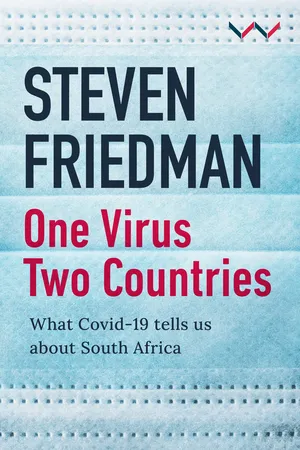
Has South Africa 'done well' at limiting illness and deaths during the COVID-19 pandemic? Academic and political commentator, Steven Friedman, thinks not. While the country's mainstream media believes it has, in his view the evidence tells another story. South Africa has experienced by far the most cases and deaths in Africa – at one point as many as the rest of the continent combined.
One Virus, Two Countries: What Covid-19 tells us about South Africa offers a searing analysis of government and expert scientists' responses to the pandemic. Friedman argues that South Africa is two societies in one – a 'First World' which resembles Western Europe and North America, and a 'Third World' which looks much like the rest of Africa or South Asia. The South African state, the media and the scientific community have largely tried to deal with the virus through a 'First World' lens in which much of the country was either invisible or a problem – not a partner. Friedman argues this approach prevented the country from responding in a way which would have protected most citizens. This is why case numbers and deaths are so high: South Africa has done worse than the rest of Africa not despite the fact that it has a 'more developed' health system, but because it does.
One Virus, Two Countries is a controversial book that will rouse much needed debate about South Africa's health and economic system in a context of serious inequality.
- 168 pages
- English
- ePUB (mobile friendly)
- Available on iOS & Android
eBook - ePub
About this book
Information
Subtopic
Political ProcessIndex
Social SciencesCHAPTER
1
One Country, Two Realities
Since it became a democracy in 1994, South Africa has been, in law, one united country. The apartheid system’s attempt to justify white domination by forcing black people to become citizens of legally independent statelets is over. But, while it has one common citizenship, it houses two worlds. This has shaped its fight against Covid-19.
It is common to point out that, according to official data, South Africa is the most unequal country in the world.1 It is equally common to remark on the contrast between the privileges and luxuries a minority enjoys and the poverty and squalor in which most are forced to live. So much of a commonplace is it that, in 2019, ahead of that year’s elections, Time magazine devoted its cover story to pointing out precisely this.2 But that hardly makes the country unique: inequality has been growing across the globe for decades3 and it is hardly the only African country in which there are large disparities between the lives of the well-off and those of the poor – and where some live in comfortable suburbs, many others in underserviced slums. What makes South Africa a standout in Africa is that the divide is less one between rich and poor as between inhabitants of two very different worlds. This makes the country more similar to those in Latin America and so it may be no coincidence that Latin America, too, has experienced high levels of Covid-19 cases and deaths.4
To understand why this is so, we need to remind ourselves of the country’s history. Under colonialism and apartheid, the two worlds were a product of law enforced by an army and police force. Initially a Dutch and then a British colony, the country formally became a Republic in 1960. But the attitudes and habits which underpinned colonisation survived. This was hardly surprising since so too did white rule, which sought to transplant the dominant culture of Europe and North America (or, since in those countries, as elsewhere, culture is diverse and ever-changing, what white South Africans believed that culture to be) on African soil. Most English-speaking whites looked to Britain as a model, often comparing its ‘civilisation’ with the supposed roughness and crudity of white Afrikaans speakers.5 And, while many of these English speakers are not liberals, the political philosopher Richard Turner’s remark that white liberals under apartheid ‘… believe that “western civilisation” is adequate, and superior to other forms, but also that blacks can, through education, attain [its] level’6 applies more broadly to English-speaking South Africa. Most Afrikaans speakers – those who supported the system – were more likely to see Germany or the Netherlands as a model. They also had a more complicated reaction, chiding ‘the West’ for not understanding the need for apartheid. But the fact that they cared about what the West thought revealed the truth: that they too craved the approval of ‘civilised’ Western countries. In the early 1950s, Piet Meyer, a key Afrikaner Nationalist ideologue, told Western intellectuals that ‘the Afrikaner nation’ was a ‘young West European nation’.7
These attitudes were given form in apartheid society. White areas, lifestyles and institutions essentially implanted Western Europe and the Unites States on African soil: visitors would remark that the suburbs of the major cities resembled Southern California. Like the citizens of those societies, whites enjoyed the vote and civil liberties – provided that they did not identify overly with black demands. Not only were black people excluded (except as labourers serving the needs of the whites who inhabited this world) by law, the division of the country into different worlds was government policy and ideology. Races and ethnic groups were held to possess a distinctive culture which would be fatally diluted if mixed with others and this was said to be a rationale for strict racial separation. Apartheid ideologues also extolled those among the colonised who, in their view, knew that they belonged to a different world and had no need to leave it. According to Daan de Wet Nel, then minister of bantu administration and development, ‘The Zulu is proud to be a Zulu, the Xhosa is proud to be a Xhosa and the Venda is proud to be a Venda, just as proud as they were a hundred years ago.’8 He meant that they knew their place and had no wish to join the white world of suburban homes, corporate office towers and malls.
This ideology began to erode as white Afrikaners became wealthier and more integrated into ‘Western’ society, and as apartheid proved increasingly unenforceable. By the time the system ended in 1994, some black people were already being admitted to this world, albeit in a subordinate position: they were allowed to perform skilled work, occupy some white-collar jobs and, from 1985, live in the cities whether or not their labour was needed by white employers. Cultural and sporting apartheid eroded so blacks were no longer excluded, at least legally, from competing with whites on the field and performing in front of them on the stage and screen. By the time apartheid formally ended, in 1994, it was discredited and not even right-wing white politicians or professionals would be caught echoing De Wet Nel’s view that two worlds were ordained by nature.
But the two worlds did not end. The reasons have been analysed elsewhere9 but the outline must be sketched here because it is the key to understanding the country’s response to Covid-19. In essence, the core goal of government (supported by implication by many of society’s influential voices and interests) since 1994 has been to extend to everyone what whites enjoyed under apartheid. The end of white rule did not, as might have been expected, produce a decisive move away from the divisions of the apartheid era towards a culture and institutions which met the needs of all citizens. One possible consequence of a social reality like that under apartheid – in which one group enjoys amenities, rights and privileges by dominating another – is that the way of life of the dominating group may come to be seen as the norm to which the society should aspire. That is largely what has happened in South Africa after apartheid.
It is easy to see why white citizens should want their world under apartheid to be the goal – it enables them to continue to live much as they had lived before. But the new black leadership shared this view. Whites lived well under apartheid and the new governing elite believed that black people should not be expected to make do with less than their dominators enjoyed. If the new elite did what logic suggested it needed to do – insist that everyone, including apartheid’s beneficiaries, would need to make do with less than what a tenth of the population had enjoyed by dominating the rest – it would reinforce white prejudices which assume that government by black people always ends in a reduction of ‘standards’. Particularly when the government was led by President Thabo Mbeki (formally for nine years but, since Nelson Mandela adopted a deliberate strategy of leaving much of the running of the government to Mbeki to show that a smooth transition to competent leadership was possible, in reality 12 to 14 years), the core goal was to show whites, at home and abroad, that rule by black people could maintain the standards which whites were assumed to expect. The government’s priority was thus those tasks which whites were thought to value.10
The politicians, officials, academics and journalists who adopted this approach would be shocked and angry if they were told they were preserving the divisions of the past in a new shell, but this was exactly what they were doing. Precisely because it was impossible to extend to everyone what only a few had enjoyed because they controlled the means of force and used it to exclude everyone else, the approach retained the division between insiders and outsiders which was central to apartheid. The development path since 1994 has centred on squeezing as many black people as possible into the institutions of suburban society (including the upper reaches of the economy) rather than fundamentally changing them. Efforts to undo the inequities of apartheid have centred not on collapsing the divisions between insiders and outsiders but on trying to ensure that as many black people as possible become insiders. Despite many claims to the contrary, attempts to deracialise the economy have centred far less on providing black people with the resources and opportunities they need to build their own economic muscle than on pressing existing corporates to concede a greater black role.11 Universities deracialised by expecting black students and faculty to adapt to the way they had always operated,12 a pattern which sparked the Rhodes Must Fall student protests of 2015.13
It is this path which has ensured that South Africa, once divided into insiders and outsiders by law and by race, continues the divide without the obvious racial barriers which underpinned apartheid. Some of the symptoms are common to all countries, including many in Africa: income inequalities, high levels of unemployment and affluence for a few, poverty for most. But in other African countries, those who benefit from these arrangements are a small fraction of the population – in South Africa, the insiders could be up to a third of the citizenry. Nor do the elites in the other countries inherit institutions and patterns of behaviour built up over centuries of white settlement. In most, the colonisers were a small group of officials, soldiers and police and their families who returned to Europe when independence came. In those countries where colonisers settled – South Africa’s neighbours Zimbabwe and Namibia, and also Kenya and Algeria – the white group was small or shrank on independence when almost all the colonisers left. In South Africa, despite high levels of white emigration, and constant white angst that their numbers are shrinking fast, some 4.6 million white people still lived in the country in mid-2019.14
In itself, this last statistic is of no great interest to anyone who does not believe that a country’s racial composition gives it advantages or disadvantages. But, in contrast to the rest of the continent, millions of people remain in South Africa who see North America and Western Europe as the most important regions on the planet. If we add to this that the country’s goal since 1994 has been to ensure that as many black people as possible are absorbed into the life world of this sizeable minority, the stratum of society which benefits from the formal economy has grown and is now no longer white only. Whether black people are inside or outside this world depends on whether they are able to participate in the formal economy: people who receive a wage and a salary are, to varying degrees, participants in the institutions and activities which white rule created. Some 9.6 million people were employed in September 2020, so the insider group is at least this large.15 It is, in fact, significantly larger since the dependents of working people as well as retired people receiving private pensions and their immediate dependents16 are also insiders since they benefit from the regular income which participation in the formal economy offers.
This does not mean that all the insiders enjoy similar incomes and lifestyles – the insider group ranges from unionised office cleaners to corporate chief executives. But it does mean that South Africa is the only country in Africa in which at least one-sixth of the society – 10 million out of a population of 59 million – and probably up to a third if immediate dependents are included, is ‘locked into’ the formal economy, a product of the Western-focused world which white rule brought and which majority rule has not sought to overturn. To varying degrees, this also means incorporation in a world which looks very much like that of the ‘First World’ – of which the affluent West is a crucial component.
At the lower end of the scale, insiders, defined as people who earn a wage or salary or other income from the formal economy (such as dividends and pensions), may live in crowded township houses or shacks, lack services, rely for news and entertainment on vernacular radio or the television channels offered by the national public broadcaster and enjoy limited access to the health and education systems. The outsiders live in a similar world, although for obvious reasons their homes are likely to be even more crowded (and more likely to be shacks) and they enjoy even less access to health care and schooling. If they happen to be women, they are likely to live in even poorer conditions than male outsiders and more likely to contract Covid-19 and to die from it. But a significant section of the insider group will own their homes and devices which enable them to connect with the world and each other in cyberspace; rely for their news and views on the internet, digital media and, for the more old fashioned, satellite television; belong to a medical aid scheme which grants them access to private care, offered in practices and hospitals which are much the same as those in the West; and send their children to suburban schools and then to university. The lives and experiences of outsiders follow a very different path.
This divide inevitably affects the way people see the world. The political commentator Aubrey Matshiqi has observed that, in South Africa’s democracy, ‘the political majority remain a cultural minority’.17 The comment is often assumed to mean that white people, a political minority, determine what is culturally acceptable. This was part of what he meant, but not all of it. Another aspect of this reality is that the values and assumptions which govern mainstream social and political life are also those of a minority, to which the majority is expected to conform if they want to be taken seriously. A key element of this reality is that, in the insider world, Europe and North America are the centres of gravity.
It is important to clarify what this means. The insiders are divided by race and political perspective – some admire ‘the West’, others loudly reject it. But both see it as a focus. In public discussion of politics, the United States of America is discussed heatedly. So, albeit to a lesser extent, is Western Europe. Other regions might get a passing mention to make a point but there are few discussions of the Modi government in India or the Bolsonaro presidency in Brazil, despite the fact that both are South Africa’s partners in the BRICS alliance (and, latterly, even when their Covid-19 cases and deaths have been widely covered by Western media). China might be mentioned as a problem or solution but its internal politics and the dynamics of its society are ignored. Events in Africa are barely discussed – when they are, the discussion is superficial and usually designed to make a point about domestic politics...
Table of contents
- Cover
- Title Page
- Copyright Page
- Contents
- Preface
- List of Acronyms
- Introduction
- Chapter 1 One Country, Two Realities
- Chapter 2 Following the Science
- Chapter 3 The Science Unravels
- Chapter 4 The Blank Cheque
- Chapter 5 The Path Not Taken
- Notes
- References
- Index
Trusted by 375,005 students
Access to over 1.5 million titles for a fair monthly price.
Study more efficiently using our study tools.
Frequently asked questions
Yes, you can cancel anytime from the Subscription tab in your account settings on the Perlego website. Your subscription will stay active until the end of your current billing period. Learn how to cancel your subscription
No, books cannot be downloaded as external files, such as PDFs, for use outside of Perlego. However, you can download books within the Perlego app for offline reading on mobile or tablet. Learn how to download books offline
Perlego offers two plans: Essential and Complete
- Essential is ideal for learners and professionals who enjoy exploring a wide range of subjects. Access the Essential Library with 800,000+ trusted titles and best-sellers across business, personal growth, and the humanities. Includes unlimited reading time and Standard Read Aloud voice.
- Complete: Perfect for advanced learners and researchers needing full, unrestricted access. Unlock 1.5M+ books across hundreds of subjects, including academic and specialized titles. The Complete Plan also includes advanced features like Premium Read Aloud and Research Assistant.
We are an online textbook subscription service, where you can get access to an entire online library for less than the price of a single book per month. With over 1.5 million books across 990+ topics, we’ve got you covered! Learn about our mission
Look out for the read-aloud symbol on your next book to see if you can listen to it. The read-aloud tool reads text aloud for you, highlighting the text as it is being read. You can pause it, speed it up and slow it down. Learn more about Read Aloud
Yes! You can use the Perlego app on both iOS and Android devices to read anytime, anywhere — even offline. Perfect for commutes or when you’re on the go.
Please note we cannot support devices running on iOS 13 and Android 7 or earlier. Learn more about using the app
Please note we cannot support devices running on iOS 13 and Android 7 or earlier. Learn more about using the app
Yes, you can access One Virus, Two Countries by Steven Friedman in PDF and/or ePUB format, as well as other popular books in Social Sciences & Political Process. We have over 1.5 million books available in our catalogue for you to explore.