'A moving and absorbing account' Adam Buxton
'Scorching ... a brave book' Helen Brown,
Telegraph
'A wise and vivid memoir of a disintegrating marriage and a study of the role of the spouse in the life of a literary giant' Fiona Sturges,
i Paper
18TH JANUARY 1990
Paul left today at 8am.
We had been married just over 22 years. The previous evening we had gone out to eat at a local restaurant, where we drank champagne and reminisced. In a short story which he wrote about that final evening of a marriage, the central characters talk wittily and poignantly about the explorer Sir Richard Burton and the sad, misunderstood wife who burnt his books.
The reality was different.
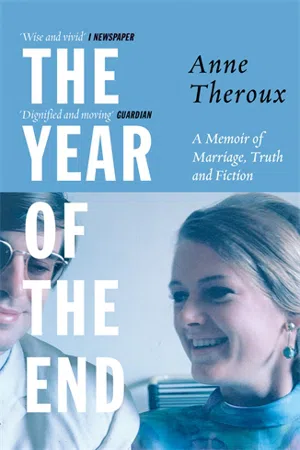
'This memoir is based on the diary I kept during 1990, the year that my first marriage came to an end.'
After 22 years, spent across four continents, with two children - Louis and Marcel - in 1990 Anne and Paul Theroux decided to separate. For that year, Anne - later a professional relationship therapist herself - kept a diary, noting not only her day-to-day experiences as a busy freelance journalist and broadcaster, but the contrasts in her feelings between despairing grief and hope for a new future.
With reflections on truth and fiction, literature and art, and the nature of marriage, alongside commentary on notable political and cultural events, and interviews with prominent writers of the time, including Kingsley Amis and Barbara Cartland, The Year of the End offers a unique insight into the unravelling of a relationship and the attempt to rebuild a life.
- 256 pages
- English
- ePUB (mobile friendly)
- Available on iOS & Android
eBook - ePub
About this book
Information
Chapter 1
Once upon a time …
Once upon a time in a warm December, when I was teaching at a school near Mount Kenya and wondering whether I should pack my bags and drive to Uganda to get married, I bought a diary for the year ahead. Inside the cover was a green, sticky-backed label made up of perforated strips, to be inserted in the diary, ready-printed with these reminders:
Tomorrow is my father’s birthday
Tomorrow is my mother’s birthday
Tomorrow is my wedding anniversary
Tomorrow is …
Tomorrow is …
When my fiancé came to visit me, wearing a dusty suit, open-necked shirt and plimsolls, having driven 500 miles from Kampala in a day, on a road that was still not completely tarmacked, he seized the diary and the green labels with delight.
‘It’s a poem by T.S. Eliot,’ he said, reading it aloud in a lugubrious voice.
I don’t remember sticking the strips into the diary. It was for the year 1968, the year of les événements in Paris and the Battle of Grosvenor Square in London, the year of the Tet Offensive, the Biafran War, the Soviet invasion of Prague, the murder of Martin Luther King and the year my first son was born in Mulago Hospital, Kampala on 13th June. None of these could have been marked in advance with a green sticker. And I no longer have that diary. However, I do have a diary for another, much later year, which often opens at this page:
18th January 1990
Paul left today at 8am.

We had been married just over 22 years.
The previous evening we had gone out to eat at a local restaurant, where we drank champagne and reminisced. In a short story which he wrote about that final evening of a marriage, the central characters talk wittily and poignantly about the explorer Sir Richard Burton and the sad, misunderstood wife who burnt his books.* The reality was different: we talked about the au pair girls who had cared for our sons while I went out to work and he wrote, and the amahs who had done the same job in Singapore. (In Africa they are called ayahs, but since we left Uganda when our first son was only four months old, we never employed one.) The conversation chronicled the years.
In 1968, a violent incident in Kampala prompted Paul to resign from his job at Makerere University and make plans to leave Africa. The poet D.J. Enright, Professor of English at Singapore University, was an admirer of my husband’s writing and offered him a post as a lecturer. Just before we were due to leave Uganda, the Vice Chancellor, a top man in Singapore’s ruling party, discovered that some of this writing might be considered seditious and tried to get the appointment blocked. Dennis Enright threatened to resign. We waited nervously in Kampala; we had no money and nowhere else to go. A compromise was reached: Paul was offered a job on the lowest possible salary and on condition he promised not to write about Singapore politics. He accepted. We lived in Singapore from 1968 until 1971.
During most of the Singapore years I taught English too, at Nanyang, the Chinese language university, where the students had Chinese names, wore conservative clothes, and were more likely (I suspected) secretly to sympathise with Mao Zedong and the Cultural Revolution than their English-educated counterparts with whom Paul studied the plays of Shakespeare and his contemporaries, and who had names like Annabel Chan and Reggie Chew. To enable us both to do our jobs, we shared our small house off Bukit Timah Road first with Ah Ho, a soft-faced Cantonese girl who left when she had a child of her own, and then with Susan, a svelte Hakka in black stretch-pants. On one very special occasion Susan came out of her room ready for the weekend in a short skirt. ‘You got legs!’ remarked Marcel, who at eighteen months had the glottal stops of the Singapore Chinese. When Louis was born in 1970, a careworn woman, whose very name, Ai Yah, was like a cry of despair, was recruited as additional help.
I suppose I wouldn’t recognise them now. We said goodbye to Singapore in November 1971, taking a final picture of Susan and Ai Yah holding the children, and flew to England. After a brief attempt at rural domesticity in Dorset, we moved to London.
In 1972, when Paul was writing Saint Jack, his revenge on the Singapore authorities, and I started work for the BBC, a north-country lass called Beryl moved into our terraced house in Catford; she was a latter-day Beatles fan but also liked the Bay City Rollers, the Jackson 5 and The Osmonds; Marcel and Louis, aged four and two, appreciated her taste in music and the house rang with shrill voices singing ‘I’ll be your long-haired lover from Liverpool’. Beryl was a good companion when my husband left on his first long absence – a term teaching at the university of Virginia. I had ordered a carpet for the hall. When it was laid, the living room door wouldn’t open. Beryl helped me remove the door from its hinges and held it while I sawed half an inch off the bottom. A few weeks later she comforted me when I cried because rain had leaked through the roof and stained the new carpet. I was crying because I found it hard to do my job and run the household without my husband, because I was ashamed of my own weakness and because our home, the first we had owned, was flawed. I wanted it to be perfect.
At Christmas I flew with the children to Virginia to be reunited with Paul. He confessed to an affair with a student, the first admitted infidelity, and I kissed him and said it didn’t matter, thinking this was true. We came back to London with a record player for Beryl, but the goodwill was marred when we found evidence of an unruly party held in our living room the previous night. Shortly afterwards Beryl left and her place was taken by a Norwegian girl called Inge, who broke the hearts of several local youths and seduced my young brother-in-law when he came to stay.
Inge was still with us when Paul went off on The Great Railway Bazaar journey, which was the beginning of his success as a writer. It was my turn to be unfaithful, and Inge shopped me when he returned. I had confessed myself, but she added further incriminating details. We span into a turmoil of misery and rage which Paul described much later in his novel, My Secret History. Miraculously we emerged, not unscathed but ready to resume a fairly happy family life. Inge was succeeded by a Welsh girl called Liz who became pregnant by a local fireman: her family made a day trip to London for the wedding. I think the next was Catherine, a lively seventeen year old who was soon part of the family. There was an Australian called Amy who ordered Louis to stand in the corner when he made a puking face at the food on his plate and a butcher’s daughter called Priscilla who entertained him by counting the planes that flew over our house. (By this time we had moved to a bigger house, in Wandsworth, and were on the flight path to Heathrow.) There was another Australian, Sue, who stayed twice, the second time with the man she married (many years later we visited them in New South Wales) and another English girl, Avril, who boiled her jeans in a saucepan used for stew and gave us all diarrhoea. And there was a German, Monika, who had a little dog called Idéfix, and who, in return for some favour which I have since forgotten, painted our bedroom purple.
In the last six or seven years there had been no au pairs, only daily cleaners: Mrs Bondy, Flora Jeffreys and Maisie Flynn. Mrs Bondy had the gift of the memorable phrase and contributed at least two to the family vocabulary: ‘They don’t have our clean ways’ (applied to anyone who lived east of Calais) and ‘Having a good pick then?’ (addressed to a child furtively fumbling with his nose). She left after a row when the central heating thermostat was mysteriously turned to max 24 hrs while we were on a skiing holiday. Flora Jeffreys left to run a canteen on a building site. Maisie Flynn died in St Thomas’ Hospital.
We talked about some, but not all of these memories over our last dinner, summoning up a procession of ghosts with mops and brooms. Back in the purple bedroom, having walked home across Wandsworth Common, we made love, as we had done a thousand times before, kissed and turned to our separate pillows. In the morning Paul called a taxi. When it arrived, he sat on the bed and hugged me and we both shed tears.
‘I’ll be back,’ he said. Then he left for ever.
My diary entry reads:
Paul left today at 8am, the beginning of a six-month separation. I spent a futile, miserable day drinking, smoking a joint (I even burnt the carpet) and hoping I can pull myself together tomorrow.
Tomorrow is …
* ‘Champagne’ in My Other Life, by Paul Theroux, 1996.
Chapter 2
August 1989
August 1989 was spent as usual on Cape Cod, in the house Paul had bought in 1983. It was a beautiful house set in three acres of land. The living room had windows on every side and to the north looked out on the long, curved bay, between Plymouth and Provincetown, that forms the inner crooked arm of the Cape. We were in East Sandwich, near the elbow, just a few miles from the Cape Cod Canal and a lighthouse, which glowed at night and hummed a warning. I used to listen to it as I lay in bed next to him.
Neither of our sons was with us that year. They were both in France at a summer school near Montpellier. Marcel would be joining us before the end of the month and then staying on in America: he had a scholarship to Yale to do an MA in International Relations. Louis would not be visiting the Cape this summer: after France he was joining the family of a school friend in Corfu, then returning to London briefly before going up for his second year at Oxford. Paul was moody and distracted, disappointed that our sons had chosen to be elsewhere. But I was there; couldn’t we enjoy at last some time alone together?
This year I was not going to collect material for radio programmes as I had during the last few summers. The obvious subjects in the area had been exhausted. I had made a half-hour programme about American attitudes to Ireland, commuting to Boston every day to interview Irish Americans from all points on the political spectrum and spending many hours waiting in vain for Edward Kennedy and Tip O’Neill to return my calls. I had investigated the history of the Native Wampanoag people and interviewed their medicine man, Slow Turtle, aka John Peters (‘my slave name’ he called it); I had been out on a whale-watching trip and talked to Captain ‘Stormy’ Mayo about whales and whaling. I had written to Stephen King in Maine, telling him how much I admired his books and asking for an interview; his secretary had politely refused.
This summer I would do nothing but swim in the pool, sunbathe, read and see if I could enjoy being a wife. Perhaps I would make beach plum jelly. This time-consuming and unrewarding activity epitomised for me the life of a housewife on Cape Cod. ‘What would I do? Make beach plum jelly?’ I asked, when Paul talked about living there permanently. He already spent more time in East Sandwich than I wanted, leaving London in June and not returning till September. The rest of us joined him for the month of August. It w...
Table of contents
- Title Page
- Dedication
- Epigraph
- Contents
- 1: Once upon a time …
- 2: August 1989
- 3: January 1990
- 4: February
- 5: March
- 6: April
- 7: May
- 8: June
- 9: July
- 10: August
- 11: September
- 12: October
- 13: November
- 14: December
- 15: Christmas 1990 and New Year 1991
- 16: That was the end …
- Postscript
- Acknowledgements
- Plates
- Copyright
Trusted by 375,005 students
Access to over 1.5 million titles for a fair monthly price.
Study more efficiently using our study tools.
Frequently asked questions
Yes, you can cancel anytime from the Subscription tab in your account settings on the Perlego website. Your subscription will stay active until the end of your current billing period. Learn how to cancel your subscription
No, books cannot be downloaded as external files, such as PDFs, for use outside of Perlego. However, you can download books within the Perlego app for offline reading on mobile or tablet. Learn how to download books offline
Perlego offers two plans: Essential and Complete
- Essential is ideal for learners and professionals who enjoy exploring a wide range of subjects. Access the Essential Library with 800,000+ trusted titles and best-sellers across business, personal growth, and the humanities. Includes unlimited reading time and Standard Read Aloud voice.
- Complete: Perfect for advanced learners and researchers needing full, unrestricted access. Unlock 1.5M+ books across hundreds of subjects, including academic and specialized titles. The Complete Plan also includes advanced features like Premium Read Aloud and Research Assistant.
We are an online textbook subscription service, where you can get access to an entire online library for less than the price of a single book per month. With over 1.5 million books across 990+ topics, we’ve got you covered! Learn about our mission
Look out for the read-aloud symbol on your next book to see if you can listen to it. The read-aloud tool reads text aloud for you, highlighting the text as it is being read. You can pause it, speed it up and slow it down. Learn more about Read Aloud
Yes! You can use the Perlego app on both iOS and Android devices to read anytime, anywhere — even offline. Perfect for commutes or when you’re on the go.
Please note we cannot support devices running on iOS 13 and Android 7 or earlier. Learn more about using the app
Please note we cannot support devices running on iOS 13 and Android 7 or earlier. Learn more about using the app
Yes, you can access The Year of the End by Anne Theroux in PDF and/or ePUB format, as well as other popular books in Social Sciences & Journalist Biographies. We have over 1.5 million books available in our catalogue for you to explore.