This volume represents an homage by contemporary scholars to the intellectual genius, the spiritual virtues, and the fraternal love that characterized the life and ministry of Bonaventure of Bagnoregio. It is also an expression of the marvelous state of the ressourcement of the Franciscan Intellectual Tradition now being accomplished in the English-speaking world. For the past several decades, there has been a unique and sustained commitment by Franciscan communities in North America to pursue and support an in-depth study of the sources of the Franciscan movement and to present those findings to the church and world in critical editions, commentaries, books and journals. The partnership between academic scholars and communities of practice in the Franciscan tradition bears fruit in this important new work. This text celebrates the 800th anniversary of the birth of the Seraphic Doctor. It arrives during the 80th anniversary of the Franciscan Institute, an academic research, publication and educational center of the Franciscan Intellectual Tradition at the first Franciscan University in the United States, appropriately dedicated to the memory of the friar, teacher, minister and bishop, St. Bonaventure.
eBook - ePub
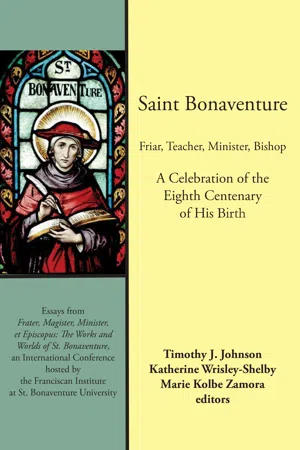
Saint Bonaventure: Friar, Teacher, Minister, Bishop
A Celebration of the Eighth Centenary of His Birth
- 742 pages
- English
- ePUB (mobile friendly)
- Available on iOS & Android
eBook - ePub
Saint Bonaventure: Friar, Teacher, Minister, Bishop
A Celebration of the Eighth Centenary of His Birth
About this book
Information
Topic
Theology & ReligionSubtopic
Christian TheologyPART I
KEYNOTE ONE
SACRAMENTS: HEALING UNTO GLORY
Throughout our Roman Catholic Tradition, from ancient biblical texts to Laudato Si, we can hear creation singing God’s praise and revealing God to us. —Linda Gibler, OP
After these opening words to her essay,1 Linda Gibler cites Pope Francis, who, with Saint Francis, “invites us to see nature as a magnificent book in which God speaks to us and grants us a glimpse of his infinite beauty and goodness.” A few lines later, the pope adds that “rather than a problem to be solved, the world is a joyful mystery to be contemplated with gladness and praise” (Laudato Si 12). If all the created world is “a joyful mystery to be contemplated,” are the created visible signs within our sacramental life not by their very nature wonderful mysteries to be contemplated, even before we ask about any sacramental grace received?
Drawing from current scientific views on cosmology, Gibler relates how the story of sacramentals—specifically water, oil, and grain—began over thirteen billion years ago, in the first moment of creation. She traces their story to the earliest time of the cosmos. When hydrogen particles emerged from the original singularity, some of them fused into helium and other elements before the universe began to cool. As atoms formed, the forces of gravity and electromagnetism compressed the atoms into clouds and increased the heat until atoms broke back into protons and electrons, which fused into new elements. With nuclear explosions and great pressure, stars were born. Collisions within the stars formed helium, oxygen, and more elements. These stars eventually collapsed, causing intense explosion which seeded the universe with all remaining elements. At this point, some hydrogen bonded with oxygen, making water. Planets formed, and water was among the elements that moved to the surface of the earth and became oceans. From these waters, life emerged, and even today every living cell comes from, and is sustained by, water.
In those early oceans, oily membranes grew to surround and protect the process that would produce life. Eventually these life forms moved to land and evolved into various plants, including olive trees. Oil has helped to sustain and protect life; it protects our cells and keeps us and our skin healthy.
Some early plants that moved onto land became grasses that propagated by producing new shoots or seeds. Nutrients in the seeds of grain do nurture the seed, but primarily nurture those who consume the grain. Among the creatures who have thrived because of grains are primates and human beings. Even beyond their use as food, grains have been used in religious rites, often as thanksgiving—from Abel’s sacrifice to today’s Eucharistic offerings.
Water, source of life; oil, protection of life; grasses of the earth, nourishment of life are the elements which speak of the basic sacraments of initiation into divine life: Baptism, Confirmation, Eucharist. Would approaching each of these elements as a “joyful mystery to be contemplated” not draw us to into “gladness and praise?” For Bonaventure, natural created elements in and of themselves are fundamental to sacramental theology and help us understand, appreciate, and receive the sacramental grace that each naturally signifies.
With this appreciation of natural elements in mind, I turn to some texts of St. Bonaventure, taken mostly from the Sentence Commentary and the Breviloquium. After studying his sacramental theology, I am convinced that, at least in the West, we have minimized the role of the sensible (and sensual) external signs in our sacramental theology and have allowed them to be hijacked by an overemphasized Aristotelian metaphysics and canon law.
This essay will consider the role of sensible signs in Bonaventure’s theology and show how he sees them as signifying grace and thereby disposing us to grace. I discuss, first, how Bonaventure understands the place of created signs in the sacraments; second, how, in particular, he understands the natural signs of bread and wine—that is, how these reveal the Eucharistic grace received; and third, the conclusion that all sacraments (especially the Eucharist—and, indeed, all of creation) are ordered to fullness of life in God-conforming glory—that is, by reception of and healing by the Uncreated Gift of Charity, the Holy Spirit.
Role of Created Signs
Bonaventure begins his commentary on the sacraments with a citation from Peter Lombard’s own work on the sacraments: “God did not bind his power to the sacraments.”2 But he adds an important qualification of his own; the sacraments are “advantageous for us.”3 The advantage is that the sacraments help dispose us to the grace God wishes to give us. They have no power to give grace. Only God bestows grace.
He clarifies this relationship of divine and sacramental power: “To dispose is ours with God’s help, but to effect is God’s alone. Therefore, God does not share effective power with anything, but he gives informative power to grace, and dispositive power to the sacraments.”4 “Hence,” he adds, “the sacraments are a help to grace, and so are not superfluous.”
In their created nature, sacramental signs, according to Bonaventure, have no extra power. They are not magical. Yet, by their natural innate created power, they can dispose the heart to the informative power of grace. Through the delivery of the external created sign, “the movement of faith is aroused.” This power to arouse faith gives the signs mystical character. They must be contemplated if they are to dispose and open our hearts to greater mystery. So, although sacramental signs do not cause grace, they nevertheless “prepare [us] for the grace that heals and cures our soul.” This disposing for grace is brought about “by virtue of [the] natural likeness these signs represent,”5 by which they dispose us toward grace. Grace itself, however, always “is effected solely by God.”6
The sacramental signs engage us fundamentally and immediately through our senses. In the first instance they are corporeal, in keeping with the fact that “God took on the totality of our human nature,”7 which includes corporeality. For Bonaventure, the contemplation of created realities offers dispositive agency. “Their function is to prompt [to facilitate or foster], to instruct, and to humble,” always according to the unique signifying nature of each created element.
The human being having been disposed, sacramental grace is then given directly by God according to the specific interior disposition that has been fostered by the created element, and as determined by the nature of each specific natural element, e. g., water, oil, food. In other words, created elements and God’s grace work together. Why this alliance? Because, Bonaventure responds, “God has decreed.”8 This divine action with created elements is consistent with the action of the God of the Covenant. As Pope Francis writes, “In the Bible, the God who liberates and saves [by grace] is the same God who created the universe, and these two ways of acting are intimately and inseparably connected.”9
We return now to Bonaventure’s fundamental stance that sacramental life begins by engagement of the senses with created corporeal realities. He writes, “This is because by offering themselves to the senses they cause a person to come to another kind of knowledge.”10 With the articulation of a corresponding word (the prayer that accompanies the use of a natural sign), the natural knowledge of the natural created elements themselves is lifted to a spiritual knowledge. So the first step in sacramental life is to humble ourselves before the sensible elements (such as water, oil, bread, and wine) and allow them to instruct us, move us, and prompt us to open our hearts to receptivity of the gift of God’s grace.
Bonaventure further develops the signification that flows from natural elements. “Grace,” he writes, “is higher than our senses, and the corporeal is nearer to us. Therefore, grace is rightly signified through the latter, [i. e., the corporeal] and not vice versa.”11 Thus it is from the visible sign that we perceive and understand the invisible grace given in a sacrament. To put it a bit more strongly, only on the foundation of the created sign are we able to perceive, understand, or receive the sacramental grace given by God. Our sacramental life thrives in that intimate connection between the God who created the elements and the God who offers saving grace.
We thus do not initially identify a particular sacrament from the particular grace given, because signs of sacraments are not identified “according to what is signified but, rather, according to the signifying species.”12 For example, Baptism is primarily identified as a washing with water, not as a purifying from original sin. It is from engaging with the signifying species (the signum)—from contemplating what water signifies, for example—that we are disposed to the specific grace (res) given in Baptism. The power to dispose us to a specific grace is what makes the sacraments advantageous for us.
Created elements also support the faith r...
Table of contents
- Cover Page
- Title Page
- Dedication
- Copyright Page
- Table of Contents
- Introduction
- Part I
- Part II
- Contributors
- Index
Trusted by 375,005 students
Access to over 1.5 million titles for a fair monthly price.
Study more efficiently using our study tools.
Frequently asked questions
Yes, you can cancel anytime from the Subscription tab in your account settings on the Perlego website. Your subscription will stay active until the end of your current billing period. Learn how to cancel your subscription
No, books cannot be downloaded as external files, such as PDFs, for use outside of Perlego. However, you can download books within the Perlego app for offline reading on mobile or tablet. Learn how to download books offline
Perlego offers two plans: Essential and Complete
- Essential is ideal for learners and professionals who enjoy exploring a wide range of subjects. Access the Essential Library with 800,000+ trusted titles and best-sellers across business, personal growth, and the humanities. Includes unlimited reading time and Standard Read Aloud voice.
- Complete: Perfect for advanced learners and researchers needing full, unrestricted access. Unlock 1.5M+ books across hundreds of subjects, including academic and specialized titles. The Complete Plan also includes advanced features like Premium Read Aloud and Research Assistant.
We are an online textbook subscription service, where you can get access to an entire online library for less than the price of a single book per month. With over 1.5 million books across 990+ topics, we’ve got you covered! Learn about our mission
Look out for the read-aloud symbol on your next book to see if you can listen to it. The read-aloud tool reads text aloud for you, highlighting the text as it is being read. You can pause it, speed it up and slow it down. Learn more about Read Aloud
Yes! You can use the Perlego app on both iOS and Android devices to read anytime, anywhere — even offline. Perfect for commutes or when you’re on the go.
Please note we cannot support devices running on iOS 13 and Android 7 or earlier. Learn more about using the app
Please note we cannot support devices running on iOS 13 and Android 7 or earlier. Learn more about using the app
Yes, you can access Saint Bonaventure: Friar, Teacher, Minister, Bishop by Marie Kolbe Zamora,Timothy Johnson,Katherine Wrisley-Shelby, Marie Kolbe Zamora, Timothy Johnson, Katherine Wrisley-Shelby in PDF and/or ePUB format, as well as other popular books in Theology & Religion & Christian Theology. We have over 1.5 million books available in our catalogue for you to explore.