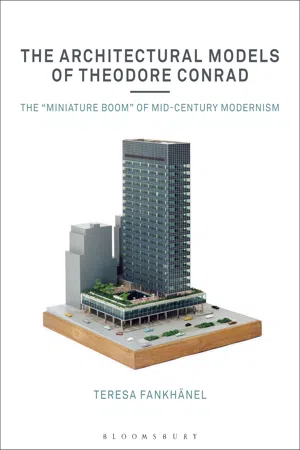
Based on the recent discovery of his fully-preserved private archive-models, photos, letters, business files, and drawings-this book tells the story of Theodore Conrad (1910-1994), the most prominent and prolific architectural model-maker of the 20th century.
Conrad's innovative models were instrumental in the design and realization of many icons of American Modernism-from the Rockefeller Center to Lever House and the Seagram Building. He revolutionized the production of architectural models and became a model-making entrepreneur in his own right. Yet, despite his success and the well-known buildings he helped to create, until now little has been known about Conrad's work and his impact on 20th century architectural history.
With exclusive access to Conrad's archive, as well as that of model photographer Louis Checkman-both of which have lain undiscovered in private storage for decades-this book examines Conrad's work and legacy, accompanied by case studies of his major commissions and full-color photographs of his works. Set against the backdrop of the surge in model-making in the 1950s and 1960s-which Jane Jacobs called "The Miniature Boom"-it explores how Conrad's models prompt broader scholarly questions about the nature of authorship in architecture, the importance of craftsmanship, and about the translation of architectural ideas between different media. The book ultimately presents an alternative history of American modern architecture, highlighting the often-overlooked influence of architectural models and their makers.
eBook - ePub
The Architectural Models of Theodore Conrad
The "miniature boom" of mid-century modernism
- 224 pages
- English
- ePUB (mobile friendly)
- Available on iOS & Android
eBook - ePub
The Architectural Models of Theodore Conrad
The "miniature boom" of mid-century modernism
About this book
Information
1
Architectural Model Making as a Profession
From Ghostwriters to Co-authors
The architect in tackling a building problem today must be more than a designer; he must have knowledge of architecture, construction, business values, laws, etc. In a large enterprise, an architect naturally becomes a part of a group cooperating and working as a unit, guided by the strongest minds in the group, whether architects’, owners’ or builders’. The architect of course should build himself into a position where he is, if possible, a directing mind in this group.1
ANDREW REINHARD, 1932
The emergence of a new network of architectural professions in the twentieth century had been in the making for hundreds of years. An early predecessor of the architect’s dissolving professional boundaries, the medieval cathedral workshop was a major landmark in a changing field that separated architects, knowledgeable patrons, and the building trades.2 This division of labor in architecture has—contrary to a Marxist understanding of it as a collaboration between specialized but often lesser qualified workers who fulfil a single task on an assembly line—always been based on highly skilled individuals who spend years in training to perfect their craft.3 Each an expert in their respective field, they come in at specific times during the inception and execution of architecture, translating one architectural medium into another. Since the Gothic cathedral, these architectural networks were the foundation for the execution of architectural ideas. From the 1850s, the division of labor began to permeate the growing architectural offices, ateliers, and partnerships as the profession of the architect itself split rapidly into more specific careers.4 Now, it included not only the construction of a building but also its design and public presentation. Since the establishment of the Beaux-Arts system in architecture schools in the mid-nineteenth century, American architects had been primarily educated as draftsmen. With the introduction of the blueprint in the late 1800s, copies of drawings were obtained more easily, leading to a declining need for low-wage draftsmen that made higher and specialized education more desirable. Architecture schools offered new degrees in design, management, and engineering that began to subdivide the profession into engineers, designers, draftsmen, and renderers. In the large architectural offices of the nineteenth and early twentieth century, these employees worked on parts of a project, while only the partners and chief designers were involved from beginning to end. What became important was teamwork and “delegation, specialization, and hierarchy.”5 Before the turn of the century, the only way to become a designer was to rise through the ranks from copyist to draftsman and then designer. In 1912, a standard educational requirement was introduced for any individual to call him or herself an Architect.6 The hurdles to becoming a professional architect were raised even higher when universities increased study times in the 1920s from initially four to five or even six years, resulting in an overall study time of seven to ten years including travels abroad and a mandatory apprenticeship as a draftsman.7 The increased specialization was reflected in architectural offices. Starting in the 1920s, many larger practices employed in-house renderers and specialists who came in at specific points in each project: Some specialized in the design stage, others focused on detailing, working drawings, or construction supervision. On a broader level, Mary Woods summed up the expanded job description: Architects were now “collaborators, partners, entrepreneurs, merchandisers, educators, employers, and lobbyists.”8 More important for the emergence of the model maker, the intensifying specialization soon crossed the boundaries of the studio and connected independent professions. The first to split was the professional architectural renderer, which became an influential but separate occupation in the late 1800s. In her account of Hugh Ferriss’ work, Carol Willis went as far as calling the delineator the “unknown ‘ghost-writer’ in successful architectural firms,” the one who charmed the client with perspectives and won the commission but who no longer had an allegiance to a single office.9 If the early 1920s were all about rendering, the following decades were largely about model making and photography. The profession of the architectural model maker emerged out of the disastrous collapse of the architectural trades during the years of the Depression. Providing a foundation for the ascent of model making into a separate profession, the material developments of the 1930s and 1940s assured the model maker a more permanent and exclusive position, as the expensive machines used to manufacture acrylic glass and aluminum were prohibitive to non-professionals. The growing importance of models, and the drive to simulate reality necessitated yet another specialization: the model photographer who worked hand in hand with the model maker.
The separation between those thinking and inventing architecture, and those making it, has existed for many years, as Alina Payne pointed out with a nod to Giorgio Vasari: “‘[Architecture’s] designs are composed only of lines, which so far as the architect is concerned, are nothing else than the beginning and the end of his art, for all the rest, which is carried out with the aid of models of wood formed from the said lines, is merely the work of carvers and masons.’”10 Until the nineteenth and early twentieth century, the architect’s “art” had, by and large, remained the drawing. With the ensuing split of the profession, modes of expression were separated into subcategories to the point that the designer in some cases provided only a series of detailed sketches and supervised the execution of all other drawn work by architecture’s ghostwriters. Similar to medieval stonemasons and carpenters who worked in one material only, the new professions each focused on a single architectural medium: the rendering, the working drawing, the model, the photo. To translate an architectural idea from one medium into another, each expert brought their own set of tools and knowledge that influenced the idea. The experience and skills unique to each profession gave them certain leverage over their part in the project. Yet, the derogatory depreciation of “merely the work of carvers and masons” that Vasari displayed for manual labor never fully disappeared as architects became more aware of their increasing reliance on ghostwriters. The model and its makers have been looked at with equal measures of awe and contempt since one of Vasari’s predecessors, Leon Battista Alberti, first uttered what would become a standard critique of the model that reverberates until today: “There is a particularly relevant consideration that I feel should be mentioned here: the presentation of models that have been colored and lewdly dressed with the allurement of painting is the mark of no architect … Better than that the models are not accurately finished, refined, and highly decorated, but plain and simple, so that they demonstrate the ingenuity of him who conceived the idea, and not the skill of the one who fabricated the model.”11 In short: do not admire the hand that built the model. Architectural historiography, following in the footsteps of Alberti and Vasari, has often neglected or obscured the division of labor in favor of singular authorship.12 Representative of this phenomenon, the most comprehensive account of model making in the twentieth century, Karen Moon’s Modeling Messages: The Architect and the Model, takes a similar stance on authorship. Yet, as responsibilities within and outside offices have been shared by many, claims for singular responsibility in architecture are seldom accurate but not without reason, as the persistent focus on how architects used and created models is based, in part, on a general problem of historical research: In many cases, there are no clear records of the collaborative nature of architecture that attribute distinct ideas or input to individuals. Over recent decades, several researchers have ventured away from this historical oversimplification and tried to capture a more complete image of the profession by researching and interviewing employees and colleagues of well-known authors like Ludwig Mies van der Rohe or the firm SOM.13 Possibly the most inventive study, Architecture: The Story of Practice, Dana Cuff’s rich ethnographically inspired account of the architectural profession, was based on interviews and case studies conducted during the 1980s in several studios that enabled her to dissect architects as socially constructed beings with their own mores, codes, and behavioral patterns. As for the architect’s way of working, she summed up her findings bluntly: “The fundamental point is a simple one: the design of our built environment emerges from collective action.”14 For photographers, the scholarly transition from ghostwriters to co-authors has been accepted more readily in recent decades, not least because photos are often easy to attribute due to their makers’ dependence on royalties which are represented visibly by professional stamps on...
Table of contents
- Cover
- Half-Title Page
- Title Page
- Contents
- List of Illustrations
- Acknowledgments
- Introduction
- 1 Architectural Model Making as a Profession
- 2 Modeling Materials
- 3 Model Drawings
- 4 Model Photography
- 5 Model Displays
- Notes
- References
- Index
- Copyright
Trusted by 375,005 students
Access to over 1.5 million titles for a fair monthly price.
Study more efficiently using our study tools.
Frequently asked questions
Yes, you can cancel anytime from the Subscription tab in your account settings on the Perlego website. Your subscription will stay active until the end of your current billing period. Learn how to cancel your subscription
No, books cannot be downloaded as external files, such as PDFs, for use outside of Perlego. However, you can download books within the Perlego app for offline reading on mobile or tablet. Learn how to download books offline
Perlego offers two plans: Essential and Complete
- Essential is ideal for learners and professionals who enjoy exploring a wide range of subjects. Access the Essential Library with 800,000+ trusted titles and best-sellers across business, personal growth, and the humanities. Includes unlimited reading time and Standard Read Aloud voice.
- Complete: Perfect for advanced learners and researchers needing full, unrestricted access. Unlock 1.5M+ books across hundreds of subjects, including academic and specialized titles. The Complete Plan also includes advanced features like Premium Read Aloud and Research Assistant.
We are an online textbook subscription service, where you can get access to an entire online library for less than the price of a single book per month. With over 1.5 million books across 990+ topics, we’ve got you covered! Learn about our mission
Look out for the read-aloud symbol on your next book to see if you can listen to it. The read-aloud tool reads text aloud for you, highlighting the text as it is being read. You can pause it, speed it up and slow it down. Learn more about Read Aloud
Yes! You can use the Perlego app on both iOS and Android devices to read anytime, anywhere — even offline. Perfect for commutes or when you’re on the go.
Please note we cannot support devices running on iOS 13 and Android 7 or earlier. Learn more about using the app
Please note we cannot support devices running on iOS 13 and Android 7 or earlier. Learn more about using the app
Yes, you can access The Architectural Models of Theodore Conrad by Teresa Fankhänel in PDF and/or ePUB format, as well as other popular books in Architecture & Architecture Criticism. We have over 1.5 million books available in our catalogue for you to explore.