eBook - ePub
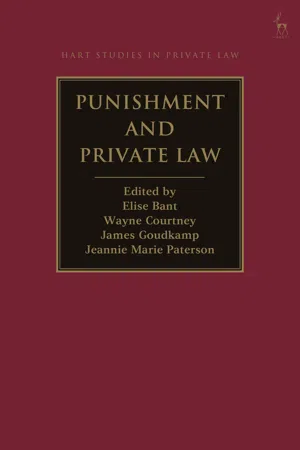
Punishment and Private Law
- 448 pages
- English
- ePUB (mobile friendly)
- Available on iOS & Android
eBook - ePub
About this book
Does private law punish? This collection answers this complex but compelling question. Lawyers from across the spectrum of the law (contract, tort, restitution) explore exactly how it punishes wrong doing. These leading voices ask whether that punishment is effective and what its societal role might be. Taking the discussion out of the technical and into a broader realms of a wider purpose, it is both compelling and thought-provoking.
Information
PART I
Introduction
1
Punishment and Private Law
WAYNE COURTNEY AND JAMES GOUDKAMP
I.The Controversy
A.Introduction
A sharp contrast is often drawn between the criminal law and private law, and this contrast frequently provides a platform for the claim that punishment rather than compensation is the province of the criminal law whereas the reverse is true for the private law. This understanding has long enjoyed substantial support. As Glanville Williams observed almost 75 years ago, ‘[i]t is commonly said that the civil action for damages aims at compensation, as opposed to the criminal prosecution which aims at punishment’.1 A remarkable feature of this claim is its mutual exclusivity. It denies that either field pursues both ends. Given this book’s purpose we do not need to evaluate the proposition that the criminal law’s purpose is punishment rather than compensation.2 We merely note that it misses an important part of the truth in view of, for example, the power of the criminal courts to make compensation orders.3 Although the goal of compensation is admittedly generally less significant than that of punishment, it is a function of the criminal law nevertheless.
As for the other half of the claim – that private law is about compensation rather than punishment – it too is a half-truth. On the one hand, it is undoubtedly the case that compensation is central to at least parts of private law. Consistently with this, compensatory damages is the only remedy for torts that is available as of right.4 On the other hand, private law recognises several remedies that are avowedly non-compensatory, such as punitive (or exemplary) damages and restitutionary damages. The claim is also mired in controversy, especially in so far as it suggests that punishment does not have, or should not have, a place in private law. Those who oppose private law operating as an engine of punishment5 draw upon several well-rehearsed arguments. It is these arguments that render punishment in private law controversial, and we begin this chapter by exploring them with reference to the chapters that comprise this collection. Many of these arguments are advanced in the context of punitive damages, which is private law’s most explicit manifestation of a concern with retribution. But they can be (and sometimes expressly are) extended so as to constitute objections to punishment in private law more generally, and it is clear that the debate about whether punishment has a place in private law goes far beyond the institution of punitive damages.
B.Punishment is Inconsistent with the Nature of Private Law
It is often claimed that punishment is incompatible with the nature of private law. Ernst Weinrib’s influential theory of corrective justice6 supplies a well-known example of the idea that is in play here.7 A key strand in his account is the proposition that private law is correlative in that it focuses on neither just the perpetrator of the wrong nor just the victim, nor even on both the perpetrator and victim independently. Instead, it is asserted that private law is concerned with both the perpetrator and victim as an interacting pair. Weinrib contends that, by virtue of private law’s bilateral structure, which he claims is its ‘most striking feature’,8 private law cannot be adequately explained by considerations that relate to only one of those parties, or even by considerations that concern both parties seen separately. Punishment, because it focuses on the wrongdoer, is a one-sided consideration and hence, in Weinrib’s view, inconsistent with the nature of private law. Thus, he writes that ‘under corrective justice damages are compensatory not punitive’.9
Weinrib’s important account of private law has been extensively debated.10 Space precludes detailed consideration of it in this chapter and it is necessary to confine ourselves to making two basic points. The first is that while there is undoubtedly considerable truth in the proposition that private law is bilaterally structured, Weinrib arguably overplays his hand. Thus, there are numerous well-documented respects in which private law deviates significantly from the paradigm of correlativity. Of particular relevance for present purposes is the fact that private law is sometimes explicitly concerned with punishment. The most obvious (but certainly not the only) instance of this concerns punitive damages, which, as their name implies, are expressly aimed at retribution. Seeking to explain away this difficulty for his account of private law, Weinrib is driven to say that punitive damages are in reality sometimes another species of award. Thus, he argues that when punitive damages are granted on account of the defendant’s having acted with a profit motive, which is one of the three situations in which they are available in England,11 they are masquerading as restitutionary damages.12 In their chapter in this volume, Goudkamp and Katsampouka argue that this account of punitive damages is as implausible as it is imaginative.13 They observe that it cannot explain, among other things, the fact that punitive damages are calibrated not by reference to the gain made by the defendant (that being how restitutionary damages are quantified) but in view of (or at least principally in view of) the defendant’s culpability. In any event, Weinrib’s argument does nothing to account for the two other situations in which punitive damages can be awarded in Engalnd, and it does not cater for other jurisdictions where punitive damages can be awarded in cases that do not fall within the three categories in which English law is prepared to grant the remedy.
Our second and more fundamental point is that even if one accepts the premise that private law is bilaterally structured, the conclusion that private law should not accommodate unilateral concerns such as punishment, which conclusion Weinrib apparently invites his reader to accept, is a non sequitur. In other words, the fact that a particular model may explain the law or a good portion of it as it presently stands does not mean that the law should be changed so as to bring it into increased conformity with that model. Just as no one would think that it follows from feminist accounts of the law that the law should be developed so as to further entrench gender inequalities, simply pointing to respects in which private law is bilaterally orientated identifies no reason in support of its being so structured.
C.Punishment of the Defendant Involves a Windfall to the Claimant
Where a claimant suffers loss as a consequence of the defendant’s wrong, the claimant will be entitled to compensatory damages. Although the claimant is in principle entitled to be fully compensated for their loss, there are compelling reasons to think that most claimants are undercompensated, sometimes significantly. For example, the claimant may not choose to pursue each and every item of loss suffered because certain items may be thought to be too minor or too expensive or too difficult to justify proving. Similarly, it is a notorious fact that where the claimant seeks redress in respect of future losses, the process of reducing those losses to a present-day capital sum may leave the claimant shortchanged because of unrealistic assumptions about the rate of return that the claimant can safely achieve on the award.14 In the United States, there is an added procedural issue: a successful litigant ordinarily cannot recover their legal costs incurred in the suit from the losing party.15 The result is that these costs will be paid from the claimant’s compensation, often leaving the claimant very far from fully compensated. Even in other parts of the common law world where costs shifting is permitted, the successful party in litigation is not indemnified in respect of their costs and, typically, only around two-thirds of the costs are recoverable.
Where the compensatory damages awarded leave the claimant undercompensated, any punitive award that is made can indirectly serve to compensate the claimant. The purpose of such an award is not, of course, compensation but compensation will be among its effects. To this extent, punitive awards are compensatory and it is awkward to characterise them as involving a windfall to the claimant. However, in certain situations punitive awards will be extra-compensatory, as where the compensatory damages fully compensate the claimant, or where the claimant has suffered no loss,16 or where the punitive award is sufficiently large that it goes beyond any shortfall in the compensatory award. Where a punitive award is extra-compensatory, it will, by definition, place the claimant into a better economic position than they would have been in had they not been wronged.17 This is sometimes thought to be objectionable.18 It is asserted that not only has the claimant not done anything to justify being made the beneficiary of such munificence but, from the claimant’s perspective, whether or not their economic situation is improved in this way is generally a matter of luck. It is certainly true that it may be a matter of chance from the claimant’s viewpoint whether they are ‘fortunate’ enough to be wronged by a defendant who deserves punishment, and a given claimant may, as a consequence of a punitive award being made, recover more than another claimant who suffers identical or even more extensive damage.
One response to the windfall objection involves emphasising that its gripe is not, in fact, with the defendant being punished but with the claimant benefiting from the punishment. The complaint would fall away if the sums extracted from the defendant were paid to the state or, indeed, if the punishment effected a setback to the defendant’s interests without any other person realising a corresponding gain.19 As such, the windfall argument is not, in fact, an argument against punishment in private law but an argument ...
Table of contents
- Cover
- Title Page
- Foreword
- Preface
- Contents
- Contributors
- Table of Cases
- Table of Legislation
- PART I: INTRODUCTION
- PART II: HISTORY, THEORY AND CONCEPTS
- PART III: PUNITIVE DAMAGES
- PART IV: LIMITING PUNISHMENT
- PART V: CONCLUSION
- Index
- Copyright Page
Trusted by 375,005 students
Access to over 1.5 million titles for a fair monthly price.
Study more efficiently using our study tools.
Frequently asked questions
Yes, you can cancel anytime from the Subscription tab in your account settings on the Perlego website. Your subscription will stay active until the end of your current billing period. Learn how to cancel your subscription
No, books cannot be downloaded as external files, such as PDFs, for use outside of Perlego. However, you can download books within the Perlego app for offline reading on mobile or tablet. Learn how to download books offline
Perlego offers two plans: Essential and Complete
- Essential is ideal for learners and professionals who enjoy exploring a wide range of subjects. Access the Essential Library with 800,000+ trusted titles and best-sellers across business, personal growth, and the humanities. Includes unlimited reading time and Standard Read Aloud voice.
- Complete: Perfect for advanced learners and researchers needing full, unrestricted access. Unlock 1.5M+ books across hundreds of subjects, including academic and specialized titles. The Complete Plan also includes advanced features like Premium Read Aloud and Research Assistant.
We are an online textbook subscription service, where you can get access to an entire online library for less than the price of a single book per month. With over 1.5 million books across 990+ topics, we’ve got you covered! Learn about our mission
Look out for the read-aloud symbol on your next book to see if you can listen to it. The read-aloud tool reads text aloud for you, highlighting the text as it is being read. You can pause it, speed it up and slow it down. Learn more about Read Aloud
Yes! You can use the Perlego app on both iOS and Android devices to read anytime, anywhere — even offline. Perfect for commutes or when you’re on the go.
Please note we cannot support devices running on iOS 13 and Android 7 or earlier. Learn more about using the app
Please note we cannot support devices running on iOS 13 and Android 7 or earlier. Learn more about using the app
Yes, you can access Punishment and Private Law by Elise Bant, Wayne Courtney, James Goudkamp, Jeannie Marie Paterson, Elise Bant,Wayne Courtney,James Goudkamp,Jeannie Paterson,Jeannie Marie Paterson, Elise Bant, Wayne Courtney, James Goudkamp, Jeannie Paterson in PDF and/or ePUB format, as well as other popular books in Law & Law Theory & Practice. We have over 1.5 million books available in our catalogue for you to explore.