- 224 pages
- English
- ePUB (mobile friendly)
- Available on iOS & Android
eBook - ePub
About this book
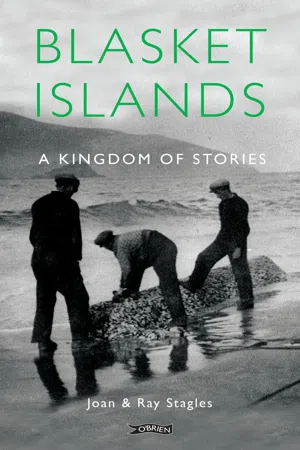
The Blasket Islands are famous for their writers, lore and unique location off the south-west tip of Ireland. This book is perfect for anyone who wants to explore the Great Blasket Island, learn its history and discover what has captivated visitors and residents in this special place.
A beautifully illustrated and compelling history of the life, traditions and customs of an isolated community that has now disappeared. The book traces the fate of the Blasket people and the slow erosion of their culture to that sad day in 1952 when the families were evacuated from the Great Blasket Island.
Tools to learn more effectively

Saving Books

Keyword Search

Annotating Text

Listen to it instead
Information

Island naomhógs being towed towards Dunquin for Mass, early 1930s.
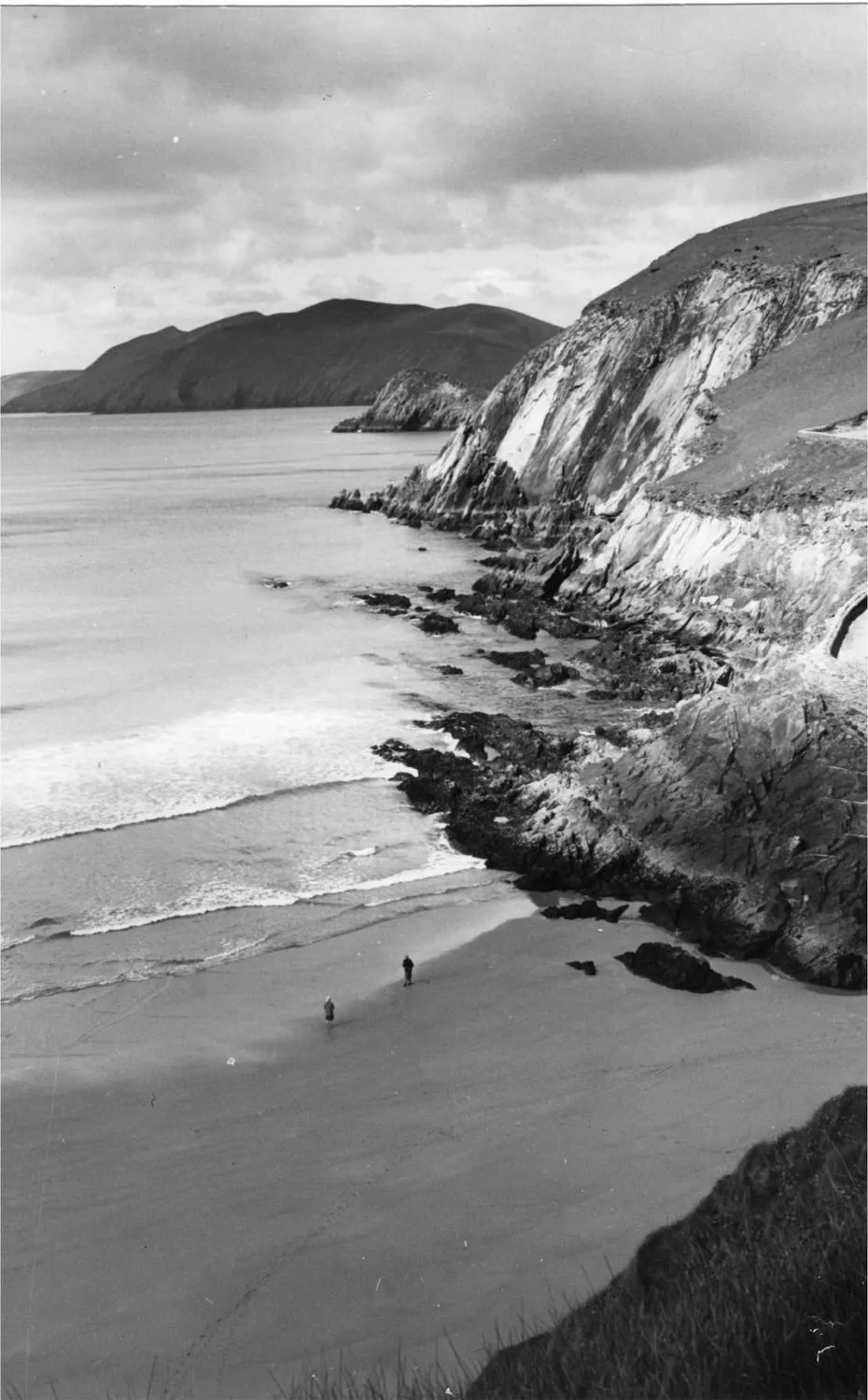
Slea Head with the Great Blasket in the distance.
Chapter 1
‘The Like of Us Will Never Be Again …’
The mountain and coastal scenery of the Dingle Peninsula is bold and grand throughout. As soon as you pass through Blennerville on the outskirts of Tralee and strike straight to the west, you find yourself in a magnificent region of bare mountain and sweeping coastline that leads you to the outermost edges of Europe. And when, sixty kilometres further on, having crossed the mountain ridge that is the backbone of the peninsula, you come to that final stretch of coast from Slea Head to Ballydavid Head – ‘next parish America’ – the grandeur of that scatter of islands at the opening of thousands of kilometres of Atlantic Ocean is overwhelming. There, at the centre of the group, is the Great Blasket Island, worthy of its name in every way.
From whatever direction you approach this most westerly point of the Dingle Peninsula and County Kerry – whether you come along the southern coastal road round Slea Head, or from the north by Clogher, or over the mountain road from Ventry to Dunquin that cuts between Mount Eagle and Croagh Martin – your first sight of the Blasket Islands is likely to give your heart a sudden jerk that is both painful and ecstatic. On the coast road from Dingle to Dunquin, the route most visitors take, you can catch glimpses of Inishvickillaune, but the shoulder of Mount Eagle conceals the rest of the Blasket group until, as you swing round Slea Head, the whole cluster of islands is dramatically revealed, floating in the Atlantic like a school of basking whales, hump-backed all of them, except for little Beiginis which lies nearest inshore as flat as a jellyfish.

Blasket Island schoolgirls wait for their teacher to pour their cocoa. Photo by Thomas Waddicor, 1932.
There are days when, from the coast road, the Great Blasket looks so close you could reach out and touch its field walls and broken houses and stroke the grass on its muscular mountain slopes. There are other days when the great island shrinks to half the size and withdraws itself far out into the Atlantic, aloof, and infinitely untouchable. At all times this island has an appearance of mysterious self-containment and otherness, totally at odds with the visible relics of human occupation and cultivation.
Many people have come to know and relish the peculiarly salty, violent, gentle, philosophical, lyrical, sardonic, devout, blasphemous, comic, tragic flavour of the Blasket community from the writings of its three most famous children: Tomás O’Crohan (Tomás Ó Criomhthain, 1856–1937), Peig Sayers (1873–1958), and Maurice O’Sullivan (Muiris Ó Súilleabháin, 1904–1950). None of them had more than a basic village school education, yet their writings have delighted men and women from all walks of life. It is one of the curiosities of their fame that although in Ireland they are rightly admired as writers in Irish, they are known chiefly through the English translations of their works. Their most famous books, The Islandman (An tOileánach, O’Crohan), Peig (Peig Sayers) and Twenty Years A-Growing (Fiche Bliain ag Fás, O’Sullivan), were all published in Irish in the short space of six years, between 1929 and 1935, yet there is a gap of almost twenty years between the dates of birth of Tomás and Peig, and just over thirty years between those of Peig and Maurice.
The three put the traditional art of storytelling to new use. No longer is it concerned strictly with legends of the ancient past or fantasies about fairies. Instead, their stories deal with the realities of their own lives and times, with real dangers of cliff and sea, with flesh-and-blood heroes of seal-hunting and storms, with salty comments on neighbours still living or recently dead. One of the most powerful fascinations of their books is the picture they give of a way of life which, though ‘modern’ in a historical sense, is nevertheless completely different from that of nearly every reader.
Here is Tomás O’Crohan’s description of his childhood experience in the late 1850s:
I wore a petticoat of undressed wool, and a knitted cap. And the food I got was hen’s eggs, lumps of butter, and bits of fish, limpets, and winkles – a bit of everything going from sea or land.
We lived in a cramped little house, roofed with rushes from the hill. Often the hens would nest in the thatch and lay a dozen eggs there.
… In a house with a large family you would find a post-bed, or maybe a bed on the floor. The old people used to spend the night in that beside the fire, with an old stump of a clay pipe going, or two pipes if there were two of them living, and smoking away … A good fire of fine turf smouldered away till morning … Two or three dogs would stretch out at the foot of the bed, the cow or the cows below them, head to the wall, and there would be a calf or two with the run of the kitchen, or lying muzzle to the fire. The ass would be tied up on the other side of the house opposite the cows, and a cat with a couple of kittens, maybe, in the chimney niche. (The Islandman)

A merry older couple outside their house. Photo by Plácido Ramón Castro del Río, 1928.
Tea was, as yet, unknown on the island. When Tomás’s mother came home from Dingle, her bags held all sorts of things, but ‘there wasn’t a taste of sugar or tea among them, for nothing was known of them in those days’.
Maurice O’Sullivan describes the conditions of his home when he was a child on the island about fifty years later:
[The house] was small and narrow, with a felt roof, the walls outside bright with lime, a fine glowing fire sending warmth into every corner, and four súgán chairs around the hearth … A fine, wholesome table it was for good, broken potatoes and two big plates of yellow bream – the custom of the island at the fall of night … My sister swept the floor and shook sand over it … I could see the dry sand sparkling on the floor in the lamplight. (Twenty Years A-Growing)

Robin Flower and Tomás O’Crohan.
O’Crohan lived on the island all his seventy-one years, which gives The Islandman a fascinating narrowness of view. He cannot help but reveal ‘the things that have meant most to me’, as he says in the last chapter, for he has no standards of contrast or comparison with other styles of life. He recalls his first suit of boy’s clothes:
The day I first wore breeches I nearly went out of my senses: I was like a puppy dog unable to stand still … It was the custom in those days, when a boy had a new garment or a new suit, for him to go into every house. You’d get a penny or two to put into your pocket in each house. I had three shillings in the pockets of the grey breeches when I came home.
Shoes were unheard of: ‘In those days men and women alike didn’t usually put on boots until their wedding day.’
It was a culture in which marriages were arranged by match-makers and dowries were exchanged. This is O’Crohan’s reference to a match made for his sister, Maura:
A match was arranged between Maura and Martin, for what he wanted was a woman who knew what work was and was able to do it; and, in all truth, Maura was a woman of that kind, and I don’t say it only because she was my sister. They didn’t ask my father for any money, for they knew he had none. (The Islandman)
Match-making is a topic that fascinates many readers – the ritual praises of the groom by the match-maker; the prolonging of the negotiations with song and drink; the speed with which the marriage follows the concluding of the match; the willing acceptance of the match by the couple involved, even if, like Peig Sayers, they may not have exchanged a word together before the match was made; the way a young man of feeling, like O’Crohan himself, allowed his own preference for a wife to be over-ruled by his sister; the strength and stability of the marriages contracted in this way.

Peig Sayers in the 1930s; Maurice O’Sullivan in Civic Guard uniform with his translator, Professor George Thomson.
Peig Sayers, in her autobiography, describes her own match being made:
One Saturday in the beginning of Shrove, Seán [her brother] was in Dingle; when he came home he told me that he had news for me.
‘What news?’ I asked him.
‘News of a match, my girl!’
‘God above! Who’s...
Table of contents
- Cover
- Title Page
- Epigraph
- Contents
- Introduction by Lorcán Ó Cinnéide
- Preface
- Part One: The People of the Blasket Islands
- Part Two: The History of the Blaskets
- Part Three: The Built Environment on the Great Blasket Island
- Part Four: Other Lives
- Practical Information
- Appendix
- Acknowledgments
- Notes
- Illustration Sources
- About the Author
- Copyright
Frequently asked questions
Yes, you can cancel anytime from the Subscription tab in your account settings on the Perlego website. Your subscription will stay active until the end of your current billing period. Learn how to cancel your subscription
No, books cannot be downloaded as external files, such as PDFs, for use outside of Perlego. However, you can download books within the Perlego app for offline reading on mobile or tablet. Learn how to download books offline
Perlego offers two plans: Essential and Complete
- Essential is ideal for learners and professionals who enjoy exploring a wide range of subjects. Access the Essential Library with 800,000+ trusted titles and best-sellers across business, personal growth, and the humanities. Includes unlimited reading time and Standard Read Aloud voice.
- Complete: Perfect for advanced learners and researchers needing full, unrestricted access. Unlock 1.4M+ books across hundreds of subjects, including academic and specialized titles. The Complete Plan also includes advanced features like Premium Read Aloud and Research Assistant.
We are an online textbook subscription service, where you can get access to an entire online library for less than the price of a single book per month. With over 1 million books across 990+ topics, we’ve got you covered! Learn about our mission
Look out for the read-aloud symbol on your next book to see if you can listen to it. The read-aloud tool reads text aloud for you, highlighting the text as it is being read. You can pause it, speed it up and slow it down. Learn more about Read Aloud
Yes! You can use the Perlego app on both iOS and Android devices to read anytime, anywhere — even offline. Perfect for commutes or when you’re on the go.
Please note we cannot support devices running on iOS 13 and Android 7 or earlier. Learn more about using the app
Please note we cannot support devices running on iOS 13 and Android 7 or earlier. Learn more about using the app
Yes, you can access Blasket Islands by Joan Stagles,Ray Stagles in PDF and/or ePUB format, as well as other popular books in History & World History. We have over one million books available in our catalogue for you to explore.