Chapter 1
‘The Like of Us Will Never Be Again …’
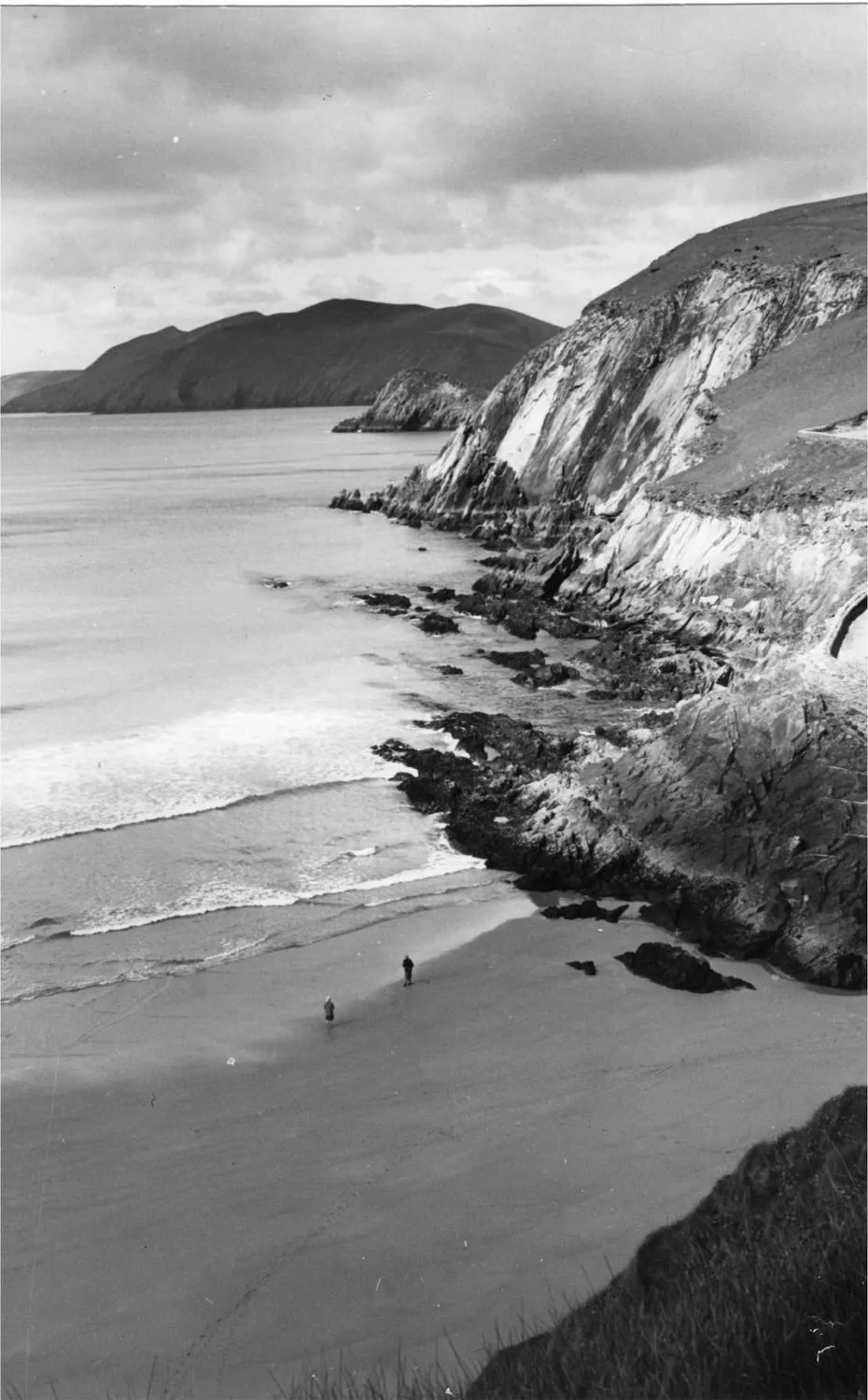
The mountain and coastal scenery of the Dingle Peninsula is bold and grand throughout. As soon as you pass through Blennerville on the outskirts of Tralee and strike straight to the west, you find yourself in a magnificent region of bare mountain and sweeping coastline that leads you to the outermost edges of Europe. And when, sixty kilometres further on, having crossed the mountain ridge that is the backbone of the peninsula, you come to that final stretch of coast from Slea Head to Ballydavid Head – ‘next parish America’ – the grandeur of that scatter of islands at the opening of thousands of kilometres of Atlantic Ocean is overwhelming. There, at the centre of the group, is the Great Blasket Island, worthy of its name in every way.
From whatever direction you approach this most westerly point of the Dingle Peninsula and County Kerry – whether you come along the southern coastal road round Slea Head, or from the north by Clogher, or over the mountain road from Ventry to Dunquin that cuts between Mount Eagle and Croagh Martin – your first sight of the Blasket Islands is likely to give your heart a sudden jerk that is both painful and ecstatic. On the coast road from Dingle to Dunquin, the route most visitors take, you can catch glimpses of Inishvickillaune, but the shoulder of Mount Eagle conceals the rest of the Blasket group until, as you swing round Slea Head, the whole cluster of islands is dramatically revealed, floating in the Atlantic like a school of basking whales, hump-backed all of them, except for little Beiginis which lies nearest inshore as flat as a jellyfish.
There are days when, from the coast road, the Great Blasket looks so close you could reach out and touch its field walls and broken houses and stroke the grass on its muscular mountain slopes. There are other days when the great island shrinks to half the size and withdraws itself far out into the Atlantic, aloof, and infinitely untouchable. At all times this island has an appearance of mysterious self-containment and otherness, totally at odds with the visible relics of human occupation and cultivation.
Many people have come to know and relish the peculiarly salty, violent, gentle, philosophical, lyrical, sardonic, devout, blasphemous, comic, tragic flavour of the Blasket community from the writings of its three most famous children: Tomás O’Crohan (Tomás Ó Criomhthain, 1856–1937), Peig Sayers (1873–1958), and Maurice O’Sullivan (Muiris Ó Súilleabháin, 1904–1950). None of them had more than a basic village school education, yet their writings have delighted men and women from all walks of life. It is one of the curiosities of their fame that although in Ireland they are rightly admired as writers in Irish, they are known chiefly through the English translations of their works. Their most famous books, The Islandman (An tOileánach, O’Crohan), Peig (Peig Sayers) and Twenty Years A-Growing (Fiche Bliain ag Fás, O’Sullivan), were all published in Irish in the short space of six years, between 1929 and 1935, yet there is a gap of almost twenty years between the dates of birth of Tomás and Peig, and just over thirty years between those of Peig and Maurice.
The three put the traditional art of storytelling to new use. No longer is it concerned strictly with legends of the ancient past or fantasies about fairies. Instead, their stories deal with the realities of their own lives and times, with real dangers of cliff and sea, with flesh-and-blood heroes of seal-hunting and storms, with salty comments on neighbours still living or recently dead. One of the most powerful fascinations of their books is the picture they give of a way of life which, though ‘modern’ in a historical sense, is nevertheless completely different from that of nearly every reader.
Here is Tomás O’Crohan’s description of his childhood experience in the late 1850s:
Tea was, as yet, unknown on the island. When Tomás’s mother came home from Dingle, her bags held all sorts of things, but ‘there wasn’t a taste of sugar or tea among them, for nothing was known of them in those days’.
Maurice O’Sullivan describes the conditions of his home when he was a child on the island about fifty years later:
O’Crohan lived on the island all his seventy-one years, which gives The Islandman a fascinating narrowness of view. He cannot help but reveal ‘the things that have meant most to me’, as he says in the last chapter, for he has no standards of contrast or comparison with other styles of life. He recalls his first suit of boy’s clothes:
Shoes were unheard of: ‘In those days men and women alike didn’t usually put on boots until their wedding day.’
It was a culture in which marriages were arranged by match-makers and dowries were exchanged. This is O’Crohan’s reference to a match made for his sister, Maura:
Match-making is a topic that fascinates many readers – the ritual praises of the groom by the match-maker; the prolonging of the negotiations with song and drink; the speed with which the marriage follows the concluding of the match; the willing acceptance of the match by the couple involved, even if, like Peig Sayers, they may not have exchanged a word together before the match was made; the way a young man of feeling, like O’Crohan himself, allowed his own preference for a wife to be over-ruled by his sister; the strength and stability of the marriages contracted in this way.
Peig Sayers, in her autobiography, describes her own match being made: