Howth Head, Dublin
BEANN ÉADAIR
Despite its proximity to Dublin, Howth Head retains its sense of being a place apart, particularly if you choose the time of your visit carefully. The best time to visit Howth is on a weekday when the weather is dull and the place is not full of crowds of people trying to get away from the city. This rocky peninsula, once an island, is steeped in history and legend. The original name for the peninsula, Beann Éadair, ‘the Peak of Étar’, is said to come from the name of the great warrior, Étar, who died for the love of Áine, the goddess of Knockainey. Diarmaid and Gráinne came here, fleeing from Fionn, and Deirdre and the sons of Usna rested here during their flight from the jealous king Conchobhar.
Howth is an attractive village and the harbour still functions as a fishing port, although these days you are more likely to meet a golfer than a fisherman as you make your way through its streets. However, to find the real Howth, leave the manicured lawns and expensive restaurants behind you and take one of the many walks by the cliffs or up into the rocky hills. The sites mentioned here are only focal points for a district which has the potential for hours of exploration.
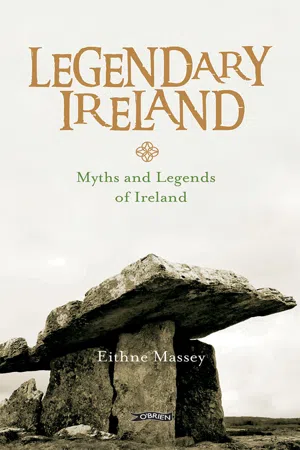
One major site is that of Aideen’s Tomb. This is a portal tomb, situated in the grounds of Howth Castle, the traditional home of the St Lawrence family and now the site of the Deerpark Hotel. The tomb is in the forested area to the right of the hotel and easily accessible from the edge of the golf course. This wilderness is particularly beautiful during late May and early June when the rhododendrons and the azaleas are in bloom. The forest on the hilly land behind is worth a visit in its own right, and those who do not mind a scramble can follow a trail to the top of the hills; from the top there are magnificent views. Tradition has it that there is a cave on the hill where Diarmuid and Gráinne slept during their travels.
The tomb itself is a huge structure, partially collapsed, with one of the largest capstones in Ireland, estimated to weigh 90 tonnes (1,771 hundredweight). Portal tombs in Ireland are among the very earliest of Megalithic remains, many dating from before 3000BC. Twisted trees and ferns grow around the tomb, lichen covers the stones, and children climb through it, fascinated by something at once so obviously man-made and at the same time on a scale massive enough to seem the work of giants. Legend tells us that Aideen, or Étaín Fholtfhinn, was a beautiful princess of the Sídh, a famous runner who was also the lover and later the wife of Oscar, grandson of Fionn. When Oscar was killed in battle, Aideen died from grief at his loss. Her home had been the sídh of Beann Éadair, and this was where she was taken to be buried. Other traditions state that this was the tomb of Crimthan, a king of the first century AD, and others still that the tomb is that of Étar himself. Whatever the truth of the legends, the tomb in the forest remains a potent, if silent, guardian of Howth’s mysterious past.
Howth was a place of many battles, and the promontory fort of Dún Griffin, (also traditionally associated with Crimthan) which surrounds the Baily Lighthouse, shows how important this site was as a defence against invasion. It is generally accepted that such forts, found all around the coast of Ireland, were built for defence against invasion by sea. They may also have been used as ceremonial centres for the gathering of the tribes for fairs or religious purposes. To reach the fort, take the trail leading down from the left of the car park on the summit. Within moments you will see the lighthouse below you. The trail leads through gorse and brambles, ferns and heather, and in early summer it is full of wild garlic. It goes down steeply to the small promontory where the lighthouse stands. Although there is no entry allowed to the grounds of the lighthouse and it is not easy to distinguish the original ditches and ramparts of the fort, it is obvious that this was an ideal defensive site. Sea and high cliffs surround it on three sides, and on the fourth, a narrow neck of rock connects it to the land. To the south is Dublin Bay and the mountains; to the north and east, nothing but sea.
Find a sheltered spot and look down steep slopes covered in sea-pinks to the twisted rocks and green water. There will be no sound but the waves lapping on the pale grey shingle far below, and the cry of the sea birds. The hectic city of Dublin will seem like another world.
Howth is a place of both escape and defence, of the beginning of exile and of coming home, and many of the tales associated with it mirror these themes of the journey outwards and the return. Imagine the warriors watching here, guarding their people from attack from the unknown lands beyond the horizon. Or think of a solitary king who once stood here, listening to the birds crying and watching in astonishment as a figure came towards him over the sea, bringing death and famine in her wake …
BÉCUMA OF THE FAIR SKIN
The High King of Ireland, Conn of the Hundred Battles, stood on a pebbly beach at Beann Éadair, and looked to the sea for comfort. It was a bright morning and the waves danced onto the seashore, but Conn was as weary and heartsick as it is possible for a man to be. For despite his wealth, his power, and all his prowess in battle, and the great prosperity and peace that had come to the land under his rulership, he had been unable to defeat the greatest enemy of all. Death had come and taken his beloved wife, Eithne, away, and without her he felt lost and dejected, a man wandering in a mist. He had left the feasts of Tara and had come to be alone with his thoughts, looking out over the sea where his son, Connla, had been taken away by a beautiful woman of the Sídh many years before. At the time, he had wept, but his wife had consoled him, saying: ‘Yes, it is hard to lose a child to the land of the Sídh; but look you, we have yet one son, Art the Lone One, who is as clever and brave and good as ever a child could be, and likely to be a great king when you and I are gone.’
However, now that his wife too had left him, Conn found no comfort in his son’s company. Art reminded him too much that strength was with youth and that he himself was no longer young; that there were to be no more great battles and marvellous adventures in love and war. His skills now were those of an old man – diplomacy and wiliness. Conn looked eastwards into the rising sun, as if it could bring him salvation with the daybreak. He thought of his wife’s wise words and of her even temper that had saved him from many a hasty action; and he thought, most painfully of all, of her arms around him in their bed, and her small feet wrapping themselves around his legs for warmth during the cold nights of winter. The king blinked through his tears and rubbed his eyes. Coming towards him over the silver waves was a coracle, a coracle that seemed to move without oar or sail, and standing in it was a figure that glowed in the light of dawn. As it came nearer, Conn realised that it was the most beautiful woman he had ever seen.
Bécuma of the Sídh, she of the Fair Skin, smiled her secret smile as she watched the figure on the shore shade his eyes with his hand to watch her approach. She knew who he was, and although she found his son, Art, more to her liking, she had decided that she was in no position to be choosy. She would start with the father and, in time, no doubt the son would come to her. Bécuma had never left herself in want of anything, which was why she had been banished from the Many-Coloured Land; she had betrayed her husband and the choice had been death by fire or banishment to the mortal realm. She had chosen banishment, but her people had warned her not to attempt to enter any of the sídh of Ireland, for their doors were closed against her. Her silver coracle brought her to land, and she heard Conn’s gasp as she stepped onto the shore, lifting her red satin cloak and grass-green gown out of the water as she did so. Her hair was yellow-gold, her eyes a clear grey, her skin like the first snow of winter. Now she was close enough for him to smell her perfume, which seemed to Conn like the scent of whitethorn on a warm summer’s day. He opened his mouth to ask her who she was, but before the words were out of his mouth, she said: ‘I am Dealbhchaem. The fame of your son Art has spread to the Many-Coloured Land and I have come to seek his love.’
Conn frowned. ‘You wish to marry my son then? Indeed, that is not good news to me.’
‘Who shall I marry then?’ she asked softly.
‘Why, none but myself,’ said Conn.
Bécuma bowed her head and put her hand in his.
‘If it is your wish, so it shall be,’ she said. ‘But grant me something in return. It would not be right to have Art at Tara so soon after we are wed, for I would wish to forget him. Send him away for a year.’
The king was perturbed. ‘I would not wish to banish my own son for no reason,’ he said.
Bécuma sighed and raised innocent grey eyes to the king’s. Conn paused. Perhaps the maiden was right; his son, so young and strong, might not be a good person to have around them so soon after their marriage.
‘It could hurt him to see you in the place of his mother,’ he said thoughtfully. ‘I will do as you wish.’
The pair travelled to Tara; there, Conn made the order to send his son from the kingdom, not even stopping to bid him farewell. For the first few months, he was deliriously happy with his beautiful young wife. Every day, Bécuma charmed him further. So enchanted was he that at first he did not notice how badly things were going with the land of Ireland. The cows gave no milk, the corn did not grow, the bees made no honey. Blight fell on all of nature so that even the women bore no children and the people began to murmur that there was a curse on the land. The poets and magicians met together and by their arts discovered that their new queen was not, in fact, Dealbhchaem, but Bécuma who had been banished from the Many-Coloured Land for her misdeeds; they told the king that he must send her away.
‘I do not care if her name is Dealbhchaem or Bécuma or the Morrigan itself,’ said Conn. ‘She is my beloved wife and I will not send her away. Find another way to rid the land of this blight.’
So the magicians conferred again, and they came back to the king with the news that if the son of a sinless couple could be found, and his blood mixed with the soil of Tara, the land would be made fertile again. Conn said that he would go on a quest to seek the sinless one. His magicians told him that it might be better to send his son, Art. But Conn had grown so tired of looking at the sad faces and listening to the hungry, crying children who surrounded him that he said angrily: ‘No – it is my task to save the land.’ He went to Beann Éadair, where he found Bécuma’s coracle and went away over the sea. He left the rule of Ireland under the stewardship of Art.
Conn returned, after many months, with a young boy from a magic island; Segda was the child of a sinless couple and the king had tricked him into coming with him back to Ireland, planning to murder him so that the land might prosper once again. However, there was much dissension that a sinless child should suffer for the fault of the king, and, at the last moment, Segda was rescued by his mother, a woman of the Sídh. She appeared befor...