Chapter One
• • • • • •
1868–1889
The Early Years
The cause of labour is the cause of Ireland, the cause of Ireland is the cause of labour. They cannot be dissevered.1
The Great Hunger of the 1840s was a major turning point in the fortunes of Ireland and the Irish. Under direct rule from the British Parliament in Westminster, more than one million people perished from starvation and diseases related to malnutrition, and one million people were forced to emigrate. The social structure of rural Ireland underwent a tremendous upheaval.
During the nineteenth century a very large section of Ireland’s citizens existed in some of the poorest and most deprived conditions in Europe. ‘The Irish peasant,’ wrote James Connolly, ‘reduced from the position of a free clansman owning his tribeland and controlling its administration in common with his fellows, was a mere tenant-at-will subject to eviction, dishonour and outrage at the hands of an irresponsible private proprietor. Politically he was non-existent, legally he held no rights, intellectually he sank under the weight of his social abasement, and surrendered to the downward drag of his poverty. He had been conquered, and he suffered all the terrible consequences of defeat at the hands of a ruling class and nation who have always acted upon the old Roman maxim of “Woe to the vanquished.”’2
At that time some argued that British rule in Ireland was benevolent, but little or nothing was done to help the poor and starving. In fact, the great shame is that the British government allowed goods and produce to be exported from Ireland during the Great Hunger, hardly a sign of altruism. Emigration, already a common enough problem, speeded up phenomenally. Now known as the Irish Diaspora, the mass exodus saw the population of Ireland cut down to half its original number within a couple of decades. Those who could afford it would pay the fare to Australia, New Zealand, Canada and, of course, America, where those of Irish descent now constitute somewhere in the region of forty million. The logical destinations for the poorest Irish emigrants included England, Wales and Scotland. James Connolly’s parents were refugees from the Great Hunger who settled in Scotland.
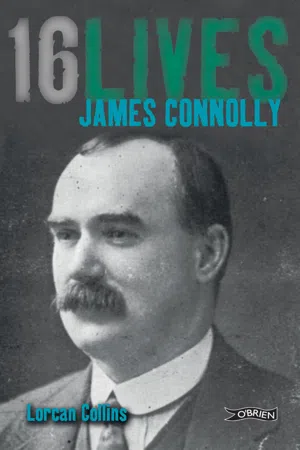
Over the years, historians have been preoccupied with a desire to prove that James Connolly was born in Ireland. In 1916 the Weekly Irish Times published a very detailed Rebellion Handbook. One section contained a ‘who’s who’ of the Easter Rising. The entry for James Connolly states that he was ‘a Monaghan man’.3 In 1924, Desmond Ryan, the respected historian and author, wrote of how, in 1880, the Connolly family was forced by poverty to move from their native Monaghan to Scotland. In 1941 the Irish Press reported that James Connolly and his family had emigrated from Anlore near Clones, County Monaghan. These and other assertions were simply attempts to ensure the Irish status of Connolly.4
To confuse matters further, Connolly put ‘County Monaghan’ as his birthplace when he filled out the 1901 census. There are at least two possible reasons why he felt it necessary to give this false information. At this time, he was living in Dublin and as an active socialist he often came under fire for not having an Irish accent. Shouts of ‘he’s not even Irish’ were not uncommon during Connolly’s lectures, and, as such, he might have felt a need to pretend to have been born on Irish soil. Secondly, it is possible that he felt that the British army was still looking for him to complete his military service, but more about this later.
Whatever the circumstances, it is unfortunate that the concern with Connolly’s birthplace should serve as a distraction from his achievements for labour and for Ireland. Nonetheless, for the purposes of definitively proving where the son of two Irish immigrants, John Connolly and Mary McGinn, was born, an examination can be carried out on his birth certificate. James was born at 107 Cowgate, Edinburgh, Scotland.
Due to the march of time and the Edinburgh slum clearances, the actual house of his birth is long gone, but there is a plaque on a wall which reads:
TO THE MEMORY OF JAMES CONNOLLY
BORN 5th JUNE 1868 AT 107 COWGATE
RENOWNED INTERNATIONAL TRADE UNION
AND WORKING CLASS LEADER
FOUNDER OF IRISH SOCIALIST
REPUBLICAN PARTY
MEMBER OF PROVISIONAL GOVERNMENT
OF IRISH REPUBLIC
EXECUTED 12th MAY 1916 AT KILMAINHAM JAIL
DUBLIN
Beside the new brass plaque are the remnants of the previous memorial, which was vandalised.
Today, the Cowgate area is given over to the world of entertainment, with a plethora of nightclubs and pubs. In James Connolly’s youth, these streets were very much part of a divided society and constituted nothing short of a slum, populated for the most part by Catholic Irish immigrants. It was the centre of ‘Little Ireland’, where thousands of families were living in single-roomed dwellings. Unemployment was high and Connolly’s father was deemed lucky to work as a manure carter for the Edinburgh Corporation. This job was at the lower end of the scale and involved shovelling animal excrement into a cart. It was poorly paid night work, but there is little doubt that the removal of dung from the streets was considered a great necessity. Such was the importance of this work that when the manure carters threatened to go on strike, at a meeting held on 13 August 1861, they received their demands at 10am the following day.
John Connolly was promoted shortly after his third and youngest son James was born. It was a good step up the ladder as Connolly’s father secured the job of lighting the gas lamps to guide the way for Edinburgh’s citizens over her cobbled streets.
Mary Connolly, James’s mother, suffered from ill health after the birth of her first child, John. It seems she had chronic bronchitis and suffered for the next thirty years until she passed away.5
Young James was formally educated in St Patrick’s School, only yards from his birthplace. This was the school that his older brothers John and Thomas also attended. In 1879, at the tender age of eleven, James’s formal education came to an end and he began work as a ‘printer’s devil’. His brother John was employed by the Edinburgh Evening News as an apprentice compositor, but James, two years younger than him, was employed at more menial tasks. His job entailed cleaning the ink from the huge print rollers and running errands for more senior staff. Later in life, Connolly would call on the skills that he acquired through his immersion in the printing process when he came to publish his own periodicals.
Newspapers were filled with the stories of the Home Rule movement and land agitation in Ireland. These subjects would have been discussed on the streets, in the public houses, and in the homes of Cowgate. Connolly, like most children, would have picked up snippets of information. Later in life, Connolly would study this period intensively and uncover some Irish idealists who would influence his own thinking, such as James Fintan Lalor (1807–49) and John Mitchel (1815–75).
For the majority of Irish citizens, the most important issue concerned the ownership of land. James Fintan Lalor spread the gospel that the ‘entire soil of a country belongs of right to the entire people of that country’.6 He also held that the return of the land to the people was more important than repeal of the Act of Union.
The figures for the huge change in land ownership due to landlords going bankrupt or simply bailing out of the sinking ship are remarkable. One quarter of the land, five million acres, changed hands in the two decades after the Great Hunger. Of course, it was not the tenant farmers who purchased the land. The new landowners were speculators and hard-nosed businessmen. The Catholic Church, for instance, increased their holdings and invested heavily in land.
In 1879 Michael Davitt founded the National Land League of Mayo, as Connolly later pointedly remarked, ‘to denounce the exactions of a certain priest in his capacity as a rackrenting landlord.’7 The priest, a Canon Bourke, had been forced by the National Land League to reduce the annual rent on his estate by 25 per cent. This was a considerable victory for the tenants, but the demand for a reduction in rent was not the sole underlying principle for the establishment of the League. Tenant farmers were agitating for the famous three ‘F’s: Fair Rent, Fixity of Tenure, and Freedom of Sale.
Anglo Irish landlords were being targeted under the cover of night: their houses were under the constant threat of attack, and their herds of cattle and sheep proved easy targets. These ‘agrarian outrages’ were the reinstatement of a tradition from the eighteenth century as an effective but cruel form of protest.
Of a less violent nature, but equally intimidating, was the concept of ostracising landlords or those who collaborated against the Land League. Although not an entirely new idea, it was most effectively and notably used against Captain Charles Cunningham Boycott in 1880. Boycott, an agent for an absentee landlord, not only donated his name to the English language, but required over a thousand soldiers to protect his imported labourers when his tenant farmers refused to harvest the crops from his estate in retaliation for his refusal to reduce rents.
Some years before this, in 1875, the use of the obstructionist policies of Joseph G Biggar (1828–90), a member of the Irish Republican Brotherhood, was introduced in the House of Commons. A fellow Fenian, John O’Connor Power (1846–1919), and a smattering of other Irish MPs soon joined him. Between them they managed to hold up the business of parliament, to the exasperation of all the other members, by talking for hours and hours on various bills that were under discussion. The father of the Home Rule movement, Isaac Butt (1813–79), did not agree with this policy and considered it to be below the conduct expected of gentlemen. But few could argue that Charles Stewart Parnell (1846–91) was not a gentleman, and when this young Protestant landlord threw his lot in with the obstructionists, Isaac Butt’s popularity began to decline until his death in 1879.
A year later, in April 1880, after a general election, Parnell became the leader of the Home Rule Party. By this stage Parnell had already joined with Davitt when they founded the Irish National Land League. The democratic Home Rule movement and the Irish National Land League were now intrinsically linked. Both gathered strength from each other at the apparent expense of more revolutionary movements, such as the Irish Republican Brotherhood.
However, it would be unwise to presume that the Fenians did not have a hand in this alliance. Davitt, as a member of the Brotherhood, had spoken at length with John Devoy (1842–1928) and other Clan na Gael organisers in America concerning his concept of the New Departure, a uniting of everyone from the Irish MPs to the tenant farmers, the IRB, the clergy, the Irish abroad and at home, all working towards the goal of Irish freedom. It would have been folly for the IRB to plan for an open revolution, considering the disastrous attempt of the Young Ireland movement of 1848, and more recently the failed Fenian uprising of 1867. It was clear that the 1880s and 1890s would be a popular time for the Home Rule Party and the Land League, and if the Fenians had at least a part in this success it could only benefit them.
In order to bring some restoration of order, a coercive bill, the Protection of Person and Property Act, was brought into force in 1881. One of the first uses of the bill was to arrest Michael Davitt, which ironically only helped to secure more monetary support from America. Then the Ladies’ Land League was formed, a considerable milestone considering that women were traditionally excluded from politics. The Land League also stepped up its activities to the extent that William Gladstone, the Liberal Prime Minister, brought in a Land Act. It was unsatisfactory in its own right, but it was accompanied by a new Coercion Act which added to the indignation of the Irish. Parnell did not want to lose the support of the Liberals and the moderates, so he avoided condemning the Land Act outright within the walls of the British Parliament. Instead, he chose to retain the support of the IRB and the more extreme elements of the Irish Parliamentary Party by launching attacks on parts of the Act in newspapers and through public speeches. In an episode reminiscent of today’s political posturing, Parnell called the British Prime Minister a ‘masquerading knight errant’ who was ‘prepared to carry fire and sword’ into Irish homesteads. On 13 October 1881, Parnell was arrested and imprisoned in Kilmainham Gaol. He was soon joined by other nationalist MPs such as John Dillon. The editor of Parnell’s United Ireland newspaper, William O’Brien, was also imprisoned.
For those MPs who found themselves imprisoned in Kilmainham Gaol in the winter of 1881–2, their reputation became allied to the revolutionaries who had gone before. Kilmainham Gaol was a politic...