BBC journalist Mervyn Jess, who has written extensively on Orange issues, strips away the mystery and myths of the Order and traces its origins and defining moments spanning three turbulent centuries. This book is essential reading for anyone interested in finding out what "the Orange" is all about.
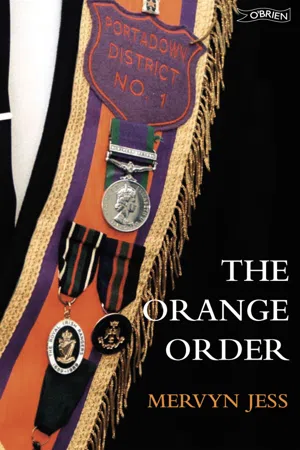
- 296 pages
- English
- ePUB (mobile friendly)
- Available on iOS & Android
eBook - ePub
The Orange Order
About this book
Born out of bloodshed, sustained by sectarianism and shrouded in secrecy, the Orange Order is one of the most abiding and controversial religion-based organisations in Europe, if not the world. A Catholic cannot join: its doors are open only to those who profess Protestantism.
Information
CHAPTER 1
THE BEGINNING
Dan Winter’s house is a small whitewashed, mud-walled thatched cottage near the village of Loughgall in County Armagh’s orchard country. It is a picture straight out of a tourism brochure: the sort of Irish idyll that attracts hundreds of thousands of people from around the world to visit these shores. This particular cottage, however, has historical foundations that are very different from those of rural Catholic Ireland which invoke images of farming families gathered round open turf fires playing traditional music with a picture of the Virgin Mary and a crucifix hanging on the wall. The walls of the Winter family home are adorned with emblems of another faith, because this dwelling at the Diamond is a historically important bastion of Protestantism – the birthplace of the Orange Order.
Hilda Winter is the widow of Derek Winter – the great, great, great, great-grandson of ‘Diamond’ Dan Winter – and she is the curator of Dan Winter’s House Ancestral Home museum. Upon arrival at this farmer’s cottage on Derryloughan Road near Loughgall, the visitors eye is drawn to a flat rock by the half-door in the porch, with the words ‘Please come in’ painted on it. Inside, the small stone-floored rooms with their low-beamed ceilings and tiny windows are home to a collection of Orange memorabilia dating from the present day back to 1795.
The Winter family has lived here since the eighteenth century but interest in the cottage as a historic site gathered momentum during the 1990 celebrations of the 300th anniversary of the Battle of the Boyne.
‘Up until the mid-nineties this was a working turkey farm,’ says Hilda Winter, who is seated beside a roaring log fire. ‘And this fire was kept going by burning the feathers.’
The museum is run on voluntary donations and gets up to three thousand visitors a year. Visiting Orange lodges have held meetings in the room where the ‘founding fathers’ discussed the tenets of the Order. In the grassy fields in front of Winter’s cottage, on 21 September 1795, a collection of men from non-Catholic denominations linked arms and agreed to band together in defence of what they saw as the Freedom of the Reformed Protestant faith. Among them were Presbyterians, Episcopalians, Quakers, Huguenots and Independents. They had just tasted victory in what became known as the Battle of the Diamond.
Their adversaries were the Roman Catholic Defenders – a vigilante group that had grown out of the violent sectarian confrontations over commerce and land in that part of Mid-Ulster.
These agrarian groups had been at each other’s throats since the 1780s. The ruthless Protestant gangs called themselves the Peep o’Day Boys because of their tactic of raiding Catholic homes at the break of dawn to catch their quarry by surprise. The Catholics formed themselves into the Defenders, a group that was also prone to going on the offensive.
Lives and property were destroyed during the period leading up to the confrontation at the Diamond. There had been attempts by both sides at reconciliation. A group calling itself the Council of Seven, including prominent people in the Protestant community and Catholic priests, managed to negotiate a truce, but it was short-lived. The fighting in County Armagh came to a head on two hillsides in the townland of Grange Lower, around a hamlet know as the Diamond. It was Monday, 21 September 1795. The Catholic Defenders lined up on Faughart Hill while the Protestants arranged themselves on the opposite side of the valley, on Diamond Hill. Folklore has it that the Defenders fired the first shot. It is of little consequence. The battle was over in minutes and the Defenders were defeated. The death toll on the Catholic side is estimated at between sixteen and sixty. Orange historians say that the Protestants left the field of battle without one single fatality and only one window in the Winter family home broken. The five victorious leaders gathered in a circle, linked hands and declared their brotherhood in loyalty to the Crown, the country and the reformed Protestant religion. These founding fathers of Orangeism included James Wilson from Dyan in Tyrone, James Sloan from nearby Loughgall and ‘Diamond’ Dan Winter who, along with his sons, had fought to defend their property in the vicinity of the confrontation.
It was to the Winter’s farm cottage that the ‘fathers’ went to discuss their next move. It was agreed to form a society that would later become the Loyal Orange Institution of Ireland. In the circumstances it was felt, however, that further discussions should take place at a location further removed from the field of battle, in case of reprisals.
Former schoolmaster James Sloan, viewed by his contemporaries as an educated man, was appointed secretary. He owned an inn in nearby Loughgall and it was to this hostelry that the leaders retired later on the day of the battle for further meetings on the formation of the Orange Institution.
In the days immediately following the fighting, the first formal meeting of Orangemen took place in Sloan’s Inn at Loughgall. Among those present was Captain John Gifford of the Royal Dublin Militia who was barracked in Portadown. The army had kept a low profile before and during the Battle of the Diamond. It is thought that Captain Gifford was supportive of the Protestant cause and was confident that they would be victorious – so he turned a blind eye to the impending violence and left them to get on with it. The fact that he was at the Sloan Inn meeting and played an important role in the proceedings supports that theory.
The English Catholic historian Plowden credits Gifford with bestowing the title of ‘Orangemen’ on the brotherhood. He also attributes to him the original obligation and regulations of this new society of Protestant men. Evidence of the Captain’s apparent dislike of Catholicism can be found in a letter Gifford wrote to a military colleague stationed in Dublin. The letter, written a few days after the Sloan Inn meeting, refers to the founding in Loughgall of ‘a society that for generations would curb both Pope and Popery in Ireland’. It would appear that it was Gifford who first drew the comparison between what the Diamond men had done and what the soldiers of William of Orange had fought for at the Battle of the Boyne nearly a century earlier. It is believed that this comparison went some way towards deciding on the title of Orangemen to refer to the members of the newly formed society.
The Orange title had been in use long before this period. Boyne Societies in commemoration of King William of Orange and his victory over Catholic King James were already in existence. A Protestant Orange Boys’ Club was started in County Tyrone in 1792 by James Wilson – a relative of Diamond Dan Winter.
Jonathan Mattison is the Convenor of the Orange Order’s Education Committee. He is also an Orange historian who completed his doctorate at Queen’s University Belfast, on nineteenth-century Irish Orangeism. ‘The foundation of the Order was officially in 1795; however there had been a number of rural and popular Protestant organisations and spells of Orangeism from the 1690s onwards, including Orange Societies and Clubs,’ he says. ‘During the Tyrconnell period in 1687-88 when he tried to change the make-up of city councils across Ireland, a lot of Protestants and Anglicans were thrown out of the Corporations and Councils. One of the most famous incidents was in Dublin where many Protestants were forced off the City Corporation. They formed their own Society or club known as the Aldermen of Skinners Alley. This is regarded as the starting point in Ireland of a Protestant/Orange-orientated society.’
The early part of the eighteenth century saw the formation of a number of Boyne Societies and Boyne Clubs in Counties Down and Wicklow as well as in Dublin city. The latter part of the century saw the formation of The Peep o’Day Boys who were the most violent Protestant grouping at that time. The vigilante style association was formed in County Armagh following the relaxation of the Penal Laws which had discriminated against Roman Catholics. The grouping was almost exclusively Anglican (Church of Ireland) and it existed to counter economic competition from Catholics over land leases, rents and the production of linen. The ‘Boys’ were also referred to as ‘Protestant Boys’, ‘Orangemen’ and ‘Wreckers’ due to their modus operandi of smashing the weaving looms in Catholic homes. Throughout the 1790s, the Peep o’Day Boys were held responsible for the expulsion of thousands of Catholics from their homes in central Ulster. It is also claimed that these Anglican extremists did not confine their attacks to Catholics, with Protestant dissenters such as Presbyterians and Quakers being targeted. Critics of Orangeism would argue that the Peep o’Day Boys were the forerunners of the Orange Order, however, there is another view that while some ‘Boys’ undoubtedly joined Orange lodges, they found themselves in a markedly different association.
According to Mattison, ‘The Orange Order, in literal terms, set itself up as a defensive organisation to defend Irish Protestantism and hearth and home.’
Another who attended those early meetings of Orangemen at Sloan’s Inn was James Wilson of Dyan. He managed to secure permission for the very first Orange lodge warrant issued. To this day, Loyal Orange Lodge No. 1 Dyan, near Caledon in County Tyrone, remains a bone of contention amongst the men from the Diamond area of Loughgall in County Armagh. Like their predecessors, they feel that the first warrant should have gone to a local lodge as their men were more directly involved in the Battle of the Diamond. It is reported that they were so upset at not getting the No.1 warrant at the time of the Battle that they sulked and refused to take up any warrant. By the time they had thawed, they were issued with a warrant for Loyal Orange Lodge No. 118. If ever there was an early example of the Ulster ‘prods’ suffering for their own renowned stubbornness, then this is it.
As a degree of compensation for this indignity, James Sloan, the Loughgall innkeeper who had facilitated these early tentative meetings of Orangemen, is regarded as being the Order’s first leader, maybe for no other reason than that he held the keys to the ‘Orange Hall’. Initially Sloan, as leader, issued handwritten warrants to newly formed lodges but this would soon be formalised with the creation of a Grand Lodge and the printing of lodge warrants.
The rural and bloody simplicity of the beginnings of an organisation that was to go on to span the world is part of what attracts those with an interest in history to the Winters’ cottage today.
‘We get all sorts coming here,’ says the curator. ‘When my husband was alive and this was still our home and a working farm, it was mostly visiting Orangemen. But now we have people from as far away as America, bus loads of tourists on the Irish history trail and students whose studies include the Orange Order.’
Somewhat surprisingly Hilda Winter is not an Orangewoman herself. She is, however, heavily involved with the work of the Women’s Institute in her local parish church where, she says, she ‘is strengthened by her faith in the Lord.’ She takes great pride in her Ulster Protestantism and her family’s place in its historical background, and has dedicated herself to preserving that part of the history of Orangeism that literally landed on her doorstep. She is well read on the subject and has carried out much of the research into her own family history and the Battle of the Diamond.
When explaining to visitors what happened at the Diamond over two hundred years ago, Hilda Winter’s style is less a lecture in history and more of ‘a story round the fireplace’.
‘When the men met in the days after the “Battle of the Diamond” to form their Orange society they didn’t want the Peep o’Day Boys in it, even though they fought in the Battle,’ she explains. ‘They were too vicious, too violent.’
While these vigilantes weren’t officially incorporated into the new Orange Institution, it is reasonable to assume that some the Peep o’Day Boys managed to slip through the net.
The forming of a fraternal bond was less problematic amongst the other co-combatants such as the Protestant Orange Boys’ Club from Dyan in Tyrone. According to Hilda Winter,
‘Those from the Dyan Club who fought at the Diamond always said they went into Battle as Orange Boys and came out as Orangemen.’
CHAPTER 2
THE FIRST 200 YEARS
Shallow understanding from people of good will is more frustrating than absolute misunderstanding from people of ill-will.
— Martin Luther King Jnr
In spite of its constitution and stated objectives, and the attempts of many of its members to live up to what the Order expects of them, as an institution it has never been far from conflict. At times, that conflict has been with Catholics contesting their competing religious and civil rights, which they saw being trampled on by Orange feet. More intriguing perhaps and certainly less well-publicised have been the periodic but continual conflicts within a Loyal Order composed of sharply differing individuals and splintered interest groups.
Institute of Conflict Research Director, Neil Jarman, says,
I think one of the fascinating things about the Orange Order is that it has managed to stay together as a single organisation. You could say it is misunderstood, but that’s assuming it has a single rationale or raison d’être. I don’t think it does and I’m not sure that it ever did. Its success is based on the fact that it can mean different things to different people at the same time. If you look at any other organisation what tends to happen is that it starts off as a democratically controlled grassroots movement, and over the years becomes institutionalised. The power moves vertically and you end up in a very centralised and controlled organisation. What’s interesting with the Orange is that it has remained largely de-centralised for over two hundred years and on that level it is interesting the way those competing tendencies have been maintained. Clearly there’s a central committee (Grand Lodge), but it doesn’t have the authority to issue dictates and even when it does (i.e. no contact with the Parades Commission) people tend to ignore the dictate and do it anyway. That’s one of the interesting things that hasn’t really been explored about the Order – how it actually managed to sustain that democratic appeal and while not becoming ossified.
The mixed and at times conflicting messages that emerge from Orangeism are probably symptomatic of the diverse nature of the many lodges that make up the Order. It is generally acknowledged that rural lodges tend to have a different way of looking at things from urban lodges. That distinction can also be extended to those members who have risen through the ranks and view Orangeism from the lofty heights of Grand Lodge.
‘They’re certainly linked but they’re different,’ says Jarman. ‘The fa...
Table of contents
- Cover
- Title Page
- Dedication
- ACKNOWLEDGEMENTS
- CONTENTS
- PROLOGUE
- CHAPTER 1: THE BEGINNING
- CHAPTER 2: THE FIRST 200 YEARS
- CHAPTER 3: ORANGE RITUAL, STRUCTURES AND MEMBERSHIP
- CHAPTER 4: DRUMCREE
- CHAPTER 5: ORANGE INFLUENCE AT HOME AND ABROAD
- CHAPTER 6: THE ORANGEMAN AND THE REPUBLICAN
- CHAPTER 7: VIEW FROM THE TOP
- CHAPTER 8: THE INDEPENDENT LOYAL ORANGE INSTITUTION
- CHAPTER 9: A NEW BEGINNING
- Plates
- About the Author
- Copyright
- Other Books
Trusted by 375,005 students
Access to over 1.5 million titles for a fair monthly price.
Study more efficiently using our study tools.
Frequently asked questions
Yes, you can cancel anytime from the Subscription tab in your account settings on the Perlego website. Your subscription will stay active until the end of your current billing period. Learn how to cancel your subscription
No, books cannot be downloaded as external files, such as PDFs, for use outside of Perlego. However, you can download books within the Perlego app for offline reading on mobile or tablet. Learn how to download books offline
We are an online textbook subscription service, where you can get access to an entire online library for less than the price of a single book per month. With over 1.5 million books across 990+ topics, we’ve got you covered! Learn about our mission
Look out for the read-aloud symbol on your next book to see if you can listen to it. The read-aloud tool reads text aloud for you, highlighting the text as it is being read. You can pause it, speed it up and slow it down. Learn more about Read Aloud
Yes! You can use the Perlego app on both iOS and Android devices to read anytime, anywhere — even offline. Perfect for commutes or when you’re on the go.
Please note we cannot support devices running on iOS 13 and Android 7 or earlier. Learn more about using the app
Please note we cannot support devices running on iOS 13 and Android 7 or earlier. Learn more about using the app
Yes, you can access The Orange Order by Mervyn Jess in PDF and/or ePUB format, as well as other popular books in Social Sciences & Education General. We have over 1.5 million books available in our catalogue for you to explore.