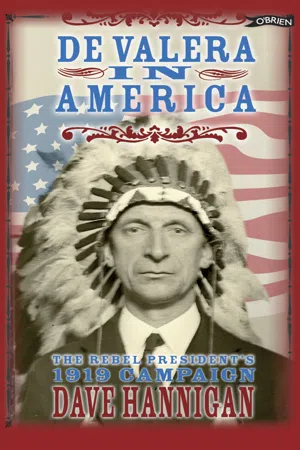
Would one not say that was a very foolish mission, indeed, a very hopeless mission from the start, to go over to the United States and to ask the Government of the United States to recognise a Government that was set up here as the result of the votes of the majority of the Irish people, by a majority of the representatives of the Irish people; to recognise the Republic which was declared here by the Irish people; that it was foolish to expect that; that, so long as Britain did not recognise it, America was not going to do such a foolish thing as to offend Britain by giving such recognition? Yes, indeed, it would have been, in ordinary circumstances, a rather hopeless mission. What inspired it? Why was it undertaken at all? Well, those of us who lived through the last war and knew what was said during the last war understand it…
– Eamon de Valera, Dáil Éireann, 16 November 1943
Nine days out of Liverpool, the 17,540 tonnes SS Lapland finally began to exit the Atlantic Ocean for the calmer, more inviting waters of New York Bay. Making its way through The Narrows and up the Hudson River, hundreds of passengers percolated to the top deck, to catch a better glimpse of the Statue of Liberty coming into view on the port side of the boat. It was a symbol of freedom, a sign the journey was nearing its end. There was cheering then. There always was once the lady of the harbour beckoned.
Manhattan lay off to their right, already steaming in the early morning of 11 June 1919, a shimmering monument to progress in the still-young century. The Singer Building, the Met Life Tower, and, larger than anything they’d ever seen before, the Woolworth, all fifty-five neo-Gothic stories of it, rising to meet them. The world’s tallest building reaching farther into the blue summer sky than any edifice ever, a metaphor for the philosophy of an entire country.
From the soldiers returning from Europe to resume lives interrupted, to the immigrants dreaming their lives anew, the reactions were similar as the skyline took their breath away. Awe. Excitement. Joy. Relief. Their destination was at hand.
Far below the whooping and the hollering, Eamon de Valera remained hidden in the lamplighter’s cabin. This dark, dank room had been his quarters since Barney Downes and Dick O’Neill, a pair of trusted Michael Collins’s lieutenants, had smuggled him aboard back in Liverpool. Rats had gnawed through his spare clothes, brandy had helped him gain his sea legs, and Frisco Kennedy, the San Francisco-born lamp-trimmer with whom he shared the tiny space, believed the tall, gaunt stowaway was on the run for murdering two policemen. He wasn’t on the run for murder. His life was way more complicated than that.
Since being famously spared execution for his part in the 1916 Easter Rising – for decades it was incorrectly assumed his American birth saved his life – he’d been imprisoned twice by the British and embarked on a political career. In the December 1918 British and Irish General Election where Sinn Féin (the party of which he was now president) ran on a promise not to sit in Westminster but to instead establish an Irish parliament in Dublin, he was returned in absentia for the constituencies of East Clare and East Mayo. Unable to make the sitting of the first Dáil, at the Mansion House on 21 January 1919, because he was still languishing in Lincoln Jail, de Valera escaped on 3 February, following a convoluted operation involving the classic cliché of cakes filled with files and keys, and returned to Ireland.
There, on 1 April, he was elected to succeed Cathal Brugha as Priomh Aire of the Dáil, making him de facto leader of a rebel government seeking independence from British rule. The title was meant to denote Prime Ministerial status but the semantics mattered little out at sea where that Dáil’s lack of international recognition was brought home to him every time de Valera lay down in his uncomfortable, temporary billet.
He was a man used to living in the twilight. In the four months since breaking out of Lincoln Jail, he’d gone from being on the lam in Dublin – at one point staying with the priests in Clonliffe College – to moving around the city with impunity, the British not bothering to arrest him, in case it would further burnish his legend. They had revoked his passport in order to restrict his movements, wanting him where they could keep an eye on his every move. This then was the only way to safely reach America, a fugitive secreted away on an English-owned ship, built at the Belfast shipyard of Harland and Wolff, just over a decade earlier.
He passed his days on a bunk that reeked of paraffin, nestled between ropes and paint, twitching at every strange footfall outside that might portend detection by the authorities. Even if the handful of crew members who knew his identity, sometimes smuggled him on deck at night to enjoy some fresh air as the rest of the ship slept, the discomfort, the stress and the stench were daily reminders of Ireland’s lowly position in the international pecking order and the size of the task ahead of him in America.
New York was the perfect launch pad for his ambitious crusade to improve Ireland’s circumstances by garnering recognition, monetary support and publicity for the attempt to break from the Empire. The newspaper and financial capital of the country, it was also a political hub and a place teeming with powerful Irish-Americans who had the resources, the influence and the desire to potentially turn his visit into a remarkable campaign for Irish freedom. All of this was underlined by the belief that the Washington government wouldn’t try to repatriate him for fear of rousing the diaspora’s vocal lobby.
With all the commotion filtering down from the decks above, de Valera finally peeked out through the porthole and caught a glimpse of the city of his birth, the place he’d left in the arms of an uncle before his third birthday. Thirty-four years later, he marvelled at the brightness of the sun beating down, but the eventual sound of the gangway being lowered onto the pier, at Chelsea, meant little to him. He had to sit and wait for every passenger to troop off. He needed the glorious New York day to turn into night and provide a welcoming cover of darkness before making a move. Even then it wasn’t his call to leave. That decision would be made by O’Neill and Downes, men practiced in the art of transporting human contraband.
When they finally came to him that morning, he handed a note to be delivered to Harry Boland. De Valera’s mission was so clandestine that not even Boland, the man he’d appointed Special Envoy to the US, just weeks earlier, knew he was coming on this particular day. Just four months earlier, the pair of them had strolled in the grounds of Dublin Whiskey Distillery, beside Clonliffe College. Back then, the talk of de Valera’s pending trip to America was such he’d told Boland that very night to procure him a large fountain pen for use on board ship. Now, he was sitting tight as O’Neill and Downes headed ashore to seek Boland out in the teeming metropolis, and to hand him this missive.
O’Neill and Downes located Boland who was so shocked by the news he ‘had a fit’. Then they organised the handover with the same smoothness with which they’d spirited their charge on to the Lapland back in Liverpool. He’d walked aboard carrying O’Neill’s bag to lend authenticity to his attempt to pass as a sailor. Half an hour before midnight, he walked off on the other side of the world, wearing Downes’s boatswain’s jacket and carrying a heaving line (a lightweight shipping rope), for extra effect. With his eyes scanning the darkness as he went, watching for unwanted observers or British spies, de Valera was taken to the back room of Phelan’s bar, on 10th Avenue, for the hand-over.
Downes and O’Neill’s mission was complete. They had delivered him to Boland, a trusted friend with an impish grin, who brought him uptown to Liam Mellows’s apartment on 39th Street. Mellows was another 1916 veteran who’d escaped from the British in Galway dressed as a nun. Just a dozen blocks down from the Nursery and Child’s Hospital where he was born, de Valera washed, and at long last changed into fresh clothes. Boland wasn’t alone through all this. He was accompanied by Joseph McGarrity, a dark-haired, moustachioed and rather dapper man with such an impeccable Republican pedigree the IRA would later use his name as an official code word for bomb warnings.
Born in Tyrone, McGarrity was a classic emigrant success story. A wealthy Philadelphia liquor merchant, he was publisher of the Irish Press in the city and a leading light in Clan na Gael, the American arm of the Irish Republican Brotherhood (IRB). He had been one of the financial backers of the Howth Gun-running in 1914 and his support of de Valera would prove practical, political and crucial. Bulmer Hobson, Roger Casement and Padraig Pearse were among the litany of previous visitors to his house on Chestnut Street, and de Valera himself spent several days there undercover and undergoing something of a makeover.
Befitting a self-made man, McGarrity was keen that an individual trying to pass as leader of a country should look every inch the part for the American audience. To this end, he took his guest to a tailor to be fitted for suits, then presented him with a set of fancy luggage and some astute advice. Priomh Aire might have been grammatically correct back home but here, it would have to give way to a term the locals could understand and immediately equate with power. President of the Irish Republic – it was simpler, more direct, and easier translated.
McGarrity left his prints on the younger man in other ways too. On the final day of his stay there, de Valera said his good-byes to the family and picked up his suitcase to leave. At which point, his more experienced comrade intervened and told him to put the bag down: a statesman didn’t carry his own valise. ‘Remember,’ said the man from Carrickmore, ‘from the moment you leave this house, you go now as President of the Irish Republic.’
The new title quickly caught on. By 22 June, it was being used in a report in The New York Times speculating about whether de Valera was in America.
‘Mrs. Charles E. Wheelwright declared that she was amused when told that her son Edward de Valera, President of the Irish Sinn Féin Republic, had been in the city (of Rochester). She and her niece said they would not believe he was in the United States until they obtained direct communication with or saw him… She said she had not heard from her son since he was imprisoned. Mrs. Wheelwright said that if he has really got away, it would be more probable that her son was in Paris.’
De Valera’s mother told a lie for her country. She’d already
had a visit from her son. Her house had been his next destination after setting foot in New York. This wasn’t the first time the pair had been reunited since the day she sent him back to Ireland all those decades earlier. Just two years after his initial departure, Catherine had returned to Bruree for a few weeks and the highlight of the visit was a day out together in Limerick city. One of his fondest childhood memories was of an American alphabet book she sent him, and as a teenager, he had written to his Aunt Hanna, in New York, beseeching her to have his mother arrange his fare to America. Nothing came of that but on a visit back to Ireland in 1907, it was reportedly Catherine who was rejected after she suggested he should accompany her back to the country of his birth.
The pair kept in regular contact by mail, even though Catherine’s personal circumstances had changed greatly since the time she’d figured her son would be better off in Ireland than struggling with her in New York. In 1888 she married English-born Charles Wheelwright, and the couple had two children: a daughter, Annie, who died at the age of seven, and a son, Thomas, who became a priest. They were living on Brighton Street in the upstate New York city of Rochester when de Valera, the rebel on the run, came calling. The little boy she sent back with Uncle Ned was now a husband, a father, a politician and a notorious revolutionary.
The pair had a lot to catch up on. After the Easter Rising, Catherine had sought to clarify the name on his birth certificate in order to prove his American origins to the British.
That step later fuelled theories about whether she and Vivion Juan de Valera had been married at the time of their son’s birth. Amongst others, de Valera’s son, Terry, later worked diligently to try to prove his father was legitimate.
It was on Brighton Street where de Valera came closest to having his cover properly blown. All the false leads and canny propaganda counted for naught, once he was introduced to his cousin, Mary Connolly, inside the Wheelwright household. Within hours of his arrival, his loquacious cousin had told half the town that Catherine’s boy, the one being written and wondered about in all the newspapers, was among them. Helpfully, Catherine herself had brazenly told the Times she hadn’t even heard from her son since his imprisonment and discounted the idea he was even in the country.
For a man hoping to stay undercover, de Valera certainly got around in those first couple of weeks. He travelled to Boston to meet with his half-brother, Thomas (who’d also campaigned on his behalf after the Rising), and to Baltimore, Maryland, to call on Cardinal James Gibbons, the public face of Catholicism in America. He also went to Washington DC to ...