MY FAMILY BACKGROUND
My grandfather, Patrick Connolly, was born in 1862 in Ballyfin, County Laois. He joined the RIC in 1882, and was stationed in Limerick. There he met my grandmother, Ellen Creagh, and they married in 1893. Ellen Creagh’s father, John Creagh, was also in the RIC. A native of Cork, his first station was Waterford, and then he was transferred to Limerick. His father, John Creagh, was also in the RIC. As Ellen Creagh was from Limerick, when my grandfather married her he was transferred out of Limerick to Scariff in County Clare, where my father was born in February 1901.
My father’s first job was as a telegram boy, delivering telegrams by bicycle. He then became a fireman on the railway, operating out of Limerick. He married my mother, Kate Minogue, from Ballintotty, Nenagh, in September 1921. I believe they met while my mother was working in a bar near the railway station in Nenagh.
My dad joined the Garda Síochána in November 1922. I can see by his application form that he was two years in the IRA, so that must have looked well at that time on application forms to join the Garda. His first station was Enniscorthy, County Wexford, in February 1923. He was a member of the first station party to arrive in Enniscorthy. After some time there, he became the Superintendent’s clerk.
The first born in the family was Eileen; she died at a very young age, and was buried on her fifth birthday. She died in the married quarters attached to the Garda Station in Enniscorthy in April 1927. My dad was transferred from Enniscorthy to Charleville in June of 1934, and the family arrived there with six children: Kitty, Paddy, Molly, Nancy, Jimmy and John. I was the first member of the family to be born in County Cork. I was born in Newline, Charleville, in August 1934. We soon moved to Prospect Lodge, The Turrets, in Charleville.
My first real memory of Charleville is my brother John cutting off the top of my finger, the middle finger of my left hand, with a hatchet, when I was about five years old. I’m sure it wasn’t intentional. Our house in Prospect Lodge was single storeyed, with a tiled floor, three bedrooms, a pantry and a dry toilet out in the garden.
My mother, God rest her, was a great provider, with a lot to do and a lot to look after. We had very little growing up really, but we survived and I think we were all the better for not having too much. My dad had a bicycle, and he was very careful with it, because it was essential for his work. We were always trying to have a go on it, but we’d have broken it up on him.
I remember some of my younger sisters being put into a tea chest in the kitchen. Once they were able to walk, to keep them out of trouble, they’d be put into the tea chest, where they could hop up and down and shout and scream. I think every one of us went through the tea chest in our time, and we all did the roaring and shouting too.
My brothers Paddy and Jimmy were great lads for hunting rabbits. They would catch them as well as hunt them, and they very often put food on the table for us. Paddy got a greyhound named Nora, from where I don’t know, which was wonderful for catching rabbits. There was great affection for this greyhound, and we still talk about it.
Paddy used to set snares for rabbits, and one day I made a snare myself. I made it from a piece of netted wire, cut with a pliers to about a foot or so long, and straightened by pulling it back and forth over a railing. Down the field was a gateway and I could see a track under the bottom rail of the gate where I took it that rabbits would go through. I set my snare there, and I went back to it some time the next day. There was a rabbit in the snare, and it looked like he was just sitting down with his head resting on the bottom rail. I went over to him, and he was dead. I was terribly sorry that I had killed the rabbit, but anyway I took him out and brought him up to my mam, and of course she was delighted. To this day, any time I see a rabbit, I think of the rabbit that I killed. But I’m sure I ate part of it myself without any problem.
One of my best memories of Charleville is going up Love Lane, about a quarter of a mile from our house, to a pond where there were collies – little fish like pinkeens. We brought jam jars, and if we caught one with red under the mouth, that was a blood cock, a real prize catch.
A big, tall man on a donkey and cart used to call to us in Charleville. Tom Fisher was his name, and he would sell tripe, drisheens, black pudding and eggs. Mam would always get something from him. I always had the impression that he was so tall, when he sat in the front of the donkey and cart he had to hold up his legs to keep them off the ground.
I don’t have much memory of going to the infants’ school in Charleville, but I know that I did. I have little memory either of the CBS in Charleville, because I was only there a short time before my dad was transferred to Clonakilty. The world knows that De Valera went to school there, and the Archbishop in Melbourne, Archbishop Mannix. We used to go and get apples from a family down the Limerick Road who were relatives of Archbishop Mannix.
Prior to leaving Charleville, Kitty, Paddy and Molly had already flown the nest, to make their own way in the world. Kitty went to Tooting Bec hospital in London, Paddy joined the Army in Cork and Molly went to some place in England as well. While the family was in Charleville, its number increased by six. I was the first born in Charleville, and then came Sadie, Joan, Eileen, Margaret and Willie. Willie was born in October 1943, and was only four months old when we left Charleville. I remember loading all our bits and pieces, as much as they were, into the lorry on the morning of the transfer. My dad went with the lorry, and we went to the railway station with my mother and went by train into Cork and on to Clonakilty.
The railway station in Clonakilty was at the top of a hill called Barracks Hill. I remember coming down from the station and it was dark. My mam, with little Willie in her arms and eight children, walked down Barracks Hill, then down Strand Road, to our new home. We were reunited with Dad and our furniture. There was great excitement – we had a two-storey house, with an indoor toilet and many other extras compared with the home we had just left.
Having left a school that De Valera had attended, I was now in a school where Michael Collins had gone.
In May of 1944, a few months after we moved to Clonakilty, Willie died. He was only seven months old. I remember we were all gathered around him, and Mam told us that he was going to die. We were all in tears, and praying as best we could. He was buried in Darrara Cemetery, about four miles from Clonakilty, the following day. That left eleven of us in the family.
Most of us had never seen the sea, or even a boat, before we went to Clonakilty, so we had great excitement the first couple of weeks, exploring the town and surrounding area. When my dad was off duty and we were off school, we often used to walk down to Inchydoney, about three or four miles away. Inchydoney is a beautiful spot, now home to a beautiful hotel. It was a long walk, and on the return journey, we would be strung out over about a quarter of a mile along the road. Mam always seemed to be home first, and well advanced with the cooking by the time we arrived.
My dad was a great gardener, and always had every inch of the garden sown with fruit and vegetables. There wasn’t sight of a weed anywhere. He always had a new plant of some sort ready to replace the one he would take out. My mam and dad were very strict on doing our lessons at night time. They made sure we did them, and did them right. We would have our books and pens and pencils ready for the morning. I can still hear someone say, who took my pencil? There’d be a bit of a squabble, looking for bits and pieces.
I got involved in sport at an early age in Clonakilty. My mam and dad would say, ‘Well, it’s going to keep you out of trouble anyway.’ I remember the first match I went to play with Clonakilty. I was only a sub, and I was going to Ballinascarthy, four miles out the road. I knew my mother had my togs washed and nicely ironed, and they were inside in the sitting room in a press. So I put my hand in, pulled out this thing and put it in my pocket. I got my boots and joined the rest of the lads heading off to Ballinascarthy. Of course there was no dressing room or anything then; we togged out in the side of the ditch. So I took off the shoes and socks and the pants, and got this thing out of my pocket. What was it? It wasn’t shorts; it was a pillowslip. It could have been worse I suppose, and anyway I wasn’t playing. In fact I was relieved, when I saw the size of the opposition.
In my first real match, in 1949, I got a little medal for being a finalist. In 1952, I played with Cork minors, and we won the Munster Championship. We were beaten by Galway in the all-Ireland semi-final, and Galway were the eventual winners. In the same year in the final, I won the Cork senior football championship with Clonakilty. After a replay I was playing centre field.
In one match in Clonakilty, in the first few minutes I dislocated my left thumb. Somebody ran in from the sideline and gave it a pull and pushed it back into place, and I played on. ‘Twas foolish, but I was okay after a couple of days. There were no scans or anything like that in those days.
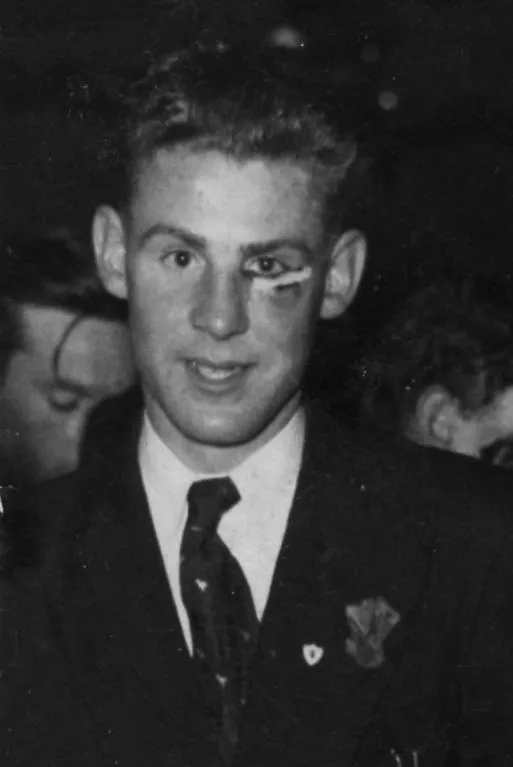
On 8 May 1955, Clonakilty played St Nick’s in the first round of the senior championships in Kinsale. The previous year, St Nick’s had beaten Clonakilty in the final, so this was a real grudge match. I happened to be captain, and we won, 2-2 to 3 points. I thought, and so did others, that another county title was looming on the horizon for Clonakilty, having just beaten the previous year’s champions. Macroom ended our dreams in the next match and we were gone. I received a beautiful black eye and a cut under the left eye during that match. It was the first of a few that I would get before the year was out.
The following morning, I picked up all my possessions and left Clonakilty on the train for Dublin. I shed a few tears on the way into Cork at leaving my mam and dad and the rest of my family behind, as I set out on my own in life.
TRAINING AT GARDA HEADQUARTERS, THE PHOENIX PARK
I arrived in Dublin, and made my way over to Crumlin to my aunt Jane Wheatly’s house. She kept me there for the night, for which I was very grateful indeed, and I was also grateful to her son Joe who brought me on the back of his Lambretta scooter up to the depot gate the following morning. Here I joined two hundred and eighteen others joining the force that day. Joe’s niece, Lorraine Wheatly, is now Chief Superintendent in charge of the Westmeath Division, based in Mullingar.
Recruits entering training had to have all the items on a list. I remember one item listed was a pair of black boots. The Connollys didn’t have the price of a pair of new boots. I had been in the Forsa Cosanta Áitiúil (FCA Army reserve) for two years or so, and had been issued with a pair of brown boots. My da, who over the years was the resident cobbler for all, did a great job of changing the colour of the FCA boots to black. I wasn’t surprised to notice that many of my fellow recruits were also former FCA members, with identical boots, which required plenty of black polish to keep the original brown colour from showing.
We were organised into classes of twenty-five, and soon integrated with each other. Our training lasted five months, and graduation day was 10 October 1955. During my time in training, I played with the Cork junior football team, and I picked up two more black eyes during the course of that championship. I was known to most of the fellows as the fellow with the black eyes.
As a Garda trainee, I was paid five pounds ten and a penny per week. Out of that we had to pay our mess bill, so we didn’t have too much to spend out of the five pounds ten and a penny. My time off in the depot centred around the Garda sports ground, kicking a ball around with colleagues who were interested in football like myself.
I missed my passing-out parade, as I went to Birmingham on that date to play in the All-Ireland junior football final against Warwickshire. Cork County Board was very strict on Rule Twenty-seven, the rule that prevented members from playing or attending foreign games. They would certainly suspend anybody that breached that rule. However, on the Saturday, the day before the final, two teammates and I got lost, so to speak, and we attended a soccer match. I will always remember it. Birmingham were playing Sunderland, and it was a spectacular scene – such a huge crowd, a beautiful pitch, great excitement and wonderful skill on display on the field. I remember one of England’s soccer greats, Len Shackleton, was playing. He was probably one of the reasons we went to the match. That was the first and only soccer match I ever attended.
We won our own match, and then I travelled back that night by boat, to arrive around six or seven o’clock in the morning. I made my way back up to the depot. All my colleagues had left, gone to their respective stations. I felt alone in the world, and missed all the lads, having missed my opportunity to say goodbye. Anyway I went straight to bed, as I was jaded tired, and the train to Kildare was leaving around seven o’clock that evening.
KILDARE, MY FIRST STATION, 1955
When I arrived in Kildare Station, the electricity was off for some reason or another. There were candles lighting in the public office, one up on the counter, and another on the fireplace. I was brought upstairs to a huge big barn of a room where there were two other men staying. The Station was a hundred years old, and the floor boards were very worn. T he nails were sticking up above the timber, and fluff and dust was coming up between the boards. I got a single bed, with a mattress about two inches thick, and a few grey blankets. No wardrobe, just a chair, and a rack overhead for your possessions. No toilet upstairs, and no water, so we had to go down to the basement to use the toilet. There were two or three big windows in the room, facing out onto the street. No curtains, but there were big shutters. We didn’t complain – we had a job and we got on with it.
My Sergeant in Kildare was John McGrath. A Tyrone man, he was strict, fair, fatherly and considerate. If you abided by him, as I think I did, he kept a man on the straight and narrow path at the beginning of his time of service. My Superintendent was Malcolm G. Crummey, an extremely nice man.
There were nine or ten Gardaí in Kildare at the time I arrived there. Great characters, and mostly elderly men, and I think the fact that my father was a Garda helped me greatly to associate with them. One of them, Pat Hennessey, was a great storyteller. One story he used to tell took place during the time the British were in the Curragh camp. The daughter of one of the officers was out late one night, and she was sexually assaulted by a man in uniform. She pulled a button off his uniform. The investigators were satisfied of the barracks the culprit came from. So all the barracks personnel were paraded the following morning in uniform. This button was from a particular place, an epaulette or sleeve, I don’t know, and th...