Chapter One
Proclaiming a Republic
Ireland has a noble history of revolutionaries who, over two centuries, attempted to overthrow British rule. However, as this chapter will show, it is also a history of failed uprisings. Beginning with the United Irishmen of Wolfe Tone in 1798 and then Robert Emmet’s rising in 1803, the chapter will go on to discuss how pacifist Daniel O’Connell’s success in achieving rights for Catholics came to be overshadowed by the decimation of the nation during the Great Hunger of the 1840s. The 1848 rising of William Smith O’Brien and the Young Ireland movement was followed in the next generation by the abortive Fenian rising of 1867; and the Irish Home Rule Movement, which sought to bring the Irish Parliament back from London to Dublin, was hugely popular from the 1870s but it, in turn, was surpassed by the Irish Republican Brotherhood who went on to stage an uprising in 1916. The success of that Rising is measured not by who won or lost but by the fact that it led directly to the War of Independence of 1919–21.
THE UNITED IRISHMEN
Born in 1763 into a Dublin Protestant family, Theobald Wolfe Tone studied at Trinity College Dublin and in London, and was called to the bar in 1789. However, he had little interest in practising as a lawyer and instead turned his attention to politics, founding the Society of United Irishmen in 1791. Influenced by events in the United States and France, the United Irishmen had a vision of Ireland as an independent nation of equality, where religious beliefs were irrelevant. In 1798, the United Irishmen staged a mass uprising against British rule in Ireland. The rebellion, which lasted from May until October, was ultimately crushed by the British, with the loss of 30,000 lives. Tone, who had sought French assistance in overthrowing the British, sailed into Lough Swilly with 3,000 men. However, the French fleet was captured on 12 October, Tone was taken prisoner, tried by court martial and sentenced to death. He died in prison on the morning of his execution, apparently having cut his own throat. Some fragments of the rebel armies survived for a number of years and waged a sort of guerrilla warfare in several counties.
A perception in Britain that the rebellion had been provoked by the misrule of the Protestant Ascendancy and a fear of collusion between Irish revolutionaries and the French led to the passing of the Acts of Union of 1800, which removed the Irish Parliament from Dublin. Irish MPs were now to sit as a minority amongst the British representatives in the Westminster Parliament. On 1 January 1801, the Union flag, as we know it today, was hoisted above Dublin Castle for the first time and a new entity was created, the United Kingdom of Great Britain and Ireland.
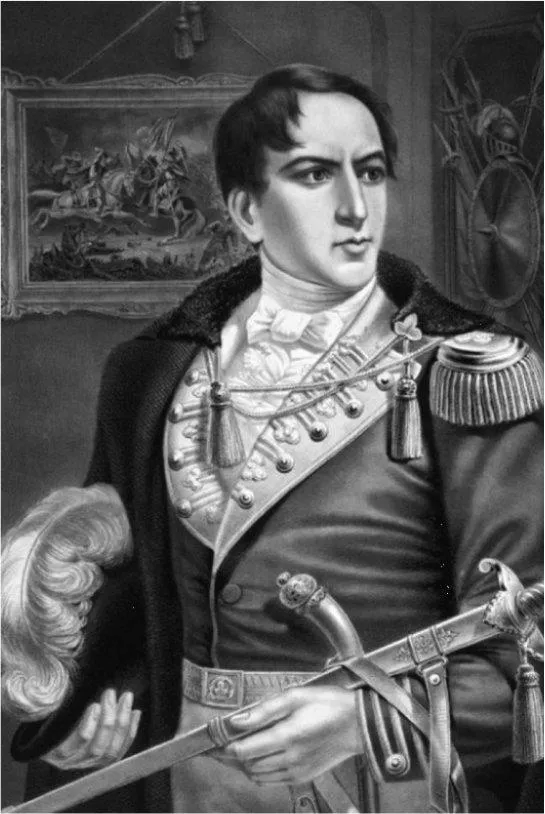
Robert Emmet, another Dublin Protestant, became one of the leaders of the United Irishmen while a student at Trinity College. Having left Trinity rather than face an inquisition into radical students, he joined his brother Thomas in France, in 1802, where he discussed Irish independence with Napoléon and Talleyrand. Determined to organise an uprising, Emmet returned to his native Dublin and, on 23 July 1803, he decided to act. Emmet’s rising was confused and ineffective and lasted no more than two hours. However, his subsequent capture, after which he was hanged and then beheaded, ensured that he was immortalised as an Irish martyr. Emmet gave a speech from the dock after sentence of death was passed, the last lines of which challenged future Irish revolutionaries: ‘When my country takes her place among the nations of the earth, then, and not till then, let my epitaph be written. I have done.’
DANIEL O’CONNELL
Penal Laws were a series of laws imposed in an attempt to force Catholics and Protestant dissenters, such as Presbyterians, to accept the authority of the Anglican church, which in Ireland was established as the Church of Ireland. From 1607, Catholics were barred from holding public office or serving in the army. They had to pay fines for non-attendance at Anglican services and their churches were transferred to the Church of Ireland. In 1652, Catholics were barred from membership of the Irish Parliament, and Catholic landholders had their lands confiscated. The Protestant Ascendancy ruling class passed further laws to restrict the religious, political and economic activities of Catholics and dissenters, but while many of these were repealed in the eighteenth century, the ban on Catholics sitting in parliament continued after the Act of Union, 1800, and Catholics were seriously under-represented in politics, law and the civil service.
Born in Kerry in 1775, Daniel O’Connell was educated in France where he developed a lifelong abhorrence of violence for political ends. Having returned to Ireland, where he built up a large practice as a barrister, he was confirmed in his pacifism by the violence of the 1798 rebellion and its aftermath. In 1823, O’Connell founded the Catholic Association, whose objective was to secure Catholic rights by constitutional means. With the support of the clergy, he turned it into a mass movement, campaigning and holding rallies around the country throughout the 1820s. In 1828, O’Connell was elected to the British Parliament, but could not take his seat as he was a Catholic. The following year, the Roman Catholic Relief Act was passed; O’Connell was victorious in a by-election in Clare and ‘the Liberator’ was able to take his seat at Westminster. It is interesting to note that although generally referred to as ‘Catholic emancipation’, the Catholic Relief Act actually raised by five times, to £10 per annum, the property qualification required to vote; this meant that many of the ‘40 shilling freeholders’, those whose rent was 40 shillings or £2 per annum, lost the right the vote.
O’Connell, who was now seen as the ‘uncrowned king of Ireland’, gave up his practice at the bar to devote his time wholly to politics and to campaigning in the 1830s and 1840s for repeal of the Acts of Union, which he believed could be achieved by peaceful means. British political leaders quickly closed ranks against him, bringing in a coercion act to prevent mass gatherings, but a change in government gave the repeal movement the space to gather momentum. Supported by the Young Irelanders, the Repeal Association organised ‘monster meetings’ throughout the country, with an estimated three-quarters of a million in attendance at one meeting at the Hill of Tara. However, the Liberal government had become alarmed by the growth of the movement and, in 1843, banned a meeting scheduled to be held in Clontarf in Dublin. O’Connell was arrested, charged with conspiracy and sentenced to a year’s imprisonment and a fine of £2,000. Although he continued his repeal activities following his early release from prison, it was clear that his tactics had failed, and the Young Irelanders withdrew from the Repeal Association. Knowing that he had been unsuccessful in his goal, O’Connell left Ireland in 1847 and died in Genoa later that year.
THE GREAT HUNGER
In August 1845, the potato blight, phytophthora infestans, was reported in the London Chronicle as having affected the crops in Ireland. The potato was the staple diet of the majority of the poor tenant farmers and the poverty-stricken landless in Ireland. Instead of Westminster Parliament enacting emergency legislation to ban the export of produce from Ireland and import supplies of food, a purposeful policy of laissez-faire was pursued. Those who could not afford food would have to rely on the sparse charity available from the state and private sources. The Irish Famine is an anachronistic misnomer as food was exported in abundance from Ireland under the armed guard of the British Army. During what is now referred to as the Great Hunger, compassion, not food, was in short supply. The Irish people were degraded by the Great Hunger and they would not easily forget that no Anglo-Irish landlord and no man of the cloth went hungry, while children perished for the want of food.
William Smith O’Brien from Dromoland, County Clare, had served as a Conservative MP in the 1820s and 1830s. However, his views changed and by 1844 he was a convinced Repealer. He became a leading member of the Young Irelanders and, with others who had split from Daniel O’Connell, founded the Irish Confederation in 1847, urging the formation of a National Guard and an armed rising. With most of the other leaders arrested, O’Brien and the Confederates still at liberty made an attempt at an uprising in July 1848 but it was illprepared and the Great Hunger had left the countryside weakened. The rising was a failure and many of the leaders of the movement were banished to Van Diemen’s Land (Tasmania).
Considered by many to have been a form of genocide, the Great Hunger from 1845 to 1852 led to the death by starvation of over one million people, and a further one million emigrated around the world, settling in England, Scotland, Wales, Australia, Canada and the United States.
THE FENIANS
Thousands of Irish people continued to emigrate throughout the second half of the nineteenth century, and the population of the country essentially halved within one generation. A significant number of Irish male immigrants in the US were sworn into a secret society formed in 1858, the Fenian Brotherhood. Its sister organisation in Ireland, the Irish Republican Brotherhood (IRB), staged an uprising in 1867 in the same year as the American wing of the Fenians invaded Canada. Neither event was a success, adding to the growing list of failed uprisings against British rule.
Physical force nationalism enjoyed a revival in the 1880s during the Land War when Anglo-Irish landlords were targeted by ‘agrarian outrages’ and the Royal Irish Constabulary earned the opprobrium of the Irish when the police acted as enforcers during evictions. Irish-Americans, under the auspices of Clan na Gael (the Irish Family), the new name for the Fenian Brotherhood since 1867, brought terror to the people of England by engaging in a bombing campaign in the 1880s. One young man arrested for his bombing activities was Thomas J. Clarke.
Born in England but raised in County Tyrone, Clarke emigrated to the US where he was influenced by Jeremiah O’Donovan Rossa. O’Donovan Rossa who was originally from Rosscarbery, County Cork, had been arrested in 1865 with other leading Fenians and sentenced to penal servitude for twenty years. Following his release in 1871 on condition that he leave Ireland, he had gone to the US where he wrote accounts of his time in prison and for a time edited the newspaper, The United Irishman. He was also responsible for creating a ‘skirmishing fund’, money to send Fenians on bombing missions, such as that for which Thomas Clarke was arrested. Clarke was sentenced to life imprisonment with hard labour but he was released after fifteen years and returned to the US where he befriended John Devoy, the head of Clan na Gael.
HOME RULE
A Protestant barrister from County Donegal, Isaac Butt was greatly influenced by the suffering he witnessed during the Great Hunger and by the idealism of the Young Irelanders. He defended many Fenians and became president of the Amnesty Association in 1869. In 1870, he founded the Irish Home Government Association, which became the Home Rule League and ultimately the Irish Parliamentary Party, the largest Irish political party of the late nineteenth century.
Charles Stewart Parnell was the son of a Wicklow landowner with nationalist sympathies. He became MP for Meath in 1875 and joined Isaac Butt’s Home Rule League. Parnell, who would become another ‘uncrowned king’, was the dominant figure in the Irish Party after the death of Butt in 1879. He married Home Rule with the campaign for tenants’ rights and even managed to earn the respect of physical force nationalists. The Liberal Party in England relied on the Home Rule MPs to keep them in government, which the Home Rule MPs did in exchange for Liberal support of their cause. However, Parnell had been having a long-running relationship with a married woman, Katharine O’Shea, and when her husband sued for divorce and scandal ensued, members of the party urged Parnell to stand down. Parnell’s refusal to do so, on the grounds that his private life had nothing to do with his political life, caused a bitter split in the party. Following Parnell’s sudden death in 1891, the Irish Party fell apart.
Despite decades of campaigning, two Home Rule bills introduced under Liberal Prime Minister William Gladstone, in 1886 and 1893, were defeated by the House of Lords, whose members were determined to keep the Union intact. Nevertheless, in spite of opposition from Conservatives and Unionists, the Parliament Act of 1911 was passed, thus depriving the House of Lords of its absolute power to veto bills passed by the House of Commons. Finally, in September 1914, the Home Rule Act was passed into the statue books. However, there it would remain as Britain had declared war on Germany on 4 August 1914, and Home Rule was suspended until after the war.
BACKGROUND TO THE EASTER RISING
A small minority of republicans and socialists in Ireland were not willing to wait for Home Rule and, indeed, wanted freedom beyond a parliament that would be subservient to Britain. One of those was Thomas Clarke who returned to Ireland from the US with the express intention of fomenting revolution. With his close comrade, Seán MacDiarmada, a Gaelic League member who had previously promoted the republican cause in Belfast, he revived the moribund secret organisation, the IRB, and the duo swore in a new generation of dedicated activists. These included Patrick Pearse, a Gaelic League enthusiast, poet and headmaster of St Enda’s School in Rathfarnham, Dublin. Another teacher at St Enda’s, Thomas MacDonagh, and his fellow poet and friend, Joseph Plunkett, also took the Fenian oath to make Ireland an independent democratic republic. A renowned uileann piper and language activist, Éamonn Ceannt, who once played a selection of Irish airs for Pope Pius X in Rome, was also in the IRB. James Connolly, a Scottish-born socialist republican, eventually swore the Fenian...