19
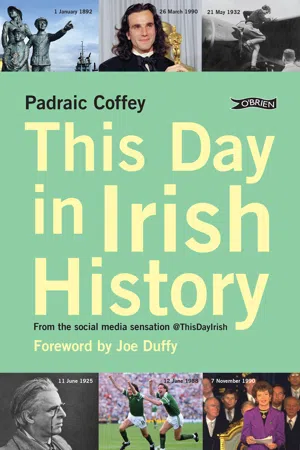
This Day in Irish History
1 January 1892: Annie Moore passes through Ellis Island
1 January 1892
Annie Moore passes through Ellis Island
When Annie Moore stepped off the SS Nevada on 1 January 1892, little could she have known that she would be recorded as the first immigrant ever to pass through Ellis Island. Annie had departed from Cobh (known as Queenstown at the time), Co. Cork, with her brothers Anthony and Philip, aged 12 and 15 respectively. She was the eldest, at 17, and all three were travelling 3,000 miles to meet their parents, who had emigrated four years earlier and landed at the first US immigration station, Castle Garden.
Annie was the first of 12 million immigrants to pass through Ellis Island between 1892 and 1954, whose descendants comprise an estimated third of the people living in the United States. When she first saw the Statue of Liberty it had been in New York Harbour less than six years, having been dedicated on 28 October 1886.
The day after Annie’s arrival, the New York Times wrote: ‘The honor [of being the first to pass through] was reserved for a little rosy-cheeked Irish girl. She was Annie Moore, fifteen [sic] years of age, lately a resident of County Cork.’ It would not be the last time that Annie’s age would be incorrectly recorded. When songwriter Brendan 20Graham penned his own tribute to Annie, ‘Isle of Hope, Isle of Tears’, he did the same.
In 2008, she was honoured at a ceremony in Calvary Cemetery, Queens, where a letter by then Democratic presidential nominee Barack Obama was read out, which said: ‘The idea of honoring those who came before you by sacrificing on behalf of those who follow is at the heart of the American experience. Irish Americans like your ancestors, and mine from Co. Offaly, understood this well.’
2 January 1904: Arthur Griffith publishes ‘The Resurrection of Hungary’
2 January 1904
Arthur Griffith publishes ‘The Resurrection of Hungary’
On this day, the first in a series of articles by Arthur Griffith known as ‘The Resurrection of Hungary’ was published in the United Irishman, the newspaper co-founded by Griffith in 1899. The articles would continue to appear until 2 July of that year. All 27 were collectively published under the same title, with the subtitle ‘A Parallel for Ireland’, in a pamphlet in November 1904.
Griffith had previously alluded to ‘the Hungarian Policy’ in a speech at the third Cumann na nGaedheal convention on 26 October 1902, saying that members of the then dominant Irish Parliamentary Party should replace their policy of attending Westminster with ‘the policy of the Hungarian deputies … refusing to attend the British Parliament or to recognise its right to legislate for Ireland’. Hungary, once dominated by its neighbour Austria, had reached the Compromise of 1867, which established a dual monarchy for the two countries and ended 18 years of animosity.
Griffith was not as hostile to Britain as some may assume – he advocated separate governments for Britain and Ireland, but suggested a common monarch be retained. His policy of abstentionism from the House of Commons would become a linchpin of Sinn Féin, the party Griffith founded in 1905. However, the proposal of a common monarch was dropped.
When Sinn Féin won 73 of the 105 Irish seats in the 1918 United Kingdom general election, Griffith’s policy was put into practice, and the first Dáil Éireann was established. Griffith is perhaps best known today, outside of his role as founder of Sinn Féin, as one of the signatories of the Anglo-Irish Treaty of 1921, a compromise hated by anti-Treaty republicans, including modern-day Sinn Féin. Nonetheless, the Treaty was arguably consistent with the compromise he had been proposing in print since 2 January 1904. 21
3 January 1602: The Battle of Kinsale
3 January 1602
The Battle of Kinsale
On 3 January 1602, the Battle of Kinsale was fought: a decisive moment in the Nine Years’ War, which had begun with Hugh O’Neill, the second Earl of Tyrone, resisting attempts by William FitzWilliam, Lord Deputy of Ireland, to install an English Sheriff in the province of Ulster. Though the war had been primarily about territory, O’Neill had explicitly invoked the Catholic religion, particularly through 22 articles in November 1599 that began by insisting that ‘the Catholic, Apostolic and Roman religion be openly preached and taught throughout all Ireland, as well cities as borough towns, by Bishops, seminary priests, Jesuits and other religious men’.
Because of this religious connection, O’Neill sought help from Catholic Spain, led by Philip II, with whom he had been communicating since 1591. Spanish troops numbering around 3,300, led by commander Juan del Águila, finally landed in Ireland in 1601: in Kinsale, Co. Cork, far away from O’Neill’s stronghold in Ulster. Upon learning of their arrival, Lord Mountjoy, the Lord Deputy of Ireland, sent approximately 7,000 troops to besiege the Spanish. O’Neill and his ally Hugh Roe O’Donnell marched south to meet their allies. When they finally joined, on 3 January 1602 (or, using the Julian calendar, Christmas Eve 1601), the battle lasted only two hours. O’Neill’s army was broken up by the English cavalry, with the majority forced to retreat to Ulster. The Spanish, realising they could not win, were permitted to return to Spain without admitting defeat.
The Battle of Kinsale did not end the Nine Years’ War, but it solidified the eventual Tudor victory, the Treaty of Mellifont in 1603, and the Flight of the Earls in 1607, when O’Neill and Rory O’Donnell, the first Earl of Tyrconnell, left Ireland never to return, thus paving the way for the Plantation of Ulster.
4 January 1909: The Irish Transport and General Workers’ Union is founded
4 January 1909
The Irish Transport and General Workers’ Union is founded
On 4 January 1909, William X. O’Brien wrote in his diary: ‘the Irish Transport and General Workers Union founded officially from this date’. O’Brien was one of the co-founders, along with James Larkin. Larkin was born in Liverpool in 1876 to parents 22from Co. Armagh, and had come to Belfast in 1907 to organise the city’s dock workers on behalf of the National Union of Dock Labourers (NUDL).
However, tension between Larkin and William Sexton, General Secretary of NUDL, resulted in Larkin’s expulsion in 1908. As a result, the ITGWU was founded. In May 1909, the ITGWU posed a rhetorical question in the preamble to its rules: ‘Are we going to continue the policy of grafting ourselves on the English Trades Union movement, losing our own identity as a nation in the great world of organised labour? We say emphatically, No!’
The pivotal moment for the ITGWU was the Dublin Lockout of 1913. William Martin Murphy, chairman of the Dublin United Tramways Company (DUTC), dismissed 340 workers he suspected of being ITGWU members. Murphy wanted his employees to sign a pledge stating that they would not be members of Larkin’s union. This led to a strike by the tramway workers in August 1913. Other employers – eventually 404 – tried to force their workers to sign a similar pledge; these workers went on strike in solidarity with the tram workers, leading to several months of industrial action which brought Dublin to a standstill.
In January 1914, the ITGWU advised workers to end the ultimately unsuccessful strike. Nonetheless, the Lockout, along with the Easter Rising of 1916, has come to define the city of Dublin in the early part of the twentieth century.
5 January 1871: The Franco-Irish Ambulance Brigade is released from duty
5 January 1871
The Franco-Irish Ambulance Brigade is released from duty
On 5 January 1871, the Franco-Irish Ambulance Brigade – a volunteer medical corps comprising surgeons, medical students and ambulance drivers – was released from its duties by the French authorities. Also known as the Ambulance Irlandais, it had been established in Dublin the previous year to assist France in its war with Prussia, which ostensibly started over the infamous Ems telegram. Soon after, the Committee for the Relief of the Sick and Wounded of the French Army and Navy was established, headed by Fr Tom Burke.
In October 1870, a notice in the Irish Times stated that ‘Volunteers for the Irish Ambulance Corps who have passed the final examination as to eligibility, are required to present themselves at the office.’ The 250 or so volunteers left that month, arriving 23at Le Havre on a ship called La Fontaine. France was already losing the war quite badly.
One novel feature of the Brigade was that it managed to circumvent the Foreign Enlistment Act of 1870, which forbade anyone in Ireland or Great Britain from accepting ‘any commission or engagement in the military or naval service of any foreign state at war with any foreign state at peace with Her Majesty’.
Though its purpose was to aid sick and wounded soldiers, several members of the Brigade joined the French Foreign Legion upon arrival. This led to the arrest of one ‘John McDonald’ (real name Joseph Patrick McDonnell, a former Fenian) in London, who was thought to have been the principal recruiter for the Brigade.
Shortly before the Armistice of Versailles, the Ambulance Irlandais returned to Ireland. It had earned a good reputation on the battlefields of continental Europe, having come to the aid of several wounded French soldiers.
6 January 1839: The Night of the Big Wind
6 January 1839
The Night of the Big Wind
When the Old Age Pensions Act became law on 1 January 1909, it entitled men and women over the age of 70 in the United Kingdom – of which Ireland was still a part – to an annual payment of £13, on a means-tested basis. Within three months, 261,668 ...