eBook - ePub
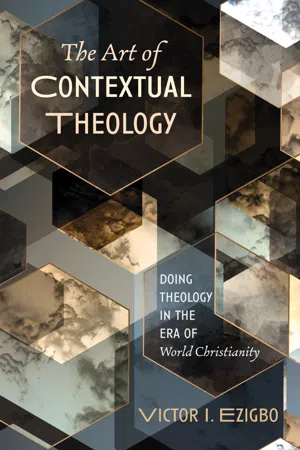
The Art of Contextual Theology
Doing Theology in the Era of World Christianity
- 246 pages
- English
- ePUB (mobile friendly)
- Available on iOS & Android
eBook - ePub
About this book
Christianity has an inherent capability to assume, as its novel mode of expression, the local idioms, customs, and thought forms of a new cultural frontier that it encounters. As a result, Christianity has become multicultural and multilingual. What is the role of theology in the imagination and articulation of Christianity's inherent multiculturalism and multi-vernacularity? Victor Ezigbo examines this question by exploring the nature and practice of contextual theology. To accomplish this task, this book engages the main genres of contextual theology, explores echoes of contextual theological thinking in some of Jesus's sayings, and discusses insights into contextual theology that can be discerned in the discourses on theology and caste relations (Dalit theology), theology and primal cultures (African theology), and theology and poverty (Latin American liberation theology).
Information
Topic
Theology & ReligionSubtopic
Christian Theology1
Theology as a Contextual Exercise
A salient feature of the field of contextual theology is the quest for rediscovering an essential nature of Christian theology: contextuality—modes of being and expression that are conditioned by a community’s context. Here, the word “context” is used broadly as an umbrella term that encompasses the history, culture (e.g., way of life, language, thought, and intellectual capital), and contemporary state affairs (e.g., life situation and social location). Christian theology’s contextuality reminds us that a context orients Christian communities towards a particular way of seeing, interpreting, constructing, and appropriating their knowledge of God-world relations. This chapter discusses Christian theology’s contextuality, the features and forms of contextual theology, and the tasks of contextual theologians.
A gathering of twenty-two theologians in 1976, mainly from Africa, Asia, and Latin America meeting in Dar es Salaam (Tanzania), would later become a watershed conference that nudged some theologians to explore the common theological and social concerns of African, Asian, and Latin American Christians.1 In their communiqué, the attendees of the conference hammered out four objectives that were embedded in their theological questions and quests. These would serve as the guidelines for their future ecumenical theological explorations:
- Sharing with one another the present trends of interpretation of the gospel in different Third World countries, particularly bearing in mind the roles of theology in relation to other faiths and ideologies as well as the struggle for a just society.
- Promoting the exchange of theological views through writings in the books and periodicals of Third World countries.
- Promoting the mutual interaction between theological formulation and social analysis.
- Keeping close contacts as well as being involved with action-oriented movements for social change.2
In these objectives, one can discern a team spirit and camaraderie among the theologians, highlighted by the controversial term “Third World.”3 They shared the desire to challenge colonialism, economic exploitation, domination of foreign powers, and racism in their continents from a Christian theological vantage point. Given that the theologians shared a similar interest in contextual theologizing, albeit for different reasons and at varying degrees, one should not be surprised that the concerns for a “just society,” “social analysis,” and “action-oriented movements for social change” formed the building blocks of the four objectives. In the “Final Statement,” they reiterated the concerns: “We . . . are convinced that those who bear the name of Christ have a special service to render to the people of the whole world who are now in an agonizing search for a new world order based on justice, fraternity, and freedom.” The document also states: “We have reflected from our experience as belonging to the oppressed men and women of the human race. We seriously take cognizance of the cultural and religious heritage of the peoples of the continents of Asia, Africa, and Latin America.”4 Though only one of the theologians examined in this book (Gustavo Gutiérrez) was present at the conference in Dar es Salaam, the theological vision of the conference has partly given the impetus for the genre and also the scope of theological exploration I undertake in this book.
Several theological presuppositions derived from Christian Scripture underlie this book, of which three are noteworthy. Firstly, the Christian view of divine revelation—God’s decision to reveal God’s mode of being and operating in the world in ways that are recognizable to human beings—ought to deter Christians from engaging in unfruitful speculations about God’s identity. Therefore, the God invoked in the Christian faith should not be construed as merely a hypothetical concept proposed by Christians as a point of departure in their explorations of the mystery of human existence. On the contrary, the Christian God, as expressed in Christian Scripture, assumes God’s self-disclosure through mediated and contextualized avenues. The writer of Hebrews puts it this way:
In the past God spoke to our forefathers through the prophets at many times and in various ways, but in these last days he has spoken to us by his Son, whom he appointed heir of all things, and through whom he made the universe. (Heb 1:1–2 NIV)
The guiding theological question about the Christian God in the field of contextual theology ought not be: What is the individual essence of the Christian God?5 A more appropriate question should be: Why the Christian God? To put it differently, why this God that Christians pray to, believe in, sing to, and worship? The “why” question is not really about epistemic rights—the rights of Christians as members of a particular religious community to propose a particular God as a theory for explaining the origins of the cosmos. On the contrary, it is about epistemic praxis—knowledge of doing—that is grounded in a mediated divine presence embodied by Jesus Christ who summons his followers to participate, as a form of worship, in the work of healing the ills of this world (see Matt 5:13–16; cf. John 17; Eph 2:8–10; Jas 2:14–19).
Secondly, Christian theology is in some ways a commentary on Christians’ beliefs about God’s proclamation of good news to this world (John 3:16), which is embodied by Jesus of Nazareth (Luke 4:16–21). He should be Christians’ window on God’s mediated presence in the world (Heb 1:1–4).6 Philip’s request: “Lord, show us the Father and that will be enough for us” and Jesus’s response: “Anyone who has seen me has seen the Father. How can you say, ‘Show us the Father’?” (John 14:8–9 NIV) suggests that Christian theology will be overreaching itself if its aim is to penetrate the unmediated mystery of God’s presence and identity. The apostle Paul warned Christians in Corinth against the illusion of those who think they can penetrate the unmediated and unrevealed mystery of God thorough theological reflections and through their spiritual gifts (1 Cor 13:8–12).
Thirdly, as an essential component of the Christian life, theologizing should be grounded in a commitment to explore and experience a relationship with God (the Triune God, in Christian parlance) and a commitment to neighbors—that is, all humans, since all human beings, as Christian Scripture teaches, are creatures and imagers of God (see Gen 1:26–27; 5:1; Mark 12:29–31). Theologizing becomes a commitment to God when it is done for the purpose of glorifying God and promoting the worship of God. Theologizing becomes a commitment to human neighbors when it is done to promote the well-being—spiritual, mental, physical, economic, and social health—of people. Given this commitment to human neighbors, grassroots Christian theologies—the theologies that are being worked out daily largely by Christians with no formal theological education—should be of prime concern to theo...
Table of contents
- Title Page
- Acknowledgments
- Introduction
- 1 Theology as a Contextual Exercise
- 2 Echoes of Contextual Theologizing in Jesus’s Teachings
- 3 Caste and Dalit Theology
- 4 Indigenous Culture and the Project of African Theology
- 5 The Poor in Latin American Liberation Theology
- 6 Christian Abandonment and the Pursuit of Spiritual Solutions in Nigerian Christianity
- Conclusion
- Bibliography
Trusted by 375,005 students
Access to over 1.5 million titles for a fair monthly price.
Study more efficiently using our study tools.
Frequently asked questions
Yes, you can cancel anytime from the Subscription tab in your account settings on the Perlego website. Your subscription will stay active until the end of your current billing period. Learn how to cancel your subscription
No, books cannot be downloaded as external files, such as PDFs, for use outside of Perlego. However, you can download books within the Perlego app for offline reading on mobile or tablet. Learn how to download books offline
Perlego offers two plans: Essential and Complete
- Essential is ideal for learners and professionals who enjoy exploring a wide range of subjects. Access the Essential Library with 800,000+ trusted titles and best-sellers across business, personal growth, and the humanities. Includes unlimited reading time and Standard Read Aloud voice.
- Complete: Perfect for advanced learners and researchers needing full, unrestricted access. Unlock 1.5M+ books across hundreds of subjects, including academic and specialized titles. The Complete Plan also includes advanced features like Premium Read Aloud and Research Assistant.
We are an online textbook subscription service, where you can get access to an entire online library for less than the price of a single book per month. With over 1.5 million books across 990+ topics, we’ve got you covered! Learn about our mission
Look out for the read-aloud symbol on your next book to see if you can listen to it. The read-aloud tool reads text aloud for you, highlighting the text as it is being read. You can pause it, speed it up and slow it down. Learn more about Read Aloud
Yes! You can use the Perlego app on both iOS and Android devices to read anytime, anywhere — even offline. Perfect for commutes or when you’re on the go.
Please note we cannot support devices running on iOS 13 and Android 7 or earlier. Learn more about using the app
Please note we cannot support devices running on iOS 13 and Android 7 or earlier. Learn more about using the app
Yes, you can access The Art of Contextual Theology by Victor I. Ezigbo in PDF and/or ePUB format, as well as other popular books in Theology & Religion & Christian Theology. We have over 1.5 million books available in our catalogue for you to explore.