A compelling book that casts the Qur'anic encounter with Jews in an entirely new light
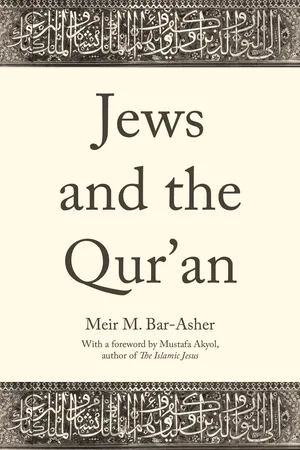
In this panoramic and multifaceted book, Meir Bar-Asher examines how Jews and Judaism are depicted in the Qur'an and later Islamic literature, providing needed context to those passages critical of Jews that are most often invoked to divide Muslims and Jews or to promote Islamophobia. He traces the Qur'anic origins of the protection of Jews and other minorities living under the rule of Islam, and shows how attitudes toward Jews in Shi'i Islam are substantially different from those in Sunni Islam. Bar-Asher sheds light on the extraordinary contribution of Jewish tradition to the Muslim exegesis of the Qur'an, and draws important parallels between Jewish religious law, or halakha, and shari'a law.
An illuminating work on a topic of vital relevance today, Jews and the Qur'an offers a nuanced understanding of Islam's engagement with Judaism in the time of Muhammad and his followers, and serves as a needed corrective to common misperceptions about Islam.
- 176 pages
- English
- ePUB (mobile friendly)
- Available on iOS & Android
eBook - ePub
Jews and the Qur'an
About this book
Information
Publisher
Princeton University PressYear
2022Print ISBN
9780691264790
9780691211350
eBook ISBN
9780691232584
Topic
Theology & ReligionSubtopic
Islamic TheologyINDEX
- ‘Abd Allah, 131, 148n42
- ‘Abd al-Rahman b. Ghanm, 113, 115
- Abitbol, Michel, Le Passé d’une discorde, 119
- Abraham: and adoption of monotheism, 67–69; hajj and, 98; and the Ka‘ba in Mecca, 69–70; in the Qur’an, 2, 30, 60, 61, 65–70
- Abu Bakr, 135
- Abu Rayḥan al-Biruni, 107
- al-Aḥbar, Ka‘b, 21, 138
- Akil al-murar, Ḥujr, 10
- ‘Ali b. Abi Talib, as successor to the Prophet, 135
- ‘Ali b. Ibrahim al-Qummi, 35
- almsgiving, obligation of, 88
- Amir-Moezzi, Mohammad Ali, 136
- antisemitism, xiii, xv
- Arabic, geo-linguistic sources of, 23
- Arab Jewish poets, 20–22
- Arberry, Arthur, 111
- ‘Ashura, fast of, 98–99
- ‘Aṣma’ (poet), 21
- al-‘Ayyashi, Muhammad b. Mas‘ud, 134
- Babylonian Talmud and Talmudic literature: comparisons between the red cow and the heifer, 85; completion of Talmud, 143n14; on David’s innocence, 79; on dietary prohibitions, 103; influence on the Qur’an, 61; influences on Babylonian Talmud, 128–29; and interpretation of the law, 91; in the interpretation of the Qur’an, 19; Joseph in, 72, 73; parallels with Qur’anic verses, 36–37; racism in, 144n3; on substitution Passover, 101
- banu Isra’il. See children of Israel
- al-Baqir, Muhammad, 124, 130–31
- Bat Ye’or, 119
- Becker, Carl Heinrich, 93
- Benjamin of Tudela, 17–18, 26
- Ben-Shammai, Haggai, 33–34; “Jew- Hatred in the Islamic Tradition and the Koranic Exegesis,” 55
- Bernard, Dominique, Les disciples juifs de Jésus du 1er siècle à Mahomet, xvi
- Bible: and killing of the prophets, 51; Qur’an’s complex attitude toward, 4; Qur’an’s references to, 29; rebuke of the Jews in, 56–57; and terminology in the Qur’an, 59–60
- biblical accounts and post-biblical literature: Abraham, 2, 29, 30, 65–70, 98; Cain and Abel, 62, 63–65; characteristics of Qur’an’s inclusion of, 58, 60–62, 78, 85; David, 2, 75–79, 80, 82, 83; Genesis, 60–63, 70; Joseph, 62, 70–75, 87; the red heifer, 83–85; Saul/Talut, 60, 80–83
- Blachère, Régis, 44, 81
- Book of Jubilees, 68
- Boyce, Mary, 130
- Brunschvig, Robert, “Herméneutique normative dans le judaïsme et dans l’islam,” 90...
Table of contents
- Cover
- Title Page
- Copyright
- Dedication
- Contents
- Foreword by Mustafa Akyol
- Preface
- Acknowledgments
- Introduction
- I. The Historical Context
- II. The Representation of Judaism and Jews in the Qur’an
- III. Biblical Accounts and Their Transformations in the Qur’an
- IV. Qur’anic Law and Jewish Law
- V. The Qur’anic Sources of the Dhimma
- VI. The Place of Judaism and the Jews in Twelver Shi‘ism
- Conclusion
- Notes
- Bibliography
- Index
Trusted by 375,005 students
Access to over 1.5 million titles for a fair monthly price.
Study more efficiently using our study tools.
Frequently asked questions
Yes, you can cancel anytime from the Subscription tab in your account settings on the Perlego website. Your subscription will stay active until the end of your current billing period. Learn how to cancel your subscription
No, books cannot be downloaded as external files, such as PDFs, for use outside of Perlego. However, you can download books within the Perlego app for offline reading on mobile or tablet. Learn how to download books offline
Perlego offers two plans: Essential and Complete
- Essential is ideal for learners and professionals who enjoy exploring a wide range of subjects. Access the Essential Library with 800,000+ trusted titles and best-sellers across business, personal growth, and the humanities. Includes unlimited reading time and Standard Read Aloud voice.
- Complete: Perfect for advanced learners and researchers needing full, unrestricted access. Unlock 1.5M+ books across hundreds of subjects, including academic and specialized titles. The Complete Plan also includes advanced features like Premium Read Aloud and Research Assistant.
We are an online textbook subscription service, where you can get access to an entire online library for less than the price of a single book per month. With over 1.5 million books across 990+ topics, we’ve got you covered! Learn about our mission
Look out for the read-aloud symbol on your next book to see if you can listen to it. The read-aloud tool reads text aloud for you, highlighting the text as it is being read. You can pause it, speed it up and slow it down. Learn more about Read Aloud
Yes! You can use the Perlego app on both iOS and Android devices to read anytime, anywhere — even offline. Perfect for commutes or when you’re on the go.
Please note we cannot support devices running on iOS 13 and Android 7 or earlier. Learn more about using the app
Please note we cannot support devices running on iOS 13 and Android 7 or earlier. Learn more about using the app
Yes, you can access Jews and the Qur'an by Meir M. Bar-Asher, Ethan Rundell in PDF and/or ePUB format, as well as other popular books in Theology & Religion & Islamic Theology. We have over 1.5 million books available in our catalogue for you to explore.