They were the forgotten commanders of World War II. While the names of Bradley and Patton became household words for Americans, few could identify Krueger or Eichelberger. They served under General Douglas MacArthur, a military genius with an enormous ego who dominated publicity from the Southwest Pacific during the American advance from Australia, through New Guinea, to the Philippines. While people at home read about the great victories that were won by "MacArthur's navy" and "MacArthur's air force," his subordinates labored in obscurity, fearful lest attention from the press lead to their replacement.
Historians too have paid little attention to the men who fought so well in the far reaches of the Pacific, and not a single biography has appeared in the decades since V-J Day. Yet General Blamey played a key role in the early battles of New Guinea. Generals Krueger and Eichelberger led American armies to major victories over the Japanese. General Kenney was one of the foremost air strategists of the war, while few airmen could match General Whitehead's tactical brilliance. Admiral Kinkaid took a crucial part in one of the greatest naval engagements in history. Admiral Barbey was an acknowledged master of amphibious warfare.
We Shall Return! addresses a serious shortcoming in the literature of World War II. Revealed for the first time is the full extent of the contributions made by MacArthur's commanders to the defeat of the Japanese. As the authors of these essays so ably demonstrate, many of MacArthur's bold decisions and innovative tactics were urged upon him by his subordinates. Clearly, these men deserve more credit for his successes than they have received.
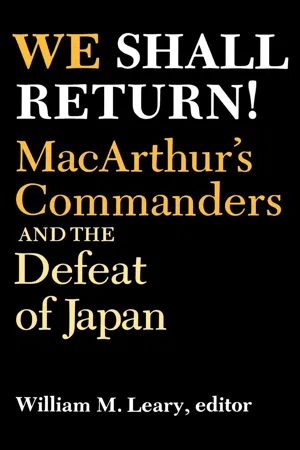
eBook - ePub
We Shall Return!
MacArthur's Commanders and the Defeat of Japan, 1942-1945
- 320 pages
- English
- ePUB (mobile friendly)
- Available on iOS & Android
eBook - ePub
About this book
Information
Publisher
The University Press of KentuckyYear
2021Print ISBN
9780813191058
9780813116549
eBook ISBN
9780813187419
NOTES
ABBREVIATIONS
AMF | Australian Military Forces |
AWM | Australian War Memorial |
CAB | Cabinet Office (Great Britain) |
CCS | Combined Chiefs of Staff |
CG | Commanding General |
CIGS | Chief of the Imperial General Staff |
COS | Chiefs of Staff |
LCMD | Library of Congress, Manuscript Division |
Msg | Message |
NOA | Navy Operational Archives |
ONH | Office of Naval History |
OPD | War Department Operations Division |
OpOrder | operation order |
OpPlan | operation plan |
Phib For | amphibious force |
PREM | Prime Minister’s Office (Great Britain) |
RG | record group |
USAF | U.S. Air Force |
USNI | U.S. Naval Institute |
WO | War Office (Great Britain) |
PREFACE
1. Douglas MacArthur, Reminiscences (New York, 1964), pp. 275-76.
2. Ibid., p. 145.
3. Daniel E. Barbey, MacArthur’s Amphibious Navy (Annapolis, 1969), pp. 24-25.
4. Jay Luvaas, ed., Dear Miss Em: General Eichelberger’s War in the Pacific, 1942-1945 (Westport, Conn., 1972), p. 20.
5. Gordon Walker, “General Walter Krueger: Mystery Man of the Pacific,” Christian Science Weekly Magazine, June 9, 1945, p. 3.
6. See Roger Olaf Egeberg, The General (New York, 1983), pp. 40-41, and Weldon E. Rhodes, Flying MacArthur to Victory (College Station, Tex., 1987).
7. D. Clayton James, The Years of MacArthur, 3 vols. (Boston, 1972-85), 2:538.
8. Leary, Interview with C.D. Eddleman, August 24, 1985.
DOUGLAS MACARTHUR AND THE WAR AGAINST JAPAN
1. The definitive biography of Douglas MacArthur is D. Clayton James, The Years of MacArthur, 3 vols. (Boston, 1970-85), of which vol. 2 covers World War II. Carol Petillo, Douglas MacArthur: The Philippine Years (Bloomington, 1981), explores the general’s obsession with the islands and offers psychological insights into his personality. The volumes of the official series, The United States Army in World War II: The War in the Pacific, provide basic material on strategy, operations, and logistics. Louis Morton, Strategy and Command: The First Two Years (Washington, D.C., 1962), in the official series, and Ronald H. Spector, Eagle against the Sun: The American War with Japan (New York, 1984), are basic overall accounts.
2. Louis Morton, The Fall of the Philippines (Washington, D.C., 1953), pp. 79-90; Walter D. Edmonds, They Fought with What They Had (Boston, 1951), pp. 73-109; Robert F. Futrell, “Air Hostilities in the Philippines, 8 December 1941,” Air University Review 16 (January-February 1965):33-45.
3. Carol M. Petillo, “Douglas MacArthur and Manuel Quezon: A Note on an Imperial Bond,” Pacific Historical Review 48 (1979):107-17. See also Petillo, MacArthur, pp. 203-13. Petillo suggests that Washington approved the gift from fear that MacArthur was losing his nerve and needed this encouragement in order to continue a maximum effort against the Japanese.
4. Douglas MacArthur, Reminiscences (New York, 1965), p. 158.
5. Lida Mayo, Bloody Buna (Garden City, 1974), pp. 171-77.
6. Australia’s military role is described in the multivolume official Australian and British histories, Australia in the War of 1939-1945 and History of the Second World War: The War against Japan. Blamey is quoted from John Robertson, Australia at War, 1939-1945 (Melbourne, 1981), p. 179, a separate one-volume account. See also David M. Horner, Crisis in Command: Australian Generalship and the Japanese Threat, 1941-1943 (Canberra, 1978).
7. MacArthur to Army Chief of Staff General George C. Marshall, January 10, 1943, quoted in Morton, Strategy and Command, p. 375.
8. The statement was made by his chief of staff, apparently quoting MacArthur; ibid., p. 542, n. 60.
9. James, MacArthur, 2:864, n. 43; MacArthur, Reminiscences, pp. 181-82.
10. Quoted in James, MacArthur, 2:349.
11. Maurice Matloff, Strategic Planning for Coalition Warfare, 1943-1944 (Washington, D.C., 1959), chap. 17; Robert W. Coakley and Richard M. Leighton, Global Logistics and Strategy, 1943-1945 (Washington, D.C., 1968), chaps. 16-20.
12. Forrest Pogue, “The Military in a Democracy: A Review of American Caesar,” International Security 3 (1979):60-62, 66-68.
13. E.B. Potter, Nimitz (Annapolis, 1976), p. 280.
14. James, MacArthur, 2:189.
15. MacArthur, Reminiscences, pp. 178-79.
16. Ronald Lewin, The American Magic: Codes, Ciphers, and the Defeat of Japan (New York, 1982), chaps. 8 and 12; Alexander S. Cochran, “MacArthur, ULTRA, et La Guerre du Pacifique,” Revue d’histoire de la deuxième guerre mondiale et des conflits contemporains 34 (January 1984);17-27; Edward J. Drea, “ULTRA Intelligence and General Douglas MacArthur’s Leap to Hollandia, January-April 1944,” in Michael Handel, ed., Intelligence and Military Operations (forthcoming). I am indebted to Dr. Drea for a prepublication copy of his manuscript.
17. MacArthur to the Chief of Military History, March 5, 1943, quoted in John Miller, jr. [sic], CARTWHEEL: The Reduction of Rabaul (Washington, D.C., 1959), p. 173.
18. The most reliable accounts of the L...
Table of contents
- Cover
- Half title
- Title
- Copyright
- Contents
- List of Maps
- Acknowledgments
- Dedication
- Preface
- Abbreviations
- Douglas MacArthur and the War against Japan
- Blamey and MacArthur: The Problem of Coalition Warfare
- Walter Krueger: MacArthur’s Fighting General
- George C. Kenney: MacArthur’s Premier Airman
- Thomas C. Kinkaid: MacArthur’s Master of Naval Warfare
- Robert L. Eichelberger: MacArthur’s Fireman
- Ennis C. Whitehead: Aerial Tactician
- Daniel E. Barbey: Amphibious Warfare Expert
- Notes
- Maps
- Bibliographical Essay
- Contributors
- Index
Trusted by 375,005 students
Access to over 1.5 million titles for a fair monthly price.
Study more efficiently using our study tools.
Frequently asked questions
Yes, you can cancel anytime from the Subscription tab in your account settings on the Perlego website. Your subscription will stay active until the end of your current billing period. Learn how to cancel your subscription
No, books cannot be downloaded as external files, such as PDFs, for use outside of Perlego. However, you can download books within the Perlego app for offline reading on mobile or tablet. Learn how to download books offline
Perlego offers two plans: Essential and Complete
- Essential is ideal for learners and professionals who enjoy exploring a wide range of subjects. Access the Essential Library with 800,000+ trusted titles and best-sellers across business, personal growth, and the humanities. Includes unlimited reading time and Standard Read Aloud voice.
- Complete: Perfect for advanced learners and researchers needing full, unrestricted access. Unlock 1.5M+ books across hundreds of subjects, including academic and specialized titles. The Complete Plan also includes advanced features like Premium Read Aloud and Research Assistant.
We are an online textbook subscription service, where you can get access to an entire online library for less than the price of a single book per month. With over 1.5 million books across 990+ topics, we’ve got you covered! Learn about our mission
Look out for the read-aloud symbol on your next book to see if you can listen to it. The read-aloud tool reads text aloud for you, highlighting the text as it is being read. You can pause it, speed it up and slow it down. Learn more about Read Aloud
Yes! You can use the Perlego app on both iOS and Android devices to read anytime, anywhere — even offline. Perfect for commutes or when you’re on the go.
Please note we cannot support devices running on iOS 13 and Android 7 or earlier. Learn more about using the app
Please note we cannot support devices running on iOS 13 and Android 7 or earlier. Learn more about using the app
Yes, you can access We Shall Return! by William M. Leary in PDF and/or ePUB format, as well as other popular books in History & Military Biographies. We have over 1.5 million books available in our catalogue for you to explore.