eBook - PDF
Late Roman to Late Byzantine/Early Islamic Period Lamps in the Holy Land
The Collection of the Israel Antiquities Authority
- 643 pages
- English
- PDF
- Available on iOS & Android
eBook - PDF
Late Roman to Late Byzantine/Early Islamic Period Lamps in the Holy Land
The Collection of the Israel Antiquities Authority
About this book
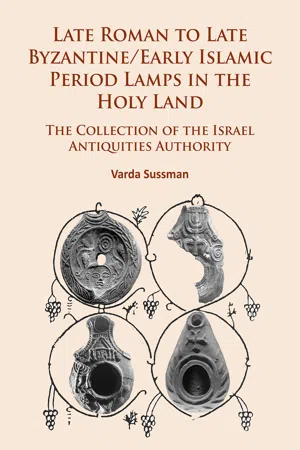
This volume illustrates lamps from the Byzantine period excavated in the Holy Land and demonstrates the extent of their development since the first enclosing/capturing of light (fire) within a portable man-made vessel. Lamps, which held important material and religious functions during daily life and the afterlife, played a large role in conveying art and cultural and political messages through the patterns chosen to decorate them. These cultural, or even more their religious affinities, were chosen to be delivered on lamps (not on other vessels) more than ever during the Byzantine period; these small portable objects were used to 'promote' beliefs like the 'press' of today. Each cultural group marked the artifacts / lamps with its symbols, proverbs from the Old and New Testaments, and this process throws light on the deep rivalry between them in this corner of the ancient world. The great variety of lamps dealt with in this volume, arranged according to their various regions of origin, emphasizes their diversity, and probably local workshop manufacture, and stands in contrast to such a small country without any physical geographic barriers to cross, only mental ones (and where one basket of lamps could satisfy the full needs of the local population). The lamps of the Byzantine period reflect the era and the struggle in the cradle of the formation of the four leading faiths and cultures: Judaism (the oldest), Samaritanism (derived from the Jewish faith), newly-born Christianity – all three successors to the existing former pagan culture – and the last, Islam, standing on a new threshold. Unlike during the former Greek and Roman periods of rule, the land of Israel during the Byzantine period did not really have a central government or authority. The variety of the oil lamps, their order and place of appearance during the Byzantine period can be described as a 'symphony played by a self-conducted orchestra, where new soloists rise and add a different motet, creating stormy music that expresses the rhythm of the era'. This volume, like the author's earlier books on this subject, is intended to create a basis for further study and evaluation of the endless aspects that lamps bring to light and which are beyond the capacity of any single scholar.
Information
Table of contents
- Cover
- Title Page
- Copyright Page
- Contents
- Introduction
- I. The Southern region: Judean Shephelah
- II: The Yavne region: (I. LR2a, LR5a included above) and II. LR 11, II. LR11a
- III. Jerusalem workshops, types III. LR12-III.B15 (Map 4)
- IV. Negev, Southern region, wheel-made oil lamps
- V. The Samaria Region (V. LR 18 - V. B27) Map 6
- _GoBack
- VI. The Phoenician coast including the Northern part of the country (VI. I B31- VI.III B 45) (#2328- #3051), Maps 7 and 8
- VII. The Bet She’an boundary, eastern part of the Decapolis (VII. LR45–VII. B54) (#3052 and #3053) (Map 9)
- VIII: Imported Oil Lamps
- Bibliography
- Concordance Table of Sites
- VIII.7 North African lamps from Carthage, fifth–sixth centuries CE, Hayes type II (Figure 228) (#3277-#3286)
- VIII. 6: Tunisian oil lamps – end of the third to the fifth centuries CE (African Red Slip Ware, Hayes Type IB) (Figure 226) (#3264-#3276)
- VIII. 5: Lamps manufactured in Tripoli; end of the fourth–fifth centuries CE (Figure 225) (#3261-#3263)
- Introduction
- VIII. 5 (#3261-#3263); VIII.6 (#3264-#3277) VIII. 7 (#3277-#3286)
- VIII. 5 – VIII. 7. North African workshops, fourth–sixth centuries CE (Figures. 225-228)
- VIII. 4: Various lamps from Asia Minor (Sussman 2008; B18 fifth–sixth centuries CE (Figure 224) (#3257-#3260)
- VIII. 3. Lamps probably from Cyprus, 5th and 6th (?) centuries CE (Figure 223) (#3254-#3256)
- Bibliography
- Concordance Table of Sites
- Catalogue
Trusted by 375,005 students
Access to over 1.5 million titles for a fair monthly price.
Study more efficiently using our study tools.
Frequently asked questions
Yes, you can cancel anytime from the Subscription tab in your account settings on the Perlego website. Your subscription will stay active until the end of your current billing period. Learn how to cancel your subscription
No, books cannot be downloaded as external files, such as PDFs, for use outside of Perlego. However, you can download books within the Perlego app for offline reading on mobile or tablet. Learn how to download books offline
Perlego offers two plans: Essential and Complete
- Essential is ideal for learners and professionals who enjoy exploring a wide range of subjects. Access the Essential Library with 800,000+ trusted titles and best-sellers across business, personal growth, and the humanities. Includes unlimited reading time and Standard Read Aloud voice.
- Complete: Perfect for advanced learners and researchers needing full, unrestricted access. Unlock 1.5M+ books across hundreds of subjects, including academic and specialized titles. The Complete Plan also includes advanced features like Premium Read Aloud and Research Assistant.
We are an online textbook subscription service, where you can get access to an entire online library for less than the price of a single book per month. With over 1.5 million books across 990+ topics, we’ve got you covered! Learn about our mission
Look out for the read-aloud symbol on your next book to see if you can listen to it. The read-aloud tool reads text aloud for you, highlighting the text as it is being read. You can pause it, speed it up and slow it down. Learn more about Read Aloud
Yes! You can use the Perlego app on both iOS and Android devices to read anytime, anywhere — even offline. Perfect for commutes or when you’re on the go.
Please note we cannot support devices running on iOS 13 and Android 7 or earlier. Learn more about using the app
Please note we cannot support devices running on iOS 13 and Android 7 or earlier. Learn more about using the app
Yes, you can access Late Roman to Late Byzantine/Early Islamic Period Lamps in the Holy Land by Varda Sussman in PDF and/or ePUB format, as well as other popular books in Social Sciences & Archaeology. We have over 1.5 million books available in our catalogue for you to explore.