eBook - PDF
Metallurgy in Ancient Ecuador
A Study of the Collection of Archaeological Metallurgy of the Ministry of Culture, Ecuador
- 223 pages
- English
- PDF
- Available on iOS & Android
eBook - PDF
Metallurgy in Ancient Ecuador
A Study of the Collection of Archaeological Metallurgy of the Ministry of Culture, Ecuador
About this book
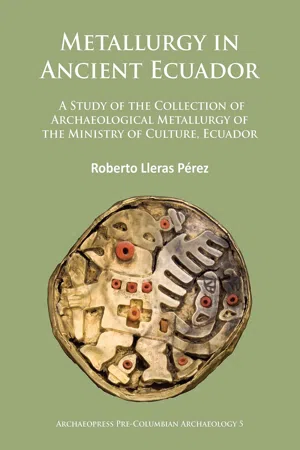
Metallurgical activity was present in Ecuador from at least 1500 BC; by around the beginning of the Common Era metallurgical manufacture and use had extended to most of the Costa and Sierra. Regional styles soon evolved giving rise to high levels of technical craftsmanship and to shaping particular iconographic and decorative patterns. Copper, gold, silver and platinum were mined, processed and converted into thousands of ornaments, offerings, tools and weapons extensively used both by elites and by the common people. By 1450, the Incas had invaded most of the Ecuadorian Sierra and eventually they integrated the diverse metallurgical traditions into their state-managed metallurgical industry. The European conquest in the sixteenth century deeply affected the native metallurgical activities, even though in some regions copper continued to be worked throughout the colonial period. The reconstruction of the general outlines of this fascinating historical process was made possible through the study of the collection of archaeological metal objects of the Ministry of Culture and Heritage of Ecuador, the compilation of previous archaeological references, laboratory analyses and C14 dating of museum objects. This work is the first one of its kind to be published on the ancient metallurgy of Ecuador.
Information
Metallurgy
in
Ancient
Ecuador
8
Figure
1
Museo
Nacional
del
Ecuador
in
Quito,
house
of
the
collection
of
pre-Hispanic
archaeological
metal
objects
The
collection
of
the
Ministry
of
Culture
9
Table of contents
- Cover
- Title Page
- Copyright Page
- Contents
- List of Figures
- Resumen en español
- Acknowledgements
- Introduction
- The collection of the Ministry of Culture
- Figure 1 Museo Nacional del Ecuador in Quito, house of the collection of pre-Hispanic archaeological metal objects
- Figure 2 Provenances of metallic objects of the collection of the Ministry of Culture of Ecuador
- Previous studies on the pre-Hispanic metallurgy of Ecuador
- Figure 3 Olaf Holm, one of the pioneers of the study of metal artefacts in Ecuador
- Metallogenesis and metal resources in Ecuador
- Figure 4 Chimborazo the highest strato-volcano in Ecuador; metal deposits are associated to volcanic activity.
- Figure 5 Alluvial river placers like this one in the lowlands of the Pacific coast abound in gold and platinum.
- Early finds and the Initial Period
- Great Regional Groups: La Tolita –Tumaco
- Figure 6 Provenances of La Tolita - Tumaco
- Figure 7 Provenance of La Tolita - Tumaco metal objects in southern Colombia
- Figure 8 La Tolita – Tumaco gold anthropomorphic mask with extensions imitating the rays of the sun: 40 x 60 x 0.3 cms.
- Figure 9 La Tolita – Tumaco gold and platinum zoomorphic mask: 7.5 x 5.5 x 4 cms.
- Figure 10 La Tolita – Tumaco gold and platinum with sodalite inlays anthropomorphic mask: 9.6 x 9 x 5.6 cms.
- Figures 11 and 12 La Tolita – Tumaco gold ear pendants: 16 x 4.6 x 1.2 and 16.2 x 4 x 1.2 cms.
- Figure 13 La Tolita – Tumaco gold and platinum zoomorphic mask, two components: 4.7 x 8.1 x 0.3 and 5.3 x 7.7 x 2.6 cms.
- Figure 14 La Tolita – Tumaco gold and platinum anthropomorphic mask: 19.8 x 19.8 x 9.6 cms.
- Figure 15 La Tolita – Tumaco gold crest for diadem: 22.3 x 32 x 0.2 cms.
- Figure 16 La Tolita – Tumaco gold necklace: 1.9 x 78 x 0.1 cms.
- Figure 17 La Tolita – Tumaco gold zoomorphic figure: 4.4 x 4.2 x 21.7 cms.
- Figure 18 La Tolita – Tumaco copper axe: 11 x 7 x 2.5 cms.
- Great Regional Groups: Jama – Coaque
- Figure 19 Provenances of Jama - Coaque metal objects
- Figure 20 Jama – Coaque gold pendants: 9 x 7 x 6; 13 x 7.5 x 4 and 12.8 x 7.9 x 4.4 cms.
- Figure 21 Jama – Coaque gold bowl: 3.4 x 12 cms.
- Figures 22 and 23 Jama – Coaque gold ear pendants:
- Figure 24 Jama – Coaque gold breastplate with zoomorphic figure:
- Great Regional Groups: Bahia
- Figure 25 Provenance of Bahia metal objects
- Figure 26 Bahia silver votive figure shaped as a raft: 6.8 x 10 x 19 cms.
- Figure 27 Bahia gold snail cover: 9.5 x 10.2 x 21.2 cms.
- Figure 28 Bahia silver chest guard: 8.7 x 17.4 x 0.3 cms.
- Figure 29 Bahia gold pair of ear pendants: 12.8 x 3.4 x 3.3 and 12.6 x 3.7 x 3 cms.
- Great Regional Groups: Milagro – Quevedo
- Figure 30 Provenance of Milagro - Manatňo
- Figure 31 Milagro – Quevedo copper crucible: 3.2 x 12 x 12 cms.
- Figure 32 Milagro – Quevedo copper mould: 1.2 x 7.7 x 17.1 cms.
- Figure 33 Milagro – Quevedo copper staff: 30 x 11.1 x 2.8 cms.
- Figure 34 Milagro – Quevedo copper axe-monies: 10.5 x 10 x 0.5; 9.2 x 8.3 x 05 and 10.9 x 10 x 0.5 cms.
- Figure 35 Milagro – Quevedo gold nose ornament: 4 x 5.6 x 0.4 cms.
- Figure 36 Milagro – Quevedo gold spiral nose ornament: 2.6 x 1.4 x 0.1 cms.
- Great Regional Groups: Manteño - Huancavilca
- Figure 36 provenances for Manteño – Huancavilca metal objects
- Figure 38 Manteño – Huancavilca silver and copper mask with crown: 30.5 x 18.3 x 15.3 cms.
- Figure 39 Manteño – Huancavilca silver and copper mask with crown:
- Figure 40 Manteño – Huancavilca silver breastplate: 23.3 x 23 x 0.9 cms.
- Figure 41 Manteño – Huancavilca silver plaque: 13 x 31 x 0.1 cms.
- Figure 42 Manteño – Huancavilca copper axe: 14 x 16.3 x 0.6 cms.
- Figure 43 Manteño – Huancavilca copper breastplate, tinculpa style:
- Great Regional Groups: Puruha
- Figure 44 Provenance of Puruha metal objects
- Figure 45 – Puruha gold spear throwers: 45 x 1.4; 46 x 1.4 and 45 x 1.8 cms.
- Figure 46 – Puruha giant copper tupo: 45.8 x 13.5 x 1 cms.
- Figure 47 – Puruha copper crown: 21 x 16.3 cms.
- Figures 48 and 49 – Puruha gold ear pendants with zoomorphic figures: 7.2 x 6.5 x 2.9 and 6.7 x 6.7 x w2.9 cms.
- Figures 50 and 51 – Puruha gold and silver ear pendants:
- Figure 52 – Puruha gold and silver nose ornament: 5.1 x 5.8 x 0.2 cms.
- Figure 53 – Puruha gold anthropomorphic pendant: 4.2 x 4 x 1 cms.
- Great Regional Groups: Cañari
- Figure 54 Povenance of Cañari metal objects
- Figure 55 – Cañari gold diadem: 6.9 x 9.7 x 1.3 cms.
- Figure 56 – Cañari gold with Spondylus inlays ear pendant lid: 6.3 x 1 cms.
- Figure 57 – Cañari gold ear pendant lid: 8.8 x 0.3 cms.
- Figure 58 – Cañari gold pendant with anthropomorphic figures: 7.4 x 6.9 x 0.4 cms.
- Great Regional Groups: Carchi – Nariño
- Figure 59 Provenenace of Carchi – Nariño metal objects
- Figure 60 Figure 59 Provenenace of Carchi – Nariño metal objects in southern Colombia
- Figure 61 – Carchi - Nariño gold mask: 14.6 x 9.4 x 1.8 cms.
- Figure 62 – Carchi - Nariño tombac ear pendants, tinculpa style:
- Figure 63 – Carchi - Nariño gold ear pendants with zoomorphic figures:
- Figure 64 Carchi - Nariño tombac nose ornament: 6.5 x 16 x 0.5 cms.
- Figure 65 Carchi - Nariño tombac necklace: 11 x 5 x 0.5 cms.
- Figure 66 Carchi - Nariño gold pendant shaped as a bird: 13.3 x 16.8 x 0.5 cms.
- Figure 67 Carchi - Nariño gold pendant shaped as a bird: 13.2 x 11.4 x 1.8 cms.
- Figure 68 Carchi - Nariño tombac breastplate: 24.5 x 28 x 0.8 cms.
- Isolated finds and problematic Groups
- Figure 69 Provenance of metal objects with no cultural attribution
- The Inca metallurgical integration
- Figure 70 - Provenance of Inca metal objects
- Figure 71 Inca silver ceremonial vase (kero): 17.8 x 16.7 cms.
- Figure 72 Inca silver arivaloid bottle: 39 x 29 cms.
- Figure 73 Inca gold and silver votive figures: 2.9 x 1 x 1 and 2.9 x 1 x 1 cms.
- Figure 74 Inca gold tupo: 13.5 x 1.6 x 3 cms.
- Figure 75 Inca bronze axe: 8.4 x 8.2 x 0.3 cms.
- Figure 76 Inca bronze head breaker: 2.6 x 9.4 x 1.5 cms.
- Iconography and symbolism in metallurgy
- Synthesis
- An interpretative proposal for the development of metallurgy in Ecuador
- References
Trusted by 375,005 students
Access to over 1.5 million titles for a fair monthly price.
Study more efficiently using our study tools.
Frequently asked questions
Yes, you can cancel anytime from the Subscription tab in your account settings on the Perlego website. Your subscription will stay active until the end of your current billing period. Learn how to cancel your subscription
No, books cannot be downloaded as external files, such as PDFs, for use outside of Perlego. However, you can download books within the Perlego app for offline reading on mobile or tablet. Learn how to download books offline
Perlego offers two plans: Essential and Complete
- Essential is ideal for learners and professionals who enjoy exploring a wide range of subjects. Access the Essential Library with 800,000+ trusted titles and best-sellers across business, personal growth, and the humanities. Includes unlimited reading time and Standard Read Aloud voice.
- Complete: Perfect for advanced learners and researchers needing full, unrestricted access. Unlock 1.5M+ books across hundreds of subjects, including academic and specialized titles. The Complete Plan also includes advanced features like Premium Read Aloud and Research Assistant.
We are an online textbook subscription service, where you can get access to an entire online library for less than the price of a single book per month. With over 1.5 million books across 990+ topics, we’ve got you covered! Learn about our mission
Look out for the read-aloud symbol on your next book to see if you can listen to it. The read-aloud tool reads text aloud for you, highlighting the text as it is being read. You can pause it, speed it up and slow it down. Learn more about Read Aloud
Yes! You can use the Perlego app on both iOS and Android devices to read anytime, anywhere — even offline. Perfect for commutes or when you’re on the go.
Please note we cannot support devices running on iOS 13 and Android 7 or earlier. Learn more about using the app
Please note we cannot support devices running on iOS 13 and Android 7 or earlier. Learn more about using the app
Yes, you can access Metallurgy in Ancient Ecuador by Roberto Lleras Perez in PDF and/or ePUB format, as well as other popular books in Social Sciences & Archaeology. We have over 1.5 million books available in our catalogue for you to explore.