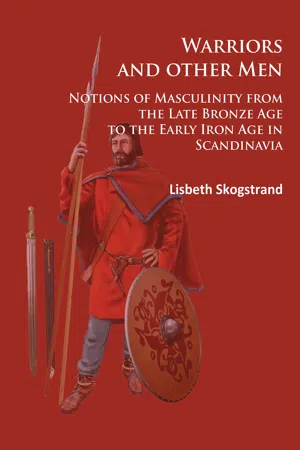
What is considered masculine is not something given and innate to males but determined by cultural ideas and ideals constructed through performative practices – today and in the past. This book questions whether androcentric archaeology has taught us anything about prehistoric men and their masculinities. Starting from broad discussions of feminist theory and critical men's studies, this study examines how notions of masculinity are expressed in cremation burials from the Late Bronze Age to the end of the Roman Period (1100 BC - 400 AD) in Eastern Norway and Funen in Denmark. It is argued that notions of masculinity were deeply intertwined with society, and when central aspects like war systems, task differentiation, or technology changed, so did gender and ideas of masculinity and vice versa. In the Late Bronze Age, an idealisation and sexualisation of the male body related to warrior esthetic was probably essential to the performance of masculinity. In the Early Roman Period, masculinity became bounded by what it was not – the unmanly. Warrior capabilities were the most prominent ideals of masculinity and concepts of unmanliness structured society, highlighting divergences between men and women. In the Late Roman Period, society grew more complex and multiple contemporary, possibly complementary masculinities associated with the rising class of free peasants, specific roles and regional differences developed and the warrior lost the dominant position as masculine ideal.
eBook - PDF
Warriors and other Men
Notions of Masculinity from the Late Bronze Age to the Early Iron Age in Scandinavia
- 193 pages
- English
- PDF
- Available on iOS & Android
eBook - PDF
Warriors and other Men
Notions of Masculinity from the Late Bronze Age to the Early Iron Age in Scandinavia
About this book
Information
Table of contents
- Cover
- Title Page
- Copyright Page
- Contents
- Acknowledgments
- 1. Introduction
- 2 Feminist Theory and the Conceptualisation of Gender
- 3 The Archaeology of Masculinity
- Figure 1 A Southern Scandinavian Bronze Age Society? From the project “The old teaching charts” at Buskerud and Vestfold Unive sity College. (https://web.archive.org/web/20120206040412/http://www-lu.hive.no/plansjer/historie/ [visited 14.01.2016])
- 4. The Social Archaeology of Burials
- Figure 2 A cremation might be a magnificent sight and an awesome ceremony lasting for several hours. www.tollundmanden.dk © Niels Bach.
- Figure 3 Constructing the kerb and placing the dead. The first stages in the erection of a mound? © Arkikon
- 5. Analysis Methods and Variables
- Figure 4 Stone pavement at Gunnarstorp, Østfold, Grave 16 (Wangen 2009, pl.73). © Museum of Cultural History, Oslo.
- Figure 5 Kerb around a LBA mound, Lerbjerg, Funen (Thrane 2004:223). © Odense City Museums.
- Figure 6 Bronze vessel, C2877, Braaten, Norderhov, Buskerud. © Museum of Cultural History, Oslo.
- Figure 7 Urn burial in profile at Herregårdsbekken, Vestfold Norway. Photo: Grethe Moell Pedersen, © Museum of Cultural History, Oslo.
- Figure 8 Urn burial surrounded by stone slabs, Lerberg, Funen (Thrane 2004: 224).© Odense City Museums.
- Figure 9 Bone layer, shown as xxx. Grave 60, Gunnarstorp, Østfold (Wangen 2009, pl.31).
- Figure 10 Vessels type B (Jensen 1997: 101).
- Figure 11 Vessel type C with rusticated lower body and incised horizontal lines (Thrane 2004, pl-58:4).
- Figure 12 Vessel type E, burial 1331, Møllegårdsmarken (Albrectsen 1971, tavle 87c), see appendix 6. © Odense City Museums.
- Figure 13 Vessel type F, burial 1174, Møllegårdsmarken (Albrectsen 1971, tavle 78e), see appendix 6. © Odense City Museums.
- Figure 14 Vessel type G, burial 1041, Møllegårdsmarken (Albrectsen 1971, tavle 138c), see appendix 6. © Odense City Museums.
- Figure 15 Vessel with handles (Sehested 1878, tavle XXIV).
- Figure 16 Urn with rosette symbols and grooves (Sehested 1884, tavle XIX).
- Figure 17 Lines, furrows, circular impressions, triangular hatchings (Sehested 1884, tavle XIX).
- Figure 18 Morphological cranial differences between males and females where 1= typically male and 5 = typically female (redrawn after Buikstra and Ubelaker 1994 in Sofaer 2006: 93).
- Figure 19 Periods used in the analysis of burials from Eastern Norway and LBA in Funen.
- Figure 20 Periods used in the analysis of Møllegårdsmarken (after Albrectsen 1956, 1968; 1971).
- 6. The Late Bronze Age in Funen, Denmark
- Figure 21 Denmark with Funen in the middle. © 2013 Google Maps.
- Figure 22 The number of burials dated to different periods (see also appendix 1, table 1).
- Figure 23 The relation between males and females in burials from per IV-VI (see also appendix 1, table 2).
- Figure 24 The relation between sex and grave types in LBA (see also appendix 1, table 3).
- Figure 25 The relation between males, age group, and grave types (see also appendix 1, table 4).
- Figure 26 The share of male and female burials containing different categories of artefacts in LBA (see also appendix 1, table 7 and 8).
- Figure 27 The relations between sex, age group and the type of vessel in LBA burials (see also appendix 1, table 9).
- Figure 28 The relation between artefact categories and vessel types in male burials (see also appendix 1, table 12).
- Figure 29 Late Bronze Age warriors possibly boasting of their ancestry at Raä 125 Hede, Kville, Sweden. Photo: Torsten Högberg, © Vitlycke Museum.
- Figure 30 Bronze razor and tweezers with gold inlay (B1515), Late Bronze Age, per.V, from a mound in Løve, Holbæk, Denmark. © National Museum of Denmark.
- Figure 31 Late Bronze Age acrobatic figurine from Grevensvænge, Denmark. © National Museum of Denmark.
- Figure 32 Sexualised performances on the rock art. Raä 182 Svälte, Kville, Sweden. Photo: Torsten Högberg, © Vitlycke museum.
- 7. The Late Bronze Age and Early Iron Age in Eastern Norway
- Figure 33 Map of Southern Norway with all counties in Eastern Norway marked. © 2012 Google Earth and Wikipedia Commons.
- Figure 34 The regional distribution of the analysed burials in Eastern Norway throughout the period under investigation. LBA a d PRIA in black and RP in white (see also appendix 2, table 1).
- Figure 35 The number of burials dated to different periods in Eastern Norway (see also appendix 2, table 2).
- Figure 36 The relations between sex and age groups in PRIA to the left and RP to the right (see also appendix 2, table 3).
- Figure 37 The relative distribution of male and female individuals in burials from LBA-LRP (see appendix 2, table 4).
- Figure 38 The relation between sex and grave types in RP (see also appendix 2, table 5).
- Figure 39 The relation between sex and burial types in RP (see also appendix 2, table 8).
- Figure 40 The relations between sex and the degree of burning in PRIA to the left and RP to the right (see also appendix 2, table 9 and 10).
- Figure 41 The relation between sex and cleaning of bones in EPRIA (see also appendix 2, table 11).
- Figure 42 The relation between sex, age group and cleaning in LRP (see also appendix 2, table 12).
- Figure 43 The relation between sex and the amounts of bones from LBA to the left to LRP to the right (see also appendix 2, table 13).
- Figure 44 The share of male and female burials containing different categories of artefacts in ERP (see also appendix 2, table 14 and 15).
- Figure 45 The share of male and female burials containing different categories of artefacts in LRP (see also appendix 2, table 16 and 17).
- Figure 46 The bear is an excellent climber. Photo and © Jan Ove Gjershaug, http://www.rovdata.no
- Figure 47 The relation between sex and bear claws in RP burials.
- Figure 48 Burnt bear claws from a burial at Sæbø, Kvinnherad, Hordaland. Photo: Ann-Mari Olsen, © University Museum of Bergen.
- Figure 49 Motif on gold bracteat possibly picturing Odin on a spiritual journey. Søtvet, Solum, Telemark R290, C9440 (Rygh 1999[1885]).
- Figure 50 Sword, javelin, spear, shield boss and shield handle in addition to three pottery vessels and resin from a bark or t ee vessel, all from a Late Roman Period inhumation burial at Bjørnstad in Østfold, C.55767 (Rødsrud 2007:135). Photo: Eirik Irge
- Figure 51 The distribution of weapons in male and female burials in ERP and LRP (see appendix 2, table 24
- Figure 52 Gold- and silver-gilded belt from the Sætrang burial in Buskerud, C.629. Photo: Erik Irgens Johnsen, © Museum of Cultural History, Oslo.
- Figure 53 Distribution of 1. Single finds of weapons and 2. Weapon burials in Eastern Norway in the second half of the Early Roman Period, B2. Possible regions marked (after Bemman and Hahne 1995:340, Abb 28).
- Figure 54 Ruins of a hill fort (R19905), Braate, Aurskog-Høland, Akershus. Photo: Lisbeth Skogstrand, © Akershus fylkeskommune.
- 8. The cemetery at Møllegårdsmarken in Funen, Denmark
- Figure 55 The location of Møllegårdsmarken in Gudme at Funen, Denmark. © 2013 Google Maps and Wikipedia commons.
- Figure 56 The number of burials dated to different periods (see also appendix 3, table 1).
- Figure 57 The relation between sex and age groups in RP at Møllegårdsmarken (see also appendix 3, table 2).
- Figure 58 The average amounts of bone in male and female burials throughout RP (see also appendix 3, Table 3).
- Figure 59 Average number of artefacts related to sex and age groups (see also appendix 3, table 4).
- Figure 60 The relative occurrence of object types during RP (see appendix 3, table 5-8).
- 9. The Changes of Warriors and Other Men; Changing Masculinities
- References
- Appendix 1 Tables, Late Bronze Age, Funen
- Appendix 2 Tables, Eastern Norway
- Appendix 3 Tables, Møllegårdsmarken
- Appendices 4-6
- Appendix 7
Trusted by 375,005 students
Access to over 1.5 million titles for a fair monthly price.
Study more efficiently using our study tools.
Frequently asked questions
Yes, you can cancel anytime from the Subscription tab in your account settings on the Perlego website. Your subscription will stay active until the end of your current billing period. Learn how to cancel your subscription
No, books cannot be downloaded as external files, such as PDFs, for use outside of Perlego. However, you can download books within the Perlego app for offline reading on mobile or tablet. Learn how to download books offline
Perlego offers two plans: Essential and Complete
- Essential is ideal for learners and professionals who enjoy exploring a wide range of subjects. Access the Essential Library with 800,000+ trusted titles and best-sellers across business, personal growth, and the humanities. Includes unlimited reading time and Standard Read Aloud voice.
- Complete: Perfect for advanced learners and researchers needing full, unrestricted access. Unlock 1.5M+ books across hundreds of subjects, including academic and specialized titles. The Complete Plan also includes advanced features like Premium Read Aloud and Research Assistant.
We are an online textbook subscription service, where you can get access to an entire online library for less than the price of a single book per month. With over 1.5 million books across 990+ topics, we’ve got you covered! Learn about our mission
Look out for the read-aloud symbol on your next book to see if you can listen to it. The read-aloud tool reads text aloud for you, highlighting the text as it is being read. You can pause it, speed it up and slow it down. Learn more about Read Aloud
Yes! You can use the Perlego app on both iOS and Android devices to read anytime, anywhere — even offline. Perfect for commutes or when you’re on the go.
Please note we cannot support devices running on iOS 13 and Android 7 or earlier. Learn more about using the app
Please note we cannot support devices running on iOS 13 and Android 7 or earlier. Learn more about using the app
Yes, you can access Warriors and other Men by Lisbeth Skogstrand in PDF and/or ePUB format, as well as other popular books in Social Sciences & Archaeology. We have over 1.5 million books available in our catalogue for you to explore.