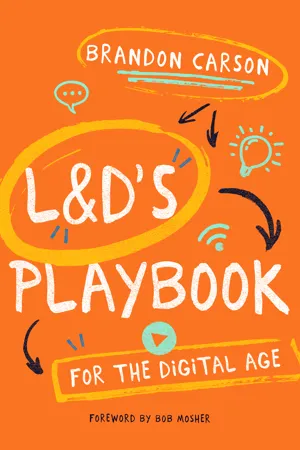
Build a Modern L&D TeamOrganizations are facing an era of rapid acceleration. As new technology and digital strategies are integrated, workers at all levels will be required to build capability much faster than before, navigating more complex systems and processes. Yet, learning and development (L&D) has lagged in this area, as too many L&D functions still focus on transactional interactions across a broad and complex portfolio while starved for resources. In L&D's Playbook for the Digital Age, Brandon Carson makes the case that it's time to reorient L&D, take a more proactive role in enabling the workforce, and create a new framework for developing skills and capabilities. L&D leaders must realize theirs is one of the most critical business functions and must be appropriately funded and resourced to realize the performance gains that are crucial to the business.L&D cannot be caught standing still and, in fact, needs a new playbook to navigate the radical and complex transformation the digital age is demanding. Stemming from the sports world, a playbook ensures the players know their roles, connect as a team, and understand the winning strategy and how to execute the game plan. For L&D, a playbook can help build alignment across the team and with stakeholders by being flexible as business needs change. Carson walks you through the steps to formulate how a new playbook could help the alignment of your L&D function—whether it's restructuring, new skilling, or rescoping. He asks readers to speak the language of business instead of the language of learning. For example, does your workforce repair aircraft or do they enable safe flight? In other words, can you be the visionary your organization requires?
- English
- ePUB (mobile friendly)
- Available on iOS & Android
eBook - ePub
L&D’s Playbook for the Digital Age
About this book
Information
Subtopic
Human Resource ManagementIndex
Business
The Three Forces of Change Driving the Digital Age
We’ve seen two years of digital transformation in the last two weeks.
—SATYA NADELLA, JUNE 2020
The digital age is leaving no industry untouched as its three forces—migration and globalization, technology, and the rapid transformation of work—bring us the largest-scale job transition since the industrial revolution. According to McKinsey, by 2030 as many as 375 million workers, or roughly 14 percent of the global workforce, may need to switch jobs (Illanes et al. 2018). Additionally, the impact of the 2020 COVID-19 pandemic is forecasted to alter how work gets done as adoption of automation and digitization significantly increases across almost every business (Dua et al. 2020). As business reorients itself, its imperatives are to determine how to effectively leverage technology to drive increases in productivity, efficiency, and innovation. Many businesses have started by evaluating, updating, and (in many instances) replacing their technology infrastructure from back to front; assessing and modifying their work systems for increased efficiency; and looking at how the work itself gets done. It’s obvious that nothing in our workplaces will be left untouched, as every aspect of the future of work revolves around digital technologies.
There are many challenges ahead as companies determine how to successfully embrace and operationalize digital strategies. Many are struggling to understand the digital paradigm itself, which requires a new mindset for business. Similar to the move from film to digital photography, the digital transformation impacts every business process. New tools, access to more data, and a diverse network afford us immediate insight into the impact products and services have on customers. This rich and heterogeneous data set requires business to be more flexible, accommodating, and innovative. Additionally, employees expect a more consumer-grade work experience, which business can bring to life through digital maturity. Before we dissect how work is affected by the digital age, let’s first dig into its three forces.
Migration and Globalization
In the mid-18th century, during the agricultural revolution, many people labored up to six days a week from sun-up to sundown. From the tough work and long hours came the need and desire to make the work easier while increasing productivity and innovation. This led to new inventions that dramatically altered farming, as well as introduced new methods to manage the farms, market the crops, and provide accessible roads and quicker transportation, ushering in the industrial revolution. The increased efficiency of farming led to a decline in available farm jobs as automation replaced many routine tasks and brought about job losses, which led people to migrate off farms and into more urban areas in search of new jobs.
Sound familiar? As we move through yet another radical societal change, certainties and expectations about how we live and work are quickly evolving. Previous disruptions afforded us more time to accommodate the change, reskill, and acclimate to the new reality. The digital age is different. The evolution is accelerating more rapidly than at any other time and we need to become accustomed to the change, especially as it applies to technology, quicker than before. The idea of constant change is part of our next normal, as innovation continues to bring exponential changes as well as the realization that for the first time in human history, all workers at all levels will interact with technology to some degree to get their work done. The genie is out of the bottle. As Ray Kurzweil, the futurist and director of engineering at Google, once said, “Once a technology becomes digital, it can accelerate exponentially” (Kurzweil 2001).
The Falklands Example
There are historical components worth exploring to help us understand what got us here. Let’s start by taking a journey to the Falkland Islands, a remote British territory in the South Atlantic Ocean, off the coast of Argentina. It’s divided into East Falkland, West Falkland, and more than 700 smaller islands. Until 300 years ago, the Falkland Islands were uninhabited. In the late 1600s, European explorers came to the islands only to abandon them after finding the treeless, rocky land to be too difficult to farm. After several attempts at staving off invaders, and settling the land, the British stayed. After the first city, Stanley, was built, farmers started emigrating to the islands. Over the years they discovered how to best use the rocky land, which couldn’t be plowed, seeded, or harvested using traditional farming methods. It became obvious that sheep farming was the best use of the land. The Falklands remained distant from the rest of the world, stifled with poverty as its citizens eked out a living from sheep farming. Many would give up and leave; at times, the islands would come close to becoming barren of humans. But the story of the Falklands is one of more than human persistence when it comes to farming. No one could have guessed that after hundreds of years of attempts at settlement, war, and strife, that in just a 20-year period this distant colony of a diminishing empire, an archipelago with a small population of just a few thousand, would undergo an astonishing change, completely transforming it into a prosperous region of unimaginable wealth.
The events that triggered this astounding turnaround came in 1982 when tensions heightened between Britain and Argentina over sovereignty of the islands. Argentina invaded and Britain responded, and in victory, expelled Argentina. Britain then issued citizenship to all the residents. In 1986, Britain permitted the Falklands to claim fishing rights off the coast of the islands. The water was rich with Chilean sea bass and squid. The islanders had watched for generations as fishing boats from other countries cast their nets into these waters to freely fill their boats with the plentiful fish. With these fishing rights, wealth arrived almost overnight. Residents were soon flush with cash and began building roads, new houses, restaurants, and two airports. It didn’t take long for the Falklands to become one of the richest places on earth, and in the 1990s, oil exploration was started off the coast. Gold was discovered, and a mining industry arose. Tourism kept rising and cruise ships made the islands a major port. Soon there were more jobs than people, with new residents from all over the world. By 2016, only 43 percent of the residents were native-born islanders.
With the influx of people from around the world, the culture changed. No longer did everyone know each other. The islands that had contained just a few thousand sheep farmers had, in less than a generation, evolved into a more densely populated area with different languages, increased alcohol and drug use, and a loss of a sense of national identity with fewer identifying as British. High-speed internet arrived and digitization proceeded at a rapid pace. Sheep farming became a heritage rather than a modern way of life as other innovations became more lucrative and usurped farming. Many long-time residents suddenly felt displaced and worried that their skills were no longer relevant (MacFarquhar 2020).
As the coronavirus pandemic unfolded in 2020, tourism stopped, oil prices plunged, and restaurants closed. Like almost everywhere else in the world, the Falklands shut down. Fishing, by far the largest revenue for most of the islanders, faltered. Some worried that after all the growth and innovation brought about over the last two decades, all they would have left is the sheep.
The Falklands story is just one example of how rapid societal shifts disrupt people on multiple levels, including their economies and jobs; the relationships they build and the cultures they construct; and the very nature of how people gather, share information, and communicate with one another. The Falklands represents in a microcosm what has been happening across the world over the last 100 years as humans have begun the largest migration in history. For most of time, people settled in rural areas; by 1950, two-thirds of the world’s population lived in nonurban environments. We are on track to reverse that by 2050 as people migrate to urban areas with a speed never before seen. By 2030 there will be 8.5 billion people on earth, and each year, 60 million in developing countries are moving into cities. This unprecedented movement of people will result in the formation of multiple megacity clusters across the earth.
The Making of Megacities
China’s urbanization is the most dramatic—it’s urbanizing at the rate of a million people a week. The population of its cities has quintupled over the last 40 years, totaling over 800 million, and by 2030, one in five city dwellers on earth will be Chinese. China is building 19 megacity clusters, which will account for nine-tenths of their economic activity. They’re already well on the way with three:
• The Pearl River Delta next to Hong Kong, with more than 60 million inhabitants
• The Yangtze River Delta, which surrounds Shanghai, with more than 152 million inhabitants
• Jingjinji, centered on Beijing, with more than 112 million inhabitants
The biggest city cluster on earth right now is Tokyo, with more than 40 million people. The Yangtze River Delta cluster will be four times that size.
It’s not just China that’s undergoing a massive population shift. Africa is also undergoing significant urbanization. As of 2000, the population of Lagos, Nigeria, was roughly 7.2 million, somewhere between that of greater Philadelphia and Chicago. By 2030 it will be 24 million, nearly as large as metropolitan New York and London combined. Nigeria is set to surpass the United States to become the third most populous country by 2050, and nowhere are cities growing faster right now than in sub-Saharan Africa, where the number of city dwellers will triple by 2050 to 1.3 billion. By 2030, Africa will have 17 cities with more than five million inhabitants, and over 90 cities with more than a million inhabitants. Cities in Africa are becoming much more important to the economy and jobs of the continent than individual countries, which often feature inefficient, often corrupt, and ineffective governments. Along with China and Africa, India is also undergoing massive urbanization and is projected to add 416 million urban dwellers by 2050 (Dews 2019).
Building the Digital Infrastructure
Five decades ago, President Nixon sent Secretary of State Henry Kissinger to Beijing to re-establish ties with China after two decades of no contact. Later, in 1979, President Carter formally recognized the People’s Republic of China as the official Chinese government instead of Taiwan, which had been formally recognized since the 1949 communist revolution. Reconnecting ties to China, which in the 1970s was still an impoverished, poorly educated nation, was the first move in transforming China into a leading superpower in our globalized world. After Carter’s recognition, the two countries were able to openly conduct business with each other, leading to a dynamic 25-year transformation for both China and the United States.
Beginning in 1977, under the leadership of Deng Xiaoping, China embarked on a historic reinvention with the aspiration of becoming an economic powerhouse. Deng brought reforms that modernized China in less than a generation. These reforms enabled it to undergo a structural readjustment by building a technology ecosystem ready to rise to the demands of the digital age. China’s opening led other nations to alter many of their processes in manufacturing and distribution, thereby creating a global market for conducting business.
China’s ascent as a global superpower has led to the creation of its Belt and Road Initiative that aims to modernize the world’s infrastructure and correlates to its construction of the megacity clusters. The strategy is a multipronged approach to building and leveraging not only its own infrastructure but also upgrading the world’s infrastructure to accommodate rapid economic shifts for knowledge sharing. The city clusters are a transformational design approach to aggregating innovation and creativity to support the digital transformation; and the Belt and Road Initiative is the enabler of the digital transformation, providing a global marketplace that’s conducive to efficient commerce. By embracing, and subsequently defining, the digital age, China is undergoing a societal revolution, with the major difference this time being its laser focus on designing an overall economic strategy for the world from the confines of authoritarian rule.
This grand urbanization migration can be traced to the end of the agricultural age as millions of people left the countryside and moved to cities seeking jobs. People engage in multiple types of migration based on either war and strife, economic conditions, or social situations. Since the industrial revolution, migration made cities the world’s economic engines and the source of the largest wealth creation ever. There are three primary factors causing the current urbanization, all driven by the digital age:
• Employment has rapidly shifted away from agriculture to manufacturing, technology, and services.
• The increased productivity and enhanced efficiency brought by digitization has spread wealth to more humans than ever before. When humans cluster, economic activity is greater, denser, and creates shorter trade links.
• Knowledge transfer is easier and rapidly creates economies of scale when it comes to innovation and creativity.
It’s still too soon to know what impact the 2020 pandemic will have on the current migration. With social distancing in mind, we might guess that people will leave urban environments and migration will decrease as megacities become viewed as dangerous to health because their transportation systems and office environments are designed for people to be in close contact.
But if you dig into the data, the situation is more nuanced. Manhattan, the New York City borough with the highest population density, was not the hardest hit with COVID-19, the disease resulting from the coronavirus (Bassett 2020). Deaths were concentrated in the less densely populated boroughs. Data is beginning to show that healthcare infrastructure is the most critical component in pandemic-related fatalities, not population density. As Geoffrey West comments in his book Scale:
Cities are effectively machines for stimulating and integrating the continuous positive feedback dynamics between the physical and social. There is a correlation between increased social interaction, socioeconomic activity, and greater economies of scale. The bigger the city the more each person earns, creates, innovates and interacts—and the more each person experiences crime, disease, entertainment, and opportunity—and all of this is at a cost that requires less infrastructure and energy for each of them. This is the genius of the city (West 2018).
Technological advancements have always grown our cities, to the point where now more than half the world’s population are city dwellers, and those advancements are one of the primary forces behind the current migration. Although it’s too early to tell if the 2020 pandemic is a once-in-a-century event or if this is a century of many pandemics to come, it’s probable to suggest that the migration won’t decline or stop. We achieved our first 10-million-person city in the 1930s and the first 100-million-person city is forecasted by the mid-21st century. As researcher Cedar Hidalgo says, “As the economy becomes more knowledge-intense, the importance of cities is going to grow, and the difference between cities and rural areas is going to grow as well” (Hidalgo 2015).
The digital age will require the global economy to be more knowledge intense, so forecasting the death or decline of the city due to the 2020 pandemic is premature. More than likely there will be a granular shift with many families continuing or slightly accelerating their move to the suburbs (which was already occurring before the pandemic) while even more young people continue their urban migration. The larger city clusters will become the primary economic engine of the digital age, and their citizens will reap the rewards of the technological advances, as well as becoming the principal feeders of diverse talent and innovation for business. Cities will continue to be the epicenter of knowledge transfer and innovation between people. Globalization involves the intricate interplay of physical geography, human institutions, and technical know-how. It’s certain that the sudden intrusion of a global pandemic will have a temporary effect on globalization, but globalization is no...
Table of contents
- Cover
- Title Page
- Copyright
- Dedication
- Contents
- Foreword
- Preface
- Introduction
- 1 The Three Forces of Change Driving the Digital Age
- 2 Reimagining L&D for the Digital Age
- 3 Driving Learning Value in the Digital Age
- 4 L&D and the Employee Experience
- 5 Executing Your New Playbook: Forecasting the Future
- Afterword
- References
- About the Contributors
- Index
- About the Author
- Back Cover
Trusted by 375,005 students
Access to over 1.5 million titles for a fair monthly price.
Study more efficiently using our study tools.
Frequently asked questions
Yes, you can cancel anytime from the Subscription tab in your account settings on the Perlego website. Your subscription will stay active until the end of your current billing period. Learn how to cancel your subscription
No, books cannot be downloaded as external files, such as PDFs, for use outside of Perlego. However, you can download books within the Perlego app for offline reading on mobile or tablet. Learn how to download books offline
Perlego offers two plans: Essential and Complete
- Essential is ideal for learners and professionals who enjoy exploring a wide range of subjects. Access the Essential Library with 800,000+ trusted titles and best-sellers across business, personal growth, and the humanities. Includes unlimited reading time and Standard Read Aloud voice.
- Complete: Perfect for advanced learners and researchers needing full, unrestricted access. Unlock 1.5M+ books across hundreds of subjects, including academic and specialized titles. The Complete Plan also includes advanced features like Premium Read Aloud and Research Assistant.
We are an online textbook subscription service, where you can get access to an entire online library for less than the price of a single book per month. With over 1.5 million books across 990+ topics, we’ve got you covered! Learn about our mission
Look out for the read-aloud symbol on your next book to see if you can listen to it. The read-aloud tool reads text aloud for you, highlighting the text as it is being read. You can pause it, speed it up and slow it down. Learn more about Read Aloud
Yes! You can use the Perlego app on both iOS and Android devices to read anytime, anywhere — even offline. Perfect for commutes or when you’re on the go.
Please note we cannot support devices running on iOS 13 and Android 7 or earlier. Learn more about using the app
Please note we cannot support devices running on iOS 13 and Android 7 or earlier. Learn more about using the app
Yes, you can access L&D’s Playbook for the Digital Age by Brandon Carson in PDF and/or ePUB format, as well as other popular books in Business & Human Resource Management. We have over 1.5 million books available in our catalogue for you to explore.