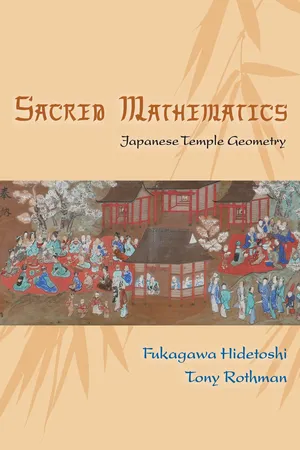
Between the seventeenth and nineteenth centuries Japan was totally isolated from the West by imperial decree. During that time, a unique brand of homegrown mathematics flourished, one that was completely uninfluenced by developments in Western mathematics. People from all walks of life--samurai, farmers, and merchants--inscribed a wide variety of geometry problems on wooden tablets called sangaku and hung them in Buddhist temples and Shinto shrines throughout Japan. Sacred Mathematics is the first book published in the West to fully examine this tantalizing--and incredibly beautiful--mathematical tradition.
Fukagawa Hidetoshi and Tony Rothman present for the first time in English excerpts from the travel diary of a nineteenth-century Japanese mathematician, Yamaguchi Kanzan, who journeyed on foot throughout Japan to collect temple geometry problems. The authors set this fascinating travel narrative--and almost everything else that is known about temple geometry--within the broader cultural and historical context of the period. They explain the sacred and devotional aspects of sangaku, and reveal how Japanese folk mathematicians discovered many well-known theorems independently of mathematicians in the West--and in some cases much earlier. The book is generously illustrated with photographs of the tablets and stunning artwork of the period. Then there are the geometry problems themselves, nearly two hundred of them, fully illustrated and ranging from the utterly simple to the virtually impossible. Solutions for most are provided.
A unique book in every respect, Sacred Mathematics demonstrates how mathematical thinking can vary by culture yet transcend cultural and geographic boundaries.
- 396 pages
- English
- PDF
- Available on iOS & Android
eBook - PDF
About this book
Information
Table of contents
- Cover Page
- Half-title Page
- Title Page
- Copyright Page
- Dedication Page
- Contents
- Foreword
- Preface
- Preface
- Acknowledgments
- What Do I Need to Know to Read This Book?
- Notation
- 1. Japan and Temple Geometry
- 2. The Chinese Foundation of Japa nese Mathematics
- 3. Japa nese Mathematics and Mathematicians of the Edo Period
- 4. Easier Temple Geometry Problems
- 5. Harder Temple Geometry Problems
- 6. Still Harder Temple Geometry Problems
- 7. The Travel Diary of Mathematician Yamaguchi Kanzan
- 8. East and West
- 9. The Mysterious Enri
- 10. Introduction to Inversion
- For Further Reading
- Index
Trusted by 375,005 students
Access to over 1.5 million titles for a fair monthly price.
Study more efficiently using our study tools.
Frequently asked questions
Yes, you can cancel anytime from the Subscription tab in your account settings on the Perlego website. Your subscription will stay active until the end of your current billing period. Learn how to cancel your subscription
No, books cannot be downloaded as external files, such as PDFs, for use outside of Perlego. However, you can download books within the Perlego app for offline reading on mobile or tablet. Learn how to download books offline
Perlego offers two plans: Essential and Complete
- Essential is ideal for learners and professionals who enjoy exploring a wide range of subjects. Access the Essential Library with 800,000+ trusted titles and best-sellers across business, personal growth, and the humanities. Includes unlimited reading time and Standard Read Aloud voice.
- Complete: Perfect for advanced learners and researchers needing full, unrestricted access. Unlock 1.5M+ books across hundreds of subjects, including academic and specialized titles. The Complete Plan also includes advanced features like Premium Read Aloud and Research Assistant.
We are an online textbook subscription service, where you can get access to an entire online library for less than the price of a single book per month. With over 1.5 million books across 990+ topics, we’ve got you covered! Learn about our mission
Look out for the read-aloud symbol on your next book to see if you can listen to it. The read-aloud tool reads text aloud for you, highlighting the text as it is being read. You can pause it, speed it up and slow it down. Learn more about Read Aloud
Yes! You can use the Perlego app on both iOS and Android devices to read anytime, anywhere — even offline. Perfect for commutes or when you’re on the go.
Please note we cannot support devices running on iOS 13 and Android 7 or earlier. Learn more about using the app
Please note we cannot support devices running on iOS 13 and Android 7 or earlier. Learn more about using the app
Yes, you can access Sacred Mathematics by Fukagawa Hidetoshi,Tony Rothman in PDF and/or ePUB format, as well as other popular books in Mathematics & Asian Art. We have over 1.5 million books available in our catalogue for you to explore.