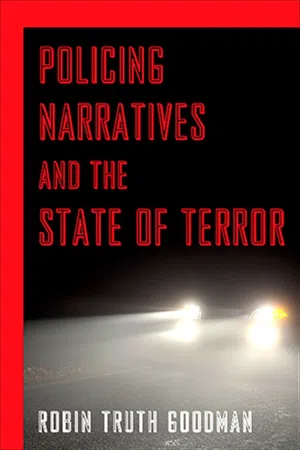
Policing Narratives and the State of Terror
eBook - PDF

Policing Narratives and the State of Terror

  1. 219 pages
  2. English
  3. PDF
  4. Available on iOS & Android
eBook - PDF

Policing Narratives and the State of Terror

About this book

Examines the recent "War on Terror" and the increasing privatization of international policing through the lens of detective fiction and security and espionage narratives.

Since the terrorist attacks of September 11, 2001, world politics have increasingly mirrored plots of detective novels, with high-profile criminal investigations that cross multiple borders and the internationalized law enforcement practices associated with the "War on Terror." Policing Narratives and the State of Terror examines the relationship between domestic policing and international policy through an analysis of contemporary popular detective fiction, police procedurals, police autobiography, security reports, and chronicles of domestic spying. Robin Truth Goodman connects these accounts of policing to the changing shape of the contemporary nation-state, marked by the denationalization of labor; commercial and criminal laws that jump borders more quickly than civil law protections; and the replacement of legal precedent by unrepeatable, exceptional executive decisions. Working at the intersection of literature, international law, and globalized commerce, Goodman astutely pinpoints how policing has become an increasingly troublesome instrument of empire, particularly in terms of national sovereignty and the growing numbers of mercenary private security forces.

Frequently asked questions

Yes, you can cancel anytime from the Subscription tab in your account settings on the Perlego website. Your subscription will stay active until the end of your current billing period. Learn how to cancel your subscription.
No, books cannot be downloaded as external files, such as PDFs, for use outside of Perlego. However, you can download books within the Perlego app for offline reading on mobile or tablet. Learn more here.
Perlego offers two plans: Essential and Complete
  • Essential is ideal for learners and professionals who enjoy exploring a wide range of subjects. Access the Essential Library with 800,000+ trusted titles and best-sellers across business, personal growth, and the humanities. Includes unlimited reading time and Standard Read Aloud voice.
  • Complete: Perfect for advanced learners and researchers needing full, unrestricted access. Unlock 1.4M+ books across hundreds of subjects, including academic and specialized titles. The Complete Plan also includes advanced features like Premium Read Aloud and Research Assistant.
Both plans are available with monthly, semester, or annual billing cycles.
We are an online textbook subscription service, where you can get access to an entire online library for less than the price of a single book per month. With over 1 million books across 1000+ topics, we’ve got you covered! Learn more here.
Look out for the read-aloud symbol on your next book to see if you can listen to it. The read-aloud tool reads text aloud for you, highlighting the text as it is being read. You can pause it, speed it up and slow it down. Learn more here.
Yes! You can use the Perlego app on both iOS or Android devices to read anytime, anywhere — even offline. Perfect for commutes or when you’re on the go.
Please note we cannot support devices running on iOS 13 and Android 7 or earlier. Learn more about using the app.
Yes, you can access Policing Narratives and the State of Terror by Robin Truth Goodman in PDF and/or ePUB format, as well as other popular books in Literature & Literary Criticism. We have over one million books available in our catalogue for you to explore.

Information

Table of contents

  1. Policing Narratives and the State of Terror
  2. Contents
  3. Acknowledgments
  4. Introduction
  5. 1. They Came Back to Baghdad
  6. 2. From the Feminist Detective to the Security State Hero
  7. 3. Terrorist Hunter
  8. 4. The Hunt for the World's Greatest Outlaw
  9. 5. Military Literati
  10. Conclusion
  11. Notes
  12. Works Cited
  13. Index